The Meaning of the Bible in Sign Language

As a hearing child of deaf parents myself, I was thrilled in 2022 to see the movie CODA win best picture, deaf actor Troy Kotsur win best supporting actor, and Siân Heder win for best adapted screenplay.  CODA stands for Children of Deaf Adults and the story centers around Ruby Rossi, a hearing teenage girl who is an amazing singer but is the only hearing member of her family.  There are good lessons in the movie about overcoming differences and obstacles through some compassion and creativity.

It was a great movie but be aware: “Mr. Kotsur used the versatility of sign language to enhance Frank’s dialogue, which is sometimes salty enough to push the limits on the movie’s PG-13 rating.”[1]  There’s one scene in particular where Frank Rossi embarrasses his daughter Ruby in front of a boy with some improvised, erotic sign language.  Versatility has negatives but also positives…

Multiple words for love in Greek (eros, agape, etc.) conceal layers of meaning when translated to English.  After watching CODA, I was reminded of an example where the expressiveness of sign language also adds layers of meaning beyond spoken English. (maybe spoken English is just a bad language?)  Not all sign language is the same – there are many dialects – but the sign for Bible I use is actually two signs: “Jesus” followed by “book.”  Every time I sign what I would just speak as “Bible,” there’s a reminder built right in that the Bible is a book about Jesus.  From start to finish, the Bible is a record of why He needed to come, what He was like when He did, and what His followers should believe, know, and do.  Jesus Christ is described right in the sign for Bible!

But there’s still another layer.  In the book of 1 Corinthians, the apostle Paul defends his ministry saying that his message needs to focus on “Christ crucified”[2], not on performing miracles to those who want signs and impressing with fancy speech those who love wisdom.  To sign “Jesus”, I touch the middle finger of my right hand to the palm of my left hand, then the middle finger of my left to the palm of my right.  What does that signify?  It’s an expressive reminder of the crucifixion of Jesus, and the nails that were barbarically driven into his hands.  Thomas, one of the 12 main disciples of Jesus, said after the first Easter that he would not believe Jesus had risen from the dead “Unless I see in his hands the mark of the nails, and place my finger into the mark of the nails, and place my hand into his side.”  Eight days later, Jesus presented Himself to Thomas and said “Put your finger here, and see my hands; and put out your hand, and place it in my side. Do not disbelieve, but believe.”  To which Thomas replied: “My Lord and my God!”  (John 20:24-29).  I don’t know if this was intended by the person who created the sign for Jesus, but it may be a liturgy recalling this encounter, reminding us that Jesus was crucified, yet lives!

So, whenever you think of the Bible, think of it in sign language where every single time you sign it, there is a reminder that the Bible is the book about Christ crucified.  After Thomas declared who Jesus was, Jesus responded: “Have you believed because you have seen me?  Blessed are those who have not seen and yet have believed.”  Every time I sign “Bible,” it testifies to those who have not seen Jesus of what He has done for them.


One Last Thing
By the way, to sign “book” you place your hands together flat, palms facing each other, in front of you, then open them as if your hands were the front and back of a book.


[1] Jurgensen, John. “Troy Kotsur of ‘CODA’ Wins Best Supporting Actor Oscar.” The Wall Street Journal, 27 March 2022.
[2] 1 Corinthians 1:23


How Shall Christians Be Known?

The mark of a relationship with Christ has taken many forms over the ages, but with one common factor: a self-sacrificing love.

In the book of Genesis, Joseph, son of Jacob, has a fascinating story.  Joseph was favored by his father, despised by his brothers, sold into slavery in Egypt, but eventually rose to a position of prominence under Pharaoh.  In Genesis 41, Pharaoh learns that Joseph has interpreted dreams and calls for his help with Pharaoh’s own distressing series of dreams.  Joseph interprets Pharaoh’s dreams as a prophecy of seven years of famine and recommends a plan to get through it.  After this interpretation comes Genesis 41:38, where “Pharaoh said to his servants, ‘Can we find a man like this, in whom is the Spirit of God?’”  We connect Pharoah’s recognition of God’s Spirit in Joseph to the correct interpretation of dreams, but there is more to it:  Joseph also cared for the people of Egypt and oversaw the plan to survive the famine.

In the book of Acts, after Peter’s proclamation of the gospel of Jesus Christ to many “rulers and elders and scribes gathered together in Jerusalem,[1] Acts 4:13 records that “when they saw the boldness of Peter and John, and perceived that they were uneducated, common men, they were astonished. And they recognized that they had been with Jesus.”  These crowds knew that Peter and John had been with Jesus, that they had a similar spirit.  They had something that comes not from this world’s schools or from what it holds in distinguished, high regard.  Instead, “they were uneducated, common men,” but they carried the mark of Jesus.  They had a connection to an unknown source of boldness and were concerned for the spiritual needs of all people.

In the Psalms, a Psalmist (probably David) wrote in Psalm 119:97-98:

Oh how I love your law!
            It is my meditation all the day.
Your commandment makes me wiser than my enemies,
            for it is ever with me.”

The Psalmist praises God’s commandment as a source of wisdom better than anything available to his enemies.  By meditating on God’s commandments, the Psalmist is “wiser than my enemies,” because he has a wisdom from an unworldly source.  He carries the mark of Christ, but what is this commandment and what is this wisdom?

In Matthew 22:37-40, Jesus says the greatest commandments are: “You shall love the Lord your God with all your heart and with all your soul and with all your mind.  This is the great and first commandment.  And a second is like it: You shall love your neighbor as yourself.  On these two commandments depend all the Law and the Prophets.”  In other words, any and all commands of God are subordinated to the command to love God and neighbor, including our enemies.

In John 13:34-35, Jesus reiterates the rule, telling His disciples: “A new commandment I give to you, that you love one another: just as I have loved you, you also are to love one another.  By this all people will know that you are my disciples, if you have love for one another.”  Therefore, how can all people “find a man…in whom is the Spirit of God?”  Where will the world find astonishing boldness and good news among even “uneducated, common men”?  They will find it in those who have the fruit of the Spirit, which begins with “love,” but also includes “joy, peace, patience, kindness, goodness, faithfulness, gentleness, self-control.”[2]

So, does someone have a physical need like those impacted by the famine in Joseph’s day?  Does someone have a spiritual need for hope that only the gospel can provide?  Love provides the answer to both needs, and by love will the world know Christ’s disciples.

Therefore, make Christ known today by loving someone as Christ would.


[1] Acts 4:5
[2] Galatians 5:22-23

Betrayed With a Kiss: Sunday Share from Charles Spurgeon

Today’s Sunday Share comes from Charles Spurgeon’s Morning & Evening devotional.  The entire morning entry for March 25th is copied below:

“Betrayest thou the Son of Man with a kiss?” —Luke 22:48

            “’The kisses of an enemy are deceitful.’ Let me be on my guard when the world puts on a loving face, for it will, if possible, betray me as it did my Master, with a kiss. Whenever a man is about to stab religion, he usually professes very great reverence for it. Let me beware of the sleek-faced hypocrisy which is armour-bearer to heresy and infidelity. Knowing the deceivableness of unrighteousness, let me be wise as a serpent to detect and avoid the designs of the enemy. The young man, void of understanding, was led astray by the kiss of the strange woman: may my soul be so graciously instructed all this day, that ‘the much fair speech’ of the world may have no effect upon me. Holy Spirit, let me not, a poor frail son of man, be betrayed with a kiss!

But what if I should be guilty of the same accursed sin as Judas, that son of perdition? I have been baptized into the name of the Lord Jesus; I am a member of His visible Church; I sit at the communion table: all these are so many kisses of my lips. AM I sincere in them? If not, I am a base traitor. Do I live in the world as carelessly as others do, and yet make a profession of being a follower of Jesus? Then I must expose religion to ridicule, and lead men to speak evil of the holy name by which I am called. Surely if I act thus inconsistently I am a Judas, and it were better for me that I had never been born. Dare I hope that I am clear in this matter? Then, O Lord, keep me so. O Lord, make me sincere and true. Preserve me from every false way. Never let me betray my Saviour. I do love Thee, Jesus, and though I often grieve Thee, yet I would desire to abide faithful even unto death. O God, forbid that I should be a high-soaring professor, and then fall at last into the lake of fire, because I betrayed my Master with a kiss.”

Grandpa Solomon’s Retirement Advice

Have you ever asked yourself what Solomon, son of David, king of Israel, and author of much Biblical wisdom, would have to say about modern retirement?  Probably not, but I’m going to write about it anyway, because Solomon actually had some relevant advice.

Since this blog is not a source of income, I have a day job which happens to involve helping companies help their employees save and invest for retirement.  In American culture, retirement has in some ways replaced heaven as the future we hope for.  Advertisements promise retirees can do all the things they dreamed of doing during their working years.  Travel.  Relax.  Read those books you’ve been putting off reading.  If you can, buy a yacht.  After all, if you’ve worked so hard for it, you deserve it, they say.  Like many marketing schemes, something good and prudent (saving for retirement) is wrapped in a lot of gloss to get you to do something you might not do otherwise.  Sacrifices made now are worthwhile because of a later reward.

A photo I took from a Florida beach over the Atlantic near sunrise. I’d like to retire here, but heaven is better.

A guest at church this morning inspired me to write this post, since he was working with a ministry to grandparents.  The ministry is called Legacy Coalition (website link).  While talking with him, I made a connection and wanted to share it here.  That connection is that Solomon[1] when writing Ecclesiastes was acting in the role of a wise, Godly grandfather in a way that offers a sharp contrast to the story of retirement that goes unchallenged in our culture.

In Ecclesiastes, Solomon lays out an argument that he lived almost the exact life pictured in our retirement ads but learned to regret it.  While still a very young man, he had the power and wealth to try anything he wanted.  He planted vineyards and drank a lot of wine.  He built gardens and pools and acquired many servants and property.  He also had 700 wives and 300 concubines.[2]  He could have everything he desired – everything the retirement ads would show you if they could be R-rated – but he ended up disappointed.  Ecclesiastes is his advice to those who come after to not repeat his mistakes.

While a blog post can’t cover all of Ecclesiastes, I must add that Solomon did encourage us to invest for the future, but also not to place all our bets on one specific vision of the future: “Cast your bread upon the waters, for you will find it after many days.  Give a portion to seven, or even to eight, for you know not what disaster may happen on earth.”  (Ecclesiastes 11:1-2).  A long, healthy and prosperous retirement is one possible future among many, but eternity with God is a future certainty.  Earlier in the book, Solomon writes: “He has made everything beautiful in its time. Also, he has put eternity into man’s heart, yet so that he cannot find out what God has done from the beginning to the end.” (Ecclesiastes 3:11)  God gives us a sense of what He has planned for us, but not many of the details.  We should not foolishly ignore the future, but we should not cling to one future we desire at the cost of the present God has given us and the future He already knows everything about.

Solomon encourages everyone – young and old – to live more in their own moment, enjoying the gifts God has given them and sharing those gifts with the people around them.  While Solomon is encouraging the young to not repeat his own mistakes, he is also encouraging the old to share their perspective.  In both cases, Solomon is telling us not to stress too much about what may or may not happen, but to invest what we have in light of what will be meaningful in eternity.  Joy comes from enjoying the relationships and things God has blessed us with now, not from sacrificing the now in light of a false vision of retirement.

Solomon recommends joy in God’s provision, and so I close with this quote, and pray that we all experience joy and thankfulness in the gifts God has given us today.  Don’t keep them to yourself.

Go, eat your bread with joy, and drink your wine with a merry heart, for God has already approved what you do.  Let your garments be always white. Let not oil be lacking on your head.  Enjoy life with the wife whom you love, all the days of your vain life that he has given you under the sun, because that is your portion in life and in your toil at which you toil under the sun. Whatever your hand finds to do, do it with your might, for there is no work or thought or knowledge or wisdom in Sheol, to which you are going.” – Ecclesiastes 9:7-10

[This Rewind Wednesday post was originally posted in March 2022]


[1] I’m going to proceed for the sake of argument that Solomon is the author of Ecclesiastes, although I know some debate that and it’s not explicitly stated.
[2] 1 Kings 11:3

“Consider Well Her Ramparts”: Participating in the Psalms

Reading the Psalms is a great devotional habit, and every now and then a Psalm or a section of a Psalm gives instructions to its reader.  The author is inviting us to participate in something about God that they have experienced by taking specific actions.  Earlier posts on participating in the Psalms (here, here, and here) have covered Psalms 96 and 100, which asked us to sing a new song and to give thanks, respectively.  Today’s post is about Psalm 48, which is a little harder to see how to participate.  Most of the Psalm praises God by talking about His city, Jerusalem, and His mountain, Mount Zion.  If our God’s dwelling place is worthy of praise, then He must be as well.  The “participating” part comes at the end, with verses 12-14:

Walk about Zion, go around her,
            number her towers,
consider well her ramparts,
            go through her citadels,
that you may tell the next generation
            that this is God,
our God forever and ever.
            He will guide us forever.

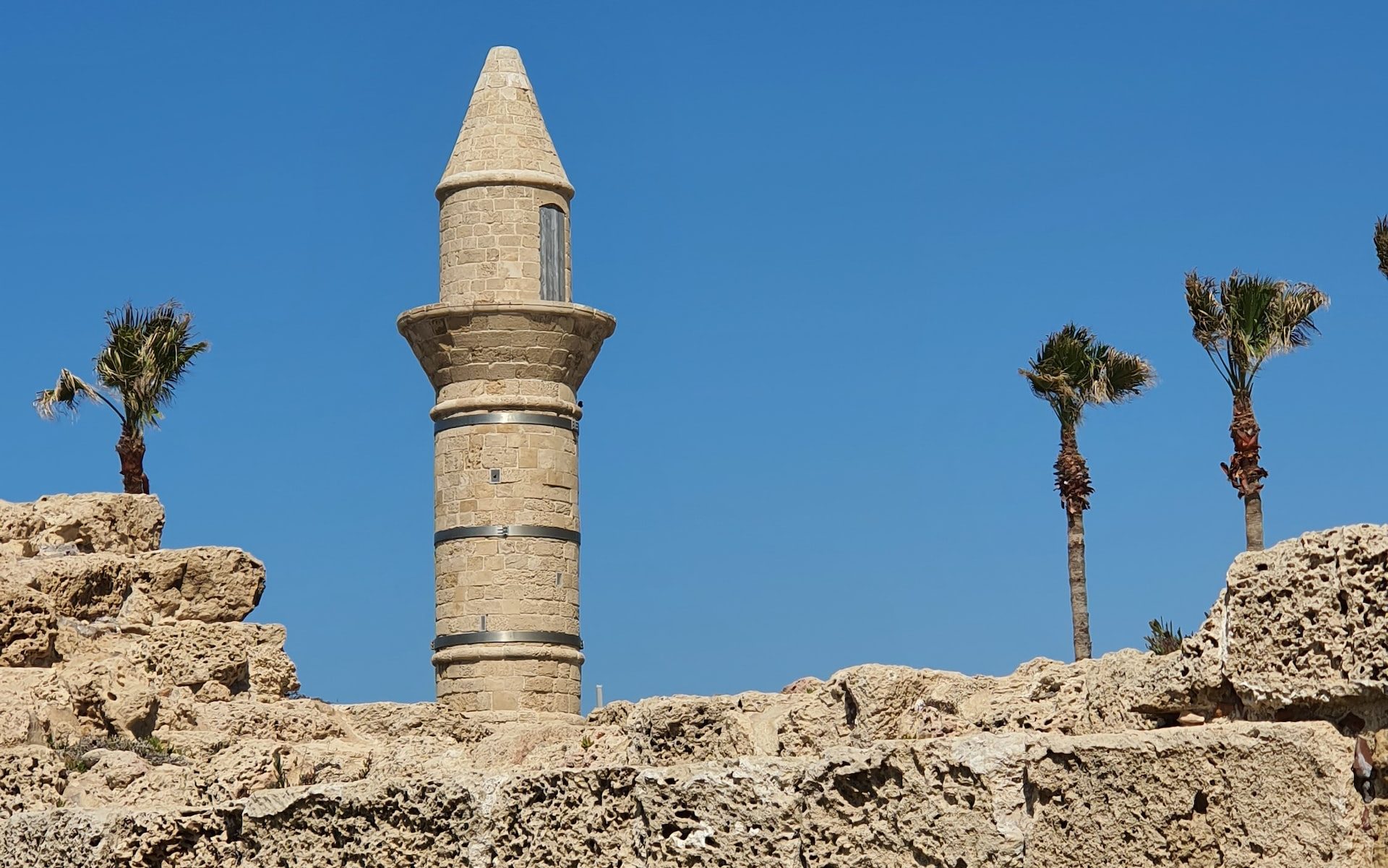
The Psalmist wrote in ancient times that it was worth it to take the time to walk around Zion, to consider the things of God and not just gloss over them quickly, but how do we do that when Christians do not consider Jerusalem and Mount Zion to be the dwelling place of God?  How do we “consider well her ramparts”?

Photo by Boris Izmaylov on Unsplash

Currently, what was represented by the temple in Jerusalem on Mount Zion is represented by His body of believers, indwelt by His Holy Spirit.  Peter wrote that members of the church, “like living stones are being built up as a spiritual house, to be a holy priesthood, to offer spiritual sacrifices acceptable to God through Jesus Christ.”[1]  Therefore, do we participate in this Psalm by considering God’s strength through the church throughout history?  When we consider the “towers”, “ramparts”, and “citadels” of the church, do we consider the great “cloud of witnesses” listed in Hebrews 12, in addition to the faithful members of the church through the centuries since then?

Do we consider well not only the strength God has given His church through history, but also the strength that He protects it with even now?  Do we consider our own “ramparts” – the armor of God listed in Ephesians 6:13-17 –

Therefore take up the whole armor of God, that you may be able to withstand in the evil day, and having done all, to stand firm.  Stand therefore, having fastened on the belt of truth, and having put on the breastplate of righteousness, and, as shoes for your feet, having put on the readiness given by the gospel of peace.  In all circumstances take up the shield of faith, with which you can extinguish all the flaming darts of the evil one; and take the helmet of salvation, and the sword of the Spirit, which is the word of God.

Consideration takes time, so to participate in this Psalm take some time, if not today then soon, to consider God’s strength as shown through a person in the Bible, in church history, or even your own community or family.  Praise God for His strength and protection over His faithful!

As the “Sons of Korah” who wrote Psalm 48 believed, it’s worth the time and effort to:

Walk about Zion, go around her,
            number her towers,
consider well her ramparts,
            go through her citadels,
that you may tell the next generation
            that this is God,
our God forever and ever.
            He will guide us forever.

Many of this blog’s posts on History (click here) are a decent starting point.


[1] 1 Peter 2:5