Dedicating Our Days to God

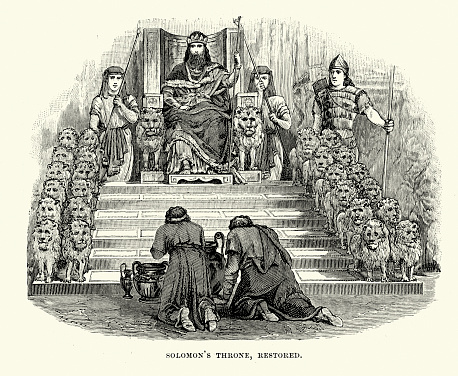
When the Temple in Jerusalem was built under King Solomon, he dedicated it first with a lengthy prayer, followed by a massive number of sacrifices:

King Solomon offered as a sacrifice 22,000 oxen and 120,000 sheep. So the king and all the people dedicated the house of God.” – 2 Chronicles 7:5

There is no record of Solomon and the people considering the loss of all this livestock as a burden or an economic catastrophe.  The Bible simply records that they made the sacrifices.  In dedicating the Temple, the people were marking it as a place to be only used in the worship of their God, and in offering such a massive sacrifice they were acknowledging that they should dedicate all they have to their God as well.

What does this mean for us today?  In the middle of 1 Corinthians 6:16, Paul wrote that “we are the temple of the living God.”  Therefore, our temple – our bodies and all we have – should be dedicated to the worship of God.  We probably don’t have 22,000 oxen or 120,000 sheep to offer Him, but what do we have to offer?

In each day, there are 1,440 minutes (or 86,400 seconds).  Are we willing to sacrifice them all to God without considering it a burden?  I know I don’t, but I pray each day to get closer to the goal of complete dedication to God.  I pray each of you will grow closer to Him as well.

Amen.

Wisdom, “in Quotes”

Corporate training booklets are great sources of interesting quotes.  I came upon this one from Greek philosopher Socrates (470 to 399 B.C.) in a training session on presentations: “The beginning of wisdom is the definition of terms.”  This makes a lot of intuitive sense because if people can’t agree on something as basic as definitions, it’s difficult to move forward.

However, I think there’s something even more fundamental – closer to the real beginning of wisdom -than the “definition of terms,” and that is: who gets to define the terms?  Doing that requires wisdom, so we can’t really be wise until we find someone worthy to define the terms.  Socrates probably considered himself a good candidate to provide it!  For most of us, in moments of honesty, we might admit that most of the time we are either trusting our own judgment, or maybe just improvising.

There’s another necessary factor.  If we find someone we can trust to define wisdom for us, but when it comes time to act we go against their advice, their definitions do us no good.  Therefore, we don’t begin to be wise without having the will to choose rightly.  Although we say we trust someone’s wisdom, by not acting on it we disrespect them, and perhaps Wisdom itself, by not following through.  We might have more knowledge, but not more wisdom.

So, I’ll suggest a better quote (there were no Bible verses in my training booklet).  In the Old Testament book of Proverbs, Solomon – another historical figure (like Socrates) famous for wisdom – wrote that:

The fear of the LORD is the beginning of wisdom,
         and the knowledge of the Holy One is insight.” – Proverbs 9:10

Solomon neatly fills in what the earlier quote is missing, because:

  • There is a Holy One, whose very character of holiness is the definition of terms we need.  His decision making has no flaw and is trustworthy.
  • He is the LORD, who has authority, and uses it to lovingly advise His people on how to live wisely.
  • Fear of the LORD means that respect for Him is required for us to not just go off on our own, but to follow His perfect advice.  This fear turns the abstract knowledge into useful wisdom.

Wisdom ignored isn’t wisdom.  As I’ve written earlier, “Wisdom is about taking the right action, not about accumulating facts.”  The verses leading up to Solomon’s above saying are Proverbs 9:7-9, which say:

Whoever corrects a scoffer gets himself abuse,
         and he who reproves a wicked man incurs injury.
Do not reprove a scoffer, or he will hate you;
         reprove a wise man, and he will love you.
Give instruction to a wise man, and he will be still wiser;
         teach a righteous man, and he will increase in learning.”

We cultivate wisdom by considering God’s works and His will for our lives (through the law and the Holy Spirit).  We cultivate wisdom by allowing Him to define our terms as only He can.  It is the presence of the fear of God – respect for His wisdom – that determines whether we scoff at correction (verses 7-8 above) or increase in learning (last verse).

The fear of the LORD is the beginning of wisdom;
         all those who practice it have a good understanding.
         His praise endures forever!” – Psalm 111:10

Daily Readings for May 4 – 10

Fellow travelers:

For those looking for a Bible reading plan, each week I post 2 chapters to read per day as a main reading plan, and for anyone who wants to read the whole Bible in 2026, I’ll post the extra chapters to read that week.  The main readings will include nearly all of the New Testament, plus Psalms, Proverbs, Ecclesiastes, the Prophets, and a few other Old Testament books.

Reading 3 chapters a day on weekdays and 4 on weekends almost exactly covers the 1,189 chapters of the Bible, so the “extra” readings will be about 9 chapters per week.  These readings will cover the Pentateuch, the OT histories, a few other OT books, plus Jude and Revelation from the NT.

I hope this encourages others to read and study their Bible more, whatever parts they decide to read.  Follow along (or not) any way you choose!

2 chapter a day plan:

Monday, May 4: Psalm 124, Job 36
Tuesday, May 5: Psalm 125, Job 37
Wednesday, May 6: Psalm 126, Job 38
Thursday, May 7: Psalm 127, Job 39
Friday, May 8: Psalm 128, Job 40
Saturday, May 9: Psalm 129, Job 41
Sunday, May 10: Psalm 130, Job 42

Extra chapters for those reading the whole Bible in 2026:
Deuteronomy 7 – 15

The Body of Christ is Irreducibly Complex

Among the various camps in the debate between creation and evolution is a set of ideas called intelligent design (ID).  A key part of ID is “irreducible complexity,” a term that comes from the book Darwin’s Black Box, by Lehigh professor Michael Behe.[1]

In short, irreducible complexity argues that evolution by chance, without an intelligent designer driving it, is unreasonable because the multiple systems in a complex organism like a human body – circulatory, digestive, endocrine, muscular, respiratory, and so on – are all interdependent on each other.  The circulatory system alone, with the heart pumping blood through an elaborate system of arteries and veins, is difficult to imagine developing by chance occurrence, but a chance evolution of that system alongside all the other parts it is dependent on is even more far-fetched.  All systems evolving together in lockstep without failing is a much more difficult problem to explain scientifically without a Creator.  The circulatory system takes what the respiratory and digestive systems take in and deliver it to the other systems that use it.  Without the other parts, it has no function and cannot survive and further evolve.

An isolated, inanimate, heart. Photo by Ali Hajiluyi on Unsplash

However, my intent here is not to prove intelligent design, but to consider the apostle Paul’s words about the church as the body of Christ.  In 1 Corinthians 12:12, he wrote: “For just as the body is one and has many members, and all the members of the body, though many, are one body, so it is with Christ.”  He continues that no part of the body can say it is not a part of the body because it has a different function than another part (1 Cor. 12:15-16), and also that no part of the body can say it doesn’t need all of the other parts (1 Cor. 12:21).  Those who are in Christ Jesus cannot be divided.

Paul follows his description of the body with 1 Corinthians 13, a powerful statement on the supremacy of love, and in context a gentle rebuke to the idea that a body can survive as individual, unrelated units.  In a human body, any part can only survive by serving the other parts.  Even an organ as incredibly complex and important as a heart cannot survive if it decided to pump blood only for itself.  Where would it get its nutrients?  How would it flee from danger?  As Paul wrote: “If the whole body were an eye, where would be the sense of hearing? If the whole body were an ear, where would be the sense of smell?” (1 Cor. 12:17).  Even an organ as important as the heart is useless in isolation.  It gets its very life and purpose by what it does for the body.

As Jesus said to His disciples in John 13:34-35 – “A new commandment I give to you, that you love one another: just as I have loved you, you also are to love one another.  By this all people will know that you are my disciples, if you have love for one another.

As the song says, they will know we are Christians by our love, and the church Jesus came to build is irreducibly complex.  There is no appendix[2] in the church, which is the body of Christ.  All members are absolutely essential.


[1] Behe, Michael.  Darwin’s Black Box (1996).
[2] While we commonly think of this organ as useless, God as our Maker didn’t put it there by accident.

Loveless Words

If I speak in the tongues of men and of angels, but have not love, I am a noisy gong or a clanging cymbal.” – 1 Corinthians 13:1

The church in 1st-century Corinth was divided over spiritual gifts, particularly the gift of speaking in tongues.  The apostle Paul wrote 1 Corinthians 13 as a gentle rebuke to the misuse of gifts and the arrogance that came from competing over them.  The first verse above could be paraphrased as “you can be speaking the most impressive-sounding things, but if you’re not saying it to benefit those who hear, you’re just making noise.”

But not just any noise – Paul purposefully chose two specific instruments.  In a symphony, an appropriately timed cymbal or gong has a glorious impact that perhaps no other instrument can match.  However, although you might not catch one bad note from a clarinet, you won’t miss a gong or cymbal played at the wrong time, even once!  To God, the only one with a truly perfect ear, that’s what loveless words sound like.

If even lifeless instruments, such as the flute or the harp, do not give distinct notes, how will anyone know what is played?” – 1 Corinthians 14:7