Dedicating Our Days to God

When the Temple in Jerusalem was built under King Solomon, he dedicated it first with a lengthy prayer, followed by a massive number of sacrifices:

King Solomon offered as a sacrifice 22,000 oxen and 120,000 sheep. So the king and all the people dedicated the house of God.” – 2 Chronicles 7:5

There is no record of Solomon and the people considering the loss of all this livestock as a burden or an economic catastrophe.  The Bible simply records that they made the sacrifices.  In dedicating the Temple, the people were marking it as a place to be only used in the worship of their God, and in offering such a massive sacrifice they were acknowledging that they should dedicate all they have to their God as well.

What does this mean for us today?  In the middle of 1 Corinthians 6:16, Paul wrote that “we are the temple of the living God.”  Therefore, our temple – our bodies and all we have – should be dedicated to the worship of God.  We probably don’t have 22,000 oxen or 120,000 sheep to offer Him, but what do we have to offer?

In each day, there are 1,440 minutes (or 86,400 seconds).  Are we willing to sacrifice them all to God without considering it a burden?  I know I don’t, but I pray each day to get closer to the goal of complete dedication to God.  I pray each of you will grow closer to Him as well.

Amen.

The Body of Christ is Irreducibly Complex

Among the various camps in the debate between creation and evolution is a set of ideas called intelligent design (ID).  A key part of ID is “irreducible complexity,” a term that comes from the book Darwin’s Black Box, by Lehigh professor Michael Behe.[1]

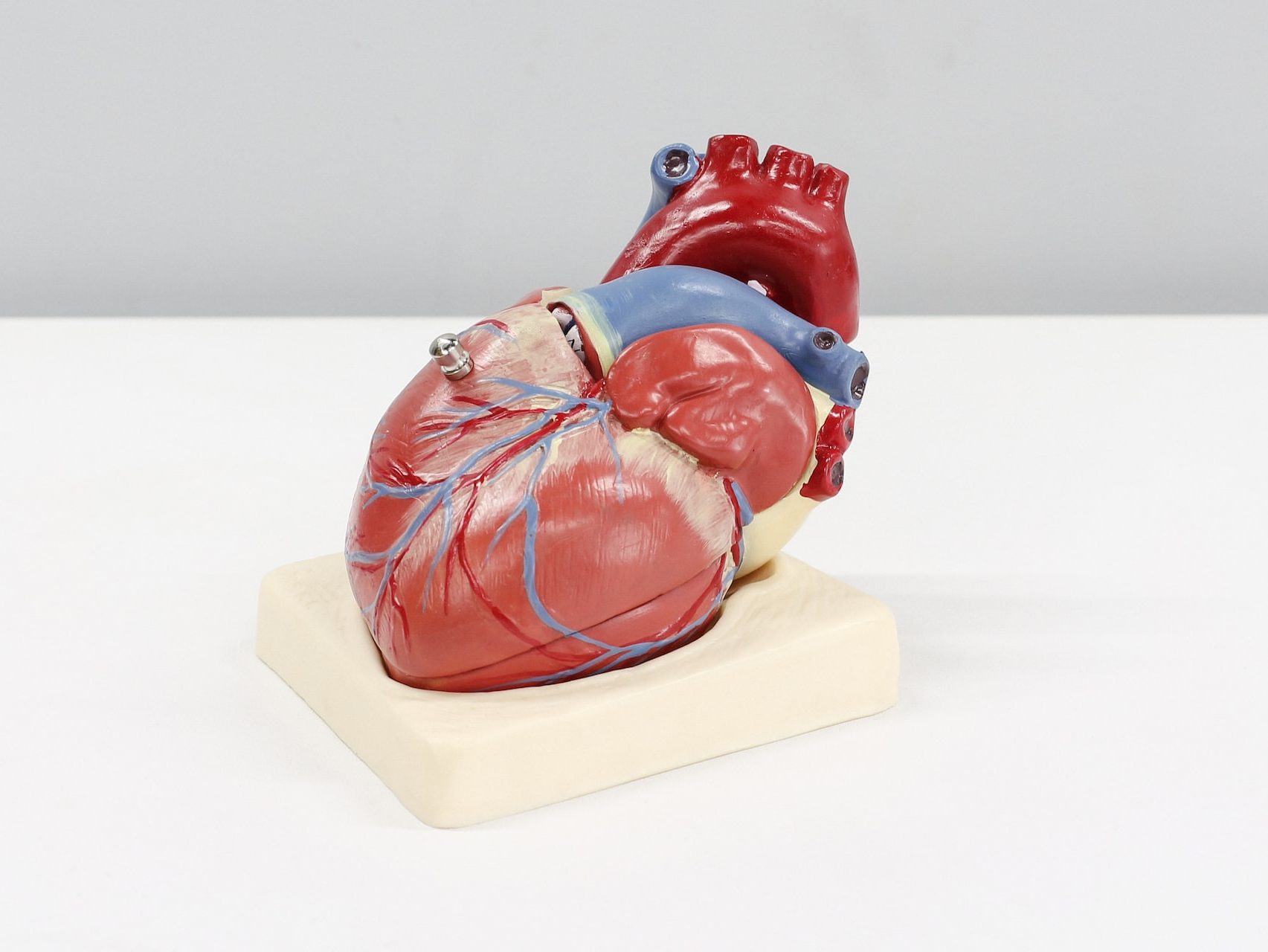
In short, irreducible complexity argues that evolution by chance, without an intelligent designer driving it, is unreasonable because the multiple systems in a complex organism like a human body – circulatory, digestive, endocrine, muscular, respiratory, and so on – are all interdependent on each other.  The circulatory system alone, with the heart pumping blood through an elaborate system of arteries and veins, is difficult to imagine developing by chance occurrence, but a chance evolution of that system alongside all the other parts it is dependent on is even more far-fetched.  All systems evolving together in lockstep without failing is a much more difficult problem to explain scientifically without a Creator.  The circulatory system takes what the respiratory and digestive systems take in and deliver it to the other systems that use it.  Without the other parts, it has no function and cannot survive and further evolve.

An isolated, inanimate, heart. Photo by Ali Hajiluyi on Unsplash

However, my intent here is not to prove intelligent design, but to consider the apostle Paul’s words about the church as the body of Christ.  In 1 Corinthians 12:12, he wrote: “For just as the body is one and has many members, and all the members of the body, though many, are one body, so it is with Christ.”  He continues that no part of the body can say it is not a part of the body because it has a different function than another part (1 Cor. 12:15-16), and also that no part of the body can say it doesn’t need all of the other parts (1 Cor. 12:21).  Those who are in Christ Jesus cannot be divided.

Paul follows his description of the body with 1 Corinthians 13, a powerful statement on the supremacy of love, and in context a gentle rebuke to the idea that a body can survive as individual, unrelated units.  In a human body, any part can only survive by serving the other parts.  Even an organ as incredibly complex and important as a heart cannot survive if it decided to pump blood only for itself.  Where would it get its nutrients?  How would it flee from danger?  As Paul wrote: “If the whole body were an eye, where would be the sense of hearing? If the whole body were an ear, where would be the sense of smell?” (1 Cor. 12:17).  Even an organ as important as the heart is useless in isolation.  It gets its very life and purpose by what it does for the body.

As Jesus said to His disciples in John 13:34-35 – “A new commandment I give to you, that you love one another: just as I have loved you, you also are to love one another.  By this all people will know that you are my disciples, if you have love for one another.

As the song says, they will know we are Christians by our love, and the church Jesus came to build is irreducibly complex.  There is no appendix[2] in the church, which is the body of Christ.  All members are absolutely essential.


[1] Behe, Michael.  Darwin’s Black Box (1996).
[2] While we commonly think of this organ as useless, God as our Maker didn’t put it there by accident.

Loveless Words

If I speak in the tongues of men and of angels, but have not love, I am a noisy gong or a clanging cymbal.” – 1 Corinthians 13:1

The church in 1st-century Corinth was divided over spiritual gifts, particularly the gift of speaking in tongues.  The apostle Paul wrote 1 Corinthians 13 as a gentle rebuke to the misuse of gifts and the arrogance that came from competing over them.  The first verse above could be paraphrased as “you can be speaking the most impressive-sounding things, but if you’re not saying it to benefit those who hear, you’re just making noise.”

But not just any noise – Paul purposefully chose two specific instruments.  In a symphony, an appropriately timed cymbal or gong has a glorious impact that perhaps no other instrument can match.  However, although you might not catch one bad note from a clarinet, you won’t miss a gong or cymbal played at the wrong time, even once!  To God, the only one with a truly perfect ear, that’s what loveless words sound like.

If even lifeless instruments, such as the flute or the harp, do not give distinct notes, how will anyone know what is played?” – 1 Corinthians 14:7

The Cross of Christ is History

Christians rightly focus on the historical fact of the life, death, and resurrection as the foundation of their faith.  Paul writes in 1 Corinthians 15:14 – “And if Christ has not been raised, then our preaching is in vain and your faith is in vain.”  For Christianity to matter, these things must have actually happened.  Therefore, a lot has been written providing evidence that these events happened, and that Christian faith is not based on speculation, but on solid history.

Today I’m going to take a different angle on the significance of the “historical” part of “historical fact.”  This post is about the more straight-forward meaning that these events happened in the past.

Why This Matters
Because Christ lived in the past, the life of righteousness He lived for us, and that we inherit through faith, is unchangeable.  There is no other life that could be lived, or will be lived, that could be better or achieve more than what God intended it to achieve.  Perfection is assured because it already happened.  He has not fallen short.

Because Christ died on the cross in the past, He did it in consideration of every past, present, and future sin of His people.  Nothing you, or I, or any of His people have done, are doing now, or will do in the future, can undo the cross, because it has already happened.  He will not change His mind, and He will stand by those who have faith in Him.

Because Christ was resurrected in the past, He has proven that death cannot hold Him and that He will raise His people to new life as well.  He is alive now, and aware of everything happening not only in the global 24/7 news cycle, but also in the hearts and minds of every man.  The same power that raised Him works in His people, telling them through His Spirit that there is no better plan than the cross to create a world where man perfectly loves God and loves his fellow man.

For if we have been united with him in a death like his, we shall certainly be united with him in a resurrection like his. We know that our old self was crucified with him in order that the body of sin might be brought to nothing, so that we would no longer be enslaved to sin. For one who has died has been set free from sin. Now if we have died with Christ, we believe that we will also live with him. We know that Christ, being raised from the dead, will never die again; death no longer has dominion over him. For the death he died he died to sin, once for all, but the life he lives he lives to God. So you also must consider yourselves dead to sin and alive to God in Christ Jesus.” – Romans 6:5-11

In a world full of pain and despair, “Preach the gospel at all times. And if necessary, use words.” – St. Francis of Assisi

Love Bigger Than Mountains

Would you be impressed if I moved a mountain by faith?  The apostle Paul might not be.  1 Corinthians 13 begins with these 3 verses:

If I speak in the tongues of men and of angels, but have not love, I am a noisy gong or a clanging cymbal.  And if I have prophetic powers, and understand all mysteries and all knowledge, and if I have all faith, so as to remove mountains, but have not love, I am nothing.  If I give away all I have, and if I deliver up my body to be burned, but have not love, I gain nothing.”

In these verses Paul uses wild exaggeration to make a point about the importance of love above all else.  Can anyone move mountains with faith?  It’s never been literally done, but even if someone did, and the reason for doing it was wrong, it would mean nothing.  Has anyone literally given away everything they have?

Also note the repetition of the word “all,” which appears 4 times.  Nobody but God has all understanding, knowledge, and faith, and in Jesus He gave up all He had for us.  Paul is saying that even if we were Godlike in these things, which we aren’t, without love even it wouldn’t matter.

No matter how “impressive” our actions are, if done for the wrong reason, they are useless.

Even if we move mountains, love is what really matters.