Cats are Not the Only Things I’m Allergic To

Although highly allergic to cats, I love the two we have, but sometimes wonder if it’s worth the trouble.  This past Saturday night, one of the cats, named Misty, was up crying much of the night, waking us up regularly.  Eventually, I realized she must have been upset about her litter.  The store was out of the “usual,” so I tried to get away with a replacement, even though I know how finicky cats are.  Sure enough, once I changed it to what I had left of the usual stuff (kept in reserve in case of finicky cat trouble), she stopped complaining.

Why am I telling you this?  Because what happened next reminded me that God is concerned about even the most minor details of our lives, and about every living creature He has made.  Sunday morning my reading schedule began with Psalm 8, which includes this:

“You have given [man] dominion over the works of your hands;
            you have put all things under his feet,
all sheep and oxen,
            and also the beasts of the field,
the birds of the heavens, and the fish of the sea,
            whatever passes along the paths of the seas.”- Psalm 8:6-8

Misty, an indoor cat who may feel like she’s trapped in the ark.

Under the mandate given in Genesis, mankind is supposed to take care of whatever God has given us – the earth and everything in it.  My study Bible helpfully noted that this includes pets, which reminded me of Misty’s crying!  I thought maybe our cats were worth the trouble after all, but God wasn’t finished making the point.

Also on my reading schedule was Genesis 7, which includes: “And the waters prevailed on the earth 150 days.” – Genesis 7:24

During the flood, Noah and his family were flooded in the ark for 150 days with two of each kind of animal (but seven of each kind of clean animal, because provision was made not only for the survival of Noah’s family, but also provision for continued worship of God).  After the 150 days, they had to wait months longer for the waters to recede and the land to dry before coming out of the ark.  Noah’s family took care of an ark full of animals for more than 150 days.  They probably lost a lot of sleep!  As for me, I only have two cats and get to leave the house.  I also have allergy medicine to make it more tolerable.

Looking back at Psalm 8, the last verse declares: “O LORD, our Lord, how majestic is your name in all the earth!”

This Lord is the same one who brought Noah, his family, and those animals through the flood.  He also cares about my family and even my pets.  In seemingly small acts like taking care of pets God has given us, we can declare the majesty of God’s name!  In whatever influence we have, big or small, God wants us to participate faithfully in the work started at creation, with the authority He has given us.

In addition to perhaps cats, what else might we be allergic to? Sin is not just a list of things we shouldn’t do, but it is our allergy to God’s dominion over the world and the way we each should have dominion over it and under him. We’re too often allergic to loving this world the way he did on the cross, yet we claim to hope for a world where that sacrificial love governs 100% of all actions.

Our Lord wants nothing more than to greet us in Paradise and say “‘Well done, good servant! Because you have been faithful in a very little, you shall have authority over ten cities.’”[1]  He literally died to make such a greeting possible.  Therefore, consider what creatures or people our Sovereign God has delegated to each of us.  What tasks or roles?  Jobs or ministries?  Do some of those things irritate and annoy us, as if we were allergic?

In aggregate, the church’s role is to have dominion over His entire creation, but not in the way the world would, exploiting everything for our own benefit and casting aside what doesn’t seem useful, but as a servant would.  Like a God who abhors all our sin as if He were allergic but decided to cover our sin with His own precious blood.  The same blood that covers us so that, like a compassionate Father, our Lord can gently say on a Sunday morning after a bad night of interrupted sleep:

“Be thankful you aren’t stuck in an ark for 150 days with thousands of animals.”


[1] Luke 19:17

To Gain What We Cannot Lose: History for January 8

On January 6, 1956, a group of American missionaries made first contact with a local tribe in Ecuador, trying to reach them with the gospel.  Two days later, on this date, January 8, 1956, five of those missionaries – Jim Elliot, Pete Fleming, Ed McCully, Nate Saint and Roger Youderian – were speared to death by the very Auca tribe they spent years preparing to minister to. But their story was not over.

Jim Elliot and others had been ministering to the Quichua people in Ecuador since 1952, with many coming to faith in Jesus.  However, the nearby Aucas (now called Waodoni) were known to kill any outsiders that entered their area, including Quichua and also oil workers at a site nearby.  Jim “knew the only way to stop the Aucas from killing was to tell them about Jesus”[1] and came up with a plan to reach them.  Working with Nate Saint, a missionary supply pilot, they spent months trying to safely build goodwill with the Waodoni by lowering supplies to them from a plane and speaking friendly Waodoni phrases from a loudspeaker.

On January 6th, they talked to a Waodoni called George, thinking they had gained some trust and they set up a later meeting.  George, however, lied to them about his intentions, and ten members of the tribe were ready in ambush with spears on January 8th.  The unarmed missionaries had no chance.

Jim Elliot

Seeking vengeance or giving up might have been a reasonable response for the other missionaries, but in a miraculous example of forgiveness, persistent faith, and a heart for the lost, Elisabeth and Valerie Elliot (Jim’s wife and young daughter), and Rachel Saint (Nate’s sister) learned the local language and moved into the jungle to live with the Waodoni in 1958.  Elisabeth wrote about serving those who killed her husband: “The deepest things that I have learned in my own life have come from the deepest suffering. And out of the deepest waters and the hottest fires have come the deepest things I know about God.”  Today, the Waodoni are a friendly tribe and many are professing Christians.  Missionaries, including members of the Saint family, still live among them today.  Elisabeth died in 2015 at the age of 88, after a long career as missionary, author, speaker, and radio host.

Jim’s Apparent Failure is God’s Victory
In life, Jim Elliot was sometimes frustrated by his effort, once writing: “No fruit yet. Why is it that I’m so unproductive? I cannot recall leading more than one or two into the kingdom. Surely this is not the manifestation of the power of the Resurrection. I feel as Rachel, ‘Give me children, or else I die.’”[2]  While attending Wheaton College in Illinois in the 1940’s, Jim developed a desire to preach the gospel, including taking the train to Chicago and talking about Jesus with people at the train station, but with little response.

“He is no fool who gives what
he cannot keep to gain
that which he cannot lose.”

– Jim Elliot

But in death, Jim was used by God to inspire many other missionaries, including his own family, through whom God’s love for the lost went out and bore more eternal fruit than Jim may have ever imagined.  His story is a reminder that faithfulness is the Christian’s objective, and God provides the fruit.

Jim wrote what has become a familiar quote to many: “He is no fool who gives what he cannot keep to gain that which he cannot lose.”  In Paradise, Jim, those affected by his ministry, and all other believers, will forever praise God for His steadfast love through the centuries.  Nothing we do for God now can look foolish from that perspective.  We have so much to gain that we cannot lose.

Soli Deo Gloria

Learn More:
This story was dramatized in the 2005 film End of the Spear and in the 2002 documentary Beyond the Gates of Splendor.  A website dedicated to Elisabeth Elliot’s life (https://elisabethelliot.org/) has more on this amazing history of God’s work.


[1] https://www.christianity.com/church/church-history/timeline/1901-2000/jim-elliot-no-fool-11634862.html
[2] https://www.inspirationalchristians.org/evangelists/jim-elliot-biography/

Driving Toward Morning’s 2022 in Books

Dear fellow travelers,

As 2022 ends, many are posting reflections on the year, including book lists.  Figured I’d jump in, even though I am a slow reader, prone to distraction, and have a job that requires multiple hours per day of reading.  So, when I see others listing 70+ books read in 2022, I tell myself that 22 books is enough, since the year was 2022.

Photo by Joyce McCown on Unsplash

So, what 22 books did I read this year?

A range of history books:
Clouds of Witnesses by Mark Noll and Carolyn Nystrom
The Residence by Kate Andersen Brower
The Devil in the White City by Erik Larson
Elizabeth: The Struggle for the Throne by David Starkey
The Offshore Islanders: A History of the English People by Paul Johnson

The first two of these made appearances in the blog, referenced in the Bibliography.  Clouds of Witnesses, which could be included in other categories, is an excellent collection of stories about Christians in Asia and Africa, giving a great perspective away from my local, American one.  More history posts will be coming from that book.  The Residence is a collection of stories from workers in the White House, from cooks and valets, and many other roles.  It ranged multiple decades of presidents and their families, with interesting takes on these very real people.

The Devil in the White City is my favorite book by one of my favorite authors, and likely will be covered as the blog’s first book review soon.  Erik Larson writes history that reads like a novel and picks amazing stories as topics.

With a family trip to England and Wales on the 2022 calendar, both history and fiction books on this list revolved around the U.K.

A range of fiction books:
Tinker, Tailor, Soldier, Spy by John LeCarré
The Hound of the Baskervilles by Arthur Conan Doyle
The Prince and the Pauper by Mark Twain
Life, the Universe, and Everything by Douglas Adams
So Long and Thanks for All the Fish by Douglas Adams

It’s only now that I realize all of these books involve England.  “Tinker” is one of my dad’s favorite books and I’d put off reading it for a long time but am glad I finally got to it.  It’s a fascinating and complicated story about a mole in the British spy network, and I picked up great quotes like “All power corrupts, but some must govern,” and “Learn the facts…then try on the stories like clothes.”  “Hound” is one I read as a teenager and picked back up for something quick and light to read, and the other 3 were new to me.  This blog began with a Douglas Adams reference, and there will likely be more to come!

Only one non-fiction book:
King’s X: The Oral History by Greg Prato

This ended up featured in two blog posts and tells the story of one of my favorite bands that never quite “made it big,” but gets a ton of respect from other musicians.  Part of the problem was that they couldn’t be pigeon-holed as either a “Christian” band, or not.

Plus some Christian commentary and devotionals:
In addition to regular Bible and study Bible reading, in 2022 I read:

4 books by Warren Wiersbe: Be Alive (John 1-12), Be Transformed (John 13-21), Be Wise (1 Corinthians), and Be Encouraged (2 Corinthians).
4 books by C.S. Lewis: That Hideous Strength, The Weight of Glory, The Abolition of Man, and The Great Divorce.
Encouragement: The Key to Caring by Larry Crabb and Dan Allender
Everyday Prayer with the Reformers by Donald McKim
Tapestry: The Book of Revelation by Glenn Parkinson

A fan of C.S. Lewis from childhood, in 2022 I aimed to read several of his books I hadn’t before, which include the last 3 above.  I love finding familiar Lewis quotes in their original context, which brings out even more meaning.  A few of these ended up in the blog.  In 2023, maybe I’ll get to Surprised by Joy, The Four Loves and all of God in the Dock.

I picked up Wiersbe’s entire “Be” series in 2021 as part of a digital subscription and am working through it over time.  A long time.  I like his overall approach and the books are a great source of thoughtful stories and quotes.

Encouragement and Everyday Prayer both ended up in the blog.  The first I had read many years ago and rediscovered ideas in it that I had forgotten the source of.  Everyday Prayer was a gift and is a short devotional covering segments of prayers from the Protestant Reformation, with related stories and Bible verses.

Lastly, I just finished Tapestry earlier today.  Glenn Parkinson is the retired former pastor of my church, and the book provides a very helpful overview of the book of Revelation, making a great case that John “did not intend to give us a puzzle no one can solve,” but intended to reveal (as in a revelation) a tapestry of images designed to encourage Christian faithfulness and perseverance in the time between Jesus’ first and second comings.

Will I read 23 books in 2023?  Who knows…in the meantime, have you read any of these 22? What books did you enjoy in 2022?

Jesus was Born to Overthrow King Herod, but How?

The story of Herod and the three wise men is familiar to most who celebrate Christmas.  After the birth of Jesus in Bethlehem, the wise men came looking for Him, having seen a star they believed signaled His coming.  Arriving in Jerusalem, they asked “Where is he who has been born king of the Jews? For we saw his star when it rose and have come to worship him.”[1]  Word of this search made it to Herod, the then-current king of that region under Rome’s authority, and his first instinct was to eliminate what he saw as a threat to his own power.  In Herod’s eyes, only he was king of the Jews.

Herod came up with a simple plan: to use the wise men to help him find this threat.  “And he sent them to Bethlehem, saying, ‘Go and search diligently for the child, and when you have found him, bring me word, that I too may come and worship him.’”[2]  However, the wise men were warned in a dream not to return to Herod, so they went home after visiting Jesus.  “Then Herod, when he saw that he had been tricked by the wise men, became furious, and he sent and killed all the male children in Bethlehem and in all that region who were two years old or under, according to the time that he had ascertained from the wise men.”[3]

Herod believed so strongly in the necessity of the power of Rome and of his place in it that he was willing to commit mass murder.  If he couldn’t find the one child he wanted, he’d just kill them all.  He feared Jesus (or His followers) would overthrow him as king, and he was right but in the wrong sense.  Jesus would overthrow Rome.  He was born to overthrow every earthly kingdom – that is inevitable.

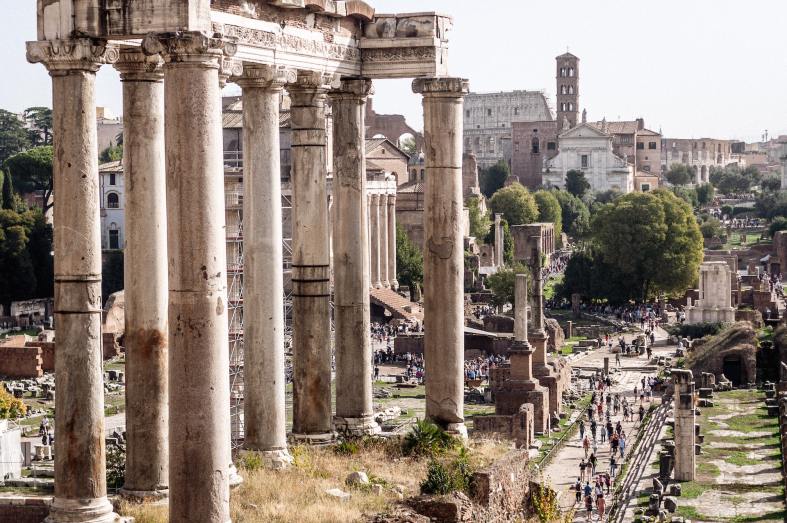
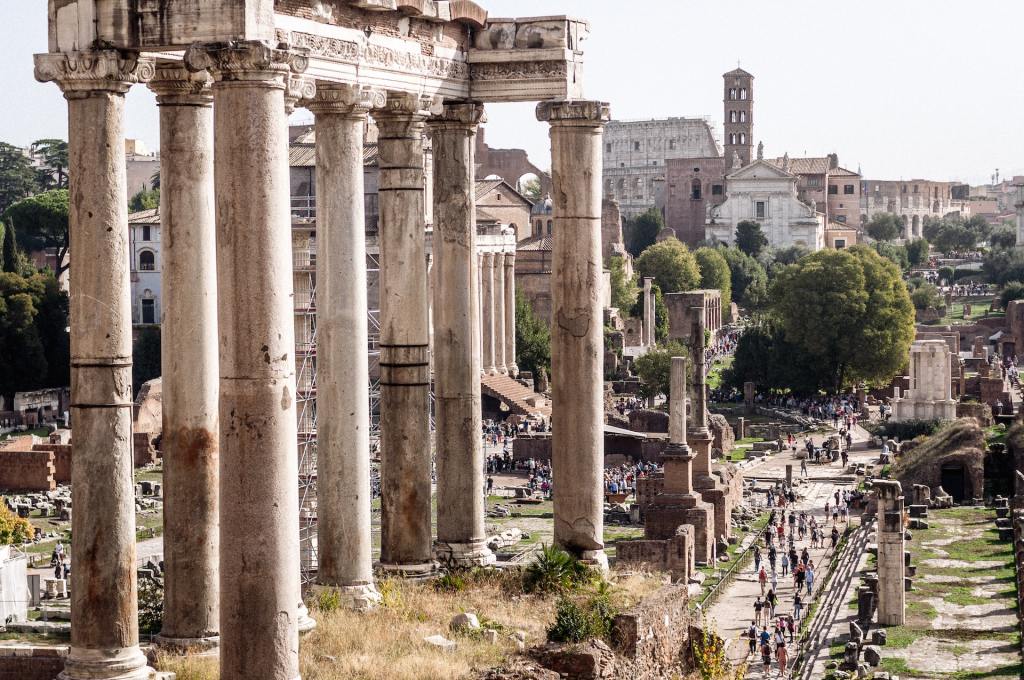
Much of Rome is already in ruins. Photo by Giu Vicente on Unsplash

Isaiah 40:17 proclaims that “All the nations are as nothing before him, they are accounted by him as less than nothing and emptiness.”  The word “emptiness” here is the Hebrew “bohu,” part of the phrase “tohu va’bohu” translated as “without form and void” in Genesis 1:2.  This phrase represents empty things with no eternal value or purpose.  So, while Isaiah doesn’t use the whole phrase from Genesis, he uses “less than” for emphasis instead.  When compared to God’s eternal purposes, all that every nation has ever devised and achieved is less than useless.  God has nothing to learn from our political and economic visions – He transcends them all.  No nation can or will accomplish what God has accomplished and will accomplish.

Therefore, Jesus’ other mission was to overthrow Herod’s dominion over Herod.  But Herod was determined to resist.  His heart was so hard that he preferred to hang on to a government willing to commit mass murder to preserve its own self-centered ways.  He thought he could preserve the façade of “Pax Romana,” the idea that worldly government can solve all of our problems, even while he, as an agent of Rome, was killing innocent children.  Herod saw it as in his own best interest, and in the interest of Rome, but this is one of many examples of “a way that seems right to a man, but its end is the way to death.”[4]

Jesus can overcome death only by overthrowing our views of our own “best interest” and what “seems right.”  He was not born and did not die and rise again just to overthrow Rome, but He came so we would have a way to overthrow ourselves and death itself.  Jesus will establish the only government that will matter in eternity: His Kingdom.  The soul of Herod, and of all of us, will outlive every society that ever existed, and ever will, on this earth.  The nations are all “accounted by him as less than nothing and emptiness.”  While Herod could find hope in Jesus if he wanted to, Rome itself never had any hope.

Therefore, the question Jesus asks all people is: Will we let Jesus overthrow us or will we, like Herod, go to great lengths to resist Jesus and try to preserve a world that is doomed to fail?

Isaiah 9:6, recently the focus of my Christmas series on 4 names describing Jesus, also says “and the government shall be upon his shoulder.”  His Kingdom will be the only government we need, and He alone is uniquely qualified to establish and rule it.

“For to us a child is born,
            to us a son is given;
and the government shall be upon his shoulder,
            and his name shall be called
Wonderful Counselor, Mighty God,
            Everlasting Father, Prince of Peace.”


[1] Matthew 2:2
[2] Matthew 2:8
[3] Matthew 2:16
[4] Proverbs 14:12, 16:25

General Washington Crosses the Delaware – History for December 25-26

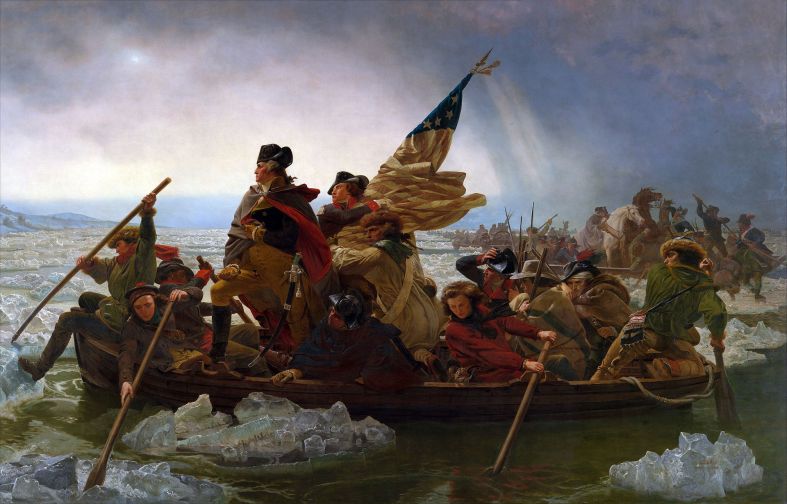
General George Washington leading the Continental Army on small boats across the Delaware River in the middle of the freezing night, surrounded by chunks of ice, is a popular story and image from early American history.  Depicted famously by German-American artist Emanuel Leutze in the painting nearby, this desperate effort was a significant turning point in the war.  The daring crossing was an act of desperation and made necessary (and possible) by a long string of events in 1776.

It had not been a good year for Washington’s army, suffering a string of defeats at Brooklyn, Kips Bay, and White Plains.  With little hope or troops left, Washington retreated with much of his army across the Delaware around November 7th, expecting the British to soon cross and strike Philadelphia, taking full advantage of their momentum and Washington’s weakness.  On November 16, 2,837 Americans surrendered at Fort Washington, after General Washington trusted Nathaniel Greene’s report that the fort could be defended.[1]  Another defeat at Fort Lee left Washington with perhaps 3,500 troops after losses and desertions.[2]  On top of this, many troops’ commitments were due to expire in early December, reminiscent of when the army had massive turnover during the siege of Boston in 1775.

Washington Crossing the Delaware by Emanuel Leutze. Public Domain.

Desperate to defend Philadelphia (where Congress had been held since the First Continental Congress in 1774), Washington expected General Lee to reinforce him soon with more troops.  However, Lee – effectively Washington’s second-in-command – had inexplicably spent the night of December 12th apart from his troops at a tavern.  Lee was ratted out and captured in a raid that took less than 15 minutes on the 13th.  Things looked bleak, but on the same day, Washington learned that Congress had relocated from Philadelphia to Baltimore for safety.

More importantly, continuing a string of possibly Providential, but certainly weather-assisted, events like a storm that allowed Washington to end the British siege of Boston with minimal bloodshed (see this post), and surprise fog that covered Washington’s overnight escape from Brooklyn (see this one), on December 13th, British General William Howe decided to cease military operations for the winter.[3]  Absent this decision, the war may have been over soon, with a British victory, but with this decision, we have the backdrop for the famous crossing of the Delaware.

Seeking opportunity for a decisive move, Washington kept his army as intact as he could manage until the time arrived.  With Christmas approaching and the British ceding the initiative, Washington now had about 6,000 troops and intelligence that about 2,000 Hessian mercenaries (the actual number was probably lower, around 1,500) were defending Trenton.  After the “Long Retreat,” as the string of defeats above came to be known, the Continental Army needed a victory, and got one.  Three separate groups were planned to cross the Delaware, but only Washington’s main force made it.  Regardless, Washington caught Hessian commander Johann Rall unprepared, in spite of warnings Rall received and disregarded.  After all, the sturdy British had closed down for the winter – why wouldn’t everyone do the same?

Just after 8am on December 26th, Washington’s force attacked, killing 21 Hessians, wounding 90, and capturing 900.  500 escaped over a bridge that was supposed to be defended by one of the two forces unable to make the crossing.[4]  Washington went on to another victory at Princeton on January 3, as the British were again caught by surprise, thinking the army was still in Trenton.[5]  The momentum had turned, with the central event being the daring crossing of the Delaware on Christmas night, in freezing weather surrounded by ice.


[1] McCullough, David.  1776  (2005).  P. 234.
[2] McCullough, David.  1776  (2005).  P. 249.
[3] McCullough, David.  1776  (2005).  P. 264-267.
[4] McCullough, David.  1776  (2005).  P. 270-281.
[5] McCullough, David.  1776  (2005).  P. 288.