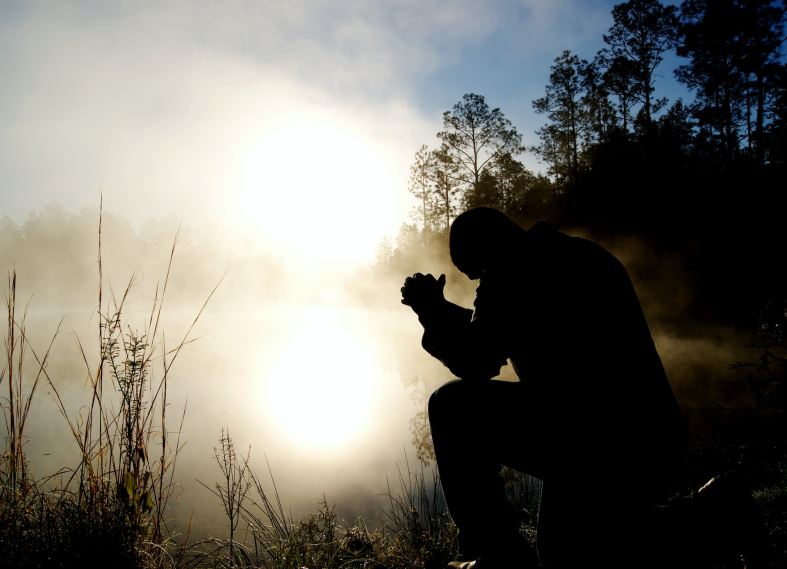
Prayer: A Quint of Quotes

Dear fellow travelers,

Here is another “Quint of Quotes” with some of my favorites on prayer, plus a bonus verse:

“Prayer is not getting man’s will done in heaven; it is getting God’s will done on earth” – Robert Law

“Pray as though everything depended on God, and work as though everything depended on you.” – Saint Augustine

“Do not pray for tasks equal to your powers.  Pray for powers equal to your tasks.” – Phillips Brooks

“We may be certain that whatever God has made prominent in His Word, He intended to be conspicuous in our lives.” – Spurgeon, on Colossians 4:2

“To be a Christian without prayer is no more possible than to be alive without breathing.” – Martin Luther

“Pray without ceasing” – 1 Thessalonians 5:17

There Goes John Bradford (to Paradise): History for February 24

Born in 1510, John Bradford was a rising Protestant minister during the reign of King Edward VI in England and was well known for his pious dedication and unselfish nature.  After studying at Cambridge and preaching regularly around London, he was appointed as Chaplain to the King in 1551.  The common expression “There but for the grace of God go I” is often attributed to him and was a reminder to himself that grace alone has saved him.  An 1822 book on prayer says that:

“The pious Martyr Bradford, when he saw a poor criminal led to execution, exclaimed, ‘there, but for the grace of God, goes John Bradford’. He knew that the same evil principles were in his own heart which had brought the criminal to that shameful end.”[1]

Bradford and others in the Tower of London, from John Foxe’s Book of Martyrs (1563). Public Domain.

His worldly fortunes changed in 1553 when the Catholic Mary I became Queen, and one of her first priorities was persecution of prominent Protestants.  Bradford was arrested within a month, imprisoned in the Tower of London, and sentenced to death.  While in the Tower, he wrote a letter to his mother on this date, February 24, in 1554, that included a powerful statement about prayer: God “doth put off our prayers, that he might recompense it with abundance, that is, that he might more plentifully pour upon us the effect of our petitions.” [2]  On July 1, Bradford was burned alive at the stake.

In another book on prayer, Donald McKim wrote about Bradford’s letter:
“We can imagine that no one would seek an answer to his prayers more ardently than Bradford while awaiting death. Yet he believed that even with no apparent answers to prayers, God plentifully pours abundance on those who pray!
At the end of his letter Bradford mentions God’s promise-which believers receive and anticipate, even in the midst of their sufferings and afflictions. Paul recorded the promise: “What no eye has seen, nor ear heard, nor the human heart conceived, what God has prepared for those who love him” (1 Cor. 2:9) Plentiful abundance! Now and forever!”[3]

In John Bradford’s story, there is a terrible irony between two things he is known for – a common phrase and his martyrdom – but in the end, God is faithful, and I hope to meet Bradford someday in Paradise, where the grace of God has bought me a place.


[1] Bickersteth, Edward.  A Treatise on Prayer.  (1822).  Sourced from https://en.wikipedia.org/wiki/John_Bradford
[2] McKim, Donald K.  Everyday Prayer with the Reformers (2020).  P. 92.
[3] Ibid.

Love When Bad Things Happen

Fellow travelers,

Sometimes things happening in the world grab our attention and make us assign more significance to them than they deserve.  Sometimes these are natural phenomena, like earthquakes, comets, or eclipses, and sometimes they are manmade phenomena, like wars.

One reason we do this is that passages in the Bible like Mark 13:5-23 describe what events will happen before Jesus returns again.  We want Him to return!  While it’s right to anticipate with excitement that Jesus is coming back, it’s important to sort out such passages by what is describing what will happen (descriptive truth) and what God tells us to do when these things happen (prescriptive truth).  In all circumstances, the God’s primary commandments for us are to love God and to love our neighbor, even if they are our enemy.  No phenomena should pull us off that path, and Mark 13:5-23 recommends that.

In the table below, I paraphrase and categorize Mark’s message into what is descriptive vs. prescriptive truth:

DescriptivePrescriptive
Many will come in my name, saying, ‘I am he!’See that no one leads you astray
You will hear of wars and rumors of wars, and nation will rise against nationDo not be alarmed
Earthquakes and famines in various locationsBe on your guard
You will be beaten in synagogues, and you will stand before governors and kings for my sakeBear witness before them and do not be anxious beforehand what you are to say
Brother will deliver brother over to death and you will be hated by allEndure
False christs and false prophets will arise and perform signs and wondersBe on guard

To Jesus, none of the things in the descriptive column are new information.  All were included in His plan from eternity past.  The actions He recommends are not new information either.  The “Prescriptive” column tells us not to panic, but to endure, to keep doing what we should be doing before these bad things happened – Love God, love your neighbor, even if your neighbor is your enemy.

On the other hand, false christs and prophets will tell us current events are unprecedented and a fulfillment of prophecy and they will tell us what we should do.  The false prophet takes the descriptive of evil in the world and creates their own false prescriptive.  They recommend an incomplete and inaccurate narrative of current events as an ultimate solution.  Their own Babel which God must “come down” from heaven to even see (Genesis 11:5).  But the true Christ calmly says, “be on guard; I have told you all things beforehand”. (Mark 13:23). The true Christ comes down from heaven and demonstrates how to create a true ladder back to heaven, offering forgiveness to all, even those who refuse to accept it or practice love.  He will be thoroughly and eternally glorified by manifesting His kingdom as the only eternal kingdom, ruled by love, not by panic over current events.

No matter what we see happening in the news or in the world, Jesus knew it was coming and He told us that in any circumstance we should obey and glorify Him, through love for Him and neighbor.  He doesn’t panic and neither should we.

Amen.

Daily Readings for February 23 – March 1

Fellow travelers:

For those looking for a Bible reading plan, each week in 2026 I will post 2 chapters to read per day as a main reading plan, and for anyone who wants to read the whole Bible in 2026, I’ll post the extra chapters to read that week.  The main readings will include nearly all of the New Testament, plus Psalms, Proverbs, Ecclesiastes, the Prophets, and a few other Old Testament books.

Reading 3 chapters a day on weekdays and 4 on weekends almost exactly covers the 1,189 chapters of the Bible, so the “extra” readings will be about 9 chapters per week.  These readings will cover the Pentateuch, the OT histories, a few other OT books, plus Jude and Revelation from the NT.

I hope this encourages others to read and study their Bible more, whatever parts they decide to read.  Follow along (or not) any way you choose!

2 chapter a day plan:

Monday, February 23: Psalm 54, Mark 14
Tuesday, February 24: Psalm 55, Mark 15
Wednesday, February 25: Psalm 56, Mark 16
Thursday, February 26: Psalm 57, Song of Solomon 1
Friday, February 27: Psalm 58, Song of Solomon 2
Saturday, February 28: Psalm 59, Song of Solomon 3
Sunday, March 1: Psalm 60, Song of Solomon 4

Extra chapters for those reading the whole Bible in 2026:
Exodus 20-28

Jesus Overcomes Tribalism

The Bible is a book for all people, in all times and places, and its lessons hold eternal value.  Yet the Bible was also written in particular times and places and knowledge of those contexts is sometimes assumed rather than explained.  For instance, in the story of Jesus and the Samaritan woman at the well in John 4, we read the phrase, in parenthesis: “(For Jews have no dealings with Samaritans.)”. We also read that Jesus and His disciples “had to pass through Samaria.”  Hate is a difficult thing to measure or quantify, but the story assumes we know something about how intense the Jews’ hate for Samaritans was.

According to Warren Wiersbe, “So intense was [the Jews’] dislike of the Samaritans that some of the Pharisees prayed that no Samaritan would be raised in the resurrection!”[1]  This hate was so strong that many Orthodox Jews would travel much longer routes around Samaria to avoid setting foot in it.  They thought the dirt itself would contaminate them.  Why all this hate?

One reason for this hate was genetic.  Anyone who reads the Old Testament knows there are many extensive genealogies.  To the Jew, it was very important to know which of the original 12 tribes you descended from and that your ancestors had not intermarried with people of other religions.  But Samaritans genealogies were not pure enough for them.  Much of Samaria was populated with the descendants of poorer Jews left behind by the Assyrians, many of whom had intermarried with foreigners the Assyrians planted there.  So, Jews in Judah looked down on Samaritans because of their mixed genealogy.  The Samaritans were considered “half-breeds.”

Another reason was religious.  When the Samaritan woman said “Our fathers worshiped on this mountain, but you say that in Jerusalem is the place where people ought to worship” in John 4:20, she was referring to an alternative Judaism.  Among other differences, the Samaritans had a center of worship on Mount Gerizim, with its own temple.  They even re-wrote parts of the Pentateuch to justify this.[2]  To Israel, Jerusalem was the only center of worship.  Sacrifices to Yahweh were only to be offered there, and every male was supposed to make a pilgrimage there three times every year.  There was to be no rival temple, and therefore the Samaritans (in the Jewish mind) had cut themselves off from the true worship of Yahweh and should be shunned.

John has to write that Jesus “had to pass through Samaria” because doing that was unusual, especially for a Jewish rabbi like Jesus.  But then Jesus went there, simply being in Samaria was a strong statement that Jesus didn’t care for the hateful tribalism.  But not only did He go there, He interacted with its people, at a time when “Jews have no dealings with Samaritans.”  Jesus was and would continue to break down these barriers.  In the four gospels, Jesus preached to the Jews first, then to the “half-breed” Samaritans, then to full Gentiles, and the apostles followed the same pattern in Acts.  This sequence progressively illustrated that the gospel is for all tribes of people.

What does this mean for us today?  Hate like what the Jews felt for Samaritans is rampant and if Jesus could overcome that hate, He can overcome any hate.  Any reasons we have for hating, or even disliking people just because of what group or tribe they belong to aren’t good enough reasons. 

But tribal rivalries are everywhere we look: national and regional, political and economic, cultural and ethnic, musical and athletic, and every other dimension we can imagine.  But no tribal loyalty is more important than the obligation to love God and love our neighbor, no matter who they are.

The apostle Paul wrote in Romans 3:38-39 –

For I am sure that neither death nor life, nor angels nor rulers, nor things present nor things to come, nor powers, nor height nor depth, nor anything else in all creation, will be able to separate us from the love of God in Christ Jesus our Lord.

Not only does this describe the love God has for us in Jesus, but it also describes the love we should have for others.  Nothing should get in the way, including any religious, racial or other differences.

Jesus overcomes tribalism, and so should His people.


[1] Wiersbe, Warren.  Be Alive (John 1-12) (1986).  P.65.
[2] Edersheim, Alfred.  The Life and Times of Jesus the Messiah (1886).  P. 274-5.