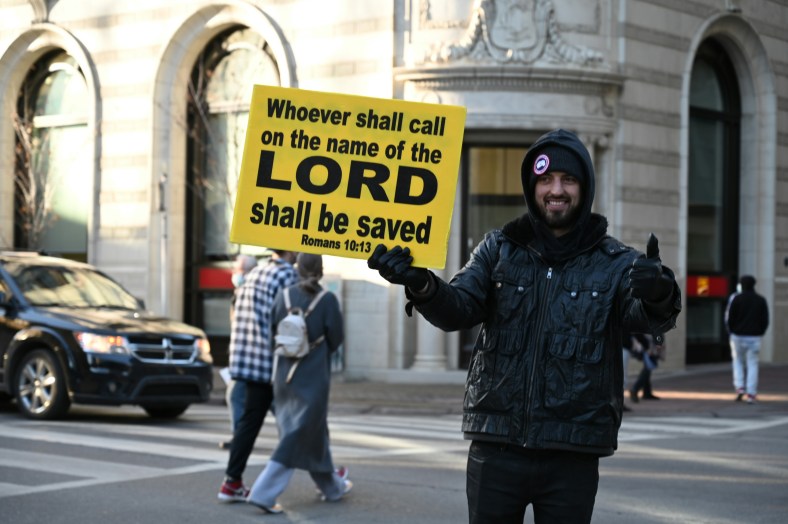
Luke 14:23 “Then the master said to the servant, ‘Go out into the highways and hedges, and compel them to come in, that my house may be filled.”
This verse is part of a larger parable about how the master invited many, but many of those declined the invitation. So, the master, wanting a full house, asks the servant to go outside the original invitation list and bring in whoever will come. However, the use of the word “compel” has led members of the church over the centuries to use the verse as justification for the use of violence to bring people into the church.
Observing the methods of the state and other Christian sects of his day, even Saint Augustine – one of the most influential writers in all of Christian history – used this verse and other “proof texts” to justify force. Augustine argued that Christ used force to compel Saul (who became the Apostle Paul) to believe in and follow Him and therefore provided a precedent (text here). Augustine’s arguments were copied in defense of the Spanish Inquisition and other blemishes on the historical record of the church. Essentially, this verse has been used to justify the means toward an end.
Critics of Christianity have, of course, jumped on the opportunity. Christopher Hitchens, one of the “New Atheists”, makes statements like “The real axis of evil is Christianity, Judaism, and Islam”, and that religion is “the main source of hatred in the world”. The evidence comes from well-known historical events, and incidentally these arguments have helped sell a lot of books.
However, is “Christianity” the culprit, or are people the problem? Did some followers of Christ get the wrong message? Could Augustine have been wrong? Are all those who claim to act for Christ really being faithful to Him? Is it logical, or even responsible, to blame the actions of a group of people on a person they claim to follow, even if the one would clearly disapprove of them?
Isn’t lumping all Christians, Muslims, and Jews in with the most violent examples of people who claim those faiths like lumping all atheists in with Stalin or Mao? Because some practice a perverse form of the original philosophy, does that make the whole philosophy rotten? Is the philosophy at fault?
The Bible is very clear that there is a distinction between those who call themselves Christian and those who actually are – a distinction that many who criticize “the church” ignore. Matthew 7:21-23 says: “Not everyone who says to Me, ‘Lord, Lord,’ shall enter the kingdom of heaven, but he who does the will of My Father in heaven. Many will say to Me in that day, ‘Lord, Lord, have we not prophesied in Your name, cast out demons in Your name, and done many wonders in Your name?’ And then I will declare to them, ‘I never knew you; depart from Me, you who practice lawlessness!’”
The Bible is also very clear that “all have sinned and fall short of the glory of God” (Romans 3:23). Nobody’s perfect, or even close. Most of the Bible is the story of the failures of people who can’t follow the will of God, but that God loves and accepts them anyway. More failures should not be a surprise, and the church would be wrong to ignore them – but instead these are evidence that man needs help, and that God’s capacity for forgiveness is vast.
Apparently the “New Atheists” find themselves in an interesting position. They are actually in agreement with Jesus, who saved his harshest words for those who used the church for its own purposes and twisted His commands. He hated hypocrisy, and called out hypocrites in public quite often, calling them a “den of thieves”, and a “brood of vipers”, among other names. From this perspective, “Christianity” is not the culprit of these crimes, but some people calling themselves “Christian” are the culprit. Or, another perspective: Christopher Hitchens’ “hypocrite” or “demon” is Martin Luther’s doctrine of “Simul justus et peccator” (simultaneously righteous yet still a sinner).
So, what does all this mean for the modern church?
A better interpretation (unless you are an Inquisitor or a New Atheist) of “compel them to come in” is found in Matthew Henry’s commentary on Luke 14:23, which says “compel them to come in, not by force of arms, but by force of arguments. Be earnest with them; for in this case, it will be necessary to convince them that the invitation is sincere and not a banter; they will be shy and modest and will hardly believe that they shall be welcome.”
In Jesus’ day, a Gentile would have been shocked to be invited into a Jewish community, and likely would have been apprehensive or suspicious. As I wrote earlier, the people who were not on the original guest list might need some convincing. After all, Jehovah had always been the God of the Jews, and there was a good degree of history between the two groups. Would an outsider need a compelling reason to come in, or would a simple hello suffice?
Exactly what these compelling reasons are is too large an issue for this post, but I’ll say that if force or reason (alone) is the method of compulsion, the church will likely be full of hypocritical people. Their brain is convinced, or they are afraid to say no, but they aren’t really committed. A church full of these people is not likely to be “compelling” to the next generation of churchgoers.
The larger issue is the pressure the church has always faced to increase membership, and if the results don’t come, there’s a big temptation to find a way. After all, if hell is a terrible place, and we don’t want people to go there, don’t the ends justify the means? However, God supplies the means, and ignoring them shows a lack of faith, not a strength of conviction. The Inquisitor is not a hero of the church, but a villain. God tells us how He wants the church to witness to the world, and it does not involve violence.
In our desire for “results”, we often become like the disciples in Mark 9:14-29. Unable to drive out a spirit, the disciples became agitated. The problem? Jesus reminds them: “This kind can come out only by prayer”. Disciples of God are supposed to accomplish God’s ends by God’s means.
God’s chosen means do not depend on reasoned arguments and force of strength, “But God chose what the world considers nonsense to put wise people to shame. God chose what the world considers weak to put what is strong to shame.” (1 Cor 1:27) When preaching to the Corinthians, Paul “didn’t use intellectual arguments. That would have made the cross of Christ lose its meaning.” (1 Cor 1:17) This is, of course, the same Paul that Augustine says is the precedent for conversion by force.
The church has sometimes pursued an end by force that cannot be achieved by reason or forceful compulsion but must be catalyzed by God Himself. As I pointed out in another post, if being witness to incredible supernatural events cannot compel belief, why would so many believe that logic or force could compel belief?
“For the foolishness of God is wiser than human wisdom, and the weakness of God is stronger than human strength.” (1 Cor 1:25)