When We Feel Downcast

We all have bad days.  Sometimes on those days it’s hard not to dwell on what’s gone wrong.  It’s hard not to make a list of the reasons why we’re feeling bad and focus on them.  It’s hard not to think about ways to immediately fix whatever problem we’re having.  However, Psalm 42 recommends a different approach.  Verse 6 of that Psalm ends with:

My soul is cast down within me;
            therefore I remember you
from the land of Jordan and of Hermon,
            from Mount Mizar.

When we feel like our “soul is cast down,” we might say therefore we need to spend our time thinking about why.  We might say therefore I’ll just feel bad for myself.  We might say therefore the world is a bad place, or therefore the universe is conspiring against us.

But I got helpful advice from a friend years ago that when you find a “therefore” in the Bible, you should ask what it’s there for.  Everything in the list above are not what this “therefore” is there for.

According to Psalm 42, the right “therefore” is to remember God.  The therefore is there to give us something to think about when we feel “cast down.”  But what does it mean to “remember” God?  How is it helpful?  It means to meditate on God’s works, in the world, in the Bible, and in our lives, as reminders that He is bigger than our problems.

We may have many, many reasons to feel down, and the Psalmist knows this.  In verse 7 is written:

Deep calls to deep
            at the roar of your waterfalls;
all your breakers and your waves
            have gone over me.

Breakers and waves – difficulties in life – can constantly come one after the other and can seem to have no end, especially if we dwell on them, but note that the Psalmist refers to the breakers and waves as “your breakers” and “your waves.”  They belong to God, and do not come to us without His permission.  Often its more natural for us to think “I need a solution” than to think “I need God,” but He is always what we need.

While difficulties can go on and on, God’s love has no end either, as written in verse 8:

“By day the LORD commands his steadfast love,
            and at night his song is with me,
            a prayer to the God of my life.”

His love is steadfast, meaning He cares for us “by day … and at night.”  He is always with us and ready to remind us of His love, even when all we can see are waves crashing over us.  If your soul is cast down, remember Him and His works.

Amen.

The Danger of “However”

When the Israelites were delivered from Egypt by God under Moses’ leadership, they were told that they were on their way to the Promised Land, and land “flowing with milk and honey.”  In a short while, they got to the borders of Canaan, their destination, and Moses sent spies to search out the land and bring back a report.

When they returned, they said the land was in fact very good and bountiful, but then they added: “However, the people who dwell in the land are strong, and the cities are fortified and very large. And besides, we saw the descendants of Anak there.” (Numbers 13:28, emphasis mine). Even though God had promised this land to Israel, and therefore Moses sent them to spy, not to decide whether to enter the land, the spies’ report discouraged the people who “said to one another, ‘Let us choose a leader and go back to Egypt.’”  Because of this disobedience springing from a lack of faith, God sentenced Israel to 40 years of wandering in the wilderness until the entire generation died, except Joshua and Caleb, who were the only 2 faithful spies among the 12.  Only then could they enter the Promised Land.

Note that the story hinges on the word “however.”  As I’ve written, while inserting the words “but God” into any situation can make it better, saying “however” to God often does the opposite.  Even if we don’t actually use the word, the idea of “however” occurs when we decide our circumstances are more than God can handle or justify ignoring God.

God may have given us something to do, but we might say (or think):
“However, I wanted to spend my Sunday relaxing.”
“However, my coworker never goes out of their way for me.”
“However, I was saving that money for my next vacation.”
“However, I like doing it this way.”
“However, my neighbor isn’t a good person.  I don’t have to love them.”

I do this all the time, and I suspect so does everyone else.  Instead of saying something like, “but God has a better idea of how I should spend my Sunday,” I go on doing whatever works for me.  Also, if we say “however” enough, it can become a barrier between us and God because He knows we aren’t listening anyway.  We can become insensitive to God’s calling for us and unable to hear Him, but it’s never too late to turn back to Him and again hear His voice.  Israel’s big “however” left them in the wilderness for 40 years but eventually they made it to the Promised Land.  Our “howevers” can hinder us for a while, but ultimately God’s will for us prevails.

Where God’s instruction isn’t clear, an analysis of “pros and cons” is usually wise (see Luke 14:28), but when we know what God wants us to do, that is the only “pro” that matters and the “cons” are irrelevant.  No “however” is good enough.

There’s always some area of my life where I’m saying “however” to God and I’m blessed by His patience.  But God doesn’t ask us to do anything without knowing it’s best for us and will glorify Him.

Pray that we can all hear His voice, listen and trust Him so we can find the way out of our wilderness!

Leviathan Defeated!

Photo by Humble Lamb on Unsplash

Isaiah 27:1 declares: “In that day the LORD with his hard and great and strong sword will punish Leviathan the fleeing serpent, Leviathan the twisting serpent, and he will slay the dragon that is in the sea.

We must acknowledge the enemy as a powerful dragon to know the difficulty of our struggle, and also that it is the LORD who ultimately must, and will, destroy him “In that day” (rather than now or when we want Him to)

“It does not do to leave a live dragon out of your calculations” – J.R.R. Tolkien, in The Hobbit

Daily Readings for July 21 – 27

Fellow travelers:

Here is the list of readings for this week: 2 chapters to read per day as the main reading plan, and extra chapters for anyone who wants to read the whole Bible in 2025.  Reading 3 chapters a day on weekdays and 4 on weekends almost exactly covers the 1,189 chapters of the Bible, so the “extra” readings are about 9 chapters per week.

This week, we return to the gospels for the last time this year, and for the rest of the year will be roughly alternating between Old and New Testament books.

Follow along (or not) any way you choose!

Monday, July 21: John 1-2
Tuesday, July 22: John 3-4
Wednesday, July 23: John 5-6
Thursday, July 24: John 7-8
Friday, July 25: John 9-10
Saturday, July 26: John 11-12
Sunday, July 27: John 13-14

Additional readings if you want to read the whole Bible this year:
Isaiah 51 – 59

Dominion: My Favorite Game

Daily writing prompt
What’s your favorite game (card, board, video, etc.)? Why?

Today’s writing prompt asks: “What’s your favorite game (card, board, video, etc.)? Why?”

Other than reading and writing, playing games probably takes up the most of my spare time.  I do play some video games, especially ones my kids are into, and that we can play together, but my favorite type of games are board games.  I’ve grown much more interested in board games in the last few years after meeting a few people at church who play them a lot, especially some of the more complicated ones.  These are people who refer to Catan and Carcassonne as “gateway games.”  We try to have regular game nights, but differing schedules often get in the way.  But fortunately, everyone in my family likes to play them, and so we do, often!

Dominion is my favorite board game and there are good reasons for that: it combines a pretty simple basic structure with a vast library of card expansions.  Typically, on your turn, you draw 5 cards, and each turn has 3 phases that go in order, using the starting 5 cards and likely some others.

First, you play Action cards that do things like give you more actions to do, draw more cards, attack other players, and many, many other things.  Next, you have a Buy phase where you play Treasure cards (basically, money) to, well, buy more cards.  Dominion is considered to have popularized (if not invented) the “deck builder” type of game because of this mechanic.  You end your turn by putting all the cards you played and all cards in your hand into your discard pile, which you shuffle when you need to when drawing 5 cards at the start of your turn or at other times.  The rest of the rules are essentially to follow the instructions on the cards you play.  You win by getting the most victory points, which are on Victory cards you can buy.

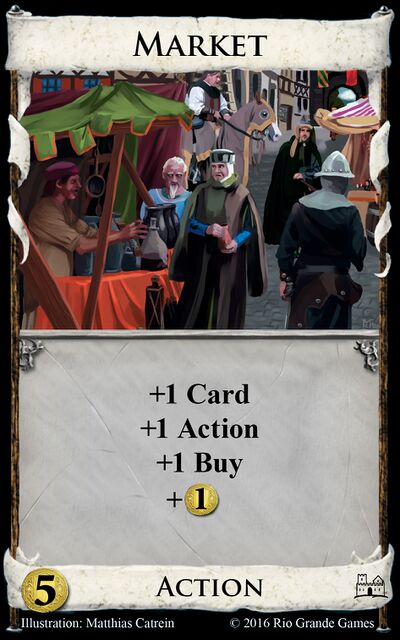
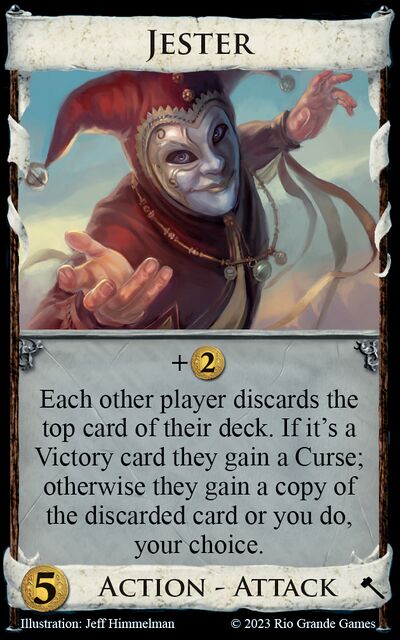
A basic example Action card is Market (pictured above), which lets you draw one more card, play one more action, buy one more thing during your buy phase, and get one more coin to spend.  A more complex card is something like Jester (also pictured) which gives you 2 coins but also may let you get a card for free from the supply.  It might also let you give your opponent a Curse (-1 point) or some other card you don’t want.

Jester doesn’t come with the base game, but from one of the 16 current expansion sets (I have 7 of them).  These expansion sets, which typically have about 25 more, different cards, are what makes the game so replayable.  Aside from the Victory and Treasure cards, which are pretty standard from game to game, each game has 10 “Kingdom” cards that you can choose however you want.  I’ve played hundreds of hands of Dominion and it’s never been the same way twice, unless we really liked a set of Kingdom cards and repeated it.

And that’s what makes Dominion my favorite game: simple basic mechanics combined with near-infinite customizability.

Honorable mention goes to Wingspan, a game where you collect bird cards.

If you’re into board games, what’s your favorite?