A Scurry of Ebenezers

What is an Ebenezer?  In the Old Testament, an Ebenezer was a “stone of help,” a kind of monument to times God helped His people.  These markers were a reminder of God’s faithfulness, providing strength for the present and future.  Sometimes in the Bible, these moments where God intervenes are noted by the phrase “but God” followed by a change in the direction of the story.

Ebenezer (pictured) is also a squirrel, and this blog’s mascot.  He represents these “but God” memorials in the Bible.  As a squirrel suddenly and unexpectedly draws our attention, Ebenezers draw our attention to reminders of God’s influence on history and our lives.  If so, a “scurry” of squirrels, as a group of them is called, should get our attention even more!  In the story of Joseph from the book of Genesis, Ebenezer (“but God”) appears multiple times:

  • Genesis 45:8 – “So it was not you who sent me here, but God. He has made me a father to Pharaoh, and lord of all his house and ruler over all the land of Egypt.”
  • Genesis 48:21 – “Then Israel said to Joseph, “Behold, I am about to die, but God will be with you and will bring you again to the land of your fathers.”
  • Genesis 50:20 – “As for you, you meant evil against me, but God meant it for good, to bring it about that many people should be kept alive, as they are today.”
  • Gen. 50:24 “And Joseph said to his brothers, ‘I am about to die, but God will visit you and bring you up out of this land to the land that he swore to Abraham, to Isaac, and to Jacob.’”

The story of Joseph is long and complicated but is really a story of extreme sibling rivalry and jealousy being turned by God into a story of salvation for all of God’s family.  God intervened in many ways.

Joseph was favored by his father over his brothers, and when he shared his dreams that his family would one day bow down to him, his brothers despised him more and sold him into slavery in Egypt.  Joseph’s brothers directly were responsible this, “but God” accomplished much for Joseph in Egypt, according to Genesis 45:8.  The result of one “but God” is that Joseph had risen to a position of great power.

In addition, Joseph’s brothers hated him enough to not only sell him into slavery, but they also lied to their father, saying Joseph had been killed by wild animals.  “But God” not only used these evil intentions and acts to raise up Joseph, but through Joseph God also “meant it for good,” as Genesis 50:20 says, keeping many people alive.  Joseph had been placed in charge of the distribution of food in Egypt during a long famine.  When Joseph’s brothers came from Canaan to buy food, Joseph concealed his identity and tested them, but eventually revealed himself and gave them a new home in Egypt, providing food and a livelihood for them for years.  God made something great out of the evil of Joseph’s brothers.

There are more bad events in Joseph’s life that God overcame, without a direct “but God” reference.  Joseph had been wrongly accused of attempted rape by the wife of his earlier Egyptian employer, Potiphar.  While spending time in prison on this charge, Joseph also suffered an extended sentence because the cupbearer, who promised to advocate for Joseph to Pharaoh, forgot about him for 2 years.  All of these things Joseph overcame, with God intervening all along the way.

One last example.  Joseph also prophesied another “but God” in the future, in Genesis 50:24.  While Egypt initially welcomed Israel with open arms, giving them land in a choice area of Egypt, as the nation of Israel grew, they were eventually bound in slavery when a Pharaoh saw their size as a threat.  Joseph knew Israel would be delivered from this slavery, and “God will visit you and bring you up out of this land to the land that he swore to Abraham, to Isaac, and to Jacob.”  The people would return to Canaan.

What does this mean for us?  That God is always intervening in our lives in more ways than we know, or probably could even comprehend.  Sometimes our lives can seem out of control and overwhelming, “but God” intervenes in our past, present, and future.

Every moment, we are surrounded by a scurry of Ebenezers, including many we are not aware of.

“God is always doing 10,000 things in your life, and you may be aware of three of them.” – John Piper

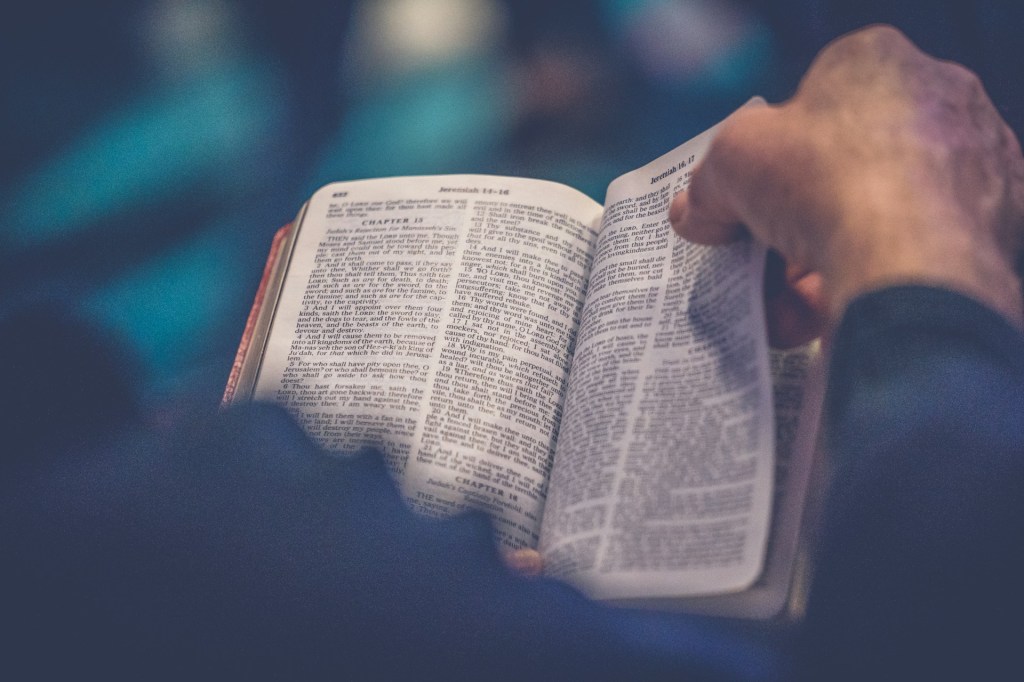
Bible in a Year: Week of February 19 – February 25

Fellow travelers:

Photo by Rod Long on Unsplash

Below are the chapters to read this week if you’re following along in my Bible in a year schedule, divided into morning and evening readings.  Follow along any way you want: just do the evening reading, flip the morning and evening, read it all.  Whatever works for you and your schedule!

This week, we’re 1/3 of the way through Psalms’ 150 chapters and done with Genesis, so on to Exodus.  If you’re wondering when we get to the New Testament, the answer is “not for a while.”  The New Testament has 260 chapters, while the Old has 929, but when we get to the New Testament it will be in focus for the rest of the year.

Monday, February 19
Morning: Psalm 50, 1 Kings 9
Evening: Genesis 50

Tuesday, February 20
Morning: Psalm 51, 1 Kings 10
Evening: Exodus 1

Wednesday, February 21
Morning: Psalm 52, 1 Kings 11
Evening: Exodus 2

Thursday, February 22
Morning: Psalm 53, 1 Kings 12
Evening: Exodus 3

Friday, February 23
Morning: Psalm 54, 1 Kings 13
Evening: Exodus 4

Saturday, February 24
Morning: Psalm 55, 1 Kings 14-15
Evening: Exodus 5

Sunday, February 25
Morning: Psalm 56, 1 Kings 16-17
Evening: Exodus 6

The Heavenly Holy of Holies

The temple King Solomon built in Jerusalem was not just as a place of worship and sacrifice, but also an image, or a model, of the cost of sin and of redemption.  The many courts, chambers, and walls were an object lesson in man’s separation from God because of his sin, and the required cost of restoring that relationship.  The most interior part of the temple, and hardest to get to, was the Holy of Holies, a room shaped like a perfect cube: 20 cubits by 20 cubits by 20 cubits.[1]  This cubed space was so sacred, and so holy, that only the high priest could enter it, and only once per year, and only after elaborate sacrifice.

However, by Christ’s sacrifice, we have hope: “We have this as a sure and steadfast anchor of the soul, a hope that enters into the inner place behind the curtain, where Jesus has gone as a forerunner on our behalf.” (Hebrews 6:19-20a).  In Mark’s gospel, we learn that when Christ died on the cross, “the curtain of the temple was torn in two, from top to bottom.”[2]  This curtain was the barrier covering the entrance to the Holy of Holies, and with Jesus’ death, entrance isn’t limited to just the high priest, but open to all who would believe in Him.  He entered “on our behalf” and anchors us to this most holy destination.

The Bible was not finished drawing this picture, though.  In Revelation 21, a new city – a new Jerusalem – is seen by the apostle John in a vision, coming down from heaven, and verse 16 says: “The city lies foursquare, its length the same as its width. And he measured the city with his rod, 12,000 stadia. Its length and width and height are equal.”  This vision was not meant to tell us that in Paradise we will all live inside a big cube.  As pastor Glenn Parkinson wrote: “Certainly all physical beings must exist somewhere, but this is not a vision of where God’s people will live, but how they will live when the former things have passed away.”[3]

Don’t put Earth in a box. Photo by The New York Public Library on Unsplash

Earlier, Revelation 21:1 referred to a whole new heaven and earth, so the new Jerusalem probably represents something about life everywhere in this new creation, and in this image, God would have used things familiar to John, the author of Revelation, otherwise the visions wouldn’t make sense.  The only other architectural cube John would probably recall from Scripture would be the Holy of Holies, but what does that mean?

I believe it means that all of the new heaven and earth will be inhabitable by both God and His people.  All of Paradise will be holier than even the Holy of Holies, but because the church will be fully sanctified, God’s people can enter His presence without the many temple courts and chambers and walls symbolizing man’s separation from God.  Relationship between Creator and created will be fully restored.  Everywhere will be holy, and everyone will be holy.

No, the New Jerusalem isn’t literally a cube, but it symbolizes that in the new world, the temple is not even needed, because all is as it should be between God and man:

“And I saw no temple in the city, for its temple is the Lord God the Almighty and the Lamb.” – Revelation 21:22

Praise God Almighty and the Lamb!


[1] 1 Kings 6:20 (a cubit was roughly 18 inches)
[2] Mark 15:38
[3] Parkinson, Glenn.  Tapestry: The Book of Revelation (2015).

The Scale of Our Trials

The apostle Paul begins 2 Corinthians with the usual greeting, followed by a section on the comfort God provides us when we suffer or are afflicted for Christ’s sake.  2 Corinthians 1:5 makes this statement: “For as we share abundantly in Christ’s sufferings, so through Christ we share abundantly in comfort too.”

On that verse, Charles Spurgeon wrote this analogy: “The Ruler of Providence bears a pair of scales—in this side He puts His people’s trials, and in that He puts their consolations. When the scale of trial is nearly empty, you will always find the scale of consolation in nearly the same condition; and when the scale of trials is full, you will find the scale of consolation just as heavy.”[1]

Therefore, when living for Christ brings trouble and opposition, remember also that our Father is ruler of all and fully intends to share His comfort with us through Christ eternally.

“For I consider that the sufferings of this present time are not worth comparing with the glory that is to be revealed to us.” – Romans 8:18


[1] From “February 12” of Spurgeon’s Morning by Morning commentary

The Weight of Lent

When reading the Old Testament prophet Jeremiah, chapters 34 and 35, I noticed the two chapters together have an interesting contrast. In chapter 34, with Jerusalem under siege by the Babylonians, King Zedekiah ordered the people to release all of their Hebrew slaves, seemingly with the motivation of appeasing God.  However, soon the people were returned to slavery.[1]  In chapter 35, this behavior is contrasted with the Rechabites, who, for about 200 years, had obeyed their ancestors’ vow to not drink wine, or build houses, but to live in tents.  God tells Jeremiah to call some Rechabites together, pour them some wine, and offer it to them.  But they refused to drink, citing their ancestral vow.[2]  The two stories together illustrate that this family could obey a stricter code than God’s, from a lesser authority (their human ancestor), and on less-important issues.  The Rechabites are an admirable example to the rest of God’s people, and a testament to what the covenant faithfulness of God to us looks like.

What does this story have to do with Lent?  This metaphor from the Apostle Paul provides some help:

Photo by Victor Freitas on Unsplash

“Do you not know that in a race all the runners run, but only one receives the prize? So run that you may obtain it.  Every athlete exercises self-control in all things. They do it to receive a perishable wreath, but we an imperishable.  So I do not run aimlessly; I do not box as one beating the air.” – 1 Corinthians 9:24-26

Paul says discipline and self-control are valuable in the same way that training is valuable to an athlete – they bring us closer to obtaining an objective that is valuable to us.  To those who love God, being a disciple will require discipline, and vows are a form of discipline.

Lent is celebrated many different ways by many different people but is generally seen as a time to practice spiritual discipline as a way to greater awareness of, gratefulness toward, and/or obedience to, God.  Often something is given up for the 40 days of Lent, which makes it in some ways similar to the vows of the Rechabites, or the Nazirite vow taken by Samson (or by his parents) in the book of Judges[3].

However, if we do not value the prize – God Himself – nothing we give up for Lent will make us – or God Himself – happy.  Lent will not help us love Him, or our neighbors, more.  Like the Israelites who flip-flopped on slavery, treating it as a bargaining chip with God and not as an act of faithfulness to Him, wrong motivations can lead to cycles of disappointment.  But, for those in Christ, the prize is worth every ounce of effort we can put into it.  Discipline during Lent can be like lifting weights for an athlete, strengthening them, and enabling them to better compete in their sport, but discipline during Lent for the sake of self-denial or for trying to impress God is to aim too low.  True religion to God is not a trade – He has already given us everything in Christ Jesus and we can’t earn more.  “Blessed are the meek, for they shall inherit the earth” – Matthew 5:5

I’ll close with this long quote C.S. Lewis’ sermon, The Weight of Glory:

“The New Testament has lots to say about self-denial, but not about self-denial as an end in itself. We are told to deny ourselves and to take up our crosses in order that we may follow Christ; and nearly every description of what we shall ultimately find if we do so contains an appeal to desire. If there lurks in most modern minds the notion that to desire our own good and earnestly to hope for the enjoyment of it is a bad thing, I submit that this notion has crept in from Kant and the Stoics and is no part of the Christian faith. Indeed, if we consider the unblushing promises of reward and the staggering nature of the rewards promised in the Gospels, it would seem that Our Lord finds our desires not too strong, but too weak. We are half-hearted creatures, fooling about with drink and sex and ambition when infinite joy is offered us, like an ignorant child who wants to go on making mud pies in a slum because he cannot imagine what is meant by the offer of a holiday at the sea. We are far too easily pleased.”[4]

[Note: Today’s post idea came to me this morning, based on the beginning of Lent and tying together a couple of things I’ve recently read.  While not really part of the Beatitudes series, this post seemed fitting.  However, with Return To Office beginning, Lent has already begun by the time I could write this!]


[1] Jeremiah 34:8-11
[2] Jeremiah 35:1-10
[3] Judges 13:7
[4] Lewis, C.S.  The Weight of Glory (1949).  P. 25-26.