Today is Mo Gaba Day

Today my local public school system is celebrating Mo Gaba Day, in honor of Mosilla “Mo” Kingsley Gaba, born on January 26, 2006.  Who is Mo Gaba?  If you aren’t a Maryland local, you likely don’t know Mo’s amazing story, but it’s worth telling!

At 9 months old, Mo had his first cancer diagnosis and soon lost his sight completely and permanently.  Over his life he fought cancer in his brain, bones, legs and elsewhere, but even with these challenges, Mo became a local celebrity because of his unquenchable enthusiasm for the Baltimore Ravens and Orioles, and for life in general.  At 9 years old, he began calling local sports radio shows in secret while his mother was at work, sharing thoughts about his teams, and about life, that seemed way beyond his years.  To listeners, he was known as “Mo from Glen Burnie.”  Over time, people also learned of his health issues and his attitude became an inspiration to, and friend of, many, including then-Orioles player Trey Mancini, who had been diagnosed with colon cancer in early 2020.  Tragically, 14-year-old Mo Gaba died on July 28, 2020, after spending 75% of his life in hospitals, but he remains inspirational to many.
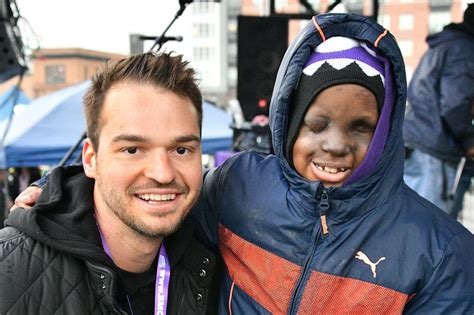
Mo Gaba and Trey Mancini

Two years later to the day, the Orioles held their first Mo Gaba Day, and something amazing happened: “Mancini hit an inside-the-park home run with a runner on base that started as what appeared to be a routine sacrifice fly. However, the ball deflected off the glove of Tampa Bay right fielder Josh Lowe after he lost it in the afternoon sun and hit him in the face, allowing Mancini to score…Trey commented about Mo playing around in the clouds so that he could score.”[1]  As Mancini rounded the bases, there was hardly a dry eye in attendance at the game, or watching on TV.  The Orioles won 3-0.

I don’t know much about Mo’s private life, the source of his hope and personality, or his religion, but share his story in the spirit of Philippians 4:8 – “Finally, brothers, whatever is true, whatever is honorable, whatever is just, whatever is pure, whatever is lovely, whatever is commendable, if there is any excellence, if there is anything worthy of praise, think about these things.”  Can followers of Christ provide hope as Mo did?

Lastly, below is what I posted to Facebook the day after hearing of his passing.

“RIP Mo Gaba, age 14.

Who is Mo Gaba?  A few years ago I started hearing him on the radio, calling in to the sports talk show I listened to in the car on my drive home.  He would have been about 10 when I first heard him.  Kids don’t call in much and the hosts usually aren’t patient with them so I wondered what was the deal with this very informed, very enthusiastic kid.  He loved his Orioles and Ravens!!!  Later I found out he was blind and had been fighting cancer his whole life. He was confined to a wheelchair. But he was so endearingly positive at all times.  The talk show host (Jeremy Conn) became a big advocate for him and his family, raising money to support him.  Other local sports figures and celebrities also began to support this kid who had an amazing personality in spite of his health problems that would crush many peoples spirits.  for example, “In 2019, Gaba became the first person to announce an NFL draft pick in Braille when he announced the Ravens’ fourth-round pick.”  Yesterday he was in the news (below) for getting into the Orioles Hall of Fame and today he’s gone.

We can all learn a lesson from his attitude in the face of adversity.  His joy was infectious. 

May we all experience joy as the world has become so negative and in turmoil!  A world that in some ways is teaching us to feel nothing but guilt and helplessness.  We are not victims in God’s eyes.

“In the day of prosperity be joyful, and in the day of adversity consider: God has made the one as well as the other, so that man may not find out anything that will be after him” – Ecclesiastes 7:14”

https://www.baltimoresun.com/sports/orioles/bs-sp-orioles-mo-gaba-hall-of-fame-20200728-5kcctc4q6zeefbzkw6ahq2xg7q-story.html


[1] https://en.wikipedia.org/wiki/Trey_Mancini

The Crushing Obligation to Keep Doing More and More – Sunday Share from Kevin DeYoung

Some days we are able to follow Jesus’ advice in Matthew 6:34 – “Therefore do not be anxious about tomorrow, for tomorrow will be anxious for itself. Sufficient for the day is its own trouble.”  Other days we feel overwhelmed by our responsibilities, and on some days, we feel like we’re carrying all the problems of the world.  Whether it’s something in a sermon, on the news, a book we’ve read, the multitude of notifications on our phones and other devices, or something in our own conscience, we feel that the world needs more than we have to give.

In the linked article, author Kevin DeYoung writes that “most Christians hear these urgent calls to do more (or feel them internally already) and learn to live with a low-level guilt that comes from not doing enough. We know we can always pray more and give more and evangelize more, so we get used to living in a state of mild disappointment with ourselves.”  He shares some thoughts on how to relieve this anxiety and focus on what we need to focus on.  After all, even Jesus “did not try to do it all. And yet, he did everything God asked him to do.”

(Estimated reading time 7 minutes)

I discovered this through fellow blogger Barbara Harper, who posts a weekly list of good reads on Saturday.

https://kevindeyoung.org/the-crushing-obligation-to-keep-doing-more-and-more/

Praying Through Road Rage

Simple errands can sometimes be aggravating if we let them.  Maybe you’ve had an experience like this: while driving through my community recently, I ended up behind a minivan that was driving well below the speed limit (or at least well below how fast I wanted to go) and seemed unsure of where they were going.  I ended up closer to their rear bumper than I should have been and thought that when I got home, I’d complain about drivers in the neighborhood to whoever would listen.  When the van finally turned right, apparently figuring out where they were going, I also remember thinking that the family in the van might end up talking about the annoying car that tailed them, having no concern that maybe they didn’t live there and had to drive slowly while they figured it out.  This is a lot of aggravation for what should be a non-event, but at the time…

Photo by Joshua Wordel on Unsplash

Somehow at that moment, Romans 12:18 popped into my head, which says: “If possible, so far as it depends on you, live peaceably with all.”  My first response was something like “God, what’s that got to do with this?”  But as I regained speed toward whatever errand I was in such a hurry to finish, I thought “God, which part of this problem depends on me?”  Hmm.  The tailgating was definitely unnecessary, and gosh, I might have really wanted to let the van know to get out of the way, but politely, without resorting to honking the horn.  Also, the idea of complaining about bad drivers when I got home depended on me…but what if the other family got frustrated about being tailed?  Is that my fault?  Well, if I had slowed down and been patient, that wouldn’t be a problem either.

When I got home, I didn’t share the story of the cautiously-driving minivan with anyone.  I hope the people in the van didn’t vent on Facebook about the rude tailgater.  Since then, I’ve been slightly better at being patient with slow drivers, because more depends on me than I often want to think.  Sometimes I’m too focused on what others are doing wrong.

“If possible, so far as it depends on you, live peaceably with all.”

Don’t Fear Jezebel’s Algorithm

Yesterday I re-posted a story of King Jehoiakim’s attempts to destroy the prophet Jeremiah’s words with fire, as recorded in Jeremiah 36:20-25 (which survived).  I decided to share it again based on two events: 1) a comment I saw on Facebook yesterday lamenting that owning a Bible could be made illegal, and 2) Facebook’s reminder to me in “Memories” that two years ago to the day I had posted this:

“To any religious person who is dismayed at “their side” being shut down by social media: Name one of Gods accomplishments that required Twitter or Facebook.  The Holy Spirit is the original (and best) social network. Listen to Him. Post to Him. Wait for Him. The Answer lies there. He remains online for eternity and He has a plan.”

Resistance to spreading God’s word is as old as time.  Consider the Old Testament story of Elijah, who prophesied during the reign of Israel’s evil king Ahab and his wife Jezebel.  According to Who’s Who in the Bible, “Jezebel devoted herself to bringing the worship of Baal and his consort Asherah to Israel. She employed 450 prophets of Baal and 400 prophetesses of Asherah (1 Kings 18:19), and persecuted the prophets of the Lord, including Elijah (1 Kings 19:1-9).”[1]  Many prophets were killed.

Elijah despaired, as written in 1 Kings 19:10 – “I have been very jealous for the LORD, the God of hosts. For the people of Israel have forsaken your covenant, thrown down your altars, and killed your prophets with the sword, and I, even I only, am left, and they seek my life, to take it away.”

Apostles also struggled to stay strong, including Paul.  When he was frustrated at resistance and lack of progress in Corinth, “the Lord said to Paul one night in a vision, ‘Do not be afraid, but go on speaking and do not be silent, for I am with you, and no one will attack you to harm you, for I have many in this city who are my people.”[2]

When Paul needed an example to encourage others to persist, he used Elijah’s story in Romans 11:2 – “God has not rejected his people whom he foreknew. Do you not know what the Scripture says of Elijah, how he appeals to God against Israel?  ‘Lord, they have killed your prophets, they have demolished your altars, and I alone am left, and they seek my life.’  But what is God’s reply to him? ‘I have kept for myself seven thousand men who have not bowed the knee to Baal.’”

Therefore, our hope is not in social networks where we can share God’s message, or in the benevolence of the programmers of algorithms that choose who sees what we post, or in the regulators and legislators who monitor the public square, or in the founding political documents that give us rights.  But:

“For as the rain and the snow come down from heaven
            and do not return there but water the earth,
making it bring forth and sprout,
            giving seed to the sower and bread to the eater,
so shall my word be that goes out from my mouth;
            it shall not return to me empty,
but it shall accomplish that which I purpose,
            and shall succeed in the thing for which I sent it.” – Isaiah 55:10-11

Social networks, algorithms, regulators and government are not our enemy, but our enemy is the one who tries to convince us we need these things more than we need the God who made them and who made us all.  His word will accomplish its purpose, and we have Elijah’s and Paul’s words and actions as evidence.

God’s word withstands the fire.  Always.


[1] Gardner, Paul D., editor.  The Complete Who’s Who in the Bible.  (1995)
[2] Acts 18:9-10

Let Justice Roll: History for January 15

On January 15, 1929, Dr. Martin Luther King Jr. was born in Atlanta, Georgia.  A leader in the U.S. civil rights movement in the 1950’s and 60’s, he is the only non-president to have a national holiday in his name, celebrated on the 3rd Monday of every January. During this holiday, many will cite positives and negatives from King’s life and legacy, and here I will focus on one, specific positive.

His father and maternal grandfather had both been pastors of Ebenezer Baptist Church in Atlanta, and he carried this religious heritage into his own studies and activism.  In pastor Tim Keller’s book “Making Sense of God” he writes that the strength of King’s arguments comes from his knowledge “that human rights have no power if they are simply created by a majority or imposed by judicial fiat. They have power only if they are really ‘there,’ existing on their own, dependent only on the fact that the wronged person before you making the claim against you is a human being.”[1]

King applied the teaching that “God created man in His own image” from Genesis 1:26-27 to argue that this image gives every person: “a uniqueness, it gives him worth, it gives him a dignity. And we must never forget this as a nation: there are no gradations in the image of God. Every man from a treble white to a bass black is significant on God’s keyboard, precisely because every man is made in the image of God.”[2]

A mighty stream. Photo by Daniel J. Schwarz on Unsplash

In one of my favorite quotes from King, he cites the American institutions of democracy and its founding documents, but knows that even these must be rooted in religious truth to be effective: “One day the South will know that when these dis­in­her­ited chil­dren of God sat down at lunch coun­ters, they were in re­al­ity stand­ing up for what is best in the Amer­i­can dream and for the most sa­cred val­ues in our Ju­deo-Chris­t­ian her­itage, thereby bring­ing our na­tion back to those great wells of democ­racy which were dug deep by the found­ing fa­thers in their for­mu­la­tion of the Con­sti­tu­tion and the De­c­la­ra­tion of In­de­pen­dence.”[3]

Keller continues in his chapter titled “A Justice That Does Not Create Oppressors” that “Martin Luther King Jr. did not ask white America to make African Americans free to pursue rational self-interest, their own individual definitions of a fulfilling life. Rather, quoting Amos 5:24, he called them to not be satisfied until ‘justice rolls down like waters, and righteousness like a mighty stream.’”[4]  God provides, and demands, more than “life, liberty, and the pursuit of happiness.”

While His justice and righteousness will only be made fully manifest in eternity, when we bring a bit of it into this world, we provide something available no other way to our neighbors, communities and beyond.  We should not be satisfied with anything less.


[1] Keller, Timothy.  Making Sense of God (2016).  P. 199.
[2] From a sermon King preached at Ebenezer Baptist Church in Atlanta, Georgia on July 4, 1965.  Cited in Making Sense of God, P. 199.
[3] From “Letter from Birmingham Jail”, dated April 16, 1963.
[4] From King’s “I Have a Dream” speech in Washington, DC on August 28, 1963.  Cited in Making Sense of God, P. 199.