Glory Days Have Not Passed You By

One of my favorite books of the Bible is Ecclesiastes, and chapter 7 in particular is full of practical wisdom, such as:

“Be not quick in your spirit to become angry, for anger lodges in the heart of fools. Say not, ‘Why were the former days better than these?’ For it is not from wisdom that you ask this. – Ecclesiastes 7:9-10

People commonly refer to the “glory days” of their past.  When they were an athlete.  When they were younger.  Before they had responsibilities.  Before they experienced a loss of a loved one, job/career, home, or anything they held valuable.  Before the Covid-19 pandemic.  Somehow the past looks better.

In these verses, Solomon, who lived a life where he gained and lost far more than nearly anyone else ever will, categorically says this is foolish. He’s not doing this to criticize, but to keep others from repeating his own mistakes. To advise against anger for the wrong reasons about things that can’t be changed or fixed.

God’s mercies are new every morning, and with the path we’ve taken before today, He has prepared us for the day ahead in a way no other path could. Strive for what is ahead – your true “glory days” in Him! Start from here and listen for Him. Perfection lies ahead.

“Give us each day our daily bread” – Luke 11:3

Do We Have It Upside Down?

Fellow travelers,

With other people, we can often decide what they know and don’t know about us.  We can guard our reputation by doing things out of the view of others or behind their backs.  We believe we can avoid any negative consequences of our actions and choices if others don’t know about them, especially people in authority.  Sometimes we may even think this applies to God.  Isaiah recognized this when he said the words of Isaiah 29:15 –

“Ah, you who hide deep from the LORD your counsel,
            whose deeds are in the dark,
            and who say, “Who sees us? Who knows us?””

The verse is directed at people who assume God has limited knowledge of us.  People who think they can avoid being seen and avoid consequences.  But things that apply to other people do not apply to God.  He knows all of our “counsel” – our thoughts – and all of our “deeds” – our actions – even if we think we’re doing them in secret.  He, as our maker, knows us better than we know ourselves.  He knows all, and Isaiah points out the foolishness of thinking He doesn’t in the next verse:

Photo by David Tomaseti on Unsplash

“You turn things upside down!
Shall the potter be regarded as the clay,
that the thing made should say of its maker,
            “He did not make me”;
or the thing formed say of him who formed it,
            “He has no understanding”?”

It’s upside down and backwards to apply what we know about people (“the clay”) to our “maker” and “him who formed it.”  He sees and understands things we don’t see or understand, not the other way around.  Pretending we can keep secrets from Him only deepens our sense of separation.  It darkens our “counsel” and ultimately our “deeds” as well.  God can’t get us back on the right path if we build up walls against Him.  In the case of Isaiah’s audience, since they were not willing to trust God, they end up allying with Egypt[1], something God had told them never to do.  In the spiritual metaphor, Egypt represents our slavery to sin, since Israel were once the slaves of Egypt, and they/we should never want to go back.  But we so often do, and often because we think He doesn’t know about it or care.

Like Paul in Romans 7:15 (“For I do not understand my own actions. For I do not do what I want, but I do the very thing I hate.”), we are people who don’t even understand ourselves.  But God knows how we’re broken, why we’re broken, and what can be done to fix us, because He is our “maker.”  So, what should we do?

First, we need to recognize that God does see and He does care.  Every thought we have and every deed we do matters to Him, because He wants us to be holy, for His glory and for our good.  He knows better than us and He expects us to act like we believe that.

Second, regular prayer of confession for purpose of self-examination and re-alignment with God is necessary, otherwise we will continue down the wrong path.  I find many of the Psalms to useful guides when it comes to these prayers, but the prayers can come from anywhere as long as they’re sincere.

Third, we must constantly seek to know Him and what He wants, and doing so means spending time with Him in His Word, the Bible.  Hebrews 4:12-13 says:

“For the word of God is living and active, sharper than any two-edged sword, piercing to the division of soul and of spirit, of joints and of marrow, and discerning the thoughts and intentions of the heart.  And no creature is hidden from his sight, but all are naked and exposed to the eyes of him to whom we must give account.”

His word can reach all of our “thoughts and intentions.”  It can remind us that nothing is hidden from Him, but it can also teach us what “thoughts and intentions” we ought to have.

Lastly, we must walk according to the Spirit, acting on the right “thoughts and intentions” and live with a clear conscience before God and man.  However, if we keep Him out because we are ashamed of our inner desires and rebelliousness, or because we think we can hide it, we are refusing the only solution He has provided for our deepest problems.

Can we do any of these things perfectly?  No, but we can and must try.  Pretending God is like other people who don’t know or care isn’t an option.  He died so we might know Him, and to know Him is to become like Him.

Amen.


[1] Isaiah 30:1-2

The Depths of David’s Emotion

One of my favorite things about the Psalms is the honesty and outpouring of emotions from the authors.  Even King David is very transparent in the many Psalms he wrote as prayers to God, making him more relatable to us.  We can see he’s not perfect, we can empathize with his pain, and we can often see ourselves mirrored in David’s experiences.

Since David is known as a man after God’s own heart, we often see the depth of his concern for others.  One such passage is Psalm 35:13-14, where David cries out:

“But I, when they were sick—
            I wore sackcloth;
            I afflicted myself with fasting;
I prayed with head bowed on my chest.
I went about as though I grieved for my friend or my brother;
             as one who laments his mother,
            I bowed down in mourning.”

How often do any of us put this much effort into crying out to God for someone else’s well-being?  But who are the “they” at the beginning of the verses?  Who is David so concerned about?  We can see that it is someone who was sick, but it wasn’t a brother or his mother, so probably not a family member.

David. Photo by Jack Hunter on Unsplash

The depth of David’s pleading to God for the “they” in Psalm 35 is even more striking because the “they”…are his enemies!  The Psalm begins with:

“Contend, O LORD, with those who contend with me;
            fight against those who fight against me!”

The rest of the Psalm suggests there are many people making false accusations about David, “malicious witnesses” out to destroy him.  David cries out to God in verse 8:

“Let destruction come upon him when he does not know it!
And let the net that he hid ensnare him;
            let him fall into it—to his destruction!”

David vents a lot of negative emotions before getting to verses 13 and 14, but he does get to the point of concern for these enemies.  He lets off a lot of steam begging God for justice, but never writes about taking justice into his own hands.  This is the honesty I love about the Psalms – if you’re angry, it’s ok to vent to God!  But it’s not ok to pray to God so you can take vengeance on your enemies yourself.

It’s only natural to be angry at our enemies, but in Christ we are more than natural, so we don’t have to do what comes naturally.  Here is what Christ expects of His people, as written in Matthew 5:43-46:

“You have heard that it was said, ‘You shall love your neighbor and hate your enemy.’  But I say to you, Love your enemies and pray for those who persecute you, so that you may be sons of your Father who is in heaven. For he makes his sun rise on the evil and on the good, and sends rain on the just and on the unjust.  For if you love those who love you, what reward do you have? Do not even the tax collectors do the same?”

David’s venting in Psalm 35 is the part that anyone can do, but what really stands out is the depth of David’s love for his enemies!  As I wrote earlier, how often do we put this much effort into crying out to God for someone else’s well-being?  Even if they are our friends?

Jesus enables us to be supernatural, which is sometimes what we need to love unconditionally and pray as David did.

“But I, when they were sick—
            I wore sackcloth;
            I afflicted myself with fasting;
I prayed with head bowed on my chest.
I went about as though I grieved for my friend or my brother;
             as one who laments his mother,
            I bowed down in mourning.”

Daily Readings for June 14 – 20

Fellow travelers:

For those looking for a Bible reading plan, each week I post 2 chapters to read per day as a main reading plan, and for anyone who wants to read the whole Bible in 2026, I’ll post the extra chapters to read that week.  The main readings will include nearly all of the New Testament, plus Psalms, Proverbs, Ecclesiastes, the Prophets, and a few other Old Testament books.

Reading 3 chapters a day on weekdays and 4 on weekends almost exactly covers the 1,189 chapters of the Bible, so the “extra” readings will be about 9 chapters per week.  These readings will cover the Pentateuch, the OT histories, a few other OT books, plus Jude and Revelation from the NT.

Regardless, I hope this schedule encourages others to read and study their Bible more, whatever parts they decide to read.  Follow along (or not) any way you choose!

2 chapter a day plan:
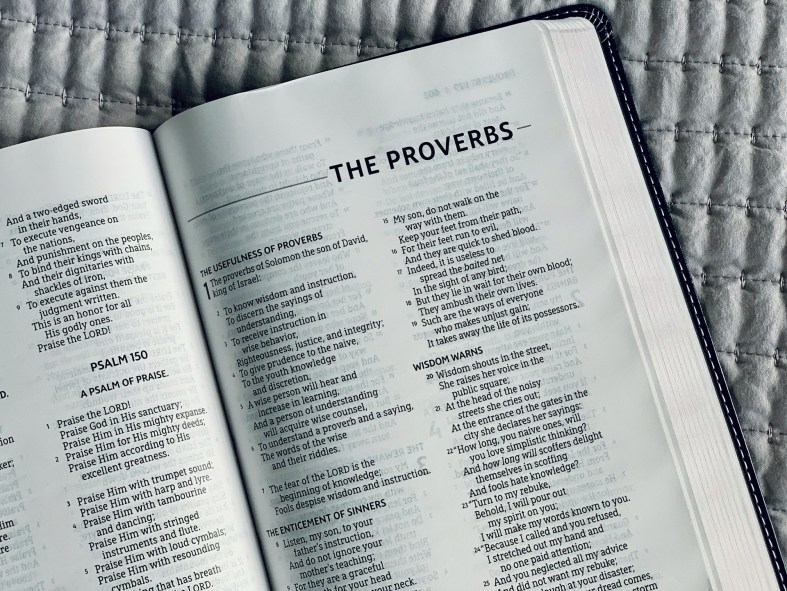
Monday, June 15: Proverbs 16, Acts 11
Tuesday, June 16: Proverbs 17, Acts 12
Wednesday, June 17: Proverbs 18, Acts 13
Thursday, June 18: Proverbs 19, Acts 14
Friday, June 19: Proverbs 20, Acts 15
Saturday, June 20: Proverbs 21, Acts 16
Sunday, June 21: Proverbs 22, Acts 17

Extra chapters for those reading the whole Bible in 2026:
Judges 3 – 11

Marlboro Man Needs the Gospel

Marlboro Man was a character used to advertise Marlboro cigarettes starting in 1954.  He became a cliché of a rugged man, often shown on horseback with a cowboy hat and some rope, confidently smoking a cigarette, and was portrayed by several different actors until 1999.  However, the origin of this famous ad campaign isn’t as well known.

Before the manly Marlboro Man manifested in 1954, Marlboro was sold as a feminine cigarette, with a red-colored filter at the tip.  Ads had phrases like “Ivory Tips Protect the Lips,” and touted that lipstick on the cigarette wouldn’t matter since it was red anyway.  But later, when the health risks of cigarette smoking came to light, Philip Morris & Co. wanted to sell Marlboro to men on the idea that filters made smoking “safer.”  However, given Marlboro’s feminine image – created through advertising – Philip Morris had to overcome that connotation, so the red tips were removed, and Marlboro Man was born as a way to sell Marlboro cigarettes to men concerned about lung cancer and other health risks.

Marlboro Man ad on a Warsaw, Poland building.

With hindsight, we know that filters don’t make smoking safer.  Ironically, and sadly, five different men who appeared in Marlboro advertisements died of smoking-related diseases, earning Marlboro cigarettes the nickname “cowboy killers.”[1]

Also with hindsight, we can see the massive power of advertising to shape our perceptions.  The Marlboro Man campaign is considered in the ad industry to be one of the best of all time, changing a “feminine” product into one of stereotypical masculinity almost overnight.  But the campaign also shows us that “There is a way that seems right to a man, but its end is the way to death”, as Proverbs 14:12 and 16:25 say.  In this case, it was very literal death in this world.

To make Philip Morris money, the ads declared that smoking was not a “way to death,” but that it was “right to a man” to be like the Marlboro Man.  It’s not entirely unlike the line “the greatest trick the Devil ever pulled was convincing the world he didn’t exist,” which was spoken by Kevin Spacey’s character in the 1995 movie, The Usual Suspects.  This line was a paraphrase of a line at least as old as the 1850’s.[2]

I recently heard a sermon where the pastor said, “the culture is trying to kill you,” and I don’t think it was an exaggeration.  Just as Marlboro ads first convinced people it was a feminine product, then turned on a dime to convince people it was a masculine product, without any real change to what was being sold, we’re all bombarded by dangerous messages every day, and many will only be seen in the broader culture as dangerous with the benefit of hindsight.  Smoking used to be considered normal.

I’m not writing this to condemn smokers, because we all have our bad habits, but to spotlight the importance of an eternal perspective.  Any culture is limited to the perspective of its leaders in that time and circumstance, and the pull of peer pressure is real.  Every culture in this world has “a way that seems right to a man, but its end is the way to death,” but also every culture needs the gospel more than it needs effective advertising campaigns.

Therefore, as the apostle Peter wrote in 1 Peter 3:8-9 – “Finally, all of you, have unity of mind, sympathy, brotherly love, a tender heart, and a humble mind.  Do not repay evil for evil or reviling for reviling, but on the contrary, bless, for to this you were called, that you may obtain a blessing.”

Marlboro Man needs the good news of the gospel, not condemnation.


[1] https://en.wikipedia.org/wiki/Marlboro_Man
[2] https://quoteinvestigator.com/2018/03/20/devil/