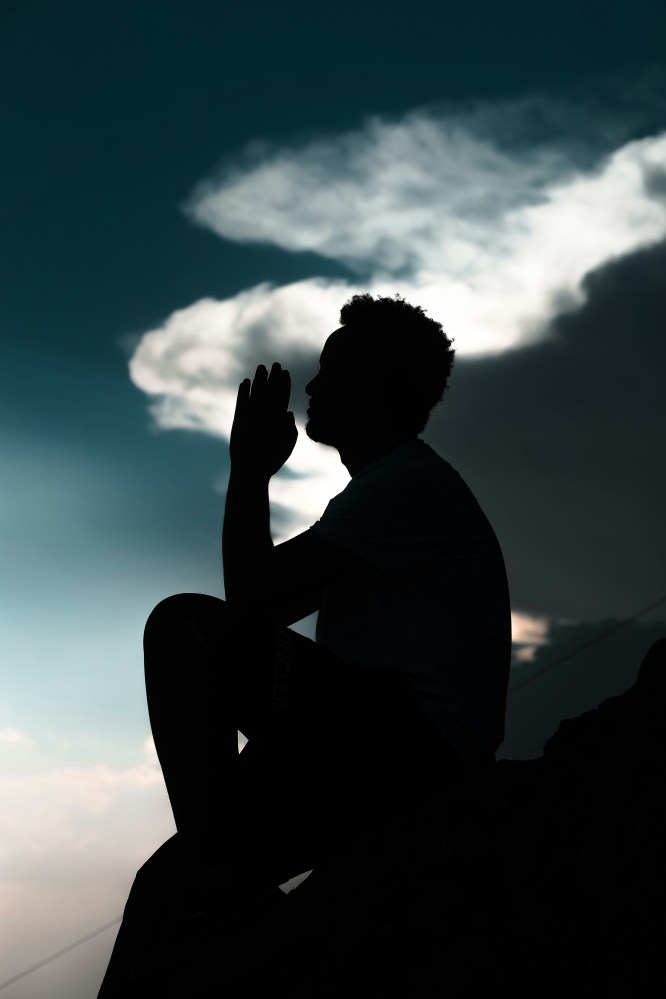
God is Faithful in Trouble

Fellow travelers,

Psalm 71 was likely written by an old man, looking back over his life and the many instances of God’s faithfulness.  Looking back over a lifetime of walking with God strengthens his current faith, and he writes to strengthen ours.  Although some might expect a testimony of God’s faithfulness to talk about uninterrupted good fortune and all the good times the Psalmist has had, in verse 20, they write:

You who have made me see many troubles and calamities
            will revive me again;
from the depths of the earth
            you will bring me up again.”

This man’s life, like most people’s lives, was filled with “many troubles and calamities,” yet these only strengthen his faith because God has rescued him every time in the past.  Without allowing us to experience trouble, how could God develop a track record of rescuing us?  John Calvin comments on this verse that:

“Had he always enjoyed a uniform course of prosperity, he would no doubt have had good reason to rejoice; but in that case he would not have experienced what it is to be delivered from destruction by the stupendous power of God. We must be brought down even to the gates of death before God can be seen to be our deliverer.”

God is always faithful, but we experience it especially in bad times.

Amen.

Christianity is Not in Decline. Ever.

The tomb is still empty!

Too much of what we hear and read in this world is filled with phrases like “post-Christian world,” or “Christianity’s decline.”  Or we could read that we’re “living in the ruins of Christendom.”  However, because Hebrews 11:1 says, “Now faith is the assurance of things hoped for, the conviction of things not seen,” our hope is not based on any ruin or decline we see in the communities and world around us.  While other things may end up in ruins or in decline, Christianity does not.  It was not in decline on Good Friday when Jesus died on the cross and it is not in decline now.

The best of the kingdom of God is always in the future, never in the past.  His kingdom is advancing daily.

Today, many will hear the good news of the kingdom of Jesus, and some may hear and be saved!  Also today, none will be snatched out of His hand! (See John 10:28)

The Death of Chairman Mao – History for September 9

Photo by manos koutras on Unsplash

On this date in 1976, Mao Zedong, or Chairman Mao, founder of the communist People’s Republic of China, died at the age of 82.  Some look at Mao’s death as a positive turning point for Christianity in China, since under Mao China had expelled all Western Christian missionaries between 1949 and 1953.  However, while it is impossible to come up with precise numbers across a 3.7 million square mile country, Christians probably were about 1 percent of China’s population when Western missionaries were kicked out, but by the 1980s about 5 percent of the population went by Christ’s name.  The Christian population grew by ten times, while the overall population doubled.  How did this happen?

Mark Noll and Carolyn Nystrom, authors of the book “Clouds of Witnesses” say the key to this growth was “the resilience of the Chinese believers themselves…securely rooted in Chinese life before Mao.” [1]  In expelling missionaries, Mao was in part responding to “treaty ports” created at the end of the 1839-42 Opium War.  Through these ports foreign powers had extra territorial rights, allowing influences including missionaries to come in, but these ports also allowed opium to flow freely into China from Western countries.  Therefore, in the mind of many Chinese, Christianity became linked with both Western imperialism and opium addiction.  When Karl Marx said “religion is the opiate of the masses” he may have been thinking of this connection.  But native Chinese believers, sometimes planted by Europe-based evangelizing organizations like China Inland Mission, remained behind and spread resilient forms of Christianity that were attractive to the Chinese population.

John Sung
Several of these Chinese Christians are profiled by Noll and Nystrom, including John Sung who lived from 1901 to 1944, before Mao’s communist revolution.  Around Christmas 1926, Sung heard child evangelist Uldine Utley preach a sermon at Calvary Baptist Church in New York, near where he was attending Union Theological Seminary.  This sermon, along with other influences, countered the liberal Christianity he was being taught where the Bible was just “a collection of myths.”  He returned to China, determined to spread the gospel in the land of his birth with frenetic energy.  In a one-year period in 1931-2, Sung and a small group of missionaries “traveled over 50,000 miles, held 1,200 meetings, preached to more than 400,000 people in thirteen provinces, registered more than 18,000 ‘decisions’” for Christ.  Many of these new Christians formed traveling bands themselves.  Sung is considered the last great evangelist in China and Southeast Asia before Mao’s reign. 

Dora Yu
Even earlier, another driver of this resilient, Chinese Christianity was Dora Yu (1873-1931).  Dora’s ministry benefitted tremendously from a 1905 decision by Dowager Empress Cixi to replace China’s traditional Confucian civil service examinations with general public schools.  Under this system, mission-run schools became a valued option, and one of Dora’s early ministries was to train “Bible women” to not only educate women generally, but also to teach them the Bible, pray with them, and teach them to live by faith.  Mostly traveling by foot, in “1903, Dora Yu visited with 925 women and 211 children.”  Later, her ministry grew and she became famous for itinerant preaching, reaching many others who would carry on the Lord’s work.

Because of our proneness to look at
the bucket and forget the fountain,
God has frequently to change His
means of supply to keep
our eyes fixed on the source

Watchman Nee

Watchman Nee
In 1920, Nee Shu-Tsu would hear Dora Yu preach.  Later known as Watchman Nee, he “planted at least four hundred Christian churches over a thirty-year period of active ministry.”  He died in 1972 in a Communist prison after spending 20 years there.  Watchman Nee wrote that “Because of our proneness to look at the bucket and forget the fountain, God has frequently to change His means of supply to keep our eyes fixed on the source.”

Whether it is a European missionary, a child preacher in New York City, a Chinese man temporarily studying in New York City, or a Chinese woman walking miles through the countryside:

How beautiful upon the mountains
            are the feet of him who brings good news,
who publishes peace, who brings good news of happiness,
            who publishes salvation,
            who says to Zion, ‘Your God reigns.’” – Isaiah 52:7

As Jesus said in Matthew 16:18 – “And I tell you, you are Peter, and on this rock I will build my church, and the gates of hell shall not prevail against it.”  This rock is the gospel of the kingdom of God, and not even a brutal regime like that of Chairman Mao could prevail against it.

Soli Deo Gloria


[1] Noll, Mark A.; Nystrom, Carolyn.  Clouds of Witnesses: Christian Voices from Africa and Asia (2011).  This post is drawn from chapters 12 and 14.

Daily Readings for September 8 – 14

Fellow travelers:

Here is the list of readings for this week: 2 chapters to read per day as the main reading plan, and extra chapters for anyone who wants to read the whole Bible in 2025.  Reading 3 chapters a day on weekdays and 4 on weekends almost exactly covers the 1,189 chapters of the Bible, so the “extra” readings are about 9 chapters per week.

Follow along (or not) any way you choose!

Monday, September 8: Joshua 9-10
Tuesday, September 9: Joshua 11-12
Wednesday, September 10: Joshua 13-14
Thursday, September 11: Joshua 15-16
Friday, September 12: Joshua 17-18
Saturday, September 13: Joshua 19-20
Sunday, September 14: Joshua 21-22

Extra chapters for those reading the whole Bible this year:
Jeremiah 48-52, Lamentations 1-4

God Breaks Out of All Boxes

Written around 600 B.C., the Old Testament book of Habakkuk outlines a conversation between the prophet Habakkuk and God, in the few years prior to Judah’s exile in Babylon.  The book begins with Habakkuk’s complaint that evil was running rampant in Judah.  Habakkuk cries out to God about the prevalence of “violence” and “iniquity.”  He cries out about how people are ignoring God’s law, yet nothing is being done about it.  There was no justice.[1]  He’s tired of seeing nothing but evil in the world every day and is frustrated that God doesn’t seem to be doing anything about it.

Then comes Habakkuk 1:5, which to me is one of the most shocking verses in the Bible:

Look among the nations, and see;
            wonder and be astounded.

For I am doing a work in your days
            that you would not believe if told.”

Why is this verse shocking?  Because next, God tells Habakkuk that He has arranged for Babylon, a “dreaded and fearsome[2] nation that does not respect God and that lives by the creed that might makes right, to conquer Judah.  Basically, Habakkuk asks God why He was allowing evil to prosper in Judah, and God answers that He will allow an even more evil nation to prosper and conquer Judah.  Habakkuk must have been perplexed, and God knew it.  He knew Habakkuk would “wonder and be astounded” and we probably feel that way sometimes too.

Habakkuk had expectations about what God could and couldn’t do, but here God says He can, and will, do things that shock us.  Things that we cannot understand, but things that will teach us to trust instead of understand.  Sometimes God doesn’t behave in line with our theological doctrine, but He always does so for a reason.

Another example of shock at God’s out-of-the-box behavior comes from John 13, one of my favorite New Testament stories.  Mere days before going to the cross, “Jesus, knowing that the Father had given all things into his hands, and that he had come from God and was going back to God, rose from supper. He laid aside his outer garments, and taking a towel, tied it around his waist. Then he poured water into a basin and began to wash the disciples’ feet and to wipe them with the towel that was wrapped around him.”[3]

Photo by Photoholgic on Unsplash

Peter was shocked.  This was not what he expected from the Messiah, the incarnate Son of God.  So, when we get to verse 8, we read: “Peter said to [Jesus], “You shall never wash my feet.” Jesus answered him, “If I do not wash you, you have no share with me.”

Peter was reluctant to accept a God that would serve him by washing his feet, but what Jesus was trying to tell the disciples was that if they wanted to follow Him as their master, they would have to serve as He served, even if it wasn’t what they expected from God.  They needed to be washed, and then to wash others.

Peter was learning that if Jesus is doing something, don’t question it!  His actions are right by the mere fact that He is doing it, whatever our reason or expectations tell us.  In the Old Testament, God decided to send His people to a Promised Land, then to cause a heathen nation to kick them out of the Promised Land.  In the New Testament, He showed us that His Messiah would be a suffering servant, to teach us to be suffering servants.

God will never do anything that contradicts His character as revealed in the Bible, but the Bible also says, “Who has measured the Spirit of the LORD, or what man shows him his counsel?” in Isaiah 40:13.  God does not fit within our boxes, our expectations and rules.  We don’t fully understand Him.  Therefore, pay close attention to Jesus the Master, and be ready to follow where He goes, even though it might be shocking!

Look among the nations, and see;
            wonder and be astounded.

For I am doing a work in your days
            that you would not believe if told.”


[1] Habakkuk 1:2-4
[2] Habakkuk 1:7
[3] John 13:3-5