The Fatherless Aren’t

There are a lot of different perspectives on truth.  Truth of the way the world is.  Truth of the way it should be.  Gospel Truth.  But this Father’s Day, I’ll focus on one particular truth:

“Religion that is pure and undefiled before God the Father is this: to visit orphans and widows in their affliction, and to keep oneself unstained from the world.” – James 1:27

This verse tells us that God the Father has a special place for those who don’t have an earthly father.  He will be Father to them.  It tells us to be Jesus to the widows and orphans, showing them the Way to, and the love of, their Father.  There is a reason the Lord’s Prayer starts with “Our Father” – because ultimately all depends on Him.

Photo by Liane Metzler on Unsplash

Many in the world reject God as Father because of the failure of fathers in the world.  The Old Testament of the Bible is not full of great examples of parents, but rather shows people with all their flaws and warts, who by God’s grace became part of God’s plan to use sinners to reach sinners.  To become the Father of His eternal people, despite the failure of His people to be good fathers.  There are no Godly offspring without the sacrifice of Jesus.  There is no human Jesus without a genealogy of sinners.  There are none to inhabit heaven without the sacrifice of a human Jesus, God’s only Son, given for you.

This Father’s Day, take every opportunity to be grateful for fathers, for parents, for those who take on parenthood in other ways, but also think about those who have no earthly provision.  Because those who see Jesus see the Father, help people see Jesus.  God’s purpose for Godly offspring will be fulfilled and praise Him that you have the awesome responsibility and opportunity to be a part of that work.

Fathers matter.  You matter.  To God and to others.  Whoever you are.

The Value of Work: A Quint of Quotes

Dear fellow travelers,

Here is another “Quint of Quotes” from my collection on the theme of work:

“We make a living by what we get, but we make a life by what we give.” – Winston Churchill

Photo by Taya Kucherova on Unsplash

“God is more concerned about His workers than He is about their work, for if the workers are what they ought to be, the work will be what it ought to be.” – Warren Wiersbe

“The Christian shoemaker does his duty not by putting little crosses on the shoes, but by making good shoes, because God is interested in good craftsmanship” – Martin Luther

“A holy life will produce the deepest impression. Lighthouses blow no horns; they only shine.” – D. L. Moody

“Whatever you do, work heartily, as for the Lord and not for men, knowing that from the Lord you will receive the inheritance as your reward.  You are serving the Lord Christ.” – Colossians 3:23-24

The Last Enemy is Death

In life there are many difficult questions, and two of the hardest are also common objections to Christianity: 1) Why doesn’t God do anything about the evil in this world? and 2) Why do bad things happen to good people?

However, the Bible does not leave Christians without hope in the face of these questions.

First, part of what God is doing about the evil in this world is the fact that everyone dies.  The Bible teaches that every bad thing in this world is a result of sin – people deviating from God’s purposes – and that because of that sin the world is cursed[1].  Not only do people hurt each other, but the creation itself, including human nature, is not in its ideal state.

Death was not originally part of this world, but came in to the world as a result of sin and is a constant reminder of it.  In Genesis chapter 5, there is a genealogy from Adam to Noah.  The phrase “and he died” is repeated over and over again and is a reminder that this world is not perfect.  God created a consequence for the sin of mankind: death.  While the Bible doesn’t explain why there was a snake in the garden or why Adam and Eve sinned, it does describe what God is doing about it.  When we ask why bad things happen, we acknowledge that bad things exist, that they shouldn’t exist, and that they can happen to anyone.  God isn’t doing nothing about the evil in the world – we all die and that is part of the judgment.

So, the two objections to Christianity (Why doesn’t God do anything about the evil in this world? and why do bad things happen to good people?) end up being contradictory because part of what God does about the evil in this world is that bad things (death) happen to everyone.

However, the Bible teaches that there are two deaths: a physical death and a spiritual death.  In the first, our soul is separated from our body and our body dies.  In the second, our soul is separated from God eternally and our soul dies but exists forever away from God’s presence and blessings.  A second thing that God is doing about the evil in this world is that the first death is universal, but the second death is not.

Fortunately, judgement and death aren’t the only things God is doing about sin.  What does this mean?  Note the second half of God’s curse on the serpent from Genesis 3:15 –

I will put enmity between you and the woman,
            and between your offspring and her offspring;
he shall bruise your head,
            and you shall bruise his heel.

Who is being bruised here?  In the last phrase, Satan is injuring Christ through the crucifixion, but it’s described as a wound to the heel because it is not fatal.  Jesus was raised to life eternal.  On the other hand, Christ shall bruise the head of Satan – a fatal blow that he will never recover from.  This was determined from the beginning.

While judgement comes to all in physical death as a result of sin, through Christ there is a way out from spiritual, eternal death.  Jesus has paid the price for our sin and has conquered eternal, spiritual death as a result.

The last enemy to be destroyed is death.” – 1 Corinthians 15:26

Praise God!


[1] See Genesis 3:19 and 3:22

Manning the Watchtower

 “I will take my stand at my watchpost
            and station myself on the tower,
and look out to see what he will say to me,
            and what I will answer concerning my complaint.” – Habakkuk 2:1

Photo by Casey Olsen on Unsplash

People like to look for patterns and predictability in the world, and even in God’s behavior.  But in Habakkuk’s case, he saw a situation that didn’t make sense to him, that God would use Babylon to brutally punish His people in Judah.  God knew it wouldn’t make sense to Habakkuk, saying “I am doing a work in your days that you would not believe if told.[1]

Habakkuk would have gone into a private corner to sulk, but instead he brought it to God and was willing to be patient and wait to see how He would answer.

Is there something that doesn’t make sense right now in your life?  In my experience, there almost always is.  Therefore, be as vigilant and patient as Habakkuk.  Take your place in watchful hope on the watchtower and see what God will do.


[1] Habakkuk 1:5b

The Queen of Sheba’s Example

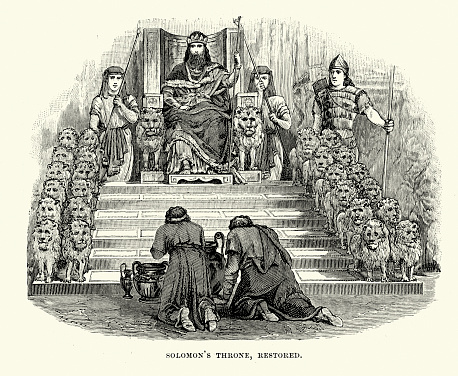
King Solomon, son of Israel’s greatest king David, was also a famous and renowned king.  God asked Solomon what he wanted, and Solomon asked for wisdom to rule the people. In addition, the Lord also gave him “riches and honor, so that no other king shall compare with you, all your days.[1]  His rule was likely the high point of Israel’s kingdom in terms of wealth.  Surely Solomon was bound to draw the attention of other nations and their rulers.

One such ruler is the Queen of Sheba, and we learn about her visit to Solomon in 1 Kings 10.  Sheba was apparently “Sabea,” far away from Jerusalem in southwestern Arabia.  Visiting Solomon was a long and difficult trip for her, especially since she brought many people and gifts along.  Why did she bother?  She came because of reports she had heard of Solomon’s wealth, but also of his wisdom.  1 Kings 10:1 says “she came to test him with hard questions” to see if he was as wise as the reports said.  Solomon answered all of her questions, and she responded that “Your wisdom and prosperity surpass the report that I heard.”[2]

Like the Queen of Sheba, we also hear reports of a King of Israel who surpasses all in wisdom: God Himself.  But like the Queen, do we put as much effort into learning about this King?  She traveled for days, maybe weeks, in order to meet Solomon in person.  Do we set aside enough time to really get to know our King?  Do we engage Him in tough conversations about our lives, testing Him with the hard questions we have?  Or do we keep Him at a distance because we’re not sure how He is relevant for our lives?

Solomon’s father, King David, wrote in Psalm 34:8 –

Oh, taste and see that the LORD is good!
            Blessed is the man who takes refuge in him!

David’s words don’t tell us to sit back and passively learn about God; they tell us to “taste” of God to see that He is “good.”  God does not shower us with blessing upon blessing trying to convince us that He is good while we selfishly go about our lives.   We must learn that He is good by trusting Him and learning to walk with Him.  We turn to Him by learning that repentance is a good thing.  That He is a God worthy of our attention.

When the Queen of Sheba became convinced that Solomon was a good and wise king, in 1 Kings 10:9 she proclaimed:

Blessed be the LORD your God, who has delighted in you and set you on the throne of Israel! Because the LORD loved Israel forever, he has made you king, that you may execute justice and righteousness.

Think of how much more blessed we are to have a King who is infinitely wiser and greater than Solomon!  Learning more of Solomon caused the Queen to burst forth in praise for God, who loved Israel enough to give them a king that will “execute justice and righteousness.”  God still loves His people and has given them a King, our Lord Jesus, who will “execute justice and righteousness” perfectly and for eternity. James 4:8 tells us to “Draw near to God, and he will draw near to you.” 

Even if it requires taking a long, difficult trip, like the Queen of Sheba’s.  He is worth the effort.


[1] 1 Kings 3:13
[2] 1 Kings 10:7