What We Need for Christmas…Part 1

What do we need for Christmas? We think a lot about what we want, but what do we really need?

James Montgomery Boice, former pastor of Tenth Presbyterian Church in Philadelphia, says:

“Suppose…that we should conduct an opinion poll to find out what men and women feel they most need. Suppose we should ask, ‘What do you feel are your greatest needs?’ ‘Well,’ people would say, ‘we have minds. So we have a need to know things rightly, to understand. We need wisdom. We also have wills, and because we have wills, we want to achieve something. We want our lives to make a difference. To do that we need power. We are also individuals, but we sense that we are not meant to be alone. We want to belong somewhere. We need satisfying relationships. We are also conscious of having done wrong things. We need to be forgiven. We need somebody to deal with our guilt. Isn’t that what we would find if we should poll people and analyze their basic experiences? Aren’t those the things we really need?”[1]

Photo by Tina Vanhove on Unsplash

Whatever mess we find ourselves and the world in, Christmas is a reminder that God has not given up on us and on the world.  Boice quotes from Isaiah 9:6, a prophecy from around 700 BC concerning the Christ we celebrate each Christmas:

“And his name shall be called Wonderful Counselor,
Mighty God, Everlasting Father, Prince of Peace.”

To meet our deepest, most significant needs, this Christ is provided for us.  Over the coming days until Christmas, I’ll be posting Christmas messages inspired by Boice’s framework about each of these 4 names, and how they are “the greatest gifts that anybody can give or we can have, and they are all in Jesus.”[2]  They are better than anything under your tree (or lost in the supply chain until after Christmas) and were delivered over 2,000 years ago.  Therefore, you can receive and open them at any time!


[1] From “May 10.” James Montgomery Boice and Marion Clark. Come to the Waters: Daily Bible Devotions for Spiritual Refreshment.  (2017).
[2] Ibid.

Confession: The Blessing Nobody Expects

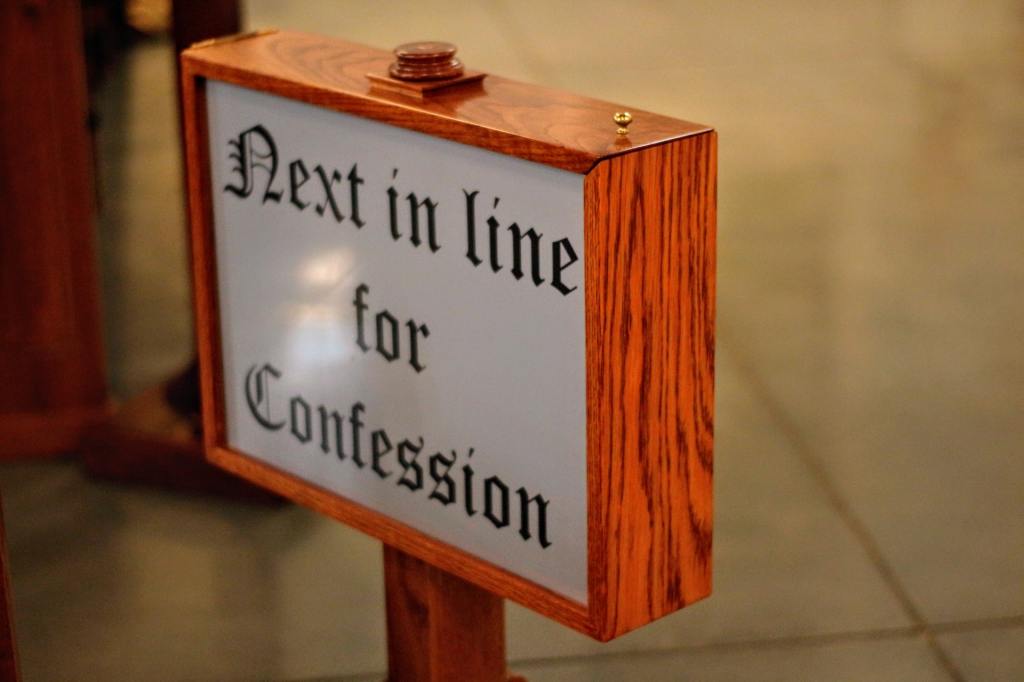
What comes to mind when you think of confession?  Think about it for a moment.

For some, the thought might be a simple private prayer, or for some a confessional booth.  For others, no specific images might come to mind, but just a feeling of someone “out to get you.”  I expect some of you thought of the Spanish Inquisition, or at least the Monty Python skit making fun of it[1].  Where do these ideas come from?

The blame belongs in many places: secular culture, bad experiences with church, an emphasis on external over internal religion, and even Monty Python comedy skits.  My fantasy baseball league even has a team named “Spanish Inquisition” because the manager of that team thinks no one expects him to win – not even himself.

The mocking of secular culture aside, confession is an uncomfortable topic even for sincere Christians.  In Humphrey Carpenter’s biography of J.R.R. Tolkien, he shares the tension over confession between Tolkien and his then-fiancée Edith.  Tolkien was a practicing Catholic, while Edith was a member of the Church of England.  They had agreed as a couple to be Catholic, but Edith “began to dislike making her confession.  It was therefore all too easy when she was worried about her health (which was often) to postpone going to mass. She reported to Ronald [Tolkien] that getting up to go to church early in the morning and fasting until she had made her communion did not agree with her.”  She insisted “my health won’t stand it.”[2]  In my own Protestant church, we have a weekly prayer of confession, which the pastor regularly defends the importance of.  Few of us probably look forward to confession, whatever form we practice it in.

Photo by Shalone Cason on Unsplash

This discomfort with confession seems to be a shared part of mankind’s fallen nature, but if we look at well-known Bible verses on confession, we find that it is really about restoration, a rebirth of man’s relationship with God and a renewal of man to his ideal nature.  It is as different from God being “out to get you” as it could be.  1 John 1:9 encourages confession, because: “If we confess our sins, he is faithful and just to forgive us our sins and to cleanse us from all unrighteousness.”  God wants to give us forgiveness and cleansing, not condemnation and guilt.  Isaiah 1:18 explains this cleansing more poetically:

Come now, let us reason together, says the LORD:
though your sins are like scarlet,
            they shall be as white as snow;
though they are red like crimson,
            they shall become like wool.

Confession doesn’t need to be a dirty word.  The word “confess” means loosely to say the same thing about something, so confession means we agree with God (say the same thing he does) about sin – that it is bad.  But confession also applies to the rest of 1 John 1:9, that God “is faithful and just to forgive us our sins and to cleanse us from all unrighteousness.”  Full confession includes agreeing about the steadfast and dependable character of God, His faithfulness and justice, as well as His desire to forgive and cleanse.  If we doubt this desire, consider what He voluntarily suffered on the cross to provide for this forgiveness, and to demonstrate His enduring love.

By adding confession about the good things of God to our confession of our sin, our confession does not make us miserable about our own condition but shows us how different we are from what God wants for us, how deeply our sin needs to be corrected, and how wonderfully God has provided for the removal of sin.

But this does not come easily.  Referencing Hebrews 4:16, which says, “Let us then with confidence draw near to the throne of grace, that we may receive mercy and find grace to help in time of need,” Puritan preacher Thomas Watson wrote that “Christ went more willingly to the cross than we do to the throne of grace.”

Why is this?  Could it be that we have trouble whole-heartedly confessing that “he is faithful and just to forgive us our sins and to cleanse us from all unrighteousness”?  Monty Python joke that “nobody expects the Spanish Inquisition,” but do we fully expect God’s throne to be one of grace when we come to confess?


[1] If you’re not familiar with the skit, here’s a 4-minute example: https://youtu.be/Cj8n4MfhjUc
[2] Carpenter, Humphrey. Tolkien: A Biography.  (1977).  P. 68-69.

Bible in a Year: Week of December 16 – 22

Fellow travelers:

Below are the chapters to read this week if you’re following along in my Bible in a year schedule, divided into morning and evening readings.  Follow along any way you want: you can just do the evening reading, flip the morning and evening, or read it all.  Whatever works for you and your schedule!  It doesn’t have to be Bible in a Year for everyone.

By the end of this week, we’ll be into the 2 final books: Daniel and Revelation.  I’m considering whether and how to continue this into 2025.  It might just be daily readings, but not a full Bible in a year.

Monday, December 16
Morning: 1 John 4-5
Evening: Isaiah 63

Tuesday, December 17
Morning: 2 John & 3 John
Evening: Isaiah 64

Wednesday, December 18
Morning: Malachi 1-2
Evening: Isaiah 65

Thursday, December 19
Morning: Malachi 3-4
Evening: Isaiah 66

Friday, December 20
Morning: Jude
Evening: Daniel 1

Saturday, December 21
Morning: Revelation 1-2
Evening: Daniel 2

Sunday, December 22
Morning: Revelation 3-4
Evening: Daniel 3

The Destiny of the Wealth of Nations

Here in the United States, the year 1776 is celebrated as the political beginning of the nation, because the Declaration of Independence was approved on July 4 of that year.  Also in 1776, The Wealth of Nations by economist and philosopher Adam Smith was published and is foundational to our nation’s economy.  Its full title of An Inquiry into the Nature and Causes of the Wealth of Nations shows its purpose was to explore what makes some nations more well-off than others, with Smith concluding that capitalism, especially the elements of free trade and competition, was the best system.  I won’t argue here for capitalism or about where wealth comes from, but about where wealth is destined to end up.

Interestingly, the phrase “wealth of the nations” appears in the Bible 3 times, all in Isaiah 60 and 61, and the phrase “wealth of all the surrounding nations” appears once, in Zechariah 14.[1]  All of these references describe the future reign of the Messiah when all nations and peoples will acknowledge Him as Lord and dedicate their wealth in tribute to Him.

Isaiah 60:4-5 is the first mention of the phrase, and it says:

Lift up your eyes all around, and see;
            they all gather together, they come to you;
your sons shall come from afar,
            and your daughters shall be carried on the hip.
Then you shall see and be radiant;
            your heart shall thrill and exult,
because the abundance of the sea shall be turned to you,
            the wealth of the nations shall come to you.”

The next few verses read like an inventory of goods (camels, gold, flocks, ships, lumber) and places (Midian, Sheba, Kedar, Tarshish, Lebanon), showing that no thing and no place is excluded from the tribute to God.  Wealth from every source belongs to Him.

In the same chapter, verse 11 declares about the eternal city of God:

Your gates shall be open continually;
            day and night they shall not be shut,
that people may bring to you the wealth of the nations,
            with their kings led in procession.”

When we inquire into future of wealth, rather than its past and its sources, we find that the wealth of the nations is all His.  We own nothing.  We are only stewards and caretakers, regardless of what economic system we live in or believe in.

The earth is the LORD’S and the fullness thereof,
                        the world and those who dwell therein” – Psalm 24:1

Soli Deo Gloria


[1] It may be where Smith got his title idea, or it may just be coincidence.

Bible in a Year: Week of December 9 – 15

Fellow travelers:

Below are the chapters to read this week if you’re following along in my Bible in a year schedule, divided into morning and evening readings.  Follow along any way you want: you can just do the evening reading, flip the morning and evening, or read it all.  Whatever works for you and your schedule!  It doesn’t have to be Bible in a Year for everyone.

We’re getting close to the end of the year, where we’ll end with Daniel and Revelation.  I’m considering whether and how to continue this into 2025.  It might just be daily readings, but not a full Bible in a year.

Monday, December 9
Morning: Zechariah 3-4
Evening: Isaiah 56

Tuesday, December 10
Morning: Zechariah 5-6
Evening: Isaiah 57

Wednesday, December 11
Morning: Zechariah 7-8
Evening: Isaiah 58

Thursday, December 12
Morning: Zechariah 9-10
Evening: Isaiah 59

Friday, December 13
Morning: Zechariah 11-12
Evening: Isaiah 60

Saturday, December 14
Morning: Zechariah 13-14
Evening: Isaiah 61

Sunday, December 15
Morning: 1 John 1-3
Evening: Isaiah 62