The Gospel is About a Who, not a How

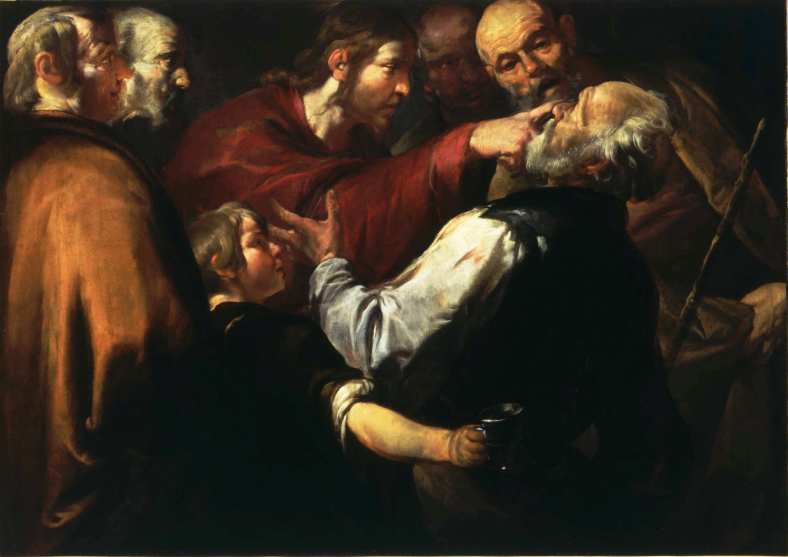
In chapter 9 of John’s gospel he records a story of Jesus healing a man who was born blind.  In John’s story, Jesus made some mud out of saliva and dirt, then put the mud on the man’s eyes.  Then Jesus tells the man to go wash off the mud in a pool.  When the man does this, his blindness is gone!

Because this man was born blind and had begged in the temple area for years, the miracle was hard to deny as a claim that Jesus was the Messiah, but many of the people put their focus on the wrong question: the how of the miracle.  Four times in the chapter someone asks how the man’s eyes were healed, as if the method of the healing was the important part.  Some of “The neighbors and those who had seen him before” asked “how were your eyes opened?[1]  Then some Pharisees asked the man how he was healed.  In both cases, the man formerly blind explained what Jesus had done.

Then, because Jesus had healed the man on the Sabbath and because practicing medicine on the Sabbath was against traditional Jewish regulations, the Pharisees asked, “How can a man who is a sinner do such signs?[2]  The Pharisees kept looking for an explanation.  A scientific or natural explanation.  Perhaps this wasn’t the same man who was born blind.  So they found his parents, “and asked them, ‘Is this your son, who you say was born blind? How then does he now see?’[3]

The better question is who healed the man born blind, but the Pharisees didn’t want to deal with that question.  They had already made up their minds that Jesus wasn’t from God.  So, they focused on the how, on the method.  People still do this today, as Warren Wiersbe wrote: “We want to understand the mechanics of a miracle instead of simply trusting the Savior, who alone can perform the miracle.”[4]

Modern people want scientific explanations because they think nothing exists outside of scientific understanding and when something doesn’t fit that worldview it is denied or explained away.  We want to fit miracles within our pre-existing understanding of the world.  And when we can’t, we resist any way we can.  In the case of the Pharisees and Jesus, “they cast him out.”[5]  Anything to avoid the real question: who is this person who can do things that don’t fit into our narrow view of the universe?  Comparing John’s gospel to modern events, we see this is nothing new.

However, if Jesus is who He said He was – God the Son – no miracle should be unbelievable because God has absolute control over His own creation.  If Jesus is God, He exists outside of our universe and so obviously can’t be explained by using scientific laws that describe this universe.  But we continue to resist.  When people want to avoid dealing with their God, they still stick to the “how” question to avoid the more important question of “who.”

If you’re struggling to understand the miraculous stories of the Bible, make sure you’re asking the right (“who”) questions.  If you’re talking to an unbeliever having the same struggles, make sure they’re asking the right questions, because: If Jesus is who God is, every how is possible, including the greatest miracle: the salvation of anyone who would believe in Him.  And, Jesus can heal anyone who is blind to this reality.


[1] John 9:8-10
[2] John 9:16
[3] John 9:19
[4] Wiersbe, Warren.  Be Alive (John 1-12) (1986).  P. 143
[5] John 9:34

Godly Habits for Leaders and Others

All the people benefit from leaders and rulers who fear God.  In Deuteronomy, when God reluctantly says Israel may set a king over them in the future[1], He also required the king to have specific habits to cultivate a fear of God in them:

And when he sits on the throne of his kingdom, he shall write for himself in a book a copy of this law, approved by the Levitical priests.  And it shall be with him, and he shall read in it all the days of his life, that he may learn to fear the LORD his God by keeping all the words of this law and these statutes, and doing them, that his heart may not be lifted up above his brothers, and that he may not turn aside from the commandment, either to the right hand or to the left, so that he may continue long in his kingdom, he and his children, in Israel.”  (Deuteronomy 17:18-20, emphasis mine)

These requirements have several parts.  First, the king was to “write for himself in a book a copy of this law.”  “This law” refers to what we now think of as the first five books of the Bible – all 187 chapters of it.  Imagine the time that would take, but this tedious exercise was designed to help the king internalize the message.  Quickly skimming over the Bible would not do.

Second, the king had to get this copy “approved by the Levitical priests,” to make sure nothing was added or left out, but also to remind the king that His authority is subject to God’s authority, as intermediated by the priests at that time.  Regardless of what laws the king might pass, God’s laws would always reign supreme and eternal.

Third, the king was to “read in it all the days of his life,” because it takes time and effort to dig the treasures of wisdom out of the Bible.  However, it is worth the effort because Psalm 19:10 tells us these truths are:

More to be desired are they than gold,
                        even much fine gold;
sweeter also than honey
                        and drippings of the honeycomb.

Also, the king would be surrounded by reminders of his worldly greatness every day, so constant meditation on the law would show him his reliance on God.  The king needs a constant reminder that he is under God, whose law applies to everyone.

These habits exist “that he may learn to fear the LORD,” which leads to “doing” the law.  Even the king is expected to do what God commands, not just tell others to.  With “doing” as the objective, the king will remain humble and learn the fear of God, because we may be able to know God’s word, but doing it is the real challenge and we can only succeed by His grace.

These habits also exist to make sure the king does not err “either to the right hand or to the left.”  This encouragement is later echoed in Moses’ words in Joshua 1:7-8, but what does it mean?  I think it means that without constant saturation in God’s word, we can fall into a trap of not following God’s positive will, but instead defining ourselves by what we’re against.  In trying to avoid one sin, we drift too far in the opposite direction and into another, equally destructive, sin.  Instead, positive obedience coming from the fear of God should be better than fine gold and “sweeter also than honey.”  Truth is often subtle and not as black-and-white as we’d like it to be.

Most of us aren’t kings, but we can apply the passage from Deuteronomy in our prayers.  1 Timothy 2:1-2 “First of all, then, I urge that supplications, prayers, intercessions, and thanksgivings be made for all people, for kings and all who are in high positions, that we may lead a peaceful and quiet life, godly and dignified in every way.”  But what shall we pray for them?  As Deuteronomy suggests, we should pray that they know God, fear God, and obey God, that they may be humble, and we may prosper.

Also, are you a leader?  Do you serve in a position of authority at your church, workplace, or other organization?  These habits will benefit you and those you serve anywhere.  (In societies where we can easily get a Bible, we don’t need to create our own copies of it, but we should seek to internalize as much of the Bible as possible, through memorization and other means.)  As Solomon wrote in Psalm 127:1 –

Unless the LORD builds the house,
            those who build it labor in vain.
Unless the LORD watches over the city,
            the watchman stays awake in vain.

If you’re not a leader, these habits are beneficial for you as well, as Psalm 128:1 says:

Blessed is everyone who fears the LORD,
                        who walks in his ways!

Amen.


[1] Deuteronomy 17:14-15

Perils of Politics: A Quint of Quotes

Fellow travelers,

Here is another “Quint of Quotes” from my collection.  Five quotes somewhat related to each other, but not exactly in agreement.  The book Faithful Presence by Bill Haslam opens by describing how polarized and angry America has become. In this environment, he asks the question: “do [Christians] just give up on the public square as a place to solve problems?”  These quotes aren’t an answer to that question, but I hope you find them interesting and thought-provoking.  Enjoy!

“Just because you do not take an interest in politics doesn’t mean politics won’t take an interest in you.” – Pericles, Greek statesman

“Only those will permit their patriotism to falsify history whose patriotism depends on history…A man who loves France for being military will palliate the army of 1870. But a man who loves France for being France will improve the army of 1870…The more transcendental is your patriotism, the more practical are your politics.” – G.K. Chesterton

“The less prudence with which others conduct their affairs, the greater the prudence with which we should conduct our own affairs” – Warren Buffett

The opening of the U.S. Constitution. Public Domain.

“I once carried on a brief correspondence with a man who objected to my interpretation of Romans 13. He said that all government was of the Devil and that Christians must not bow to the authority of ‘the powers that be.’ I pointed out to him that even his use of the United States mail service was an acceptance of governmental authority. The money he spent buying the paper and stamps also came from the ‘powers that be.’ For that matter, the very freedom he had to express himself was a right guaranteed by—the government!” – Warren Wiersbe

“When we are wrong, make us willing to change. And when we are right, make us easy to live with.” – Peter Marshal

Church is Not a Shopping Mall

I recently had a very strange dream, which occurred (kind of) in the church I went to as a kid.  This church, in Washington, D.C., has been around for over 130 years and meets in a stone building and has an amazing pipe organ in the main sanctuary.  The appearance and structure of the church communicates permanence and tradition.

In this dream, I was roughly a teenager on one end of the church building but had to meet up with my family at the other end of the building.  I started out in a place that seemed like the church I knew, but as I travelled to the other end, things got really bizarre.  First, the size of the building seemed to keep expanding and the number of people in it kept multiplying.  Soon I noticed that there was a gift shop selling all sorts of kitsch that had nothing to do with religion.  I kept going in the same direction, trying to find my family, but the building just kept growing as I went, eventually having many levels, with huge moving walkways and escalators.  The dream ended with me still in the church, but this end of it had become a very upscale, very massive, shopping mall.  I remember wondering “how did the church turn into this?”

What to make of this?  Consider what a shopping mall is.  Yes, it’s a large collection of stores in one place, but not a random collection.  Those stores were chosen to be as diverse as possible.  The more of our desires and wants the mall can meet by having different types of stores, the more economically successful the mall will be, and that’s what matters to the mall operator.  People want fancy clothes, jewelry, entertainment, snacks and candy, toys, and many other things.  So, a mall can represent our “do whatever you want” culture.

I wonder if the seed of the dream was something I saw on Twitter a few days before: “There are infinite ways to be non-binary.”  What they were saying is that not only are there not just two genders, but that we can endlessly create new ones with no limit at all.  It’s like a sexual version of the shopping mall, and also a denial that there’s any real right or wrong or that there’s any such thing as an inappropriate desire.  But can we really make ourselves into anything we want to be without consequences?

Consider this: no competent computer engineer would tell us that we can just arrange a diverse group of components any way we want and end up with a working computer.  The engineer isn’t being intolerant or mean, they just know what it takes to make a computer do what it’s supposed to.

Likewise, when Jesus says “Enter by the narrow gate. For the gate is wide and the way is easy that leads to destruction, and those who enter by it are many. For the gate is narrow and the way is hard that leads to life, and those who find it are few,”[1] He is not being intolerant or mean by saying we can’t do whatever we want to, He just knows that we were designed, what we were designed to do, and also what will ultimately satisfy us.

Christian churches are supposed to teach us how to follow Christ, not tell us to do whatever we want to, but now many churches, just like in my dream, have turned into proverbial shopping malls.  In many cases, we’ve forgotten that people are not accidents of random circumstances in nature, and we’ve forgotten that our Creator knows what’s best for us.  We’ve decided to pursue “the way that is easy” forgetting that it “leads to destruction.”  Too many churches, now including the one I went to in DC, say that Jesus will meet whatever needs we think we have, rather than saying that Jesus knows what we need better than we do; that it’s our idea of need that must be changed.

It’s our idea of need
that must be changed

When Jesus said, “For God so loved the world, that he gave his only Son, that whoever believes in him should not perish but have eternal life,” the “world” He loves is the one where we’ve come up with infinite ways to reject Him.  Where we’ve come up with infinite ways to deny that He made us and knows better than us what’s right and wrong, what “leads to life” and what “leads to destruction.”

When God gave His Son, His sacrifice was sufficient for all sin and can cover all the infinite ways we decide to ignore what’s good for us.  Because God loved this world, it’s also true that His people should communicate His love and grace at all times to all people, by word and action.  Yet it’s also true that church is not a shopping mall regardless of what people can imagine in their dreams that it should be.  The church is called to a higher standard of living, a holy standard informed by our Creator’s knowledge of what works.

So, in these troubling times, pray that people will continue to find Jesus, both within and outside the church and what much of it has become.  That God’s people will love holiness, but also love sinners.  Pray that we find the way that is hard but leads to life and that God’s church is a beacon calling people to it.

Amen.


[1] Matthew 7:13-14

Pictures of Holiness and Grace

A picture can be, as they say, worth a thousand words.  To make an impression, sometimes God uses pictures or images, and one example is how He lets us know just how holy He is.

When calling Isaiah to be a prophet, God gave him an image in Isaiah 6:1 “In the year that King Uzziah died I saw the Lord sitting upon a throne, high and lifted up; and the train of his robe filled the temple.”  In this vision of a throne room, why bother to mention that “the train of his robe filled the temple”?  Because in this image of God’s presence, there is no room for anything that isn’t holy.  If anyone tries to walk into the temple, they will tread on the Lord’s robe with their dirty feet, and any lord would be immensely offended at that.  James Boice commented on the verse, that: “This suggests that there is room for no one else at the highest pinnacle of the universe.  It is not just that Jehovah reigns, therefore, but also that no one else reigns beside Him or in opposition to Him”[1]

Photo by Wonderlane on Unsplash

A similar picture of holiness comes from Revelation 15:8, which says: “and the sanctuary was filled with smoke from the glory of God and from his power, and no one could enter the sanctuary until the seven plagues of the seven angels were finished.”  Until God’s judgment was complete – both on the unrepentant and on the cross for His people – there would continue to be no room in the sanctuary for anyone but the Lord.

A third picture, which was not just a vision, but built in actual, physical form, is the “Holy of Holies.”  During most of the Old Testament period, priests implemented an elaborate sacrificial system to illustrate God’s requirements for meeting with sinners: an innocent creature had to die.  These animals symbolized the later sacrifice of Jesus Christ.  But the “Holy of Holies” was the ultimate statement of how serious approaching God is.

This innermost room of the temple was only entered once per year (on the Day of Atonement, or Yom Kippur), and only by the high priest, who only can enter after hours of preparation.  Once there, the high priest would sprinkle the blood of a sacrificed bull on and in front of God’s “mercy seat”, the cover of the ark of the covenant and a sign of His presence.  Later Jewish tradition (not found in the Bible) indicates that others would stand outside the room holding a rope that was tied to the high priest, who also had bells tied around his waist.  If those outside heard the bells jingling, followed by silence, they would assume the high priest did not atone properly for the sins of the people, died in God’s presence, and needed to be dragged out by the rope.  God’s holy presence was to be taken seriously.

So Isaiah, presented with God’s holiness, cried out “Woe is me! For I am lost; for I am a man of unclean lips, and I dwell in the midst of a people of unclean lips; for my eyes have seen the King, the LORD of hosts!”  Isaiah’s “Woe” comes down to current times in the expression “Oy!”  Isaiah knew instinctually that being in God’s temple was a bad idea.  However, God provides redemption for His people, which He pictured for Isaiah like this: “Then one of the seraphim flew to me, having in his hand a burning coal that he had taken with tongs from the altar.  And he touched my mouth and said: “Behold, this has touched your lips; your guilt is taken away, and your sin atoned for.”[2]

Isaiah was not saved by a burning coal, but by what it represented: the future sacrifice of Jesus Christ.  In God’s steadfast love for His people, He offered Jesus once for all, and the only sacrifice necessary and sufficient for us to know God.  Therefore, there is no longer a barrier to His holy presence for God’s people, so the writer of Hebrews says, “Let us then with confidence draw near to the throne of grace, that we may receive mercy and find grace to help in time of need.”[3]

Yes, God is holy and must be honored as holy, but when we feel insufficient or feel like yelling “oy!” when things go wrong, we can come “with confidence” to Jesus in His temple and ask Him to reassure us of His provision for our sin.  That we may know, like Isaiah, that “your guilt is taken away, and your sin atoned for.”

Amen


[1] From “May 9.” James Montgomery Boice and Marion Clark. Come to the Waters: Daily Bible Devotions for Spiritual Refreshment.  (2017).
[2] Isaiah 6:6-7
[3] Hebrews 4:16