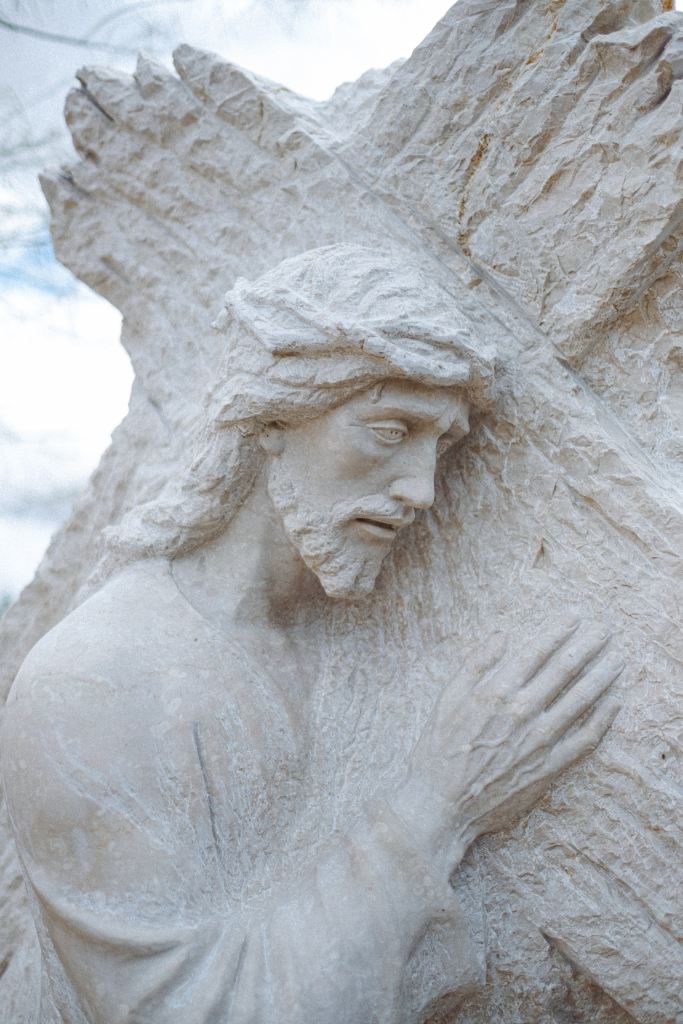
Sacrificed for You

The Old Testament book of Leviticus is probably the hardest book in the Bible for many to read.  Much of it outlines, in detail, the duties of priests and Levites (the book’s name comes from this group) in worship, including the sacrificial system involving animals practiced in ancient times.  However, there are many pictures of Christ embedded in these stories and rituals, one being the requirement that each individual lay their hands on any bull offered for their sin.

This is first described in Leviticus 1:3-5a – “If his offering is a burnt offering from the herd, he shall offer a male without blemish. He shall bring it to the entrance of the tent of meeting, that he may be accepted before the LORD. He shall lay his hand on the head of the burnt offering, and it shall be accepted for him to make atonement for him.  Then he shall kill the bull before the LORD” (emphasis mine)

Why is it so important that each person lay their hand on their sacrifice?  I think there are at least 3 reasons:

First, the sacrifice is for each of us specifically and individually.  Atonement is not a blanket covering everyone with no distinction – it focuses on each individual.  God does not have a limited attention span, where time spent with one person takes away from time spent with another. He can, and does, focus on us all.  Since He desires relationship with each person, He wants us to be aware of the need for sacrifice at individual level, as well as the connection created at an individual level.

Second, the sacrifice shows us the severity of our sin.  Before a just God, no sin can go unpunished, or He would commit injustice.  Only blood can atone for sin, and having each person make a personal connection with their sacrifice highlights the seriousness of our own sin, discouraging us from thinking other people’s sin is more serious than our own.  Even the priests, as shown in Leviticus 8:14, had to lay their hands on their own sacrifice, showing even those who might be considered, or consider themselves, more spiritual are not exempt.

Third, nobody else can worship for us since the purpose of worship is to have a personal relationship with our Lord and Maker.  It is the sacrifice that restores our relationship to God, not the priest that intermediates the sacrifice, which is highlighted by the fact that Jesus became both the sacrifice and the High Priest.  Just as I can’t have a real relationship with someone only by hearing about them through someone else, I can’t have a real relationship with God through someone else’s worship.  The faith of people you know – parents, friends, teachers, pastors – will do you no good.  Each must have his own faith because what He wants is us.

Photo by Cdoncel on Unsplash

In Leviticus we find a picture of Jesus, who lived a perfect life for us, not so that we don’t have to be perfect, but so that we can become perfect.  He died for each of us, specifically, and needed to die because no other sacrifice could cover the severity of our sins before a just God.  Through His sacrifice, we are adopted as members of His family, to live perfectly in Paradise for eternity.

Jesus lamented of the religious people of his day in Matthew 23:37 – “O Jerusalem, Jerusalem, the city that kills the prophets and stones those who are sent to it! How often would I have gathered your children together as a hen gathers her brood under her wings, and you were not willing!”  When He offered relationship, they insisted on religion, and missed being touched by their Maker’s hands.

One More Picture
Much more recently than Leviticus was written, a similar point was made by Mel Gibson in his movie The Passion of the Christ[1].  During the scene where Jesus is being crucified, Gibson decided to film his own hands driving the spike into Christ’s hand.  It is the only time Gibson appears in the film.  The film’s website (since removed) said this was “symbolic of the fact that he holds himself accountable first and foremost for Christ’s death.”  Gibson, in Leviticus terms, chose to “lay his hand on the head of the burnt offering.”

Yes, Jesus suffered terribly for the sin of each of us, but He willingly did it because it was needed to gather His people to Himself.  “Lay your hand” on His sacrifice and thank Him that He wants to know you personally.

Amen.


[1] Gibson, Mel.  The Passion of the Christ.  (2004)
Bible in a Year: Week of April 1 – 7

Fellow travelers:

Happy Easter!  He is risen!

Below are the chapters to read this week if you’re following along in my Bible in a year schedule, divided into morning and evening readings.  Follow along any way you want: just do the evening reading, flip the morning and evening, read it all.  Whatever works for you and your schedule!  It doesn’t have to be Bible in a Year for everyone.

Monday, April 1
Morning: Psalm 92, 1 Chronicles 16
Evening: Leviticus 2

Tuesday, April 2
Morning: Psalm 93, 1 Chronicles 17
Evening: Leviticus 3

Wednesday, April 3
Morning: Psalm 94, 1 Chronicles 18
Evening: Leviticus 4

Thursday, April 4
Morning: Psalm 95, 1 Chronicles 19
Evening: Leviticus 5

Friday, April 5
Morning: Psalm 96, 1 Chronicles 20
Evening: Leviticus 6

Saturday, April 6
Morning: Psalm 97, 1 Chronicles 21-22
Evening: Leviticus 7

Sunday, April 7
Morning: Psalm 98, 1 Chronicles 23-24
Evening: Leviticus 8

Only Resurrection Will Satisfy

Dear fellow travelers,

When the apostle Paul wrote in 1 Corinthians 10:11-12 – “Now these things happened to them as an example, but they were written down for our instruction, on whom the end of the ages has come.  Therefore let anyone who thinks that he stands take heed lest he fall” – he was referring to the story of Israel’s 40 years of wandering in the wilderness between Egypt and the Promised Land.  In verse 5, Paul wrote “with most of them God was not pleased, for they were overthrown in the wilderness.”  Paul assures us that “these things” help keep us from temptation and strengthen our faith in these last days.

But what are these lessons?  One of them can be found in the only Psalm written by Moses – Psalm 90.  A key verse in that Psalm is verse 12, which says:

“So teach us to number our days
            that we may get a heart of wisdom.”

And what is wisdom?  One way I describe it is: the ability to choose paths that lead to life, over paths that lead to death, paths that Moses unfortunately was very, very familiar with.  He may have understood the consequences of neglecting God in our daily lives better than anyone for three reasons.

First, in recording the events of Genesis, Moses knew that ever since Adam and Eve, mankind has been facing, and mourning, the consequences of sin.  The repetition of “and he died” in the genealogy of Genesis 5 and elsewhere reminded Moses of the result of missing the mark of God’s righteousness.  Centuries before Paul, Moses knew that “sin came into the world through one man, and death through sin, and so death spread to all men because all sinned.”[1]

Second, Moses also saw the consequences of sin very clearly in the shortening of lifespans.  In Psalm 90:10, he wrote:

“The years of our life are seventy,
            or even by reason of strength eighty;
yet their span is but toil and trouble;
            they are soon gone, and we fly away.”

This same Moses wrote about early patriarchs who were said to live hundreds of years[2], but by Moses’ day 80 years was considered a long life.

And also, Moses is known as author of the book of Numbers, which as the 4th book in the Pentateuch, lines up with Psalm 90, the first Psalm in book 4 of the Psalms.  Numbers tells of the consequences of Israel’s disobedience and grumbling on their journey to the Promised Land, and why it took 40 years and the entire generation that left Egypt (except Joshua and Caleb) died.  Psalm 90 is almost a summary of what Moses learned from that experience:

“So teach us to number our days
            that we may get a heart of wisdom.”

Photo by Kelly Sikkema on Unsplash

What does this have to do with the resurrection?  Psalm 90 starts with these 2 verses:

“Lord, you have been our dwelling place
            in all generations.
 Before the mountains were brought forth,
            or ever you had formed the earth and the world,
            from everlasting to everlasting you are God.”

Moses, who led Israel out of Egypt, through the wilderness for decades, and to the threshold of the Promised Land, says the only dwelling place of God’s people is not a specific place, but it is the Lord Himself.  When we are with Him, we are home.

Moses concluded Psalm 90 with verses 16 and 17:

“Let your work be shown to your servants,
            and your glorious power to their children.
Let the favor of the Lord our God be upon us,
            and establish the work of our hands upon us;
            yes, establish the work of our hands!”

While Moses’ understanding of a resurrection and an afterlife was likely very minimal and vague, he was able to conclude that the best way to spend our short lives here is to do work that matters in eternity, which God has laid out for us to do[3].  We should let Him “establish the work of our hands.”  All through the Pentateuch, Moses recorded the choices between life and death made by Israel, and one of his conclusions is: life is short; live for God!

However, a life truly dedicated to God only makes sense if there is a life to come.  Only resurrection will satisfy because Paul wrote: “If in Christ we have hope in this life only, we are of all people most to be pitied.”[4]  However, since there was an Easter resurrection and there is a resurrection to come, we may look forward to our Promised Land of a new heaven and a new earth.  Moses knew our only other option is a long, purposeless meandering on this earth ending in death.

Therefore, let us pray as Moses wrote in Psalm 90:14 –

“Satisfy us in the morning with your steadfast love,
            that we may rejoice and be glad all our days.”

May we – in wisdom – choose the paths that lead to life everlasting! Amen.


[1] Romans 5:12
[2] Genesis 5:27 and 9:29, for example
[3] Ephesians 2:10
[4] 1 Corinthians 15:19

Suffering of the Beloved

Many Psalms contemplate the reality of evil and suffering in the world, but in most cases, those Psalms end on a note of hope.  For example, Psalm 73 details the Asaph’s envy of the success and prosperity of the wicked in this world.  He considered following their path, and verse 2 says “But as for me, my feet had almost stumbled, my steps had nearly slipped.”  But by verse 28, the last verse of the Psalm, the writer is hopeful and returning to praise for God in faith:

“But for me it is good to be near God;
            I have made the Lord GOD my refuge,
            that I may tell of all your works.”

In contrast, Psalm 88 begins like this:
“O LORD, God of my salvation,
            I cry out day and night before you.”

And ends like this (verse 18):
“You have caused my beloved and my friend to shun me;
            my companions have become darkness.”

This is perhaps the low point of the Psalms, or even the whole Bible, ending with neither hope or praise, but only faith expressed in desperate prayer.  The Psalmist, Heman[1] the Ezrahite according to the introduction, describes himself like this: “For my soul is full of troubles, and my life draws near to Sheol” (verse 3).  And like this: “Afflicted and close to death from my youth up” (verse 15).  After writing that his companions have shunned him, he says that “my eye grows dim through sorrow,” which I take to mean that his sorrow is so great it is clouding his perception of everything.  Sorrow is all he can see.  Heman feels he is near death, perhaps because of sickness or depression, or maybe because society has rejected him, and he feels left for dead (verse 8).

Such despair isn’t as uncommon as we might think in the face of trouble.  The apostle Peter needed to encourage his first-century audience with these words in 1 Peter 4:12: “Beloved, do not be surprised at the fiery trial when it comes upon you to test you, as though something strange were happening to you.”  Note that to Peter, suffering is not “strange” for a Christian, nor should we “be surprised” by it.  Peter’s comment was immediately referring to persecution, but the same idea applies more broadly.  Suffering is part of life in this world – for anyone.

But also notice the first word in the verse: “Beloved.”

Peter begins his statement about suffering with this so that those experiencing suffering do not think that God does not love them.  Our circumstances don’t, and can never, mean that we are not loved by God.  For us in modern times, we might be “surprised” by trials if we live in places friendly and welcoming to Christian culture.  Those who live in places hostile to Christianity may not be as surprised at trials that come, but need reassurance that they are loved.  In these places, that trials are not “strange,” but common, could bring people to a place without hope.

Photo by Wesley Tingey on Unsplash

However, when we are feeling like Heman, God still loves us, and like Heman we can pour out all our frustration to God.  He can take it.  Even when we are in “the valley of the shadow of death,”[2] He remains with us and will sustain us.  When it seems we have nothing else, He will be there and listen.

Consider whether the Father did not love the Son when He suffered, or whether His suffering was proof that He loves us?   Therefore, Peter goes even farther in 1 Peter 4:13-14 – “But rejoice insofar as you share Christ’s sufferings, that you may also rejoice and be glad when his glory is revealed. If you are insulted for the name of Christ, you are blessed, because the Spirit of glory and of God rests upon you.”

Good Friday was not the end of Jesus’ story, and although the day had three hours of darkness, the Son rose again and there was light!  Likewise, Psalm 88 was not the end of the Psalms; the last Psalm (150), begins like this:

“Praise the LORD!
Praise God in his sanctuary;
            praise him in his mighty heavens!”

And ends like this:
“Let everything that has breath praise the LORD!
            Praise the LORD!”

He is risen and you are Beloved.  Amen.


[1] Not He-Man, one of the fictional Masters of the Universe.
[2] Psalm 23:4

Serving Other Gods

Foundational to God’s relationship with His people – His covenant – is the idea that He will be our God and we will be His people.  If we forsake all other “gods,” we will be blessed immeasurably by the true God, Yahweh.

However, in the time of the Old Testament prophet Jeremiah, right before the exile of Judah into Babylon, God’s people were not being faithful to Yahweh and were worse than prior generations in their rebellion.  So, Jeremiah says in chapter 16, verse 13 – “Therefore I will hurl you out of this land into a land that neither you nor your fathers have known, and there you shall serve other gods day and night, for I will show you no favor.”

This punishment has 2 parts: banishment from the Promised Land, and also “you shall serve other gods day and night.”  Have you ever thought that serving gods other than Yahweh is a punishment, or just that its bad or sinful?   It certainly isn’t the way the world sees it: many consider serving any god as punishment.  Others might have their own gods and would only consider serving other gods, including Yahweh, as punishment.  But here the Bible says that it is only punishment to follow false gods.

Why is this?  A good explanation comes from another prophet, Zechariah, in chapter 10, verse 2:

“For the household gods utter nonsense,
            and the diviners see lies;
they tell false dreams
            and give empty consolation.
Therefore the people wander like sheep;
            they are afflicted for lack of a shepherd.”

Compared to a loving, omniscient, wise God, these other gods have no knowledge or wisdom and are not benevolent.  They cannot give us what we need to live and are not worthy of worship.  They cannot guide us like our Good Shepherd can.  Therefore, when we choose to follow anything other than Yahweh, are we punishing ourselves?

When Yahweh said “You shall have no other gods before me” in Exodus 20:3, He said it for our own benefit, and for His glory.

Amen.