How to Avoid Being the “Greater Fool”

My day job involves helping people save and invest for retirement, and every now and then it involves helping people avoid speculation.  What’s the difference between investment and speculation?  A short explanation is that speculation often means you’re trusting the “Greater fool theory” to make money.  According to Investopedia[1], “The greater fool theory states that you can make money from buying overvalued securities [stocks, bonds, currency, etc.] because there will usually be someone (i.e., a greater fool) who is willing to pay an even higher price.”  Another way to put it is that speculators buy things because they think someone else will later find them more valuable, whether they actually are or not.  Speculators seek to sell before others figure out that what they’re selling might be worthless.  Instead of trusting this, investors do some work to find out what something is worth and why it would be worth more later to someone else.

In an earlier post about saving for retirement, I noted that “Solomon did encourage us to invest for the future” but also “not to stress too much about what may or may not happen.”  So, this post is not about how to best invest for goals like college or retirement, but about how do we avoid ultimately being the greater fool?  The longer you extend the time frame – even beyond death and into eternity – any investment or speculation in this world looks very different.  In the words of Jim Elliot, an American missionary martyred in Ecuador: “He is no fool who gives what he cannot keep to gain that which he cannot lose.”[2]  In eternity, much of what we now consider investment will look like foolish speculation.

Consider this excerpt from Ecclesiastes 2:18-21.  “I hated all my toil in which I toil under the sun, seeing that I must leave it to the man who will come after me, and who knows whether he will be wise or a fool?…sometimes a person who has toiled with wisdom and knowledge and skill must leave everything to be enjoyed by someone who did not toil for it. This also is vanity and a great evil.”

Solomon is cautioning against counting on things we can’t control, such as what will be done with our worldly goods after we’re gone.  If we agonize over accumulating goods, not only are we not satisfied, but do we also teach the next generation to overvalue things, rather than their Creator, thus making our efforts futile and foolish?  Even if our goods outlive us, can we hope that they help those who receive them more than they helped us?  Or is this just speculation?

As an alternative, Solomon says in 2:24: “There is nothing better for a person than that he should eat and drink and find enjoyment in his toil. This also, I saw, is from the hand of God, for apart from him who can eat or who can have enjoyment?”

Solomon argued that we can’t trust in goods to help our descendants – but what about the question of whether our goods will do us any good in eternity?  Can we trust goods to help us after we’re gone?  Jesus had this in mind in Mark 8:36, when He said: “For whoever would save his life will lose it, but whoever loses his life for my sake and the gospel’s will save it.  For what does it profit a man to gain the whole world and forfeit his soul?  For what can a man give in return for his soul?”

Jesus’ question is rhetorical, because we cannot offer any goods to God which are not already His: “The earth is the LORD’s and the fullness thereof, the world and those who dwell therein.”[3] Also, nobody else can pay the cost of our soul either, because they owe their own.

Jesus, the Greater Fool
If our souls are eternal, but we’ve spoiled them by speculating on the goods of this world, who is the greater fool who will pay for them?

Fortunately, the only One who can pay the cost of our souls is also the one who values them the most – even more than we do.  This One was willing to become a fool to the world to purchase the souls of His people.  This One has a soul that was not wasted on the things of this world; therefore, He can offer it for others if He chooses to.

Fortunately, this One is also the One who values every soul the most because as Creator, He loves His people.  An old proverb says, “a thing is worth only what someone else will pay for it.”  On the cross, this One paid His own life for you, because to Him you are worth it and His own life was the price He was willing to pay.

Jesus is this One and in eternity, the only way to avoid the “greater fool theory” is to give our lives to Him and follow His advice to love Him and love our neighbor.  Then we will always have everything we need, and we will never lose it.  Even after death and into eternity.

“Do not lay up for yourselves treasures on earth, where moth and rust destroy and where thieves break in and steal, but lay up for yourselves treasures in heaven, where neither moth nor rust destroys and where thieves do not break in and steal.  For where your treasure is, there your heart will be also.” – Jesus, in Matthew 6:19-21


[1] https://www.investopedia.com/terms/g/greaterfooltheory.asp
[2] More on Jim Elliot likely coming in a future History Bits post.
[3] Psalm 24:1
The Joy, Unity, and Peace to Come – Psalms of Ascent #6

Finally, we return to a series on the Psalms of Ascent (Psalms 120-134), used as a liturgy for ancient Israelites travelling to Jerusalem for annual worship festivals.  Today’s post focuses on Psalm 122, where David writes of the joy found in the destination – the house of the LORD in Jerusalem.  When first written, this house would be the tabernacle, since the temple was built under David’s son Solomon, but when the Psalm was organized into its present order, this house would be the temple.  After the pilgrims look up from their circumstances in Psalm 121 to find their help in the LORD, in Psalm 122 they reflect on what they will find at the end of their journey.

This short, 9-verse Psalm has three sections: an expectation of joy, a path to unity, and a prayer for peace.  I’ll summarize each as we go.

First, expectant joy.  Verses 1 and 2 of the Psalm say:
“I was glad when they said to me,
            ‘Let us go to the house of the LORD!’
Our feet have been standing
            within your gates, O Jerusalem!”

David was glad to attend corporate worship, and this joy would be an encouragement to other when worship required a lot of travel, large crowds, and disruption of daily routines.  In the following sections, David explains where his joy comes from: that worshipping with others reminds him of what only God can truly provide: Unity and Peace.  David doesn’t expect everyone arriving in Jerusalem to get along and have a perfect experience, but it doesn’t ruin his joy because God promised these things to those who worship Him.  While perfect is unattainable in this imperfect world, corporate worship acknowledges that this world is not all there is, and that God’s people will worship perfectly in eternity.

Second, a path to unity.  In verses 3 to 5 David writes:
“Jerusalem—built as a city
            that is bound firmly together,
to which the tribes go up,
            the tribes of the LORD,
as was decreed for Israel,
            to give thanks to the name of the LORD.
There thrones for judgment were set,
            the thrones of the house of David.”

Corporate worship is a physical, visible reminder of our membership in a tribe that is not of this world.  From all the tribes of the world, God calls His people and promises to make a perfect unity out of vast diversity.  However, unity only exists when differences are resolved through either forgiveness or judgment.  Worship should remind us that every injustice ever committed will be judged.  Every offense to God’s laws of love will be paid for by either the sinner, or by Christ on the cross, and we can be thankful for both.  We do not experience perfect unity or justice yet, but we know that the price has been paid for God’s people to be perfectly unified in eternity.  Jesus ultimately sits on the throne David established; therefore Jesus’ authority in mercy and in judgment provides a hopeful expectation that overcomes the current, inevitable conflict that exists among God’s people, and between God’s people and the world.  He remains “glad when they said to me, ‘Let us go to the house of the LORD!’”

Lastly, peace.  The final verses of the Psalm say:
“Pray for the peace of Jerusalem!
            “May they be secure who love you!
Peace be within your walls
            and security within your towers!”
For my brothers and companions’ sake
            I will say, “Peace be within you!”
For the sake of the house of the LORD our God,
            I will seek your good.”

The Holman Bible Commentary notes that these prayers for peace are “a reference to divine protection from hostile nations. They needed an indivisible unity and impregnable safety that can come only from God. Where God finds unity, he commands his blessing there.”  While Christians do not take pilgrimages to Jerusalem, in Matthew 18:20 Jesus says, “For where two or three are gathered in my name, there am I among them.”  God does not promise absence of trial and persecution to His people, but He asks that in worship we do all we can to promote joy and unity within His church, wherever His people congregate.  Peace can, and should, exist within the church even if peace is absent outside the church, since God’s peace is not dependent on circumstance.

David found joy in expectation of worshiping with God’s people, based on God’s promises.  This week, pray for joy, unity and peace as God’s people gather locally, but also globally.  While we remain yet unperfected by His grace, we hold fast to His promises and to His call to ascend to His sanctuary for worship.

Amen.

This post continues a series on the Psalms of Ascent. To start at the beginning, click here, and for the next post click here.

Rewind Wednesday is Also Blessed are the Meek #6!

This Rewind Wednesday not only revisits an old post about a cornerstone, but also provides a capstone for the series on “Blessed are the meek, for they shall inherit the earth,” the third Beatitude from Jesus’ Sermon on the Mount in Matthew 5.  “Creation vs. Anti-Creation” was first posted on May 28, 2021, as the second-ever post to this blog.  In it was an as-brief-as-possible history of creative forces working with and against God in this world but culminating when “All God’s people will inherit a perfect heaven and earth” where “All creative forces will be aligned to achieve perfection.”

The Beatitudes tell us the meek are blessed, but also why they are blessed: because God will give them the earth as an inheritance.  Not this stinky one, but a perfected one.  Heaven will be full of people made like Christ, who perfectly follow His law of self-sacrificial love.  Both creation and character will be made whole.  However, if we don’t agree on His definition of “perfect” then neither will we humble ourselves and be meek, nor will we inherit the earth.

Even if our early efforts at following Christ are imperfect, without those early efforts the later efforts may never happen.  What can you build on the cornerstone of Christ?

Read “Creation vs. Anti-Creation” at the link below! (Estimated reading time 10 minutes)

Don’t Let the Stink Stop You – Blessed are the Meek #5

Since it’s been nearly 3 months since the last post on the topic, here’s a review of the series on meekness[1] so far.  The first two posts contrasted two characters from the movie The Matrix, Agent Smith and Neo, to Jesus.  Agent Smith was the “Malevolent Incarnation,” who used and enforced rules to keep people in their place.  Smith can’t stand the stink of humanity and just wants to be free of it.  Neo, the hero of the Matrix series, is the “Ambivalent Incarnation” who wants to free mankind from rules, but otherwise wants to let them be as they are.  However, under Neo’s no-rules philosophy of “everyone should do what they want,” there is no foundation from which to object to anything someone else does, including brutal oppression.  Any objection is also an objection to the same philosophy Neo claims to hold, and “no city or house divided against itself will stand.”[2]

Jesus, contrasted to these, is the “Benevolent Incarnation.”  Jesus is more aware of the problems that make Agent Smith repulsed by us and that make him want to control us, but He also does not leave us alone with no way to overcome our problems.  He rules us for our good, and because we cannot meet His perfect standard, He lived it in our place, then died to cover the cost of our failure.  He wants to fix our stink, not because He hates us as Agent Smith does, but because He loves us in spite of our stink.  He refuses to allow us to stink forever, as Neo would.  He is benevolent, not malevolent or ambivalent.

Meekness is the third step in the Beatitudes, an intentionally sequential series of statements that describe what’s involved in following God, like gears in a machine: “First, being poor in spirit means that we have emptied ourselves of all illusions that our plans are better than God’s.  Second, mourning the state of ourselves and our world means we are emotionally engaged.  That we care.  In the third Beatitude, being meek is where we begin to engage our will, submitting it to God as our benevolent Lord.”

He wants us to also be benevolent incarnations, however we often don’t want to engage the third gear of meekness, where “the rubber meets the road” so to speak.  But if we don’t embrace it “the first two Beatitudes alone can leave us in a place where we’re a mess and the world is a terrible place and there’s nothing we can do about any of it.  It can be a place of depression and despair.”

Martha almost found herself stuck in this place when Jesus returned to Bethany after the death of Lazarus, her brother.  Jesus found the family mourning, then: “Jesus said, ‘Take away the stone.’ Martha, the sister of the dead man, said to him, ‘Lord, by this time there will be an odor, for he has been dead four days.”  (John 11:39).  Jesus intended to raise Lazarus from the dead, but for Martha the stink was all she could think of.  Patently, Jesus encouraged her, the stone covering the entrance to the tomb was moved, and Lazarus walked out of the grave alive!

Don’t Let the Stink Stop You
Does the stench of sin keep us from being meek?  Do we, like Agent Smith, just want people to behave so we can go about our way?  Or does our obedience come first?  Jesus wants us to live as He lived, but we only can if we accept His righteousness and become invested in it at all levels of our being.  If we are truly poor in spirit and mourn our sin, what’s stopping us?

God won’t tell us to move the stone from Lazarus’ grave – that was Martha’s task. It also was not Jesus’ task.  We don’t do what Jesus would do, but what He would have us do.  He could have moved the stone Himself, but He wanted Martha to participate in His work, but to do that she had to be willing to be uncomfortable.

We all are often in Martha’s place, struggling with what Jesus wants us to do.  He asks us to do things that don’t make sense to us, that don’t make sense to the world, and sometimes it stinks (sometimes literally).  Jesus wants to bring His people to life, as He did with Lazarus, but there may be a stone He wants you to move, and it will only move if you have faith in Him stronger than the stink involved.

Meekness is the Cross
Meekness means carrying the cross the Father assigns to us.  For Jesus it was taking on all the sin of the world, not just by His death on a literal cross, but also by proactively taking on the consequences of it for the benefit of others.  We stink but He did not leave us alone.  For us, carrying the cross involves taking on some of the stink of the world, stepping into the suffering of others and offering the life that only Jesus can give.  What an amazing contrast this is to what’s so common today: pointing out sin everywhere and demanding those “other sinners” pay the price, or demanding that government solve the problem somehow, or withdrawing from problems that seem too big to do anything about.

Is there a stinky situation you’re aware of, but avoiding?  Being meek toward Jesus means we’re on board with His plan of salvation and willing to do our part, whatever that is.  Sometimes all that’s needed to bring someone life is moving a stone and enduring the odor.  While the smell was enough for Martha to hesitate, to Jesus it was part of the cost of living and dying for us.  He was willing to bear it, and if we meekly move the stone, Jesus will do the rest.


Post Script
Sometimes I put off writing thinking the time is better spent on the people and situations right in front of me.  Is hiding behind a screen and keyboard just an avoidance tactic?  At other times I know that each person’s meekness includes a response to their own calling and use of their specific gifts: “if service, in our serving; the one who teaches, in his teaching.” (Romans 12:7). Meekness is difficult, and I pray we all find better balance as we grow in Christ.  Do the things God calls you to, even if it stinks sometimes!


[1] If you have the time, the previous posts are here: [1], [2], [3], and [4].  But I’ll summarize here as best I can.
[2] Matthew 12:25

Finding Port for the Good Ship Ambivalent

From yesterday’s post, you’ll know I am reading King’s X: The Oral History, a book chronicling the history of the rock band King’s X, by Greg Prato.  Yesterday, I dove into one of their more bizarre and unknown songs, but today is about the band’s biggest hit.  “It’s Love” got to “#6 on Billboard’s Mainstream Rock charts and #1 on the FM Radio Airplay charts. It was our highest-ranking single, ever,”[1] according to Ty Tabor, the band’s guitarist and sometimes lead singer, who wrote the song.

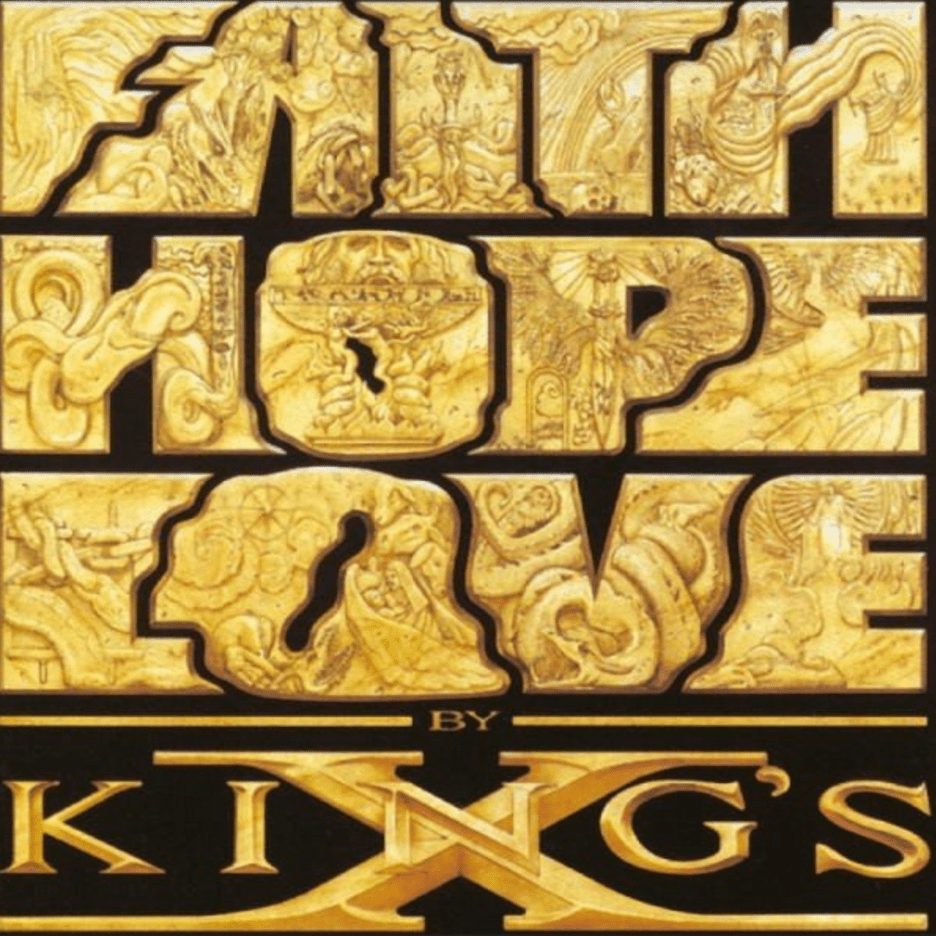
I knew both Christianity and King’s X by reputation before becoming a true fan of either, but both were growing at the same time in me during college.  Having heard of King’s X but never actually heard their music, I once saw one of their CDs in a friend’s dorm room.  My friend said it was his roommate’s but that he wasn’t much of a fan.  Before leaving I picked up the CD and looked at it.  The album, called “Faith, Hope, Love” had a cool cover, and included the song “It’s Love.”

Album cover of “Faith Hope Love” by King’s X

Later, the memory of that album cover made the triad of faith, hope, and love jump out at me whenever I saw it in the Bible, including 1 Corinthians 13:13, which says: “So now faith, hope, and love abide, these three; but the greatest of these is love.”  This triad is all over the place and there are many verses explaining the relationships between them.  Seeing these references also made me come back to the band and give them a listen. The rest, as they say, is history.

Before getting into “It’s Love”, you can find the lyrics here, or listen to the song here.  I promise it’s an easier one to listen to than “Six Broken Soldiers” and also that this post will be shorter than yesterdays.

Overall, the message is fairly simple: Ty says he doesn’t know everything, but the thing he wants to share from his experience is that love is the most important thing in life.  Love both keeps the world from falling apart (“holding back the weather”), but also eventually love is what requires a loving God to bring about a plan to fix what’s wrong with the world (“the same will let it go”).

But there’s one line in the song I didn’t really get until reading about it recently: “There’s a ship on the ocean, and I can’t decide if I like it.”

There Ty is, enjoying good company, the beach, and the ocean, but he wasn’t sure about the ship on the ocean.  There’s an ambivalence about the ship, and a suggestion that maybe it’s an exception to the overall message of “love,” but I couldn’t figure out more than that.  I wasn’t alone in not getting it.

In the book, Ty says his brother didn’t understand the line, so he explained: “my point was, man’s progress is wonderful and everything, but when the ship turns over and poisons all the fish, that’s not so wonderful. So, it was me contemplating all that we do and all that I’m happy with about it, but how much destruction it causes. It’s yet again one of those socially conscious songs. I just had to say it.”[2]  It was almost that Ty was struggling with whether love applied when someone does something that “poisons all the fish.”  In tricky, real-life situations, does love still rule?  Ty doesn’t seem sure.

Contemplating What is Crooked
Yesterday I quoted Romans about Paul’s inner conflict, but later in the same chapter, Paul wrote: “So I find it to be a law that when I want to do right, evil lies close at hand.” (Romans 7:21). This idea that even our best efforts at goodness in this world are tainted is not a new one.  Solomon referred to something similar twice in the Old Testament book of Ecclesiastes, in 1:15 – “What is crooked cannot be made straight, and what is lacking cannot be counted.”  And also in 7:13 – “Consider the work of God: who can make straight what he has made crooked?”

What Paul and Solomon are getting at is that there are things in this world, including us, that will remain crooked and unfixed until God’s plan is completed in eternity.  The Bible tells us that all of creation is cursed by God because of our sin.  Some things are wrong because God has made them so.  Until a person establishes this in their own heart and mind, they will chase the wind of worldly utopia until they become hopelessly ambivalent, or continue on, highly motivated but frustrated and angry.  The phrase “under the sun” comes up 28 times in the book of Ecclesiastes (by my quick count) and refers generally to the actions of mankind done without consideration of God’s wisdom or eternal consequences.  Everything done “under the sun” is lacking, and none of it can provide the satisfaction and meaning true wisdom can deliver.

It’s Still Love
Since “under the sun”, even good things come with a cost, what do we do?  We can’t be ambivalent to those costs to the point of not caring, but we also can’t be so committed to removing these costs that our efforts become another cost.  The world is broken, but also people are broken, and how we treat them matters.

Despite any ambivalence about the ship on the ocean, it’s still “love that holds it all together.”  Therefore, the priority is always to focus on obedience and thankfulness to God, who tells us to love, not on utopian alternatives to God that tell us something is more important than loving every one of our fellow humans.  The proverbial ship on the ocean and its problems are seen by God and are part of His plan.  He cares about our conflicts and paradoxes, but still tells us to have faith, hope, and love.

However, rejection of love means prioritizing our own, temporary, interests and decide who we should love and who we should hate based on that.  One side will defend the necessity of the ship – and more ships – at all costs, because it’s good for the economy.  They can make money and enjoy what little time on earth they have.  The other side will condemn those who poison the fish, or might possibly poison fish in the future, because this earth is all they have, and they want to protect it.  “Under the sun” there is no nuance or ambivalence about the ship, but our opinion of the ship determines everything, including whether we can enjoy the beach and the ocean that we do have.

The answer lies not in some abstract move to the center politically, but in knowing that there is more than what exists “under the sun.”  Regardless of the conflicts inherent in living with broken people in a broken world, faith in God to save us, hope in His provision of a perfect future, and the priority of love for God and others, is always the right answer.  We can be a little ambivalent about the ship on the ocean, but we should have no ambivalence about love, nor about its partners, faith and hope.  We should pursue them with everything God has gifted us with and give Him the glory.  We can’t fix all the world’s problems, but we can show the world the character of its Creator and show it the way to a better world.

“So now faith, hope, and love abide, these three; but the greatest of these is love.”  Always.


[1] Prato, Greg. King’s X: The Oral History (2019).  P. 105.
[2] Prato, Greg. King’s X: The Oral History (2019).  P. 95.