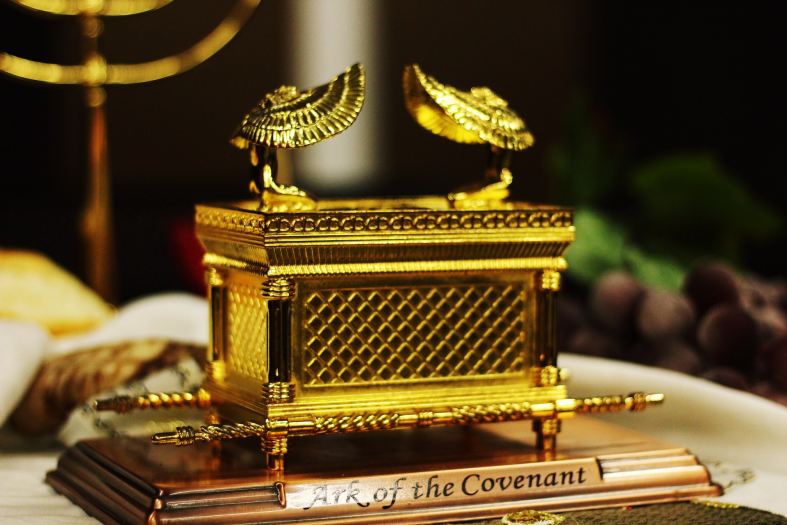
“Bezalel made the ark of acacia wood. Two cubits and a half was its length, a cubit and a half its breadth, and a cubit and a half its height.” – Exodus 37:1
Most of Exodus chapters 36-40 cover the many, many details of the construction of the tabernacle and all of its utensils and other parts. We may tire of reading chapters of details, but the point is that Bezalel and others put a massive amount of care (and obedience) into the implementation of God’s pattern for the tabernacle, as shown to Moses on the mountain.
What does it mean for us now? That we should put as much care into learning what God wants of us and put it into action in our lives.
“For whatever was written in former days was written for our instruction, that through endurance and through the encouragement of the Scriptures we might have hope. May the God of endurance and encouragement grant you to live in such harmony with one another, in accord with Christ Jesus, that together you may with one voice glorify the God and Father of our Lord Jesus Christ.” – Romans 15:4-6
Here is the list of readings for this week: 2 chapters to read per day as the main reading plan, and extra chapters for anyone who wants to read the whole Bible in 2025. I hope this encourages others to read and study their Bible more, whatever parts they decide to read.
Follow along (or not) any way you choose! Also, let me know if you’re interested in me doing this again next year with a different order of books.
Somehow, this week we will be in 10 different books of the Bible!
2 chapter a day plan:
Monday, December 8: James 1-2 Tuesday, December 9: James 3-4 Wednesday, December 10: James 5, Jude Thursday, December 11: 1 John 1-2 Friday, December 12: 1 John 3-4 Saturday, December 13: 1 John 5, 2 John Sunday, December 14: 3 John, Nehemiah 1
Extra chapters for those reading the whole Bible this year: Habakkuk 3, Zephaniah 1-3, Haggai 1-2, Zechariah 1
Fans of the dystopian Hunger Games novels and movies know that the story takes place in a country called Panem. There, the extravagantly wealthy Capitol district holds an annual, televised battle royale, The Hunger Games, where children from each of the 12 desperately poor districts fight to the death until there is only one remaining. The purpose of these demented Games is to remind the people of the power of the Capitol, but also to provide entertainment. But why is the country called Panem?
Panem is likely a reference to the Latin phrase “panem et circenses,” or “bread and circuses,” which “means to generate public approval, not by excellence in public service or public policy, but by diversion, distraction, or by satisfying the most immediate or base requirements of a populace, by offering a palliative: for example food (bread) or entertainment (circuses).”[1] Under this way of thinking, for a government to remain in power it needs to provide the basic needs of its people. For an especially cynical government, it would mean they need only provide just enough bread and just enough circuses to keep the population from overthrowing them.
In the case of The Hunger Games, the Capitol reminded the other districts that they could have no bread (panem) without the Capitol’s “benevolence,” and that the only entertainment (circuses) they get is to watch their children kill each other. Talk about a government providing the very bare minimum!
The Hunger Games is obviously an extreme example, but fortunately, Christianity offers a better answer than just the bare minimum of “panem et circenses.” What benefits does it offer? Psalm 103 in the Bible begins in the first 2 verses with a call to:
“Bless the LORD, O my soul, and all that is within me, bless his holy name! Bless the LORD, O my soul, and forget not all his benefits”
And what are these benefits? Is it more than “bread and circuses”? It is, as verses 3-5 tell us that the Lord is the one:
“who forgives all your iniquity, who heals all your diseases, who redeems your life from the pit, who crowns you with steadfast love and mercy, who satisfies you with good so that your youth is renewed like the eagle’s.”
This Psalm says He can take care of both our spiritual and physical maladies. Jesus performed many miracles, so we “may know that the Son of Man has authority on earth to forgive sins,”[2] solving our spiritual alienation from God and each other. Likewise, the body’s diseases do not heal magically or by chance; they heal because God created us with that ability. He is the Great Physician.[3]
Also, He is the One who can save us “from the pit” – from ourselves and the punishment that our sin deserves, replacing our banishment from God’s presence with “love and mercy.” He is the One who has the perspective needed to define what is good, and as our Maker, knows what we need to thrive and be renewed. He offers many benefits we cannot find anywhere else.
Not just the fictional Panem, but all the nations of the real world, have nothing to offer but varying degrees of bread and circuses, various diversions and distractions and palliatives. No government in the world can provide the benefits God provides – those listed in Psalm 103 – and therefore only God offers what can truly satisfy. Therefore,
“Bless the LORD, O my soul, and forget not all his benefits”
Here is another “Quint of Quotes” from my collection on the theme of time:
“People are frugal in guarding their personal property; but as soon as it comes to squandering time they are most wasteful of the one thing in which it is right to be stingy.” – Seneca
“You will never ‘find’ time for anything. If you want time, you must make it.” – Charles Buxton
“Your reality is yours. Stop wasting time looking at someone else’s reality while doing nothing about yours.” – Steve Harvey
“Time is short. Eternity is long. It is only reasonable that this short life be lived in the light of eternity.”- Charles Spurgeon
“Look carefully then how you walk, not as unwise but as wise, making the best use of the time, because the days are evil.” – Ephesians 5:15-16
Chapter 14 of John’s gospel begins with Jesus saying to His closest disciples “Let not your hearts be troubled. Believe in God; believe also in me.” Near the end of the chapter, Jesus says “Peace I leave with you; my peace I give to you. Not as the world gives do I give to you. Let not your hearts be troubled, neither let them be afraid.” In between, He gives His followers many words of encouragement because they needed it. Why?
Leading up to this, Jesus had just told them “Truly, truly, I say to you, one of you will betray me,”[1] predicting Judas would soon turn Him over to be killed. Since He knew He would be raised again and ascend to heaven, He had to tell them: “Little children, yet a little while I am with you. You will seek me, and just as I said to the Jews, so now I also say to you, ‘Where I am going you cannot come.’”[2] Then, in front of all the others, He told Peter, who had just offered to die for Jesus, “Truly, truly, I say to you, the rooster will not crow till you have denied me three times.”[3]
In quick succession, this small group of 12 disciples were told that 2 of them would soon be unfaithful, and that their leader would soon be leaving them. They must have felt devastated and troubled in their hearts. Had they given up so much for Jesus, only for it to fall apart? Likewise, when we’re bombarded with bad news in quick succession, our heart may tell us to be troubled, but “The heart is deceitful above all things, and desperately sick; who can understand it?” (Jeremiah 17:9)
Instead of listening to our gut feeling or our instincts, the only one in whom there is no deceit – Jesus – says to trust Him. He says: “Peace I leave with you; my peace I give to you. Not as the world gives do I give to you. Let not your hearts be troubled, neither let them be afraid.”
If you’re troubled with something today, bring it to Him and ask Him for His peace. It can overcome anything.
Sunrise over the Atlantic Ocean. I took this from a beach in Florida.





 Driving Toward the Morning Sun