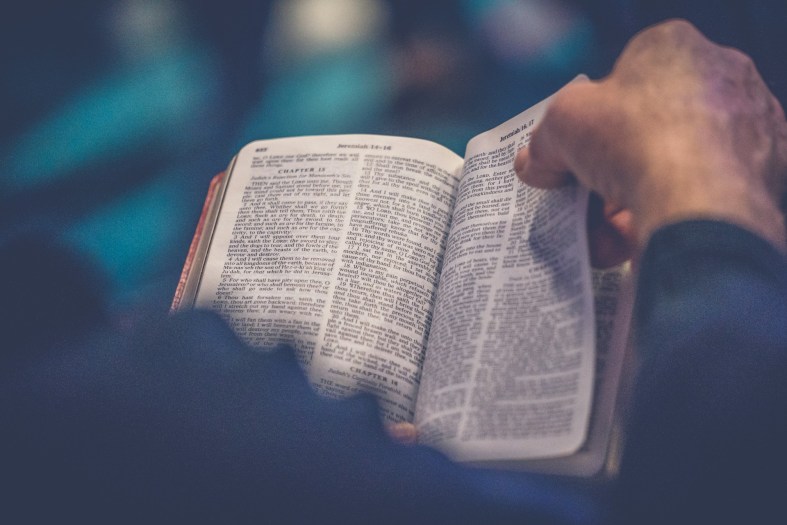
Daily Readings for November 24 – 30

Fellow travelers:

Here is the list of readings for this week: 2 chapters to read per day as the main reading plan, and extra chapters for anyone who wants to read the whole Bible in 2025.  I hope this encourages others to read and study their Bible more, whatever parts they decide to read.

Follow along (or not) any way you choose!  Also, let me know if you’re interested in me doing this again next year with a different order of books.

2 chapter a day plan:

Monday, November 24: Hebrews 4-5
Tuesday, November 25: Hebrews 6-7
Wednesday, November 26: Hebrews 8-9
Thursday, November 27: Hebrews 10-11
Friday, November 28: Hebrews 12-13
Saturday, November 29: Ezra 1-2
Sunday, November 30: Ezra 3-4

Extra chapters for those reading the whole Bible this year:
Jonah 1-4, Micah 1-5

Sacrificed for You

The Old Testament book of Leviticus is probably the hardest book in the Bible for many to read.  Much of it outlines, in detail, the duties of priests and Levites (the book’s name comes from this group) in worship, including the sacrificial system involving animals practiced in ancient times.  However, there are many pictures of Christ embedded in these stories and rituals, one being the requirement that each individual lay their hands on any bull offered for their sin.

This is first described in Leviticus 1:3-5a – “If his offering is a burnt offering from the herd, he shall offer a male without blemish. He shall bring it to the entrance of the tent of meeting, that he may be accepted before the LORD. He shall lay his hand on the head of the burnt offering, and it shall be accepted for him to make atonement for him.  Then he shall kill the bull before the LORD” (emphasis mine)

Why is it so important that each person lay their hand on their sacrifice?  I think there are at least 3 reasons:

First, the sacrifice is for each of us specifically and individually.  Atonement is not a blanket covering everyone with no distinction – it focuses on each individual.  God does not have a limited attention span, where time spent with one person takes away from time spent with another. He can, and does, focus on us all.  Since He desires relationship with each person, He wants us to be aware of the need for sacrifice at individual level, as well as the connection created at an individual level.

Second, the sacrifice shows us the severity of our sin.  Before a just God, no sin can go unpunished, or He would commit injustice.  Only blood can atone for sin, and having each person make a personal connection with their sacrifice highlights the seriousness of our own sin, discouraging us from thinking other people’s sin is more serious than our own.  Even the priests, as shown in Leviticus 8:14, had to lay their hands on their own sacrifice, showing even those who might be considered, or consider themselves, more spiritual are not exempt.

Third, nobody else can worship for us since the purpose of worship is to have a personal relationship with our Lord and Maker.  It is the sacrifice that restores our relationship to God, not the priest that intermediates the sacrifice, which is highlighted by the fact that Jesus became both the sacrifice and the High Priest.  Just as I can’t have a real relationship with someone only by hearing about them through someone else, I can’t have a real relationship with God through someone else’s worship.  The faith of people you know – parents, friends, teachers, pastors – will do you no good.  Each must have his own faith because what He wants is us.

Photo by Cdoncel on Unsplash

In Leviticus we find a picture of Jesus, who lived a perfect life for us, not so that we don’t have to be perfect, but so that we can become perfect.  He died for each of us, specifically, and needed to die because no other sacrifice could cover the severity of our sins before a just God.  Through His sacrifice, we are adopted as members of His family, to live perfectly in Paradise for eternity.

Jesus lamented of the religious people of his day in Matthew 23:37 – “O Jerusalem, Jerusalem, the city that kills the prophets and stones those who are sent to it! How often would I have gathered your children together as a hen gathers her brood under her wings, and you were not willing!”  When He offered relationship, they insisted on religion, and missed being touched by their Maker’s hands.

One More Picture
Much more recently than Leviticus was written, a similar point was made by Mel Gibson in his movie The Passion of the Christ[1].  During the scene where Jesus is being crucified, Gibson decided to film his own hands driving the spike into Christ’s hand.  It is the only time Gibson appears in the film.  The film’s website (since removed) said this was “symbolic of the fact that he holds himself accountable first and foremost for Christ’s death.”  Gibson, in Leviticus terms, chose to “lay his hand on the head of the burnt offering.

Yes, Jesus suffered terribly for the sin of each of us, but He willingly did it because it was needed to gather His people to Himself.  “Lay your hand” on His sacrifice and thank Him that He wants to know you personally.

Amen.


[1] Gibson, Mel.  The Passion of the Christ.  (2004)

Is Money the Root of All Evil?

Everyone has probably heard the phrase “money is the root of all evil” or some variation of it.  The phrase is usually directed at someone who has a lot of money by someone who doesn’t, with the implication being that the rich person is evil in some way, or many ways.  It’s a phrase that might make the ones with less money feel better about themselves.  At least they’re not “evil.”

However, while the phrase actually comes from the Bible (sort of), it isn’t biblical at all.  The source of the phrase is 1 Timothy 6:10 but notice some important differences in the wording in the ESV translation (the NIV, NKJV, NASB, and other translations are very similar):

For the love of money is a root of all kinds of evils. It is through this craving that some have wandered away from the faith and pierced themselves with many pangs.”

The first thing to note is that in 1 Timothy, it’s “love of money” that is the problem, not just “money.”  This means that it’s possible to have a lot of money and for that not to be a moral problem.  As Voddie Baucham said, “Let me clear up something…God is not against you having things.  He’s against things having you.”  There are a lot of very generous rich people and there are a lot of good things that wouldn’t get done, in the church or otherwise, without the monetary contributions of these people.  Those who have money, but don’t love it (money doesn’t have them) often put large amounts of what they have to work for God’s kingdom in many different ways.  Having money doesn’t make them evil.  The root of all evil is therefore something else other than money.

Also notice 1 Timothy says, “a root,” not “the root.”  One means evil has one root, and the other means that there is more than one root.  The wording from 1 Timothy tells us that “all kinds of evil” can grow from things other than the “love of money.”  Money and the love of it are not required to make someone evil.  Many things can be the “root” or source of evil in people, including in some cases the lack of money, ironically.

Lastly, 1 Timothy says, “all kinds of evils” not “all evil.”  So, the “love of money” isn’t the source of all evil, but it can cause many different types of evil.  Greed, covetousness, and haughtiness are some that come to mind.  But also consider that the dislike of people who have money, whether they love it or not, can be the source of jealousy, envy, covetousness (which can come from having or not having money) and other “kinds of evils.”

So, what’s wrong with the saying that “money is the root of all evil”?  It can have the effect of elevating greed and related sins to a higher (worse) level of sin than other sins.  It can become a weapon in the hands of economic and political activists.  But the 1 Timothy version doesn’t do either of these things.  Instead of creating an “us vs. them” situation, with the poor on one side and the rich on the other, the Biblical text shows us that sin comes in many forms, has many causes, and that nobody is immune from sin.

Sin itself is the ultimate problem of humanity, not “love of money,” although that is one kind of sin.  If “money is the root of all evil” then those who don’t love money wouldn’t need Jesus.  But those who hate money are sinners too.  Poor people are sinners too.  They just have different faults.  In the eyes of a holy God, no fault can be tolerated, because His purpose is to have a perfect humanity.  The solution to our economic and political problems is not to eliminate money or the rich, but the solution is that we need a way to remove all sin so we can be reconciled to God and have a path to a sinless life.  “Money is the root of all evil” may cry out for revolution, but “For the love of money is a root of all kinds of evils” cries out that Jesus is the only solution.

Jesus’ sacrifice for our sins is the only thing that will satisfy the requirements of our holy God, bringing us into His family and providing a way that “love of money” and all other sins can be destroyed forever.

For the love of money is a root of all kinds of evils,” but “God so loved the world, that he gave his only Son, that whoever believes in him should not perish but have eternal life.”

The Scale of Our Trials

The apostle Paul begins 2 Corinthians with the usual greeting, followed by a section on the comfort God provides us when we suffer or are afflicted for Christ’s sake.  2 Corinthians 1:5 makes this statement: “For as we share abundantly in Christ’s sufferings, so through Christ we share abundantly in comfort too.”

On that verse, Charles Spurgeon wrote this analogy: “The Ruler of Providence bears a pair of scales—in this side He puts His people’s trials, and in that He puts their consolations. When the scale of trial is nearly empty, you will always find the scale of consolation in nearly the same condition; and when the scale of trials is full, you will find the scale of consolation just as heavy.”[1]

Therefore, when living for Christ brings trouble and opposition, remember also that our Father is ruler of all and fully intends to share His comfort with us through Christ eternally.

For I consider that the sufferings of this present time are not worth comparing with the glory that is to be revealed to us.” – Romans 8:18


[1] From “February 12” of Spurgeon’s Morning by Morning commentary

“Let Not the Flood Sweep Over Me”

A recent post was about Jeremiah’s comparison of false religion to a broken cistern, with God alternatively being “the fountain of living waters.”[1]  Jeremiah lived when most of God’s people – including most of the priests and prophets – had turned from Him to follow other gods.  As Jeremiah remained faithful, correctly predicting that Jerusalem would fall to Babylon, he was persecuted, including this instance in Jeremiah 38:6, where King Zedekiah’s officials “took Jeremiah and cast him into the cistern of Malchiah, the king’s son, which was in the court of the guard, letting Jeremiah down by ropes. And there was no water in the cistern, but only mud, and Jeremiah sank in the mud.”

Since God is “the fountain of living waters,” the only path to eternal blessing, it’s incredibly ironic that Jeremiah, one of the few remaining faithful prophets and therefore a rare source of God’s “living waters,” should be cast into a cistern with no water.  Perhaps it was broken.  King Zedekiah thought he could silence the “living waters” Jeremiah represented by casting them into a cistern, trading truth for falsehood.

Photo by Mishal Ibrahim on Unsplash

Later, Jeremiah seems to recall the cistern experience in Lamentations 3:52-57, where he said:

I have been hunted like a bird
            by those who were my enemies without cause;
they flung me alive into the pit
            and cast stones on me;
water closed over my head;
            I said, ‘I am lost.’
‘I called on your name, O LORD,
            from the depths of the pit;
you heard my plea, ‘Do not close
            your ear to my cry for help!’
You came near when I called on you;
            you said, ‘Do not fear!’”

Returning to the book of Jeremiah, we read that Ebed-melech, an Ethiopian eunuch, heard of Jeremiah’s situation and pleaded his case: “My lord the king, these men have done evil in all that they did to Jeremiah the prophet by casting him into the cistern, and he will die there of hunger, for there is no bread left in the city.”[2]  This unlikely source – a foreigner – was Jeremiah’s deliverance from God to rescue Jeremiah from the well.  Ebed-melech gathered 30 men, “Then they drew Jeremiah up with ropes and lifted him out of the cistern. And Jeremiah remained in the court of the guard.”

Jeremiah was not the only Old Testament figure to suffer for his faithfulness.  Many years earlier, King David also referred to “sinking in the mire” in the Messianic Psalm 69, verses 14-15:

“Deliver me
            from sinking in the mire;
let me be delivered from my enemies
            and from the deep waters.
Let not the flood sweep over me,
            or the deep swallow me up,
            or the pit close its mouth over me.”

David knew this feeling of sinking came not because of his sin, but when he was faithfully serving his Lord.  David’s “sinking in the mire” happened under these circumstances from verse 9 of the same Psalm:

For zeal for your house has consumed me,
            and the reproaches of those who reproach you have fallen on me.”

In Jeremiah’s case, as well as David’s and that of Jesus, whom Psalm 69 foreshadowed[3], we know we that cannot judge our faithfulness based on whether it improves our circumstances.  When we do, we might stop being faithful because it seems we are “sinking in the mire.”  Being reproached by the world and feeling down aren’t the circumstances we prefer, but “Blessed are those who are persecuted for righteousness’ sake, for theirs is the kingdom of heaven.”[4]  Through these and all other circumstances, God develops in us deeper trust in Him.

Therefore, with David may we pray:

But as for me, my prayer is to you, O LORD.
            At an acceptable time, O God,
            in the abundance of your steadfast love answer me in your saving faithfulness.” – Psalm 69:13

And in His time, He will deliver us, perhaps in ways we don’t expect.

Coda

In 1995, Christian rock group Jars of Clay released their self-titled album, and the track “Flood” has similar themes to this post.  The song was also a mainstream hit, charting as high as No. 12 on the Billboard Modern Rock Tracks chart,[5] amazing for a song that is essentially a prayer like David’s in Psalm 69.

You can check out the song’s lyrics here: https://genius.com/Jars-of-clay-flood-lyrics

Or, if you have 3 ½ minutes, watch the music video here:


[1] Jeremiah 3:13
[2] Jeremiah 38:9
[3] John 2:17, 15:25, Acts 1:20, Romans 11:9-10, 15:3
[4] Matthew 5:10
[5] https://en.wikipedia.org/wiki/Flood_(Jars_of_Clay_song)