Meet Ebenezer, the Blog’s Mascot

Every blog needs a mascot, right?  Well, maybe not every blog, but I decided this one does.  Before I introduce him, a little backstory on where he came from.

Boston is one of my favorite places to visit, and when I was there in October 2022, we got this great picture of a squirrel in Boston Common.  The squirrels there ignore people most of the time, instead of running away like squirrels usually do.  But this one was not afraid of us at all; he walked right up and stared us down.  He stayed like this long enough for us to take a picture and was still around after we walked away.  For squirrels, fear of humans is a learned behavior and, in some environments, they just go about their business, unconcerned.

Ebenezer, at home in Boston Common

He was a great contrast to the “squirrel moments”[1] dogs (and people) have when they are “distracted by random nothingness.”  The Facebook page where I share this blog is called “A place to inject hopeful reminders of eternity into the distraction that is Facebook.”  I’ve used this squirrel as my social media picture before to joke that it was the best way to draw attention, and if people are easily distracted by squirrels, why not use one to distract people toward the blog?

So, this squirrel is now the mascot for Driving Toward Morning!  But he needs a name.  What to call him?

Meet Ebenezer
Many people know the name Ebenezer from Scrooge in A Christmas Carol, but in the Bible an Ebenezer is a stone monument constructed as a tangible and visible reminder of God’s past help for His people.  Ebenezer means “stone of help,” and such monuments were built in Genesis 28:18, 35:14, Joshua 4:9, 1 Samuel 7:12 and elsewhere.  When I write, I’m often trying to create a type of written Ebenezer.

For example, inspired by a devotional about Ephesians 2:4, I wrote a post about the power of the words “but God.”  In it, James Montgomery Boice says: “The words ‘but God’ show what God has done. If you understand those two words – ‘but God’ – they will save your soul. If you recall them daily and live by them, they will transform your life completely.”[2]

So, I’ve decided to name him “Ebenezer, the ‘But God…’ Squirrel,” but you can just call him Ebenezer.  Whenever I see Ebenezer, I hope to be pulled back into awareness of God’s help when I am distracted or frustrated.  I hope to be reminded to store up treasure in heaven as squirrels store food for the winter.  I hope to fear God and not man.  I hope to be encouraged to “pray without ceasing” (1 Thessalonians 5:17), as every squirrel I see reminds me that interrupting the seeming chaos of the world with “but God” can change everything.

Next time, and every time, you see a squirrel, I hope you are reminded of the same.  The world is not random, and God is relevant to your situation, whatever it is.

If you’re ever in Boston and see Ebenezer, say hello to him for me.


[1] https://www.urbandictionary.com/define.php?term=SQUIRREL%21%21
[2] From “November 7.” James Montgomery Boice and Marion Clark. Come to the Waters: Daily Bible Devotions for Spiritual Refreshment.  (2017).

Two Words That Might Save Your Soul

Being human is difficult, but sometimes a pause to reflect can make a big difference.  Ephesians 2:4 says: “But God, being rich in mercy, because of the great love with which he loved us…”  Pastor James Boice jumps on those first two words as a key turning point: “But God! Here is where the beauty and wonder of the Christian gospel comes in.”

Ephesians 2 begins with people following “the course of this world,” chasing whatever “passions” and “desires” came to mind.  Before “but God”, we were all “dead” (v 1) and “by nature children of wrath” (v 3).  All of our efforts are doomed to failure.

The story does not stop there.  For God’s people it never does.  After “but God”, we have been made alive together with Christ (v 5), we are shown the immeasurable riches of His grace (v 7), and we are enabled to do the good, meaningful works He has prepared for us (v 10).

When we wonder whether this world is all there is and that this is the best we can do, we respond “But God…” When frustrated with yourself, with others, or with the world in general, bring to mind the words “but God.”  These words are relevant to every situation because He has not left things as they are, but He intervened through Jesus on the cross and through His Spirit in our lives every day.  “The words ‘but God’ show what God has done. If you understand those two words – ‘but God’ – they will save your soul. If you recall them daily and live by them, they will transform your life completely.”[1]

Call the words “but God…” to mind whenever you’re overcome with negativity.  Say “but God…” to others who are struggling.  For every situation, He can fill the “…” with hope if you pause and give Him the opportunity.  But also, when you see God’s blessings in your daily life, think “but God” because He has not left us alone.


[1] From “November 7.” James Montgomery Boice and Marion Clark. Come to the Waters: Daily Bible Devotions for Spiritual Refreshment.  (2017).
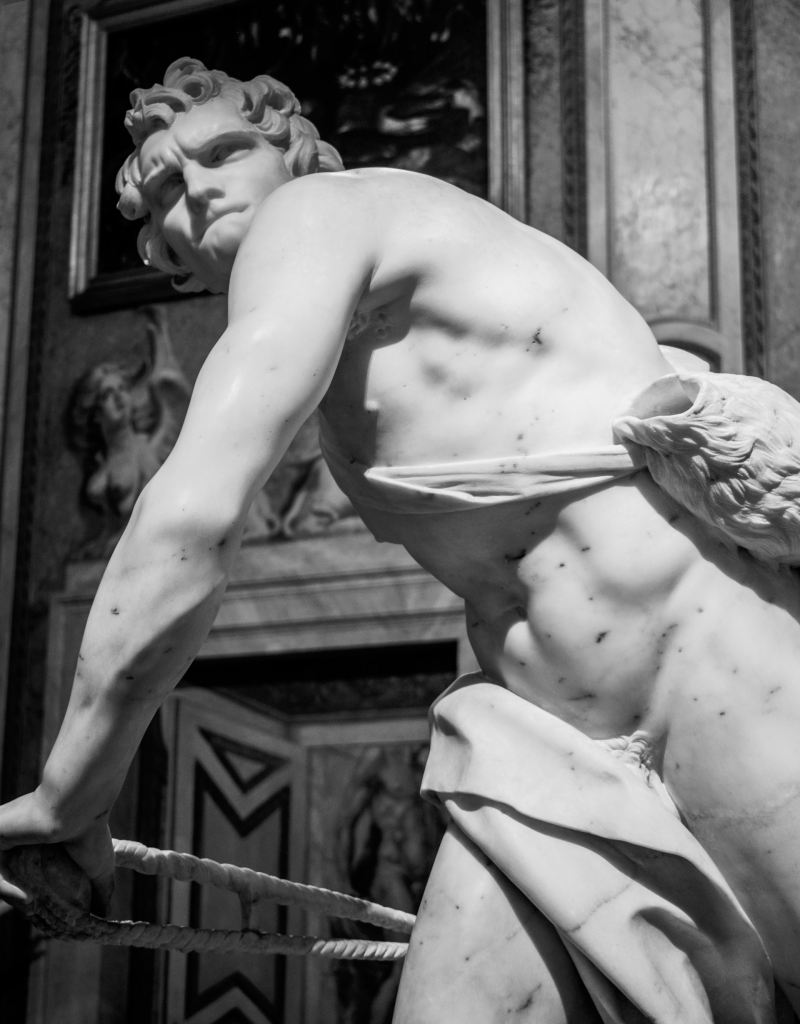
David’s Spiritual Battle with Goliath

David’s defeat of Goliath is such a popular story that it has become a cliché.  For example, unbalanced games in sports where one team is much better than the other are referred to as “David vs. Goliath.”  In these cases, the storyline is about whether a seemingly physically inferior opponent can beat a physically superior one.  However, this misses the point of the story – that it was a spiritual battle.

On one side of the battle, we have false gods.  After David decided to fight and was approaching Goliath, 1 Samuel 17:43 says: “And the Philistine [Goliath] said to David, ‘Am I a dog, that you come to me with sticks?’ And the Philistine cursed David by his gods.”  But even though Goliath invoked his gods in curses, he was counting on his size and strength advantage to win the battle.  He was not actually relying on “gods,” and did not expect to win “by his gods”, but by the god of worldly strength and dominance.

On the other hand, David was clear that this was a battle between true and false gods.  In 1 Samuel 17:26, David says “What shall be done for the man who kills this Philistine and takes away the reproach from Israel? For who is this uncircumcised Philistine, that he should defy the armies of the living God?” and also in verse 37 David says “The LORD who delivered me from the paw of the lion and from the paw of the bear will deliver me from the hand of this Philistine.”  David was actually trusting in and relying on his God for victory, unlike Goliath who just used his gods’ names in vain.  David knew his relative physical weakness against Goliath was not relevant.

So, to Goliath the battle was David vs. Goliath, but to David it was the true God vs. false gods.  And that’s why David won. David wanted to beat Goliath so “that all this assembly may know that the LORD saves not with sword and spear. For the battle is the LORD’S, and he will give you into our hand.” (verse 47)

People also curse us by their gods when we refuse to live by those gods’ standards.  These may be gods of wealth or convenience or rebellion, and many of our spiritual battles are against this world’s gods.

Does it sometimes seem foolish not to make choices based only on what’s best financially?  Is it sometimes inconvenient to worship?  Is it sometimes inconvenient to love our families, congregations, and neighbors?  Is it tempting sometimes to sin “only once” or if we think nobody will find out?

These are battles we all face, but we’re not going to win by doing better by the world’s gods’ standards, but by relying on the true God.  So, a question for us is: do we see these challenges as spiritual battles between true and false gods?  Or do we invoke God in name only like Goliath did, and then rely on our own strength?

The key to the battle between David and Goliath is that David won because 1) he knew his God is real, and 2) because he actually relied on Him.  We can win the same way and overcome the giants that seek to overthrow us.

For we do not wrestle against flesh and blood, but against the rulers, against the authorities, against the cosmic powers over this present darkness, against the spiritual forces of evil in the heavenly places.” – Ephesians 6:12

Things God Counts

Fellow travelers,

Are you ever so fearful or anxious about something that you lose sleep about it? Are there things out of your control that you toss and turn over? Maybe it’s so bad that you even cry. If you’re like this, you’re definitely not alone, and in fact, King David struggled with this kind of anxiety.

In Psalm 56, David laments that his enemies are constantly out to get him, and then in verse 8, David wrote about God:

You have kept count of my tossings;
            put my tears in your bottle.
            Are they not in your book?

What David means is that God sees all of our anxiety and every detail about how it affects us.  He counts every time we toss and turn at night.  He counts every tear you cry, and keeps track of them all, because he cares.

This realization causes David to write in verses 10 and 11:

In God, whose word I praise,
            in the LORD, whose word I praise,
in God I trust; I shall not be afraid.
            What can man do to me?

Prayer or any religious practice won’t always cure anxiety, but as long as we suffer, God knows and cares about it.  We can trust Him to provide for us, sometime between now and eternity.

As Paul wrote about the glory of our salvation:

If God is for us, who can be against us?  He who did not spare his own Son but gave him up for us all, how will he not also with him graciously give us all things?[1]

Amen


[1] Romans 8:31b-32

The Priestly Blessing

What comes to mind when you think of Old Testament priests?  Fancy robes?  Their handling of sacrifices?  Their separation to service of Yahweh?  The corrupt priests Jesus later confronted in the New Testament?

What we sometimes forget is that everything the Old Testament priests did was done to allow God to be present with and bless His people, as a preview of how Christ makes us acceptable to God so He can live in us.  In Numbers 6, God commands Aaron and his sons to proclaim this blessing to the people of Israel:

The LORD bless you and keep you;
the LORD make his face to shine upon you and be gracious to you;
the LORD lift up his countenance upon you and give you peace.[1]

John Calvin makes this comment on the blessing: “This doctrine is especially profitable, that believers may confidently assure themselves that God is reconciled to them, when He ordains the priests to be witnesses and heralds of His paternal favor towards them. The word to bless is often used for to pray for blessings, which is the common duty of all pious persons; but this rite…was an efficacious testimony of God’s grace; as if the priests bore from His own mouth the commandment to bless.”

May we be blessed today by our Lord, whose face shines like the sun and whose grace gives us peace!


[1] Numbers 6:24-26