Be a Cloud of Witness – Psalms of Ascent #8

Photo by Aaron Burden on Unsplash

The last post on the Psalms of Ascent ended with God’s people dealing with “the scorn of those who are at ease” and “the contempt of the proud” at the end of Psalm 123.  That Psalm emphasized the Lordship of the Lord, who is “enthroned in the heavens.”  Those who follow the kingdoms of the world often have contempt and scorn for those who follow another way, who declare another Lord.  However, Psalm 124 explains that our Lord has not left us alone:

“A Song of Ascents. Of David.

If it had not been the LORD who was on our side—
            let Israel now say—
if it had not been the LORD who was on our side
            when people rose up against us,
then they would have swallowed us up alive,
            when their anger was kindled against us;
then the flood would have swept us away,
            the torrent would have gone over us;
then over us would have gone
            the raging waters.

Blessed be the LORD,
            who has not given us
            as prey to their teeth!
We have escaped like a bird
            from the snare of the fowlers;
the snare is broken,
            and we have escaped!

Our help is in the name of the LORD,
            who made heaven and earth.” (emphasis mine)

This Psalm speaks of times when we know only the Lord could have saved us, and we’ve learned that, “When all you have is God, He is enough.”  Sometimes life is hard because of circumstances that force us to depend on Him, and we learn to trust Him and Him alone.  The best way to know for ourselves that He is good is to act on our trust in Him, even when it’s hard or doesn’t make sense.  When God works wonders for us, we should keep a record of God’s power and faithfulness in your life, like the memorial stones Israel placed after crossing the Jordan.[1]

The other thing to notice about Psalm 124 is that it is entirely written with plural pronouns.  David, the author, is telling us that the works of God in our lives, especially when there seemed no other way forward, are to be shared with the community of believers.  “Let Israel now say” is something we do together.  The church must be a community of people who share God’s work in their lives, as a contrast to “the proud” and “those who are at ease.”  The One we serve – and the One they ridicule – wants us to testify to His salvation, and not any other hoped-for salvation.

John Calvin notes on the last verse (8): “The contrast between the help of God, and other resources in which the world vainly confides, as we have seen in Psalm 20:7, ‘Some trust in chariots, and some in horses, but we will remember the name of the Lord our God,’ is to be noticed, that the faithful, purged from all false confidence, may betake themselves exclusively to his succor, and depending upon it, may fearlessly despise whatever Satan and the world may plot against them.”

We know what God has done for us, but as a community we amplify the common witness of God being faithful.  Hebrews 11 chronicles the faith of God toward His people in the Bible, in order that we may have a “cloud of witnesses” encouraging us not to “grow weary or fainthearted” as we endure hostility from sinners for serving our Lord.[2]  Psalm 124 is part of a liturgy for ancient Israelites traveling to corporate worship in Jerusalem and can be applied to corporate worship today.  God calls all of His people to join the cloud of witnesses.

Therefore, when you attend worship this week, find a way to join someone else’s cloud of witness.  Tell them what God has done for you, that only He could do.  Then tell someone else.  If you need encouragement yourself, pray that God would meet your need.

Dear fellow travelers: Be a cloud of witness.  Show others your memorial stone.


[1] See Joshua 4
[2] See Hebrews 12:1-4

Be Glad for Today

Fellow travelers,

While I don’t know how most of my readers will spend their day today, and I’m even uncertain about what I’ll do today, there’s one thing about today I do know:

This is the day that the LORD has made;
            let us rejoice and be glad in it.” – Psalm 118:24

Today, we may have activities and responsibilities we didn’t choose, but this is the day we have.  We don’t have control over things we’d like to control, but this is the day we have.

Today, we have no other day but this one, and it is from the Lord.  It is a good day because it is given to us by Him.  If He is good, it is good.

Today, “This is the day that the LORD has made;
            let us rejoice and be glad in it.” – Psalm 118:24

Rejoice in this day!


“There is a vital objection to the advice merely to grin and bear it. The objection is that if you merely bear it, you do not grin.” – GK Chesterton

The Transfiguration: A Preview of Glory and Delight

In Psalm 36:8, David thanks God that His people may “drink from the river of your delights.”   Here, the word for “delights” is the plural of “Eden”, and the “delights” are the occasional sips God provides us that point to a past and future paradise.  These “delights” strengthen our hope of heaven and strengthen us to live in this world for Him.  Jesus provided such a moment for His disciples in the event known as the Transfiguration, when Jesus took His disciples Peter, James, and John up a mountain for a vision of His future glory.  Matthew records in his gospel that Jesus “was transfigured before them, and his face shone like the sun, and his clothes became white as light.”[1]

Moses and Elijah also appeared and spoke with Jesus, perhaps representing the law and the prophets of the Old Testament and how it all pointed to Jesus.  Peter wanted to make this moment last, and offered to “make three tents here, one for you and one for Moses and one for Elijah.[2]  But it was not intended to last long, yet.

The Transfiguration was a preview of heaven, a sneak peek into what eternity will be like, a promise of future blessing under Jesus, the glorified King.  The fulfillment of everything the law and prophets hinted at will be realized.  However, Moses and Elijah soon disappeared, Jesus and His disciples descended from the mountain, and the disciples very soon struggled as we all do, but they persevered as we also must.

Pray that God will make eternity real to His people today, even if for only a moment, giving a “drink from the river of your delights” and strengthen us to live for Him.


[1] Matthew 17:2
[2] Matthew 17:4

Letting God Pick Our Battles II

Photo by Andrey Grinkevich on Unsplash

The Apostle Paul wrote in Philippians 4:13 “I can do all things through him who strengthens me,” yet he also wrote in 2 Corinthians 12:7-9 that “to keep me from becoming conceited,” a “thorn was given me in the flesh.”  He writes: “Three times I pleaded with the Lord about this, that it should leave me.  But he said to me, ‘My grace is sufficient for you, for my power is made perfect in weakness.’  Therefore I will boast all the more gladly of my weaknesses, so that the power of Christ may rest upon me.”

The nature of Paul’s “thorn” has been disputed for centuries, but Galatians 4:13 suggests it was a physical problem, a “bodily ailment” rather than a moral shortcoming.  So, the lesson of the “thorn” is not that God prevented Paul from overcoming some specific sin to keep him humble – He wants Paul (and us) to be satisfied with nothing less than righteousness.

However, one lesson of the “thorn” is that Paul didn’t mean by “I can do all things” that he could do whatever he wanted and succeed.  Instead, the “thorn” is an example of a battle Paul would not win, because this “thorn” had a purpose in bringing Paul closer to God’s grace and power.  In God’s wisdom, Paul was better off with this ailment than without it.

Yesterday’s post said “Picking your battles, rather than trying to fight and win every fight that comes your way, is a good piece of advice.  However, who should pick which battles to fight?”  In the case of the “thorn”, God picked a battle for Paul not to fight, telling him instead to focus on growing in faith.  The thorn had a purpose in Paul’s striving toward righteousness, which was more important than any physical ailment.  Had Paul continued to insist to God that the thorn should be removed, he would still have the thorn, but he would also not grow in his relationship with his Lord.

Sometimes there are battles He wants us to fight in His strength for His glory, and sometimes there are battles He tells us not to fight so we can focus on His grace and power while in this life, in light of His promises to heal our physical ailments in Paradise.

Today’s post closes the same way as yesterdays: “Sometimes life is hard on purpose, so that God alone may be glorified in victory, and also so that we may grow in our faith in His strength.  When we let Him pick our battles, we learn that His righteousness is the only thing that will satisfy us.  Nothing less will do.”

Letting God Pick Our Battles

Image by Richard Mcall from Pixabay

Picking your battles, rather than trying to fight and win every fight that comes your way, is a good piece of advice.  However, who should pick which battles to fight?  The Old Testament book of Judges is a record of the consequences of Israel’s failure to completely conquer the promised land, a battle God gave them to fight and win.  Judges also shows more generally what happens when anyone picks the wrong battles to fight: they end up with less than what God intended for them.

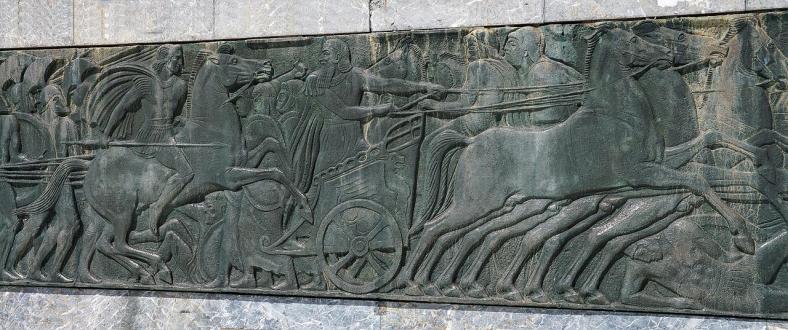
For example, Judges 1:19 tells us: “And the LORD was with Judah, and he took possession of the hill country, but he could not drive out the inhabitants of the plain because they had chariots of iron.

This verse, especially the second part, is written from a human perspective.  God did not tell Israel to conquer all of the promised land, except for the plains.  God is not afraid of chariots.  He told them to conquer all of it, but Israel thought that chariots couldn’t be defeated, so they decided not to fight in the plain.  By using their own judgement and preferring to fight in hills or forests where chariots were less effective, they failed to fully receive what God had promised them.

An application to us is that our inheritance is Christ’s righteousness, and Jesus tells us “Blessed are those who hunger and thirst for righteousness, for they shall be satisfied.[1]  Jesus is telling us that righteousness is like food and drink.  We can never have enough because no matter how much we eat and drink, our hunger and thirst soon return.  We are all in different places, at different levels of knowledge and maturity, but in Christ we are all on the same path and have an appetite only He can satisfy.

To be satisfied, we cannot settle for what we have already accomplished, the hill country we have already taken.  To be satisfied, we must fight the chariots in the plains if that is what God wants us to do, so that we learn to rely on His strength.  To be satisfied, we move from only fighting battles we choose based on our own wisdom and ability to choosing the battles we will win in His strength.

Sometimes life is hard on purpose, so that God alone may be glorified in victory, and also so that we may grow in our faith in His strength.  When we let Him pick our battles, we learn that His righteousness is the only thing that will satisfy us.  Nothing less will do.


[1] Matthew 5:6