Letting God Pick Our Battles

Image by Richard Mcall from Pixabay

Picking your battles, rather than trying to fight and win every fight that comes your way, is a good piece of advice.  However, who should pick which battles to fight?  The Old Testament book of Judges is a record of the consequences of Israel’s failure to completely conquer the promised land, a battle God gave them to fight and win.  Judges also shows more generally what happens when anyone picks the wrong battles to fight: they end up with less than what God intended for them.

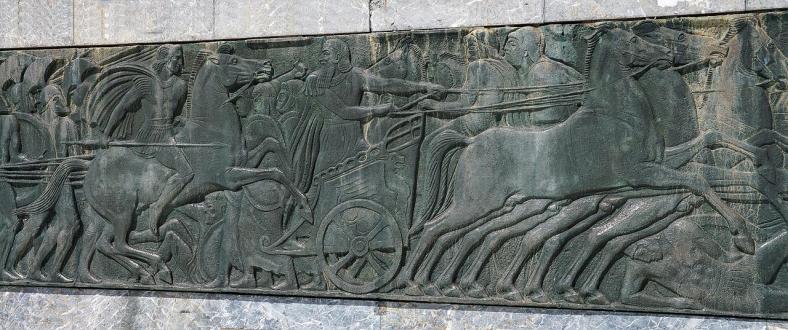
For example, Judges 1:19 tells us: “And the LORD was with Judah, and he took possession of the hill country, but he could not drive out the inhabitants of the plain because they had chariots of iron.”

This verse, especially the second part, is written from a human perspective.  God did not tell Israel to conquer all of the promised land, except for the plains.  God is not afraid of chariots.  He told them to conquer all of it, but Israel thought that chariots couldn’t be defeated, so they decided not to fight in the plain.  By using their own judgement and preferring to fight in hills or forests where chariots were less effective, they failed to fully receive what God had promised them.

An application to us is that our inheritance is Christ’s righteousness, and Jesus tells us “Blessed are those who hunger and thirst for righteousness, for they shall be satisfied.”[1]  Jesus is telling us that righteousness is like food and drink.  We can never have enough because no matter how much we eat and drink, our hunger and thirst soon return.  We are all in different places, at different levels of knowledge and maturity, but in Christ we are all on the same path and have an appetite only He can satisfy.

To be satisfied, we cannot settle for what we have already accomplished, the hill country we have already taken.  To be satisfied, we must fight the chariots in the plains if that is what God wants us to do, so that we learn to rely on His strength.  To be satisfied, we move from only fighting battles we choose based on our own wisdom and ability to choosing the battles we will win in His strength.

Sometimes life is hard on purpose, so that God alone may be glorified in victory, and also so that we may grow in our faith in His strength.  When we let Him pick our battles, we learn that His righteousness is the only thing that will satisfy us.  Nothing less will do.


[1] Matthew 5:6
Daily Readings for June 16 – 22

Fellow travelers:

Here is the list of readings for this week: 2 chapters to read per day as the main reading plan, and extra chapters for anyone who wants to read the whole Bible in 2025.  Reading 3 chapters a day on weekdays and 4 on weekends almost exactly covers the 1,189 chapters of the Bible, so the “extra” readings are about 9 chapters per week.

Follow along (or not) any way you choose!

Monday, June 16: Proverbs 17, Luke 6
Tuesday, June 17: Proverbs 18, Luke 7
Wednesday, June 18: Proverbs 19, Luke 8
Thursday, June 19: Proverbs 20, Luke 9
Friday, June 20: Proverbs 21, Luke 10
Saturday, June 21: Proverbs 22, Luke 11
Sunday, June 22: Proverbs 23, Luke 12

Additional readings if you want to read the whole Bible this year:
Isaiah 6 – 14

The Fatherless Aren’t

There are a lot of different perspectives on truth.  Truth of the way the world is.  Truth of the way it should be.  Gospel Truth.  But this Father’s Day, I’ll focus on one particular truth:

“Religion that is pure and undefiled before God the Father is this: to visit orphans and widows in their affliction, and to keep oneself unstained from the world.” – James 1:27

This verse tells us that God the Father has a special place for those who don’t have an earthly father.  He will be Father to them.  It tells us to be Jesus to the widows and orphans, showing them the Way to, and the love of, their Father.  There is a reason the Lord’s Prayer starts with “Our Father” – because ultimately all depends on Him.

Photo by Liane Metzler on Unsplash

Many in the world reject God as Father because of the failure of fathers in the world.  The Old Testament of the Bible is not full of great examples of parents, but rather shows people with all their flaws and warts, who by God’s grace became part of God’s plan to use sinners to reach sinners.  To become the Father of His eternal people, despite the failure of His people to be good fathers.  There are no Godly offspring without the sacrifice of Jesus.  There is no human Jesus without a genealogy of sinners.  There are none to inhabit heaven without the sacrifice of a human Jesus, God’s only Son, given for you.

This Father’s Day, take every opportunity to be grateful for fathers, for parents, for those who take on parenthood in other ways, but also think about those who have no earthly provision.  Because those who see Jesus see the Father, help people see Jesus.  God’s purpose for Godly offspring will be fulfilled and praise Him that you have the awesome responsibility and opportunity to be a part of that work.

Fathers matter.  You matter.  To God and to others.  Whoever you are.

The Value of Work: A Quint of Quotes

Dear fellow travelers,

Here is another “Quint of Quotes” from my collection on the theme of work:

“We make a living by what we get, but we make a life by what we give.” – Winston Churchill

Photo by Taya Kucherova on Unsplash

“God is more concerned about His workers than He is about their work, for if the workers are what they ought to be, the work will be what it ought to be.” – Warren Wiersbe

“The Christian shoemaker does his duty not by putting little crosses on the shoes, but by making good shoes, because God is interested in good craftsmanship” – Martin Luther

“A holy life will produce the deepest impression. Lighthouses blow no horns; they only shine.” – D. L. Moody

“Whatever you do, work heartily, as for the Lord and not for men, knowing that from the Lord you will receive the inheritance as your reward.  You are serving the Lord Christ.” – Colossians 3:23-24

The Last Enemy is Death

In life there are many difficult questions, and two of the hardest are also common objections to Christianity: 1) Why doesn’t God do anything about the evil in this world? and 2) Why do bad things happen to good people?

However, the Bible does not leave Christians without hope in the face of these questions.

First, part of what God is doing about the evil in this world is the fact that everyone dies.  The Bible teaches that every bad thing in this world is a result of sin – people deviating from God’s purposes – and that because of that sin the world is cursed[1].  Not only do people hurt each other, but the creation itself, including human nature, is not in its ideal state.

Death was not originally part of this world, but came in to the world as a result of sin and is a constant reminder of it.  In Genesis chapter 5, there is a genealogy from Adam to Noah.  The phrase “and he died” is repeated over and over again and is a reminder that this world is not perfect.  God created a consequence for the sin of mankind: death.  While the Bible doesn’t explain why there was a snake in the garden or why Adam and Eve sinned, it does describe what God is doing about it.  When we ask why bad things happen, we acknowledge that bad things exist, that they shouldn’t exist, and that they can happen to anyone.  God isn’t doing nothing about the evil in the world – we all die and that is part of the judgment.

So, the two objections to Christianity (Why doesn’t God do anything about the evil in this world? and why do bad things happen to good people?) end up being contradictory because part of what God does about the evil in this world is that bad things (death) happen to everyone.

However, the Bible teaches that there are two deaths: a physical death and a spiritual death.  In the first, our soul is separated from our body and our body dies.  In the second, our soul is separated from God eternally and our soul dies but exists forever away from God’s presence and blessings.  A second thing that God is doing about the evil in this world is that the first death is universal, but the second death is not.

Fortunately, judgement and death aren’t the only things God is doing about sin.  What does this mean?  Note the second half of God’s curse on the serpent from Genesis 3:15 –

“I will put enmity between you and the woman,
            and between your offspring and her offspring;
he shall bruise your head,
            and you shall bruise his heel.”

Who is being bruised here?  In the last phrase, Satan is injuring Christ through the crucifixion, but it’s described as a wound to the heel because it is not fatal.  Jesus was raised to life eternal.  On the other hand, Christ shall bruise the head of Satan – a fatal blow that he will never recover from.  This was determined from the beginning.

While judgement comes to all in physical death as a result of sin, through Christ there is a way out from spiritual, eternal death.  Jesus has paid the price for our sin and has conquered eternal, spiritual death as a result.

“The last enemy to be destroyed is death.” – 1 Corinthians 15:26

Praise God!


[1] See Genesis 3:19 and 3:22