Doctrine in Action

Photo by Ameen Fahmy on Unsplash

In C.S. Lewis’ book The Screwtape Letters, senior demon Screwtape writes fictional letters to Wormwood, a junior demon, on how to defeat his “patient.”  In one of these letters, Screwtape advises: “As long as [man] does not convert it into action, it does not matter how much he thinks about this new repentance… Wallow in it… Write a book about it; that is often an excellent way of sterilising the seeds which [Heavenly Father] plants in a human soul… Do anything but act. No amount of piety in his imagination and affections will harm [the cause of evil] if [it is kept] out of his will… The more often he feels without acting, the less he will ever be able to act, and, in the long run, the less he will be able to feel.”

Christianity is not a soul-less doctrine, but a restoration of the right relationships between souls and their Creator, which should lead to action.  Teaching should lead to love.  In 1 Timothy 1:3-4 Paul writes to Timothy: “As I urged you when I was going to Macedonia, remain at Ephesus so that you may charge certain persons not to teach any different doctrine, nor to devote themselves to myths and endless genealogies, which promote speculations rather than the stewardship from God that is by faith.”  In his commentary on the verse, John Calvin says that Paul “judges of doctrine by the fruit; for every tiling that does not edify ought to be rejected, although it has no other fault; and everything that is of no avail but for raising contentions, ought to be doubly condemned.”

Calvin’s note and Screwtape’s fictional letter remind me of the linked Monty Python video of philosophers philosophizing about soccer while simultaneously “playing” soccer.

Every doctrine and institution of the church should empower His people to live for Him.  Are we playing the right game, and are we playing to win?

What Wisdom Means to Me

I’ve had some sort of working definition of “wisdom” for most of my life.  I think most of us have.  As a teenager, I remember joking that it was the ability to learn from other people’s mistakes.  It sounded teenager-wise, but how do I know what’s a mistake?  Later, I read somewhere about wisdom being something like “skill at living life”.  Also sounds useful, but perhaps vague and worldly feeling.  Even later in life, I started thinking of it as “being able to make decisions based on facts, instead of based on wishful thinking.”  This has been even more useful, but which facts do you follow?  How do you choose between two “true” options?  What if you don’t have all the needed facts?

I think my current definition is better: Wisdom is the ability to choose between the path of righteousness and the path of the wicked.  In the Psalms and the Biblical wisdom literature like Proverbs, there is a contrast between these two paths, and the idea that moral decisions are like choosing a route between places.  You can be on one path or the other, and with wisdom, “you will understand righteousness and justice and equity, every good path[1]

Moving down a path is an action, and therefore, wisdom is about taking the right action, not about what we know, believe, or say.  It’s not about accumulating facts.  Facts matter, but they aren’t wisdom all by themselves.  Adding the context of the Great Commandments[2], wisdom is what tells us how to love God and others actively, and in a way based on obedience that leaves the results to God.  For example, in the book of Acts, Ananias didn’t minister to Saul, the notorious persecutor of Christians, because Ananias thought it would end up well for himself[3], he did it because God told him to, and God knew that future Saul was Paul, the author of much of the New Testament.  Ananias didn’t decide based on the facts as he knew them, but he adjusted the facts in light of revelation from God.  Also, wisdom might sometimes tell you the best action is to do nothing, to not to do something specific.  Sometimes wisdom flashes a red light while others are flashing green.  “There is a way that seems right to a man, but its end is the way to death” – Pr. 14:12 and 16:25.

Photo by Alex Shute on Unsplash

This way of thinking about wisdom explains why the Way, the Truth and the Life must be a Person, not a set of rules or a philosophy.  Truly, only each of us, in our individual relationships with God through the Holy Spirit, can learn wisdom.  Only in a relationship with this Person can we figure out what our purpose and identity in the body of Christ is.  This wisdom is proactive and specific to each of us.  Nobody else’s situation is your situation, and nobody else has the same relationships, abilities, and resources.  Books, advice, and experience can be helpful, but we each need to “taste and see[4] the Holy Spirit in us, working at our very core where only He can reach, and directing us down the right paths at the right times.

True wisdom will put us on a path that provides us, and this world, a taste of heaven through us.  It is informed by a justice and righteousness – God’s law and Christ’s character – that is not of this world.  With wisdom we can build and create new things on the cornerstone of Christ.  The world might not like it, but the world is not your Creator who is all wise.  Therefore, pray for and seek God’s wisdom as the immensely valuable treasure that it is!


[1] Proverbs 2:9
[2] Matthew 22:37-39.  In short, love God and love your neighbor.
[3] Acts 9:13
[4] Psalm 34:8

Profit in Reading Genealogies

Some parts of the Bible are harder to read than others.  Some things seem repetitive or pointless, but we know that “All Scripture is breathed out by God and profitable for teaching, for reproof, for correction, and for training in righteousness”. (2 Timothy 3:16). For me, it can be very hard to concentrate while reading the many long genealogies, mostly of people I know nothing about.  But maybe the point is that God does know all those people.

Photo by Rod Long on Unsplash

I’ve heard a story that may or may not be true, but I’m sure it’s at least possible, and an example of how God can use long genealogies in a profitable way.  The story goes like this: a Christian who attended church regularly invited a non-Christian friend to church, and they accepted.  They had been having some discussions and the friend was curious, so the Christian was hopeful.  However, the pastor on that day decided to preach on one of the long genealogies in the Old Testament.  The Christian sat there disappointed because they were hoping their friend would hear the gospel.  In a complete surprise to the Christian, the friend said soon after the service that they had decided to follow Christ.  When asked why, the friend said something like: “I never was close with my family, but the idea that God cared about each and every one of the people listed in those genealogies convinced me that God cares about me.  He didn’t leave them out of His book.  He cares about me and wants me to be part of His family.”

Like I said, I’m not sure that this is a true story, but the point that mattered to the friend in the story remains: God cared enough about every person in those genealogies to have them recorded in the Bible.  He thought of every one of them.

God has another book full of names in addition to the Bible and its genealogies: His book of life[1] which has the name of every one of His people listed in it.  If you are a Christian, your name is in that book and God loves you as His adopted family.  Like the genealogies, this book tells us that every person is precious to God and He knows each one personally and intimately. I’ve been posting a Bible in a Year schedule, and it’s now starting 1 Chronicles which begins with many genealogies.  If you find those hard to read, maybe as you read each name, remember that God loves that person, and loves you as well.  Nobody is irrelevant to God, and that’s a key part of the good news of the gospel!


[1] Philippians 4:3, Revelation 3:5, 13:8

What is Our Conscience?

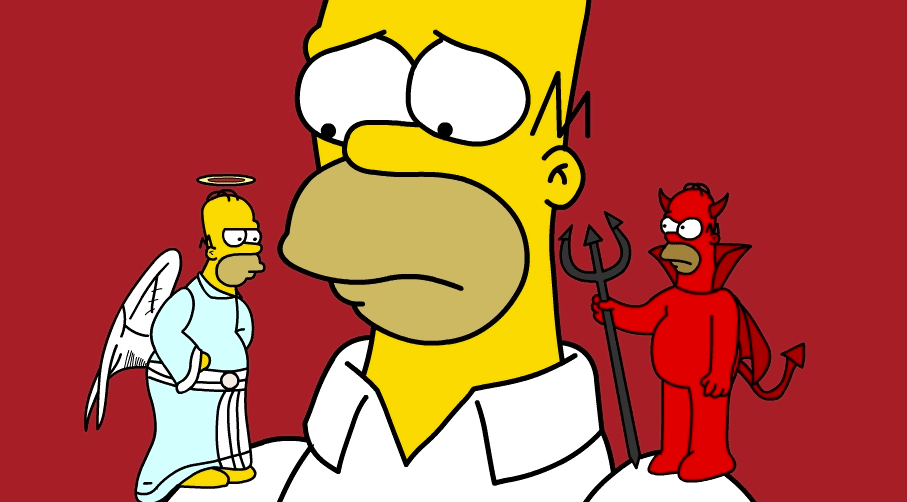
What do you think of when you think of a conscience?  For some it’s the image from old cartoons of a person with an angel on one shoulder and a devil on the other, each giving competing moral advice.  That image is funny partly because it might not be far from the truth.

For some, a conscience is a “moral compass” – that internal voice that helps us distinguish right from wrong.  While this is another good image for a conscience, we have new technology now.  We use GPS now, and when I think of a conscience, the voice of my GPS comes to mind.  Let me explain.

A compass is too simple a metaphor.  The voice of our conscience is not usually like a clear sign or bright, flashing lights pointing the way (although God can use whatever means He chooses).  In my experience, a conscience is more like a broken GPS system, that has many voices, not just one, like a real GPS.  Not that we’re all “hearing voices,” but since our conscience is giving us directions, a voice seems a good metaphor.  You could call it an influence or something else.  Anyway, some of the voices tell us to go places we shouldn’t and not to go places we should, and some of them lead us the right way.  We find ourselves weighing the pros and cons of these multiple voices.  For every decision we make, there’s a reason we make it, and often we don’t explicitly think about why.  It could be something we learned from our culture, our family, our education, or from anything we’ve experienced.  It might come from something we saw or listened to recently, or many years ago.  It could also be something we just invented ourselves.  But it’s there, trying to influence us.

Now not everyone has the same voices in their conscience.  For someone who isn’t a Christian, their GPS considers all the factors it has, and they make decisions as they see fit by prioritizing among the influences.  But for a Christian, salvation requires realizing our GPS is fundamentally broken, trusting someone who knows how to fix it, and then striving to follow the new instructions.  When this happens, a Christian gets an added feature in their internal GPS – a new voice.  This voice is the Holy Spirit, but it doesn’t become the only voice, it just adds one more competing voice to the cacophony. However, the Spirit is the only voice that can be trusted to guide us to the right destination 100% of the time.

As we make decisions in the world, each of us try to follow the advice of our conscience, but we must remember that our consciences are broken until we reach heaven.  Many voices work hard to influence us, and any voice that we follow into disobedience from God can be considered an idol for us.  Only the Holy Spirit speaks with the wisdom needed for us to fulfill our purpose as individuals made in God’s image.

However you think of what a conscience is, let Him rule it, and “in your hearts honor Christ the Lord as holy” – 1 Peter 3:15a

Then you can have a clean conscience, whatever you do.

Lessons from an Unlikely Idol

The history of the kings of Judah can read like a back-and-forth between construction of idols by bad kings and the destruction of idols by good kings.  Hezekiah was one of the few good kings, and one reason is recorded in 2 Kings 18:4, which says:

“[Hezekiah] removed the high places and broke the pillars and cut down the Asherah. And he broke in pieces the bronze serpent that Moses had made, for until those days the people of Israel had made offerings to it (it was called Nehushtan).”

Judah was meant to have only one God, the true God Yahweh, and to destroy anything that would lead them to idolatry.  Unfortunately, worshipping other gods in high places was not uncommon, and neither was worship of Asherah.  What’s interesting about this verse is the mention of this “Nehushtan.”  The origin of this bronze snake that Moses made comes from a story in the book of Numbers.

As often happened while they wandered the wilderness, the people of Israel complained to God and Moses that they would have been better off if still in Egypt.  They hated the food God was providing and accused Him of leading them into the wilderness to die.  As discipline for this grumbling, “the LORD sent fiery serpents among the people, and they bit the people, so that many people of Israel died.”[1]  The people repented and asked for the serpents to be removed, and Moses prayed for them.

The answer was that “Moses made a bronze serpent and set it on a pole. And if a serpent bit anyone, he would look at the bronze serpent and live.[2]  This serpent being lifted up was later identified in John 3:14 as a prelude to Jesus being lifted up on the cross, but in Hezekiah’s day it had become an idol, an object that took people away from worship of the true God and the then-future Christ.  Instead of being a symbol of salvation, the bronze serpent became a symbol of idolatry, which leads to damnation.

The story of the serpents ends there, and there is no mention that God told the people to keep this bronze serpent, or that God told them to give it a name.  This was probably the beginning of the problem, that Israel added to God’s intentions for it.

So, what are the lessons for us?

Nehushtan, the bronze serpent, was created at God’s command to be an aid to worship, a device for reminding His people of His provision for them, from above.  Instead, it became an idol.  What this tells us is that anything, even something once (or currently) used in worship, can become an idol.  Even things like private Bible study or public singing of hymns can be idols if we use them as ends in themselves and not as a way to worship our only God.  A thing can be an idol not because of what it is, but because of our attitude toward it.

Also, something that is an idol to one person might not be an idol to another.  The bronze serpent was not an idol to Moses, but it was to people in Hezekiah’s time.  So, if we know that something tempts us, that thing might not be a temptation for others, and vice versa.  Therefore, we should not be quick to judge others for doing things that bother us, but may not be a problem for them, and are not specifically prohibited in the Bible.

When Christ was raised up on the cross like the bronze serpent and was raised from the dead like those who survived the bites of serpents, He identified Himself as the only God and the only one worthy of our worship, but He also identified Himself as the merciful one who desires that we be merciful to each other.

Like ancient Israel, we all have Nehushtans in our lives that corrupt our worship, and like the good king Hezekiah, we must remove them from our lives to reform our worship.


[1] Numbers 21:6
[2] Numbers 21:9