Being a Master at Washing Feet

English author Samuel Johnson said, “The true measure of a man is how he treats someone who can do him absolutely no good.”  I recently read The Residence, a book of real stories about White House staff over the years.  In a chapter on how staff often go unnoticed comes this humiliating negative example:

President [Lyndon] Johnson often undressed in front of staffers and was famous for rattling off orders while he was sitting on the toilet.  Once, reporter Frank Cormier was shocked to see Air Force One Steward Sergeant and Valet Paul Glynn kneel before the president while they were in midair and wash his feet – all the more so because Johnson never once acknowledged Glynn.

“Talking all the while, Johnson paid no heed except to cross his legs in the opposite direction when it was time for Glynn to attend to the other foot,” Cormier observed.[1]

When looking for an example of a servant being humiliated, author Kate Andersen Brower chose the washing of feet.  Worse than having someone undressing in front of you and worse than being bossed around from a toilet.

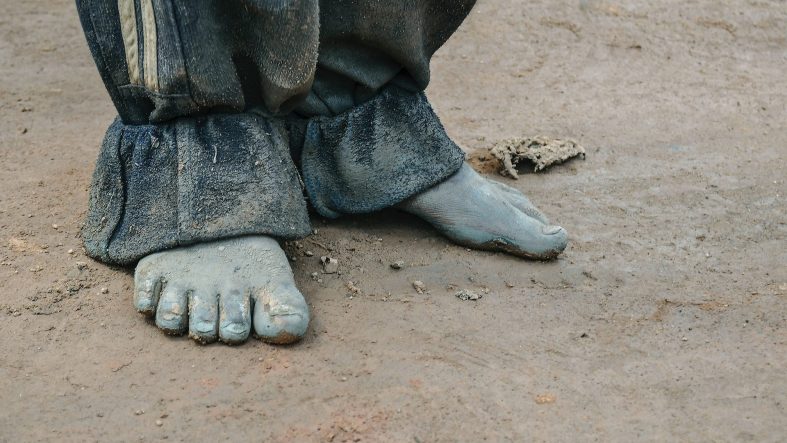
Photo by Felicia Montenegro on Unsplash

Jesus, looking for an example of how his disciples should serve and love each other, chose the same act, but from a different perspective and with a different attitude:

“Jesus, knowing that the Father had given all things into his hands, and that he had come from God and was going back to God, rose from supper. He laid aside his outer garments, and taking a towel, tied it around his waist. Then he poured water into a basin and began to wash the disciples’ feet and to wipe them with the towel that was wrapped around him.” – John 13:3-5

Jesus does not need anything from us, we cannot provide anything He cannot provide for Himself, but He showed us how much He cares by washing His disciples’ feet.  He was willing to experience humiliation for His people, and He asks us to care in the same way:

“For I have given you an example, that you also should do just as I have done to you. Truly, truly, I say to you, a servant is not greater than his master, nor is a messenger greater than the one who sent him.” – John 13:15-16

“The true measure of a man is how he treats someone who can do him absolutely no good.”

Ask Him to give us compassion for those with dirty feet, and to give us the strength to serve as He did.  Because He has washed our dirty feet again and again.


[1] Brower, Kate Andersen.  The Residence: Inside the Private World of the White House.  (2015).  P. 88.

The Priorities of the Good Samaritan

The parable of the Good Samaritan is well-known, even by those who aren’t Christian.  Briefly, it goes like this: a man is robbed, beaten, and left for dead on the side of a road.  First a priest, and then a Levite, passed him by, offering no help at all.  But a Samaritan, a member of a group despised by many Jews, stopped and helped the man, even bringing him to further help and paying the necessary expenses.

There is a lesson in the story about priorities – what this Good Samaritan put first, and what he didn’t.  But before covering his #1 priority, here are some things he did not prioritize, even though these aren’t necessarily bad things:

His first priority was not to fight for stricter laws against robbers.  What the robbers did was probably already illegal, and definitely not morally right.  We don’t know the fate of the robbers in the story, but they might have gotten away with this near murder.  In modern times, if criminals are getting away with bad behavior, a movement sometimes grows to make something that is already illegal “more illegal.”  If robbing is against the law, some might lobby to make the punishment harsher, or to focus laws on particular victims or perpetrators, but if they’re getting away with it now, how will these changes help?  The Good Samaritan couldn’t do much about this immediately, so it wasn’t his first priority.

His first priority also was not to raise public awareness of violence along the highways.  He didn’t create posters and social media hashtags (I write as if those things existed then).  Such a campaign can have benefits.  It could help people be more careful when traveling, it might encourage the government to allocate more of its limited resources toward highway safety, but it will never completely solve the problem. The Good Samaritan couldn’t do much about this immediately, so it wasn’t his first priority either.

Photo by youssef naddam on Unsplash

So, what was the Good Samaritan’s priority?  He focused on what he could control, and any other concerns came later.  He focused on the problem right in front of him – a man beat up and near death on the side of the road.  Sometimes we can focus so much on advocating, that we lose sight of doing.  (I worry about that for myself as someone who spends so much time blogging.)  But the Good Samaritan “proved to be a neighbor[1] by taking care of the neighbor right in front of him.

We can also be deluded into thinking that our government and other institutions should be able to solve all of our problems if only we fight hard enough for it.  However, they never will be enough, because any and all institutions are made up of people who too often deny their own responsibility for the problems of the world. Especially on social media, we often get the illusion that we can offload our responsibility for the world to others, and that what’s happening somewhere else is more important than what’s right in front of us.

While advocacy can be a good and necessary thing, God wants us to prioritize doing, which is what everyone in heaven will do!  In heaven, everyone will be like the Good Samaritan (and like Jesus), and therefore we won’t need better laws, awareness campaigns powered by advertising and hashtags, or stricter enforcement of laws.  The bloody victim by the roadside won’t exist.  And that is something to look forward to!

In the meantime:
“I think each village was meant to feel pity for its own sick and poor whom it can help and I doubt if it is the duty of any private person to fix his mind on ills which he cannot help. This may even become an escape from the works of charity we really can do to those we know. God may call any one of us to respond to some far away problem or support those who have been so called. But we are finite and he will not call us everywhere or to support every worthy cause. And real needs are not far from us.” – C.S. Lewis


[1] Luke 10:36

God is Faithful in Trouble

Fellow travelers,

Psalm 71 was likely written by an old man, looking back over his life and the many instances of God’s faithfulness.  Looking back over a lifetime of walking with God strengthens his current faith, and he writes to strengthen ours.  Although some might expect a testimony of God’s faithfulness to talk about uninterrupted good fortune and all the good times the Psalmist has had, in verse 20, they write:

You who have made me see many troubles and calamities
            will revive me again;
from the depths of the earth
            you will bring me up again.”

This man’s life, like most people’s lives, was filled with “many troubles and calamities,” yet these only strengthen his faith because God has rescued him every time in the past.  Without allowing us to experience trouble, how could God develop a track record of rescuing us?  John Calvin comments on this verse that:

“Had he always enjoyed a uniform course of prosperity, he would no doubt have had good reason to rejoice; but in that case he would not have experienced what it is to be delivered from destruction by the stupendous power of God. We must be brought down even to the gates of death before God can be seen to be our deliverer.”

God is always faithful, but we experience it especially in bad times.

Amen.

Bible in a Year: Week of March 11-17

Fellow travelers:

Below are the chapters to read this week if you’re following along in my Bible in a year schedule, divided into morning and evening readings.  Follow along any way you want: just do the evening reading, flip the morning and evening, read it all.  Whatever works for you and your schedule!  It doesn’t have to be Bible in a Year for everyone.

Last week I fell behind a bit on both Exodus and 2 Kings – it happens – but I’m catching up.

Monday, March 11
Morning: Psalm 71, 2 Kings 14
Evening: Exodus 21

Tuesday, March 12
Morning: Psalm 72, 2 Kings 15
Evening: Exodus 22

Wednesday, March 13
Morning: Psalm 73, 2 Kings 16
Evening: Exodus 23

Thursday, March 14
Morning: Psalm 74, 2 Kings 17
Evening: Exodus 24

Friday, March 15
Morning: Psalm 75, 2 Kings 18
Evening: Exodus 25

Saturday, March 16
Morning: Psalm 76, 2 Kings 19 – 20
Evening: Exodus 26

Sunday, March 17
Morning: Psalm 77, 2 Kings 21-22
Evening: Exodus 27

The Sovereign Over Nations

Fellow travelers,

Jesus said in Luke 14:11 – “For everyone who exalts himself will be humbled, and he who humbles himself will be exalted.”  Centuries earlier, the prophet Isaiah used striking word pictures to show that God does this with entire nations, not just with individual people.

First, Isaiah describes the ancient nation of Babylon as a woman, who exalted herself but will be humbled, in Isaiah 47:1-3:

Come down and sit in the dust,
            O virgin daughter of Babylon;
sit on the ground without a throne,
            O daughter of the Chaldeans!
For you shall no more be called
            tender and delicate.
Take the millstones and grind flour,
            put off your veil,
strip off your robe, uncover your legs,
            pass through the rivers.
Your nakedness shall be uncovered,
            and your disgrace shall be seen.
I will take vengeance,
            and I will spare no one.”

Ancient Babylon exalted themselves above all nations, claiming to be the greatest power ever in the world.  Here Isaiah says Babylon will be publicly disgraced, called down from the throne, and made to do menial labor.  While God had used Babylon to judge His people and bring them into exile, Babylon would not escape being humbled before God.

Then Isaiah gives a contrasting picture about the future of God’s people in a humble woman who will be exalted in Isaiah 52:1-2:

Awake, awake,
            put on your strength, O Zion;
put on your beautiful garments,
            O Jerusalem, the holy city;
for there shall no more come into you
            the uncircumcised and the unclean.
Shake yourself from the dust and arise;
            be seated, O Jerusalem;
loose the bonds from your neck,
            O captive daughter of Zion.”

Here the “daughter of Zion,” God’s family, will be freed from bondage and put on beautiful garments.  Spiritually, this means His people will be freed from slavery to sin, which will not exist in the new heaven and earth to come.  What a glorious future we have!

Therefore, “Humble yourselves before the Lord, and he will exalt you.” – James 4:10