Missionaries Saved By Mysterious Army: History for March 28

Even people who believe in angels and demons may not see how they are relevant.  The Bible contains a lot of hints about a spiritual world we can’t see, but not a lot of detail about what it all means to us.  One of these hints is in the Old Testament book of 2 Kings during a war between Israel and Syria.  Trying to kill the prophet Elisha, the Syrian army surrounded the city of Dothan where he was staying.  Elisha’s servant saw the army, was worried and asked Elisha what they should do.  Elisha (and the LORD) responded:

“He said, ‘Do not be afraid, for those who are with us are more than those who are with them.’ Then Elisha prayed and said, ‘O LORD, please open his eyes that he may see.’ So the LORD opened the eyes of the young man, and he saw, and behold, the mountain was full of horses and chariots of fire all around Elisha.” – 2 Kings 6:16-17

On today’s date, March 28th, in 1953 something happened in Kijabe, Kenya which may be eerily similar to the events of 2 Kings.  I know several solid, Christian, professional people not known for sensationalism who were at the site of this event a handful of years later, and who spoke to people who witnessed it.  For this post, my primary source is the book “School in the Clouds: The Rift Valley Academy Story” by Phil Dow[1], but I could have written it entirely from second-hand accounts from people I know.  So, what happened?

In the decade of the 1950’s, Kenya was a British colony, but was embroiled in what is known as the Mau Mau, an extremely violent uprising against British rule.  Colonialism had added a new facet to tribal animosity in Kenya that existed long before the “Scramble for Africa”[2], where some Africans embraced and defended British efforts, while others strongly resented it and endorsed any means to repel the British and restore the “pure” African culture that existed before.

As part of a broader pattern of atrocities designed to scare the British into leaving, the Mau Mau planned an attack on Rift Valley Academy (RVA), a boarding school for children of missionaries.  Not only was the school symbolic of unwelcome outside influence in the eyes of the Mau Mau, but the school had also opened its doors as a refuge for Africans fleeing Mau Mau threats elsewhere.  On March 26th, Mau Mau fighters attacked a Christian group of Kikuyu (one of the Kenyan tribes) a few miles from RVA, killing 97 villagers and wounding 32 others, largely with machetes.  The Kikiyu tribe, historically a lower socioeconomic group, was divided between those who joined the Mau Mau for independence and those who backed British involvement because they saw Christianity and other Western influences as a positive.

RVA was on high alert, knowing the campus of schoolchildren and their caregivers were the Mau Mau’s next target.  Phil Dow wrote in his book:

“The sun rose Saturday morning accompanied by a host of rumors that confirmed an impending Mau Mau raid on RVA. Convinced that they would be attacked, several high school girls took time in the afternoon to write letters they hoped would be read by their parents if they were to be killed. That night the students went to bed under a star-filled sky fully clothed and expecting to be awakened by the sounds of gunfire and angry voices.”

They were awakened in the middle of the night to the sound of an alarm, some distant gunfire, but soon followed by an “all clear” bell.


Weeks later, some Mau Mau were caught hiding near the school and questioned about what happened on the night of March 28th.  They confirmed that an attack on RVA was attempted with the intention of burning the school to the ground and killing anyone they found there, but the attack was repelled by lines of British soldiers encircling the campus.  Later, other witnesses claimed the same.  However, “in March of 1953 there were no British soldiers at Kijabe.”  Multiple sources on RVA’s campus and among British authorities attest that the campus was vulnerable and mostly undefended, but something happened that spared the community and the lives of everyone in it so that the missionary work could continue.  The attempted attack raised the awareness of the British and provided time for them to install “protection of the very worldly kind” for RVA, including limited troops stationed there, along with defensive walls, barbed wire, and guard posts with mounted machine guns.

Dow concludes: “Whatever did happen that night, the Christian community at RVA was convinced that they had been kept safe by supernatural intervention. Indeed, the night’s events continue to be remembered as an example of God’s provision for the devoutly Christian community.”

What Elisha said in the Old Testament as:
“Do not be afraid, for those who are with us are more than those who are with them”

Paul echoes in the New as:
“What then shall we say to these things? If God is for us, who can be against us?  He who did not spare his own Son but gave him up for us all, how will he not also with him graciously give us all things?” – Romans 8:31-32

Amen.


Interested in more History? Select “History Bits” from the “Blog” drop down menu at the top of the page.


[1] Dow, Phil. School in the Clouds: The Rift Valley Academy Story.  (2003).  P. 130-132
[2] See summary at https://en.wikipedia.org/wiki/Scramble_for_Africa
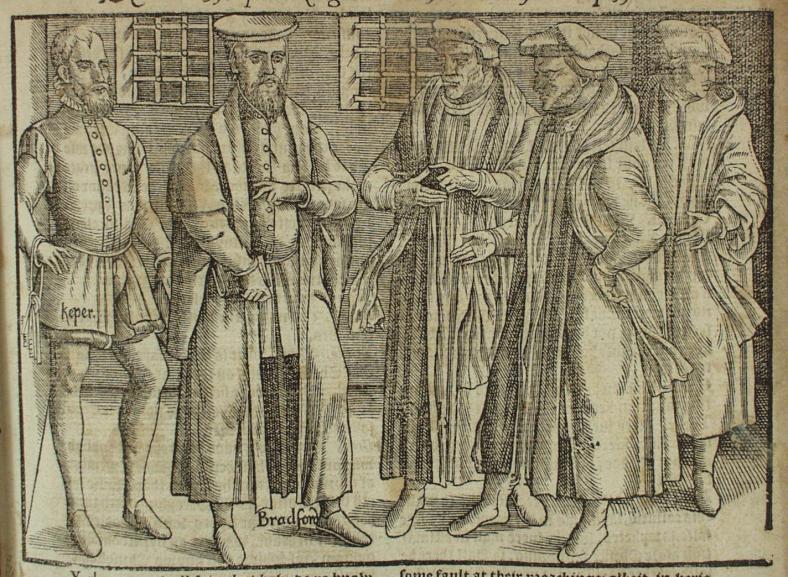
There Goes John Bradford (to Paradise): History for February 24

Born in 1510, John Bradford was a rising Protestant minister during the reign of King Edward VI in England and was well known for his pious dedication and unselfish nature.  After studying at Cambridge and preaching regularly around London, he was appointed as Chaplain to the King in 1551.  The common expression “There but for the grace of God go I” is often attributed to him and was a reminder to himself that grace alone has saved him.  An 1822 book on prayer says that:

“The pious Martyr Bradford, when he saw a poor criminal led to execution, exclaimed, ‘there, but for the grace of God, goes John Bradford’. He knew that the same evil principles were in his own heart which had brought the criminal to that shameful end.”[1]

Bradford and others in the Tower of London, from John Foxe’s Book of Martyrs (1563). Public Domain.

His worldly fortunes changed in 1553 when the Catholic Mary I became Queen, and one of her first priorities was persecution of prominent Protestants.  Bradford was arrested within a month, imprisoned in the Tower of London, and sentenced to death.  While in the Tower, he wrote a letter to his mother on this date, February 24, in 1554, that included a powerful statement about prayer: God “doth put off our prayers, that he might recompense it with abundance, that is, that he might more plentifully pour upon us the effect of our petitions.” [2]  On July 1, Bradford was burned alive at the stake.

In another book on prayer, Donald McKim wrote about Bradford’s letter:
“We can imagine that no one would seek an answer to his prayers more ardently than Bradford while awaiting death. Yet he believed that even with no apparent answers to prayers, God plentifully pours abundance on those who pray!
At the end of his letter Bradford mentions God’s promise-which believers receive and anticipate, even in the midst of their sufferings and afflictions. Paul recorded the promise: “What no eye has seen, nor ear heard, nor the human heart conceived, what God has prepared for those who love him” (1 Cor. 2:9) Plentiful abundance! Now and forever!”[3]

In John Bradford’s story, there is a terrible irony between two things he is known for – a common phrase and his martyrdom – but in the end, God is faithful, and I hope to meet Bradford someday in Paradise, where the grace of God has bought me a place.


[1] Bickersteth, Edward.  A Treatise on Prayer.  (1822).  Sourced from https://en.wikipedia.org/wiki/John_Bradford
[2] McKim, Donald K.  Everyday Prayer with the Reformers (2020).  P. 92.
[3] Ibid.

The Death of Chairman Mao – History for September 9

Photo by manos koutras on Unsplash

On this date in 1976, Mao Zedong, or Chairman Mao, founder of the communist People’s Republic of China, died at the age of 82.  Some look at Mao’s death as a positive turning point for Christianity in China, since under Mao China had expelled all Western Christian missionaries between 1949 and 1953.  However, while it is impossible to come up with precise numbers across a 3.7 million square mile country, Christians probably were about 1 percent of China’s population when Western missionaries were kicked out, but by the 1980s about 5 percent of the population went by Christ’s name.  The Christian population grew by ten times, while the overall population doubled.  How did this happen?

Mark Noll and Carolyn Nystrom, authors of the book “Clouds of Witnesses” say the key to this growth was “the resilience of the Chinese believers themselves…securely rooted in Chinese life before Mao.” [1]  In expelling missionaries, Mao was in part responding to “treaty ports” created at the end of the 1839-42 Opium War.  Through these ports foreign powers had extra territorial rights, allowing influences including missionaries to come in, but these ports also allowed opium to flow freely into China from Western countries.  Therefore, in the mind of many Chinese, Christianity became linked with both Western imperialism and opium addiction.  When Karl Marx said “religion is the opiate of the masses” he may have been thinking of this connection.  But native Chinese believers, sometimes planted by Europe-based evangelizing organizations like China Inland Mission, remained behind and spread resilient forms of Christianity that were attractive to the Chinese population.

John Sung
Several of these Chinese Christians are profiled by Noll and Nystrom, including John Sung who lived from 1901 to 1944, before Mao’s communist revolution.  Around Christmas 1926, Sung heard child evangelist Uldine Utley preach a sermon at Calvary Baptist Church in New York, near where he was attending Union Theological Seminary.  This sermon, along with other influences, countered the liberal Christianity he was being taught where the Bible was just “a collection of myths.”  He returned to China, determined to spread the gospel in the land of his birth with frenetic energy.  In a one-year period in 1931-2, Sung and a small group of missionaries “traveled over 50,000 miles, held 1,200 meetings, preached to more than 400,000 people in thirteen provinces, registered more than 18,000 ‘decisions’” for Christ.  Many of these new Christians formed traveling bands themselves.  Sung is considered the last great evangelist in China and Southeast Asia before Mao’s reign. 

Dora Yu
Even earlier, another driver of this resilient, Chinese Christianity was Dora Yu (1873-1931).  Dora’s ministry benefitted tremendously from a 1905 decision by Dowager Empress Cixi to replace China’s traditional Confucian civil service examinations with general public schools.  Under this system, mission-run schools became a valued option, and one of Dora’s early ministries was to train “Bible women” to not only educate women generally, but also to teach them the Bible, pray with them, and teach them to live by faith.  Mostly traveling by foot, in “1903, Dora Yu visited with 925 women and 211 children.”  Later, her ministry grew and she became famous for itinerant preaching, reaching many others who would carry on the Lord’s work.

Because of our proneness to look at
the bucket and forget the fountain,
God has frequently to change His
means of supply to keep
our eyes fixed on the source

Watchman Nee

Watchman Nee
In 1920, Nee Shu-Tsu would hear Dora Yu preach.  Later known as Watchman Nee, he “planted at least four hundred Christian churches over a thirty-year period of active ministry.”  He died in 1972 in a Communist prison after spending 20 years there.  Watchman Nee wrote that “Because of our proneness to look at the bucket and forget the fountain, God has frequently to change His means of supply to keep our eyes fixed on the source.”

Whether it is a European missionary, a child preacher in New York City, a Chinese man temporarily studying in New York City, or a Chinese woman walking miles through the countryside:

“How beautiful upon the mountains
            are the feet of him who brings good news,
who publishes peace, who brings good news of happiness,
            who publishes salvation,
            who says to Zion, ‘Your God reigns.’” – Isaiah 52:7

As Jesus said in Matthew 16:18 – “And I tell you, you are Peter, and on this rock I will build my church, and the gates of hell shall not prevail against it.”  This rock is the gospel of the kingdom of God, and not even a brutal regime like that of Chairman Mao could prevail against it.

Soli Deo Gloria


[1] Noll, Mark A.; Nystrom, Carolyn.  Clouds of Witnesses: Christian Voices from Africa and Asia (2011).  This post is drawn from chapters 12 and 14.

The Fog God Hath Wrought – History for August 30

Photo by Carsten Stalljohann on Unsplash

On March 5th, 1776, a sudden change in the weather led to a decisive victory for the American Revolutionary Army and an end to the British occupation of Boston (see my post on that date here).  On this date, August 30, in 1776, weather intervened again.  The American Revolution could have ended in bitter loss, but for “a peculiar providential occurrence” – Pea-soup fog.  “So very dense was the atmosphere,” remembered Benjamin Tallmadge, “that I could scarcely discern a man at six yards’ distance.”  For the book “What Ifs? Of American History”, historian David McCullough wrote a chapter describing the significance of these events.[1]

After a humiliating loss in Brooklyn (including more than 1,000 surrendered troops), George Washington found himself and his 9,000-man army cornered at the end of a peninsula by a British force numbering over 30,000, plus a vast navy.  Left with few options and overwhelming odds, George Washington quickly ordered the army to evacuate Brooklyn overnight by anything they could find or make that would float, across the East River to Manhattan.  The escape depended entirely on the element of surprise and the cover of darkness.  The scale and boldness of the escape was enormous – one Connecticut man recalled crossing the river 11 times that night, ferrying troops and equipment across.  The evacuation continued well into the morning, when the British might easily have seen what was happening, close in, and utterly destroy Washington’s army.

However, the escape remained concealed under a different kind of darkness, because “a heavy fog settled in over the whole of Brooklyn, concealing everything no less than had the night”[2]  By the time the fog cleared, the escape was complete, and the British, expecting a victorious day, were instead astonished by another overnight, weather-assisted, disappearing act by the American army.

McCullough says that without the fog: “Washington and half the Continental Army would have been in the bag, captured, and the American Revolution all but finished. Without Washington there almost certainly would have been no revolution.”  Because of the fog, “the entire force, at least nine thousand troops, possibly more, plus baggage, provisions, horses, field guns, everything but five heavy cannon that were too deep in the mud to budge, had been transported over the river in a single night with a makeshift emergency armada assembled in a matter of hours. Not a life was lost.”

This was not the first time, nor would it be the last time, that weather – or Providence – would play a key role in the American struggle to break away from British rule.  Therefore, let every people and nation seek the LORD this day, who can wield nature itself in favor of – or against – the very nations.

“Are there any among the false gods of the nations that can bring rain?
Or can the heavens give showers?
Are you not he, O LORD our God?
We set our hope on you,
for you do all these things.” – Jeremiah 14:22


[1] From “What the Fog Wrought.” David McCullough and Robert Cowley.  What Ifs? Of American History (2003).  P. 52-54.
[2] McCullough, David.  1776 (2005).  P. 191.

The Affair of the Sausages: History for March 9

The idea that the Protestant Reformation began with Martin Luther nailing the ninety-five theses to the door of All Saints’ Church in Wittenberg, Germany is fairly well known.  Less known is that the spark for Reformation in nearby Switzerland was a controversy over sausages.

March 9th was the first day of Lent in 1522, and Huldrych Zwingli, a pastor in Zurich, Switzerland, was the guest of printer Christoph Froschauer, who published some of Zwingli’s sermons and later his translation of the Bible into German.  Froschauer, working long hours with his staff, invited Zwingli to dinner on March 9th and served slices of smoked sausage to fortify everyone for the work ahead.  However, during Lent eating meat was illegal under the Catholic church-run government at the time, and Zwingli was arrested along with others at the dinner.

Photo by Rich Smith on Unsplash

Zwingli said he did not eat any sausage and so was spared the indignity of arrest, but the event was a turning point for him, and about one month later he preached a sermon titled “Freedom of Choice and Selection of Food” where he argued for freedom of conscience regarding observance of Lent.  The sum of the sermon was: “if you want to fast, do so; if you do not want to eat meat, don’t eat it; but allow Christians a free choice.”[1]

Zwingli, having previously been only loosely connected to Martin Luther and other Reformation figures and ideas, was appalled by the prioritization of state and priestly authority over the authority of God in each person’s heart:

“If you would be a Christian at heart, act in this way. If the spirit of your belief teaches you thus, then fast, but grant also your neighbor the privilege of Christian liberty, and fear God greatly, if you have transgressed his laws, nor make what man has invented greater before God than what God himself has commanded…You should neither scorn nor approve anyone for any reason connected with food or with feast days whether observed or not.”

Also in the sermon, Zwingli emphasizes the “why” a Christian does what he does over the “what”:

“Here is another sign of the times. I think that there is danger of this age being evil and corrupt rather than reaching out towards everlasting righteousness. Further, simple people think everything is all right if they go to confession in Lent only, observe the fast, take Communion and thus account for the whole year. God should, however, be acknowledged at all times and our life should be one of piety, whereas we act to the contrary when we think that it is quite enough if we pay attention only to the times of fasting whereas Christ says, ‘Be vigilant: for you know not the day or the hour’”

In an earlier post on Lent, I wrote that whatever our liturgy, it is useless as a “bargaining chip” with God, and that “if we do not value the prize – God Himself – nothing we give up for Lent will make us – or God Himself – happy.”  Zwingli became a forceful voice during the Reformation arguing that external pressure from church and state can strip us of grace and enslave us to legalism, but he also recognized with Paul that “Every athlete exercises self-control in all things”[2]  Self-control cannot be forced by others, but in search of an “imperishable” prize, each should prayerfully consider the disciplines that help them better serve God, in accordance with His word, while showing grace towards others who God may ask to behave differently.  Not all athletes compete in the same events and train the same way.

Closing Note
I once considered naming this blog “Lenten Sausages” after the events described above, but that might have defined the blog as what it’s against.  Instead, the current name emphasizes the common destiny of all for whom Christ was crucified.  Every Christian became one because of Christ.  Before there were Protestants there were Christians.  Many of them.  After there were Protestants there are Catholic believers and Protestant nonbelievers, and vice versa.  One man’s liturgy is sometimes another man’s legalism.  Regardless of what’s on the sign in front of your church, it’s what’s inside that matters.

Soli Deo Gloria


[1] Zwingli, Huldrych.  “Freedom of Choice and Selection of Food.”  (1522)
[2] 1 Corinthians 9:25