Marlboro Man Needs the Gospel

Marlboro Man was a character used to advertise Marlboro cigarettes starting in 1954.  He became a cliché of a rugged man, often shown on horseback with a cowboy hat and some rope, confidently smoking a cigarette, and was portrayed by several different actors until 1999.  However, the origin of this famous ad campaign isn’t as well known.

Before the manly Marlboro Man manifested in 1954, Marlboro was sold as a feminine cigarette, with a red-colored filter at the tip.  Ads had phrases like “Ivory Tips Protect the Lips,” and touted that lipstick on the cigarette wouldn’t matter since it was red anyway.  But later, when the health risks of cigarette smoking came to light, Philip Morris & Co. wanted to sell Marlboro to men on the idea that filters made smoking “safer.”  However, given Marlboro’s feminine image – created through advertising – Philip Morris had to overcome that connotation, so the red tips were removed, and Marlboro Man was born as a way to sell Marlboro cigarettes to men concerned about lung cancer and other health risks.

Marlboro Man ad on a Warsaw, Poland building.

With hindsight, we know that filters don’t make smoking safer.  Ironically, and sadly, five different men who appeared in Marlboro advertisements died of smoking-related diseases, earning Marlboro cigarettes the nickname “cowboy killers.”[1]

Also with hindsight, we can see the massive power of advertising to shape our perceptions.  The Marlboro Man campaign is considered in the ad industry to be one of the best of all time, changing a “feminine” product into one of stereotypical masculinity almost overnight.  But the campaign also shows us that “There is a way that seems right to a man, but its end is the way to death”, as Proverbs 14:12 and 16:25 say.  In this case, it was very literal death in this world.

To make Philip Morris money, the ads declared that smoking was not a “way to death,” but that it was “right to a man” to be like the Marlboro Man.  It’s not entirely unlike the line “the greatest trick the Devil ever pulled was convincing the world he didn’t exist,” which was spoken by Kevin Spacey’s character in the 1995 movie, The Usual Suspects.  This line was a paraphrase of a line at least as old as the 1850’s.[2]

I recently heard a sermon where the pastor said, “the culture is trying to kill you,” and I don’t think it was an exaggeration.  Just as Marlboro ads first convinced people it was a feminine product, then turned on a dime to convince people it was a masculine product, without any real change to what was being sold, we’re all bombarded by dangerous messages every day, and many will only be seen in the broader culture as dangerous with the benefit of hindsight.  Smoking used to be considered normal.

I’m not writing this to condemn smokers, because we all have our bad habits, but to spotlight the importance of an eternal perspective.  Any culture is limited to the perspective of its leaders in that time and circumstance, and the pull of peer pressure is real.  Every culture in this world has “a way that seems right to a man, but its end is the way to death,” but also every culture needs the gospel more than it needs effective advertising campaigns.

Therefore, as the apostle Peter wrote in 1 Peter 3:8-9 – “Finally, all of you, have unity of mind, sympathy, brotherly love, a tender heart, and a humble mind.  Do not repay evil for evil or reviling for reviling, but on the contrary, bless, for to this you were called, that you may obtain a blessing.”

Marlboro Man needs the good news of the gospel, not condemnation.


[1] https://en.wikipedia.org/wiki/Marlboro_Man
[2] https://quoteinvestigator.com/2018/03/20/devil/

What is Our Conscience?

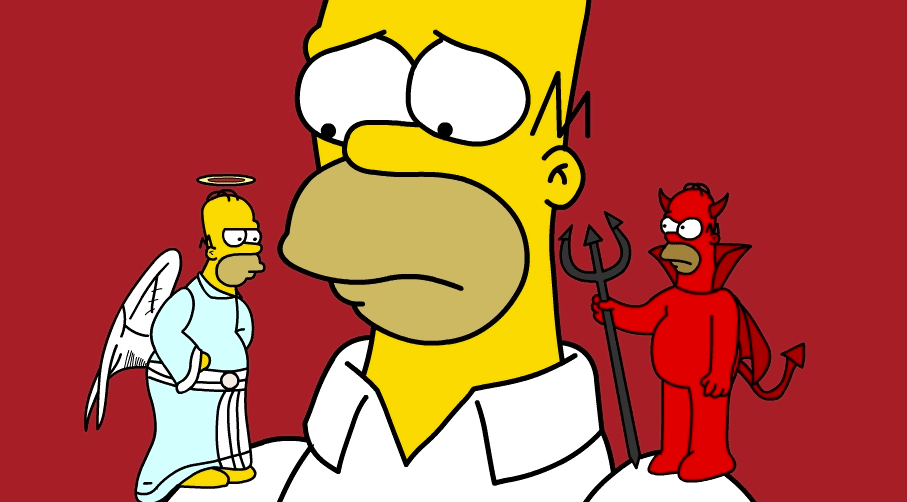
What do you think of when you think of a conscience?  For some it’s the image from old cartoons of a person with an angel on one shoulder and a devil on the other, each giving competing moral advice.  That image is funny partly because it might not be far from the truth.

For some, a conscience is a “moral compass” – that internal voice that helps us distinguish right from wrong.  While this is another good image for a conscience, we have new technology now.  We use GPS now, and when I think of a conscience, the voice of my GPS comes to mind.  Let me explain.

A compass is too simple a metaphor.  The voice of our conscience is not usually like a clear sign or bright, flashing lights pointing the way (although God can use whatever means He chooses).  In my experience, a conscience is more like a broken GPS system, that has many voices, not just one, like a real GPS.  Not that we’re all “hearing voices,” but since our conscience is giving us directions, a voice seems a good metaphor.  You could call it an influence or something else.  Anyway, some of the voices tell us to go places we shouldn’t and not to go places we should, and some of them lead us the right way.  We find ourselves weighing the pros and cons of these multiple voices.  For every decision we make, there’s a reason we make it, and often we don’t explicitly think about why.  It could be something we learned from our culture, our family, our education, or from anything we’ve experienced.  It might come from something we saw or listened to recently, or many years ago.  It could also be something we just invented ourselves.  But it’s there, trying to influence us.

Now not everyone has the same voices in their conscience.  For someone who isn’t a Christian, their GPS considers all the factors it has, and they make decisions as they see fit by prioritizing among the influences.  But for a Christian, salvation requires realizing our GPS is fundamentally broken, trusting someone who knows how to fix it, and then striving to follow the new instructions.  When this happens, a Christian gets an added feature in their internal GPS – a new voice.  This voice is the Holy Spirit, but it doesn’t become the only voice, it just adds one more competing voice to the cacophony. However, the Spirit is the only voice that can be trusted to guide us to the right destination 100% of the time.

As we make decisions in the world, each of us try to follow the advice of our conscience, but we must remember that our consciences are broken until we reach heaven.  Many voices work hard to influence us, and any voice that we follow into disobedience from God can be considered an idol for us.  Only the Holy Spirit speaks with the wisdom needed for us to fulfill our purpose as individuals made in God’s image.

However you think of what a conscience is, let Him rule it, and “in your hearts honor Christ the Lord as holy” – 1 Peter 3:15a

Then you can have a clean conscience, whatever you do.

“If Necessary”

All Christians face trials for following Jesus.  These can range from being disregarded or ignored, all the way to physical persecution and even death.  In the face of these trials, Christians can feel targeted or that their trials are unfair.  However, Peter assures us that all the trials we face for Jesus have a purpose.

In 1 Peter 1:6-7, he wrote: “In this you rejoice, though now for a little while, if necessary, you have been grieved by various trials, so that the tested genuineness of your faith—more precious than gold that perishes though it is tested by fire—may be found to result in praise and glory and honor at the revelation of Jesus Christ.”

Note the words “if necessary.”  Those words beg the question of what is necessary and who decides that it is necessary?  Do we get to pick and choose our own trials, or would we probably choose to avoid them altogether?  Should we trust ourselves to choose wisely?  If we chose for ourselves, we might pick only trials we’ve already overcome or ones we are sure we can handle, but as Warren Wiersbe wrote: “We must not think that because we have overcome one kind of trial that we will automatically ‘win them all.’ Trials are varied, and God matches the trial to our strengths and needs.”[1]

Fortunately for all of us, God is the one who decides if, when, and why trials are “necessary.”  He decides whether we have trials, and only He knows all of the flaws in our faith and the best way for us to overcome them and grow in faith.  He ensures we face only “necessary” trials that test the “genuineness” of our faith and turn it into something “more precious than gold.”  These trials expose our impurities so that they may be removed.  Because of the words “if necessary,” we can rejoice in our salvation even when going through trials of all kinds.  They aren’t random or meaningless.

Therefore, we can rejoice even in our trials knowing they will “result in praise and glory and honor at the revelation of Jesus Christ.”  Any time we feel “grieved by various trials” we know they are temporary, and they serve God’s purpose for us.

Amen.


[1] Wiersbe, Warren.  Be Hopeful (1 Peter) (1982).  P. 35.

Suffering of the Beloved

Many Psalms contemplate the reality of evil and suffering in the world, but in most cases, those Psalms end on a note of hope.  For example, Psalm 73 details the Asaph’s envy of the success and prosperity of the wicked in this world.  He considered following their path, and verse 2 says “But as for me, my feet had almost stumbled, my steps had nearly slipped.”  But by verse 28, the last verse of the Psalm, the writer is hopeful and returning to praise for God in faith:

But for me it is good to be near God;
            I have made the Lord GOD my refuge,
            that I may tell of all your works.

In contrast, Psalm 88 begins like this:
O LORD, God of my salvation,
            I cry out day and night before you.”

And ends like this (verse 18):
You have caused my beloved and my friend to shun me;
            my companions have become darkness.”

This is perhaps the low point of the Psalms, or even the whole Bible, ending with neither hope or praise, but only faith expressed in desperate prayer.  The Psalmist, Heman[1] the Ezrahite according to the introduction, describes himself like this: “For my soul is full of troubles, and my life draws near to Sheol” (verse 3).  And like this: “Afflicted and close to death from my youth up” (verse 15).  After writing that his companions have shunned him, he says that “my eye grows dim through sorrow,” which I take to mean that his sorrow is so great it is clouding his perception of everything.  Sorrow is all he can see.  Heman feels he is near death, perhaps because of sickness or depression, or maybe because society has rejected him, and he feels left for dead (verse 8).

Such despair isn’t as uncommon as we might think in the face of trouble.  The apostle Peter needed to encourage his first-century audience with these words in 1 Peter 4:12: “Beloved, do not be surprised at the fiery trial when it comes upon you to test you, as though something strange were happening to you.”  Note that to Peter, suffering is not “strange” for a Christian, nor should we “be surprised” by it.  Peter’s comment was immediately referring to persecution, but the same idea applies more broadly.  Suffering is part of life in this world – for anyone.

But also notice the first word in the verse: “Beloved.

Peter begins his statement about suffering with this so that those experiencing suffering do not think that God does not love them.  Our circumstances don’t, and can never, mean that we are not loved by God.  For us in modern times, we might be “surprised” by trials if we live in places friendly and welcoming to Christian culture.  Those who live in places hostile to Christianity may not be as surprised at trials that come, but need reassurance that they are loved.  In these places, that trials are not “strange,” but common, could bring people to a place without hope.

Photo by Wesley Tingey on Unsplash

However, when we are feeling like Heman, God still loves us, and like Heman we can pour out all our frustration to God.  He can take it.  Even when we are in “the valley of the shadow of death,[2] He remains with us and will sustain us.  When it seems we have nothing else, He will be there and listen.

Consider whether the Father did not love the Son when He suffered, or whether His suffering was proof that He loves us?   Therefore, Peter goes even farther in 1 Peter 4:13-14 – “But rejoice insofar as you share Christ’s sufferings, that you may also rejoice and be glad when his glory is revealed. If you are insulted for the name of Christ, you are blessed, because the Spirit of glory and of God rests upon you.

Good Friday was not the end of Jesus’ story, and although the day had three hours of darkness, the Son rose again and there was light!  Likewise, Psalm 88 was not the end of the Psalms; the last Psalm (150), begins like this:

Praise the LORD!
Praise God in his sanctuary;
            praise him in his mighty heavens!

And ends like this:
Let everything that has breath praise the LORD!
            Praise the LORD!

He is risen and you are Beloved.  Amen.


[1] Not He-Man, one of the fictional Masters of the Universe.
[2] Psalm 23:4

Letting God Set the Agenda

One of the most significant ways the media influence us is by what’s called “agenda setting,” which means is that they tell us what is important and what we should care about by choosing what issues or topics to cover most often and most prominently.  For example, if a topic appears regularly on the front pages of newspapers or the covers of magazines or in the “Breaking News” of a TV news program, those editors have decided those items are more important, and want us to feel the same.  Unfortunately, there’s also an old saying in journalism that “if it bleeds, it leads,” meaning that bad news should get more coverage because it’s good for the business of journalism.

Related, but not the same, is “framing” which means the way the media covers something (the words they use, the sources they cite, etc.) affects our attitudes about it.  When the media consistently use words like “radical” or “extreme” to represent only the other side, or if they lump all the news that bleeds to a specific group of people and not another, they’re employing framing.

The problem is that the same issues aren’t always as important to all people, and often the media’s agendas don’t align with what should be each person’s agenda.  It’s like news coverage is designed to make us think the world is so evil that we can’t do anything about it, but also that very little is our own responsibility (or fault).  As Corrie ten Boom wrote about her time in a Nazi concentration camp: “this was the great ploy of Satan in that kingdom of his: to display such blatant evil that one could almost believe one’s own secret sins didn’t matter.”

Is it really good or healthy to feel all the world’s problems are on our shoulders? However, all media have to make choices about what to cover and how to cover it, so there is no avoiding these problems…unless you have another source for your agenda and the framing of it.  That source is God, and here are some verses from His word that can guide us:

Cast Your Anxieties
Humble yourselves, therefore, under the mighty hand of God so that at the proper time he may exalt you, casting all your anxieties on him, because he cares for you.” – 1 Peter 5:6-7

We can recognize that there is a sovereign God, and ultimately His agenda is the only one that matters.  With that knowledge, we know that there are many times where all we can do is pray to the One who sees all the bad news we do, and much more.  He is in control.

If It’s Worthy, It Leads
Finally, brothers, whatever is true, whatever is honorable, whatever is just, whatever is pure, whatever is lovely, whatever is commendable, if there is any excellence, if there is anything worthy of praise, think about these things.” – Philippians 4:8

We can recognize that good news isn’t always easy to find, but we should seek it out, even if it’s in our own homes, families, or neighborhoods.  There is always something worthy of praise to pay attention to.

Frame Your Responsibility Locally
For we are his workmanship, created in Christ Jesus for good works, which God prepared beforehand, that we should walk in them.” – Ephesians 2:10

Too much attention to the big picture problems of the world can distract us from the work God has put right in front of us, which we were created to do.  God wants us to be faithful, not to save the world (He has already done that!)

I agree with C.S. Lewis, who wrote: “I think each village was meant to feel pity for its own sick and poor whom it can help and I doubt if it is the duty of any private person to fix his mind on ills which he cannot help. This may even become an escape from the works of charity we really can do to those we know. God may call any one of us to respond to some far away problem or support those who have been so called. But we are finite and he will not call us everywhere or to support every worthy cause. And real needs are not far from us.”

Yes, global problems matter and there is always a lot of bad news, but today let God set your agenda and frame it through the lens of His eternal victory in Christ.