What is Our Conscience?

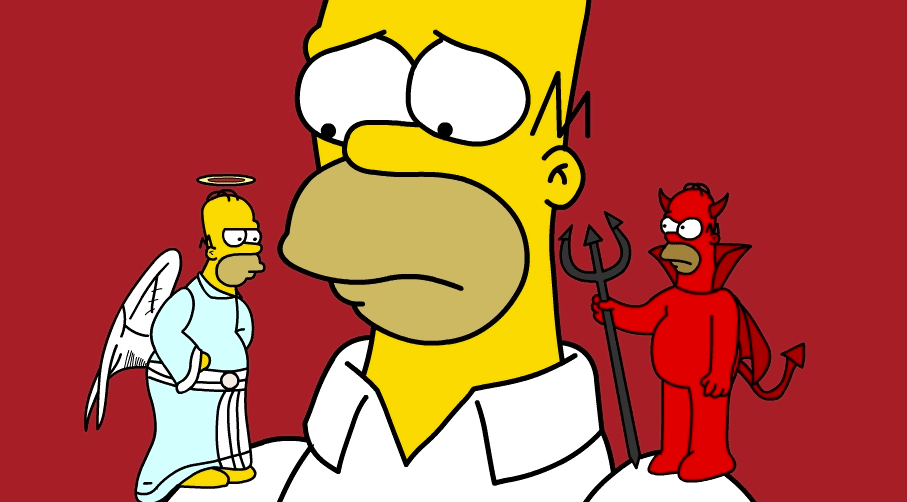
What do you think of when you think of a conscience?  For some it’s the image from old cartoons of a person with an angel on one shoulder and a devil on the other, each giving competing moral advice.  That image is funny partly because it might not be far from the truth.

For some, a conscience is a “moral compass” – that internal voice that helps us distinguish right from wrong.  While this is another good image for a conscience, we have new technology now.  We use GPS now, and when I think of a conscience, the voice of my GPS comes to mind.  Let me explain.

A compass is too simple a metaphor.  The voice of our conscience is not usually like a clear sign or bright, flashing lights pointing the way (although God can use whatever means He chooses).  In my experience, a conscience is more like a broken GPS system, that has many voices, not just one, like a real GPS.  Not that we’re all “hearing voices,” but since our conscience is giving us directions, a voice seems a good metaphor.  You could call it an influence or something else.  Anyway, some of the voices tell us to go places we shouldn’t and not to go places we should, and some of them lead us the right way.  We find ourselves weighing the pros and cons of these multiple voices.  For every decision we make, there’s a reason we make it, and often we don’t explicitly think about why.  It could be something we learned from our culture, our family, our education, or from anything we’ve experienced.  It might come from something we saw or listened to recently, or many years ago.  It could also be something we just invented ourselves.  But it’s there, trying to influence us.

Now not everyone has the same voices in their conscience.  For someone who isn’t a Christian, their GPS considers all the factors it has, and they make decisions as they see fit by prioritizing among the influences.  But for a Christian, salvation requires realizing our GPS is fundamentally broken, trusting someone who knows how to fix it, and then striving to follow the new instructions.  When this happens, a Christian gets an added feature in their internal GPS – a new voice.  This voice is the Holy Spirit, but it doesn’t become the only voice, it just adds one more competing voice to the cacophony. However, the Spirit is the only voice that can be trusted to guide us to the right destination 100% of the time.

As we make decisions in the world, each of us try to follow the advice of our conscience, but we must remember that our consciences are broken until we reach heaven.  Many voices work hard to influence us, and any voice that we follow into disobedience from God can be considered an idol for us.  Only the Holy Spirit speaks with the wisdom needed for us to fulfill our purpose as individuals made in God’s image.

However you think of what a conscience is, let Him rule it, and “in your hearts honor Christ the Lord as holy” – 1 Peter 3:15a

Then you can have a clean conscience, whatever you do.

Time to Build the Church

What’s more important, your house or God’s?

Haggai was a prophet during the time shortly after the end of the Babylonian exile.  His main focus was encouraging the people to complete the rebuilding of the Temple, which had been destroyed at the beginning of the exile, in 586 B.C.  After returning to Israel, the people had become lazy and complacent about God’s house, the Temple, saying “the time has not yet come to rebuild the house of the LORD,[1] and made excuses not to rebuild it.  But Haggai challenged them, in true prophetic fashion, asking “Is it a time for you yourselves to dwell in your paneled houses, while this house lies in ruins?[2]  The problem was that the people took great care of their own houses with fancy paneling, yet weren’t concerned that the Temple was still a ruin.  “The time has not yet come,” they said.

Haggai told the people: “Go up to the hills and bring wood and build the house, that I may take pleasure in it and that I may be glorified, says the LORD.”[3]  This would involve a lot of hard work, God knows what it takes to build His Temple, and He also knows that it needs to be done and should be a priority.

Today, the equivalent of the Temple is the body of believers known as the church.  1 Peter 2:5 says, “you yourselves like living stones are being built up as a spiritual house, to be a holy priesthood, to offer spiritual sacrifices acceptable to God through Jesus Christ.”  God’s goal for the church is to perfect it in Jesus’ likeness, therefore no matter what condition the church is in here, it always needs to be built up.  We may be tempted to say “the time has not yet come” because we won’t be perfected until eternity, but He says ““Go up to the hills and bring wood and build the house, that I may take pleasure in it and that I may be glorified, says the LORD.”

Building the church (God’s house) may feel as difficult as climbing hills, gathering and transporting wood from forests to build a literal, physical Temple.  It’s not easy and we shouldn’t expect it to be.  But God will build His church and He wants our help.

When writing of our diverse spiritual gifts, Paul wrote in 1 Corinthians 14:12 – “So with yourselves, since you are eager for manifestations of the Spirit, strive to excel in building up the church.” Has the time come to build His church?  Yes, it has.

Strive to excel.”


[1] Haggai 1:2
[2] Haggai 1:4
[3] Haggai 1:8

“If Necessary”

All Christians face trials for following Jesus.  These can range from being disregarded or ignored, all the way to physical persecution and even death.  In the face of these trials, Christians can feel targeted or that their trials are unfair.  However, Peter assures us that all the trials we face for Jesus have a purpose.

In 1 Peter 1:6-7, he wrote: “In this you rejoice, though now for a little while, if necessary, you have been grieved by various trials, so that the tested genuineness of your faith—more precious than gold that perishes though it is tested by fire—may be found to result in praise and glory and honor at the revelation of Jesus Christ.”

Note the words “if necessary.”  Those words beg the question of what is necessary and who decides that it is necessary?  Do we get to pick and choose our own trials, or would probably choose to avoid them altogether?  Should we trust ourselves to choose wisely?  If we chose for ourselves, we might pick only trials we’ve already overcome or ones we are sure we can handle, but as Warren Wiersbe wrote: “We must not think that because we have overcome one kind of trial that we will automatically ‘win them all.’ Trials are varied, and God matches the trial to our strengths and needs.”[1]

Fortunately for all of us, God is the one who decides if, when, and why trials are “necessary.”  He decides whether we have trials, and only He knows all of the flaws in our faith and the best way for us to overcome them and grow in faith.  He ensures we face only “necessary” trials that test the “genuineness” of our faith and turn it into something “more precious than gold.”  These trials expose our impurities so that they may be removed.  Because of the words “if necessary,” we can rejoice in our salvation even when going through trials of all kinds.  They aren’t random or meaningless.

Therefore, we can rejoice even in our trials knowing they will “result in praise and glory and honor at the revelation of Jesus Christ.”  Any time we feel “grieved by various trials” we know they are temporary, and they serve God’s purpose for us.

Amen.


[1] Wiersbe, Warren.  Be Hopeful (1 Peter) (1982).  P. 35.

Letting God Set the Agenda

One of the most significant ways the media influence us is by what’s called “agenda setting,” which means is that they tell us what is important and what we should care about by choosing what issues or topics to cover most often and most prominently.  For example, if a topic appears regularly on the front pages of newspapers or the covers of magazines or in the “Breaking News” of a TV news program, those editors have decided those items are more important, and want us to feel the same.  Unfortunately, there’s also an old saying in journalism that “if it bleeds, it leads,” meaning that bad news should get more coverage because it’s good for the business of journalism.

Related, but not the same, is “framing” which means the way the media covers something (the words they use, the sources they cite, etc.) affects our attitudes about it.  When the media consistently use words like “radical” or “extreme” to represent only the other side, or if they lump all the news that bleeds to a specific group of people and not another, they’re employing framing.

The problem is that the same issues aren’t always as important to all people, and often the media’s agendas don’t align with what should be each person’s agenda.  It’s like news coverage is designed to make us think the world is so evil that we can’t do anything about it, but also that very little is our own responsibility (or fault).  As Corrie ten Boom wrote about her time in a Nazi concentration camp: “this was the great ploy of Satan in that kingdom of his: to display such blatant evil that one could almost believe one’s own secret sins didn’t matter.”

Is it really good or healthy to feel all the world’s problems are on our shoulders? However, all media have to make choices about what to cover and how to cover it, so there is no avoiding these problems…unless you have another source for your agenda and the framing of it.  That source is God, and here are some verses from His word that can guide us:

Cast Your Anxieties
Humble yourselves, therefore, under the mighty hand of God so that at the proper time he may exalt you, casting all your anxieties on him, because he cares for you.” – 1 Peter 5:6-7

We can recognize that there is a sovereign God, and ultimately His agenda is the only one that matters.  With that knowledge, we know that there are many times where all we can do is pray to the One who sees all the bad news we do, and much more.  He is in control.

If It’s Worthy, It Leads
Finally, brothers, whatever is true, whatever is honorable, whatever is just, whatever is pure, whatever is lovely, whatever is commendable, if there is any excellence, if there is anything worthy of praise, think about these things.” – Philippians 4:8

We can recognize that good news isn’t always easy to find, but we should seek it out, even if it’s in our own homes, families, or neighborhoods.  There is always something worthy of praise to pay attention to.

Frame Your Responsibility Locally
For we are his workmanship, created in Christ Jesus for good works, which God prepared beforehand, that we should walk in them.” – Ephesians 2:10

Too much attention to the big picture problems of the world can distract us from the work God has put right in front of us, which we were created to do.  God wants us to be faithful, not to save the world (He has already done that!)

I agree with C.S. Lewis, who wrote: “I think each village was meant to feel pity for its own sick and poor whom it can help and I doubt if it is the duty of any private person to fix his mind on ills which he cannot help. This may even become an escape from the works of charity we really can do to those we know. God may call any one of us to respond to some far away problem or support those who have been so called. But we are finite and he will not call us everywhere or to support every worthy cause. And real needs are not far from us.”

Yes, global problems matter and there is always a lot of bad news, but today let God set your agenda and frame it through the lens of His eternal victory in Christ.

Faith Takes More Than Proof

When writing his gospel, John had an objective in mind.  As he wrote in John 20:31, he was recording Jesus’ miracles and signs “that you may believe that Jesus is the Christ, the Son of God, and that believing you may have life in his name.”

What was John’s objective?  To persuade anyone reading “that Jesus is the Christ, the Son of God, and that believing you may have life in his name.”

In the same book, John says that many were not convinced by miracles:
“But although He had done so many signs before them, they did not believe in Him, that the word of Isaiah the prophet might be fulfilled, which he spoke: “Lord, who has believed our report?  And to whom has the arm of the Lord been revealed?” – John 12:37

John says this failure to convince was intentional on God’s part and a fulfillment of prophecy.  John claims to be a first-hand witness of many miracles performed by Jesus, climaxing in the resurrection of one Lazarus, who was apparently dead for so long that “there is a stench” (John 11:39).  John spends a lot of time setting the scene — many people had gathered to comfort Martha and Mary, the sisters of the deceased — pointing out that Lazarus had his own tomb, which indicates he was probably affluent and well-known – and so on.  This miracle was to be very public.  The result when Lazarus came out?  John says many believed in Jesus, but many others did not believe, and some even saw Him as a threat – resulting in His crucifixion.

So John, writing for the specific purpose of creating belief, tells us the ultimate miracles are not enough to generate belief in everyone.  “Proof” does not always convince, and those who disagree hold their beliefs as strongly as those who agree.   Whatever your beliefs, have you ever been frustrated when someone just won’t come around to your view, no matter what you said?  Would you be more frustrated if you were told that any argument you could make wouldn’t be good enough?

Some deny miracles because of a purely naturalistic worldview where the supernatural is not allowed in.  Miracles do not exist, and never did.  In this view, mankind was created through an unknowing process of natural selection and is a type of animal, although perhaps a special animal.  These people have just as much conviction as I do.  I could argue against those views, which really are what G.K. Chesterton called a “dogma of materialism” because proving it would require disproving every claim about a supernatural occurrence that any human has ever claimed.  This is, of course, impossible.  The dogma of materialism is a matter of faith, however much proponents of evolution and other “scientific” ideas claim overwhelming evidence and vast consensus.  It takes faith to fill in the gaps in the evidence.  Those who disagree with me are obviously willing to accept these gaps.

On the other hand, we have the oral and written testimony of many people reporting many supernatural things over the centuries.  This includes John’s records of many first century miracles.  However, John also testifies that a man raised from the dead was not enough to convince the skeptics on the scene.  This man, Lazarus, even became the target of death threats, because he was evidence that threatened the well-being of those who made their living off the established religion.

There is more to proof than meets the eye.  There is more to life than cold reason.  People have reasons for believing what they do and acting how they act, and the Apostle Paul says “we do not wrestle against flesh and blood…”  (Ephesians 6:12).  Therefore, nothing I can write, do, or say is guaranteed to convince anyone, but I take heart that Chesterton also wrote: “When I fancied that I stood alone I was really in the ridiculous position of being backed up by all of Christendom.”


If you are a Christian – what argument can you make that is better than raising a man from the dead, then following that up by raising yourself from the dead?  If Jesus couldn’t convince everyone, the best anyone can do is follow Peter’s advice to “in your hearts honor Christ the Lord as holy, always being prepared to make a defense to anyone who asks you for a reason for the hope that is in you; yet do it with gentleness and respect, having a good conscience, so that, when you are slandered, those who revile your good behavior in Christ may be put to shame.” – 1 Peter 3:15-16

What are the reasons for the hope that is in you?