Your Family is More Important Than Your Furniture – Songs of Ascent #4

A prominent feature of the culture I live in is the demand that everyone must respect the “individualism” of everyone else.  Pressure to affirm whatever anyone else wants affirmed about them has ballooned all over the news, social media, corporate policy, and even in churches.  There’s an assumption built into this, which is that the sincere ability to love someone can be the result of someone else threatening us to do it.  Exert enough legal, social, cultural, or even physical pressure and someone’s fundamental nature can be changed by coercion.  The coal turns into a diamond.

Tomorrow is Sunday, so today we return to the Songs of Ascent, a liturgy used in ancient Israel to prepare for worship at the annual festivals in Jerusalem.  What does this have to do with the last paragraph?  In Psalm 120, the first Song of Ascent, we read (post here) that no matter where we live, or where we come from, no matter our genealogy, we live among people with “lying lips” who can’t get along with each other.  In Psalm 121, we are encouraged to find the answer outside of our current place:

“A Song of Ascents.

I lift up my eyes to the hills.
            From where does my help come?
My help comes from the LORD,
            who made heaven and earth.

He will not let your foot be moved;
            he who keeps you will not slumber.
Behold, he who keeps Israel
            will neither slumber nor sleep.

The LORD is your keeper;
            the LORD is your shade on your right hand.
The sun shall not strike you by day,
            nor the moon by night.

The LORD will keep you from all evil;
            he will keep your life.
The LORD will keep
            your going out and your coming in
            from this time forth and forevermore.”

The Psalm asks us to take our eyes off of the world around us and look upward for our hope.  Not just talk about the idea of it, but to actually do it.  To turn off the outside world and its circumstances and seek God’s help.  It takes effort because the idea that we can solve our own problems is so powerful.  The fall of Adam and Eve was driven by a curiosity that there may be a better system than the one they already had.  In a literally perfect society, they wanted something else.  If we aren’t intentional about avoiding this trap, it’s easy to not realize we are in it.

We’re All Messed Up
I’ve written much about Tyler Joseph, the songwriter of the band twenty øne piløts, and his campaign to create music and stories that help people deal with mental illness.  In an interview years ago, the interviewer criticized Tyler for calling himself “messed up.”  Was Tyler being too hard on himself?  This was Tyler’s response:

“I know I’m messed up. I think to myself I should be able to control myself.  I look at a lamp and I decide that I’m going to stand up and not hit that lamp. Why can’t I make decisions like that about everything in life. I’m not going to get angry at my brother. I want to be the best brother. Why can’t I do what I want to do? That’s messed up. Something is broken in the way we live. It’s proof that something is not right.”

Tyler is explaining Romans 7:13-21, especially verses 15 and 21, but in a way that’s as plain as day to anyone being honest with themselves.  Romans 7:15 and 21 say: “For I do not understand my own actions. For I do not do what I want, but I do the very thing I hate.”  And “So I find it to be a law that when I want to do right, evil lies close at hand.”

What if the problem with every person individually is that they are unable, no matter how much external pressure is put on them, to treat other individuals the way they should be treated? If true, it puts the first paragraph into an entirely different light.

In this exact moment as I write this, I’m being very careful not to spill my drink on my laptop.  I have no desire to do anything violent to the couch I’m sitting on but just to enjoy having a place to sit.  If I stop writing to check something on my phone, I make sure I put it down gently in a spot where it won’t fall off and hit the floor.  But at the same time, I know I don’t always treat people with the same respect.  I know if I’m interrupted in the middle of what I think is a great thought or phrase I could get irritated and rude.  Not always, but I could.  I know I could be a better son, husband, father, employee, and friend.  So why don’t I?

Why do we treat our furniture better than our family, even in a culture that increasingly demands with all its strength that we prioritize every individual?  Because we are broken in a way that no political or economic system, no culture or tradition, can fix.  One may be better or worse than another, but none of them has the power to solve the real problem that we can’t consistently love people more than we love our furniture.  We have to go somewhere else to find the answer.

Therefore,
“I lift up my eyes to the hills.
            From where does my help come?
My help comes from the LORD,
            who made heaven and earth.”

As pilgrims traveling to Jerusalem, the Israelites were telling a story by making the effort to move.  A story that the towns they leave behind – no matter where they are coming from – don’t have the answer to their most important problems.  On the long journey, they travelled in large groups and slowly, sometimes by foot.  They probably had constant reminders of their own inability to treat the family they traveled with better than whatever furniture or baggage they brought along for the trip. While togetherness is sometimes uncomfortable, together we must lift up our eyes and look for the answer outside of everything we know.

We’re broken and can’t fix ourselves, but “The LORD will keep you from all evil; He will keep your life.”  Take some time out of your week and each day to look up to the hills and seek Him.  To set aside everything else.  To focus on the LORD, because He alone loves us in the way we need to be loved and can help us love others the way they need to be loved.  He won’t seek to break you to make you do it, but He Himself was broken to provide us a way.

Faith: A Practical, Living Teacher

Photo by Thomas Somme on Unsplash

Years ago, I saw a drawing of a child suspended in the air, clutching the string of a single balloon, with the caption: “Faith isn’t faith until it’s all you’re holding on to.”  It was a very simple picture, but it made me think: Where does this kind of faith come from?  A faith that turns intellectual trust into action, especially potentially dangerous action?

One way is that we can learn it from others.  I’ve read a lot of Christian apologetics – or writings in defense of Christian faith.  Writers such as Josh McDowell and Ravi Zacharias were held in reverent awe by many in my college years, the logic being that “if someone that smart can be a Christian, it must be reasonable to believe!”  While there is definitely value in learning from others, there is also the hazard of learning to trust our teachers (instead of our Teacher).  Then when they fall, it hurts us personally and can damage our witness.  We know what ended up happening to Ravi Zacharias[1].

There is also the testimony of the Bible.  In the book of Hebrews, chapter 11 chronicles the faith of many in the Bible, and Hebrews 12:1 calls these our “cloud of witnesses.”  We can learn a lot from these people, but they don’t just teach us facts about God.  The writer of Hebrews adds that because of these witnesses, we should “lay aside every weight, and sin which clings so closely, and let us run with endurance the race that is set before us, looking to Jesus, the founder and perfecter of our faith, who for the joy that was set before him endured the cross, despising the shame, and is seated at the right hand of the throne of God.”[2] He is our Lord, and these witnesses tell us to follow Him, not just be able to describe Him.

One of the best lessons on this comes from G.K. Chesterton, who is well-known for his arguments in defense of the reasonableness of Christianity.  However, near the end of his book Orthodoxy, he says that he has a better idea: “And that is this: ‘that the Christian Church in its practical relation to my soul is a living teacher, not a dead one. It not only certainly taught me yesterday, but will almost certainly teach me tomorrow.’”  Apologetics is not about winning arguments, but about growing our ability to trust Him and learning to explain that to others.

While we can learn from others and from the Bible to build up our faith, what God has done for us personally is the best testimony because it is the most real to us.  Everything else is hearsay, as they say in court.  We are all learning to let Him tell us where to go and what to do.  To discern not only His truth, but His will, in the testimony of modern apologists and in the Bible.  To make our own Ebenezers, or memorials to His faithfulness to us when we’ve acted in faith in Him, even if it meant holding on to nothing else.  Therefore:

“Oh, taste and see that the LORD is good!
Blessed is the man who takes refuge in him!” – Psalm 34:8

The best way to know that He is good is to try for ourselves, even when it’s hard or doesn’t make sense.


[1] If you don’t know, after Ravi died it was revealed that he had inappropriate relationships with massage therapists and others.  A once-influential ministry ended up in tatters, and some of Ravi’s followers ended up embarrassed and wondering what to believe.
[2] Hebrews 12:1b-2

The Gospel is About a Who, not a How

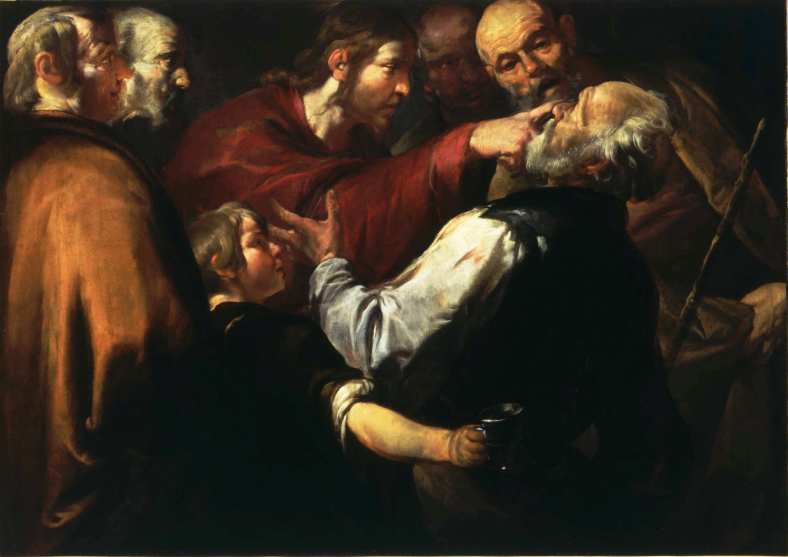
In chapter 9 of John’s gospel he records a story of Jesus healing a man who was born blind.  In John’s story, Jesus made some mud out of saliva and dirt, then put the mud on the man’s eyes.  Then Jesus tells the man to go wash off the mud in a pool.  When the man does this, his blindness is gone!

Because this man was born blind and had begged in the temple area for years, the miracle was hard to deny as a claim that Jesus was the Messiah, but many of the people put their focus on the wrong question: the how of the miracle.  Four times in the chapter someone asks how the man’s eyes were healed, as if the method of the healing was the important part.  Some of “The neighbors and those who had seen him before” asked “how were your eyes opened?” [1]  Then some Pharisees asked the man how he was healed.  In both cases, the man formerly blind explained what Jesus had done.

Then, because Jesus had healed the man on the Sabbath and because practicing medicine on the Sabbath was against traditional Jewish regulations, the Pharisees asked, “How can a man who is a sinner do such signs?”[2]  The Pharisees kept looking for an explanation.  A scientific or natural explanation.  Perhaps this wasn’t the same man who was born blind.  So they found his parents, “and asked them, ‘Is this your son, who you say was born blind? How then does he now see?’”[3]

The better question is who healed the man born blind, but the Pharisees didn’t want to deal with that question.  They had already made up their minds that Jesus wasn’t from God.  So, they focused on the how, on the method.  People still do this today, as Warren Wiersbe wrote: “We want to understand the mechanics of a miracle instead of simply trusting the Savior, who alone can perform the miracle.”[4]

Modern people want scientific explanations because they think nothing exists outside of scientific understanding and when something doesn’t fit that worldview it is denied or explained away.  We want to fit miracles within our pre-existing understanding of the world.  And when we can’t, we resist any way we can.  In the case of the Pharisees and Jesus, “they cast him out.”[5]  Anything to avoid the real question: who is this person who can do things that don’t fit into our narrow view of the universe?  Comparing John’s gospel to modern events, we see this is nothing new.

However, if Jesus is who He said He was – God the Son – no miracle should be unbelievable because God has absolute control over His own creation.  If Jesus is God, He exists outside of our universe and so obviously can’t be explained by using scientific laws that describe this universe.  But we continue to resist.  When people want to avoid dealing with their God, they still stick to the “how” question to avoid the more important question of “who.”

If you’re struggling to understand the miraculous stories of the Bible, make sure you’re asking the right (“who”) questions.  If you’re talking to an unbeliever having the same struggles, make sure they’re asking the right questions, because: If Jesus is who God is, every how is possible, including the greatest miracle: the salvation of anyone who would believe in Him.  And, Jesus can heal anyone who is blind to this reality.


[1] John 9:8-10
[2] John 9:16
[3] John 9:19
[4] Wiersbe, Warren.  Be Alive (John 1-12) (1986).  P. 143
[5] John 9:34

Broken, But Not Beyond Repair

Actual disaster footage. Viewer discretion advised.

A doctor friend of mine said there’s an inside joke that “if you put two bones alone in a room together, they’ll find each other.”  I heard this after breaking my left collarbone in the summer of 2011.  Even when I was young, I wasn’t a great athlete, but I did always hustle.  So after a decade of not doing much athletically, I joined my work softball league and thought at least I would try hard and have fun.  But when I hit a weak ground ball to the shortstop and decided to “hustle,” disaster saw its opportunity.  The fields we played on were poorly maintained, with holes where the hitters stand.  Instead of doing the smart thing and stopping after I tripped in this hole, I tried to keep running (because hustle!) and soon ended up falling hard on my shoulder with a loud snapping sound.  The picture above is my actual X-ray from that night.

This isn’t a great memory, but it’s also a reminder of the miracle of healing. I had the option of surgery or just letting it grow back together, and I chose letting it heal.  However, it didn’t “just” get fixed. It was by design and no accident.

My collarbone was broken clean through, with the two sides of the bone not even touching any more.  I could feel them moving around independently.  When I think about the millions of “decisions” the cells in these bones, interacting with the tissue around them, had to make to do something they’ve never done before, I have to be convinced something beyond my own anatomy and genetic history was at work.  An impersonal evolution may have never seen these bones break in just this way before, so how did the bones know what to do?  I certainly wasn’t aware of telling these bones what to do.  They didn’t “just” fix themselves.

I can only credit the creative power of my Maker, along with David, who wrote:
“For you formed my inward parts;
            you knitted me together in my mother’s womb.
I praise you, for I am fearfully and wonderfully made.
Wonderful are your works;
            my soul knows it very well.
My frame was not hidden from you,
when I was being made in secret,
            intricately woven in the depths of the earth.
Your eyes saw my unformed substance;
in your book were written, every one of them,
            the days that were formed for me,
            when as yet there was none of them.” – Psalm 139:13-14

Everyday Miracles
Miracles happen every single day in every human body, yet we often miss them or refuse to call them miracles.  Maybe we do that because calling them miracles would mean we have to give credit to the power behind the miracle, and we’d rather not.  Ever since Adam and Eve looked at God’s good creation and decided they’d rather make their own decisions, mankind has persisted in acting like bones that would rather grow apart than follow their Creator’s design.  As a result, the world is broken into billions of personalities that don’t know how to connect, that don’t know how to knit agape love into the trillions of decisions they make, and interactions they have, each day. 

We all have a choice in every moment: do we “just” do whatever we think is best and expect the right outcome to “just” happen, or do we look at nature and think that maybe the Person who knows how to make bones fix themselves knows how to guide our lives to the best outcome.

Our heavenly Father wants to knit us together once again, in a world that isn’t broken and where we aren’t broken.  None of us are beyond repair, and our Maker will restore us if we let Him.  Every human being in history has been bad at love, except One, and He is calling to every one of us to trust Him.  “Just Do It” is not a good motto.

“Many are the afflictions of the righteous,
            but the LORD delivers him out of them all.
He keeps all his bones;
            not one of them is broken.” – Psalm 34:19-20

Supernatural Claims of Natural Men

Have you ever heard a voice from heaven?  If you did, how would you know to believe it?

In John 12:28 Jesus said in front of a crowd of people: “Father, glorify Your name.  Then a voice came from heaven, saying “I have both glorified it and will glorify it again.”

When this voice spoke, the hearers still had to decide whether or not to believe it.  Not everyone on the scene had faith that this voice was actually God.  Not everyone who heard it and thought it was God decided that this God deserved their obedience, even though these people were eyewitnesses to a supernatural event that many today would be thrilled to see, to “prove” God’s existence.

Suppose someone on the scene looked up at the sky and said: “Who do you think you are?  I don’t know who this ‘Jesus’ guy is, and I sure don’t know who you are – why should I follow you?”  Perhaps the voice from heaven responds with a bolt of lightning, and this poor man is now a dead smoldering heap.

Now, the man next to this one could be thinking: “I really should follow this Jesus person, because if I don’t, the next bolt could be for me.”  This is rational, solid reasoning.  But reason is not the same as faith.  This man’s other response could be: “Jesus really is the Son of God and deserves my loyalty.  I’m grateful that He is willing to accept me as I am.”  Did the lightning really provide convincing evidence of this?  Are there still other alternatives?  Could the voice be interpreted as some other deity trying to gain followers?  Perhaps, so therefore this second response is more like faith than reason.

So, even faced with overwhelming evidence, “reason” does not power a decision to truly make a decision, “faith” does.  Reason can lead a horse to water, but it can’t make him drink.  “For it is by grace you have been saved, through faith–and this not from yourselves, it is the gift of God” (Eph 2:8)

In addition, claims contrary to Christianity require a supernatural faith (albeit one without a source), and here are two examples

1) “There is no God” – Some say that if he exists, he should show himself.  Of course, as we have seen, even those who claimed to know Jesus Himself and witness his miracles say this would not convince a skeptic who decided not to believe.  Also, how does one prove God does not exist?  Europeans used to believe there was no such thing as a black swan because they had never seen one – until they traveled more of the world.  They could never prove that black swans did not exist, but they could (and did) believe it.   To prove it, they would have to be personally present in all parts of the universe at all times simultaneously – in essence, they would need to be God to prove that all swans were white.  “There is no God” cannot be proven by reason, but a skeptic can claim that they have not witnessed God in their experience, and that they have faith that God does not exist outside their experience.

2) “Man is the result of purely natural processes” – If “natural” is that which science has explained, and “supernatural” is everything else, it turns out that this is a claim about the supernatural, not a claim that there is no supernatural.  If you change “observed” to “observable” in Merriam-Webster’s definition of “supernatural” (“of or relating to an order of existence beyond the visible observable universe”), you see this distinction.  Merriam-Webster takes for granted that all things “supernatural” will become “natural” through scientific advancement in the way the current majority thinks they will.  The consensus in Galileo’s day was that everything revolved around the earth – but the consensus was proved wrong.  Proving that man is purely natural requires that the current thinking on evolution is correct, and faith that nothing outside of current knowledge could ever possibly over-turn it.

However, in the words of G.K. Chesterton, “Science knows nothing whatever about pre-historic man; for the excellent reason that he is pre-historic.”  The “evidence” for one species changing into another is based on deductions from historical fossils, not on eyewitness accounts.  While man has observed species mutate and acquire new traits, we have not yet seen a monkey (or anything else) mutating into a man.  Regardless, theories of human evolution make a lot of claims about the history of mutations across species.  It takes the observed changes within a species, and assumes that over millennia these mutations lead to one species changing into another, then another…  It also claims that future evidence will inevitably support current evidence, in spite of the fact that evidence for evolution has been overturned repeatedly in history.  Even in my own experience, what I was taught in middle school was different than what I was taught in college about evolution.  If the historical track record is not that good, why have faith that the future track record will be perfect?  Evolutionists refer to the process of discovery by trial and error consistently as “progress”, but is it always?  Unless you already know beyond any shadow of doubt what you are progressing toward, how do you know you are progressing?

I’m not claiming to have dis-proved evolution here, but only to show that to prove it beyond a shadow of any possible doubt is beyond the power of reason.  It’s another black swan.

Claims that there is no supernatural, are claims about the supernatural.  These claims would require supernatural means to prove.  They require seeing the future and the past, therefore, to believe a supernatural claim without supernatural evidence requires faith.  It is beyond reason and proof.  To me, the evidence and the logic do not live up to the claims they want to support.

Claims that there is no supernatural,
are claims about the supernatural.

All people have faith – just in different things.  Materialists fail to explain how man, as a mere complex set of materials and chemical reactions, consciously and intentionally goes about his life pondering deep thoughts about the origin of himself, while an earthworm does not bother.  Christians – even the authors of the Bible – fail to explain how some consciously and intentionally choose faith when presented with miracles, while others do not.

There will always be such a thing as the “supernatural”.  All people speculate about what’s out there in that realm of knowledge we can’t reproduce in a lab.  Many people have dogmas about what’s in that realm – evolutionists believe that everything they do not understand yet will confirm that there is no God; religious people believe that there is enough evidence in the world we’ve already observed to warrant the possibility of a God.

On the one hand, you have the supernatural claims of natural men, claiming two things: 1) that they (and you) are the accidental result of millennia of chemical mutations, and that these chemicals follow rules that they do not know the origins of (yet); and 2) that the chemicals in their brain “believe” without a doubt that they can predict that what they do not know will confirm what they currently know and believe.  This future evidence will prove their current belief, which was itself the result of a chain of accidental chemical reactions (but apparently under the purposeful control of some unknown thing that seeks to convince you of your mere natural chemicalness).

On the other hand, there is a written record of a man who claimed to be from that supernatural realm, who sees the future and the past, who knew there were black swans.  How many there were.  Where they were.  And that the Europeans would eventually find them.  This man asked for your belief – which set of claims is more reasonable?

“Come near to God and he will come near to you” – James 4:8