David’s Spiritual Battle with Goliath

David’s defeat of Goliath is such a popular story that it has become a cliché.  For example, unbalanced games in sports where one team is much better than the other are referred to as “David vs. Goliath.”  In these cases, the storyline is about whether a seemingly physically inferior opponent can beat a physically superior one.  However, this misses the point of the story – that it was a spiritual battle.

On one side of the battle, we have false gods.  After David decided to fight and was approaching Goliath, 1 Samuel 17:43 says: “And the Philistine [Goliath] said to David, ‘Am I a dog, that you come to me with sticks?’ And the Philistine cursed David by his gods.”  But even though Goliath invoked his gods in curses, he was counting on his size and strength advantage to win the battle.  He was not actually relying on “gods,” and did not expect to win “by his gods”, but by the god of worldly strength and dominance.
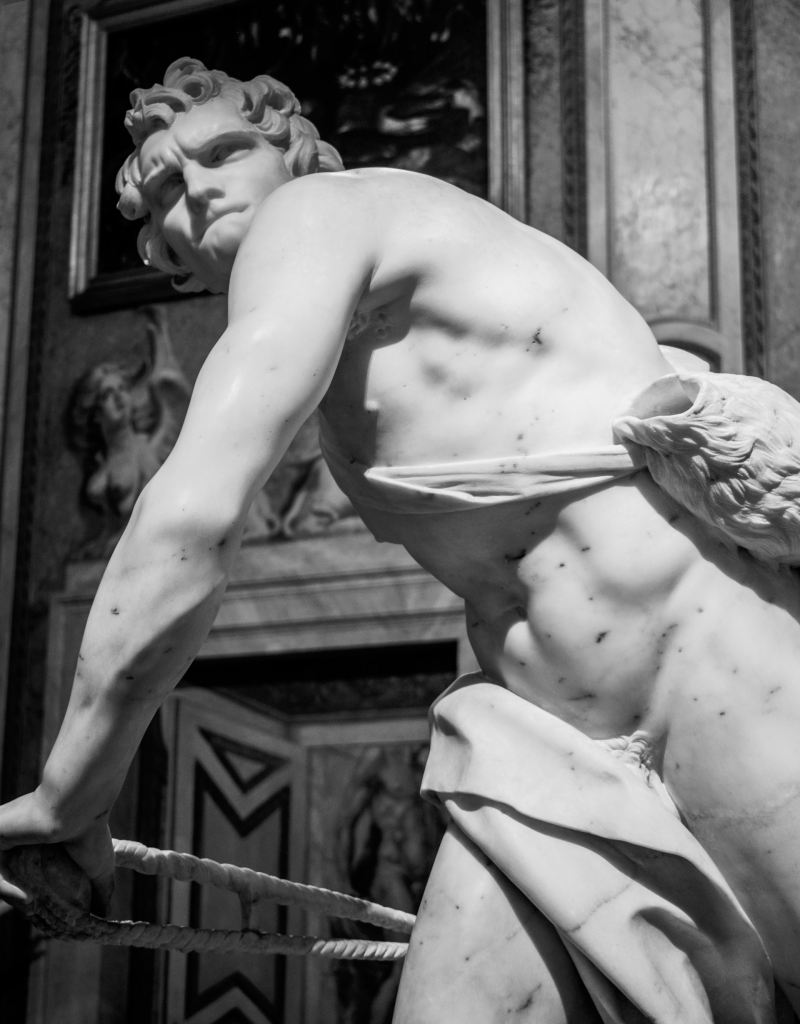
On the other hand, David was clear that this was a battle between true and false gods.  In 1 Samuel 17:26, David says “What shall be done for the man who kills this Philistine and takes away the reproach from Israel? For who is this uncircumcised Philistine, that he should defy the armies of the living God?” and also in verse 37 David says “The LORD who delivered me from the paw of the lion and from the paw of the bear will deliver me from the hand of this Philistine.”  David was actually trusting in and relying on his God for victory, unlike Goliath who just used his gods’ names in vain.  David knew his relative physical weakness against Goliath was not relevant.

So, to Goliath the battle was David vs. Goliath, but to David it was the true God vs. false gods.  And that’s why David won. David wanted to beat Goliath so “that all this assembly may know that the LORD saves not with sword and spear. For the battle is the LORD’S, and he will give you into our hand.” (verse 47)

People also curse us by their gods when we refuse to live by those gods’ standards.  These may be gods of wealth or convenience or rebellion, and many of our spiritual battles are against this world’s gods.

Does it sometimes seem foolish not to make choices based only on what’s best financially?  Is it sometimes inconvenient to worship?  Is it sometimes inconvenient to love our families, congregations, and neighbors?  Is it tempting sometimes to sin “only once” or if we think nobody will find out?

These are battles we all face, but we’re not going to win by doing better by the world’s gods’ standards, but by relying on the true God.  So, a question for us is: do we see these challenges as spiritual battles between true and false gods?  Or do we invoke God in name only like Goliath did, and then rely on our own strength?

The key to the battle between David and Goliath is that David won because 1) he knew his God is real, and 2) because he actually relied on Him.  We can win the same way and overcome the giants that seek to overthrow us.

For we do not wrestle against flesh and blood, but against the rulers, against the authorities, against the cosmic powers over this present darkness, against the spiritual forces of evil in the heavenly places.” – Ephesians 6:12

Things God Counts

Fellow travelers,

Are you ever so fearful or anxious about something that you lose sleep about it? Are there things out of your control that you toss and turn over? Maybe it’s so bad that you even cry. If you’re like this, you’re definitely not alone, and in fact, King David struggled with this kind of anxiety.

In Psalm 56, David laments that his enemies are constantly out to get him, and then in verse 8, David wrote about God:

You have kept count of my tossings;
            put my tears in your bottle.
            Are they not in your book?

What David means is that God sees all of our anxiety and every detail about how it affects us.  He counts every time we toss and turn at night.  He counts every tear you cry, and keeps track of them all, because he cares.

This realization causes David to write in verses 10 and 11:

In God, whose word I praise,
            in the LORD, whose word I praise,
in God I trust; I shall not be afraid.
            What can man do to me?

Prayer or any religious practice won’t always cure anxiety, but as long as we suffer, God knows and cares about it.  We can trust Him to provide for us, sometime between now and eternity.

As Paul wrote about the glory of our salvation:

If God is for us, who can be against us?  He who did not spare his own Son but gave him up for us all, how will he not also with him graciously give us all things?[1]

Amen


[1] Romans 8:31b-32

Daily Readings for July 7 – 13

Fellow travelers:

Here is the list of readings for this week: 2 chapters to read per day as the main reading plan, and extra chapters for anyone who wants to read the whole Bible in 2025.  Reading 3 chapters a day on weekdays and 4 on weekends almost exactly covers the 1,189 chapters of the Bible, so the “extra” readings are about 9 chapters per week.

Follow along (or not) any way you choose!

Monday, July 7: Numbers 9-10
Tuesday, July 8: Numbers 11-12
Wednesday, July 9: Numbers 13-14
Thursday, July 10: Numbers 15-16
Friday, July 11: Numbers 17-18
Saturday, July 12: Numbers 19-20
Sunday, July 13: Numbers 21-22

Additional readings if you want to read the whole Bible this year:
Isaiah 33 – 41

“The Sea was No More”

  One of my favorite places to be is the ocean.  I love the roar of the waves and the feel of the sand.  I love catching waves with a boogie board or just bodysurfing.  Being in the ocean is my “happy place.”  But will it be that for me in heaven?  Will it be like that, only better, or will it be something completely different?

The Bible doesn’t provide us with a lot of specifics about what the afterlife will be like, but the Apostle John’s vision in Revelation 21:1 says, “Then I saw a new heaven and a new earth, for the first heaven and the first earth had passed away, and the sea was no more.”  Once upon a time, that last phrase – “the sea was no more” – bothered me a little bit.  How could one of my favorite things on earth not exist in heaven?

Two thoughts have gotten me over that, and I’m no longer bothered by it.

Chaos

First, that “the sea was no more” may not be literal.  What does that mean?  While the sea was part of God’s original creation and declared “very good”, later it is described as a source of chaos and evil, where Leviathan lives and the serpent emerges.  In ancient times, the sea was seen as chaotic and dangerous.  It was something to be feared and avoided.  In Canaan and other ancient societies, many believed there were gods over the sea and when the sea became stormy and unruly, it meant those gods needed to be appeased.  Therefore, when we see Moses parting the sea, or see Jesus calming the sea in a storm, or even walking on the sea, we are seeing God’s power over not only the chaos and disorder of the literal and the figurative sea, but also His power over the supposed Canaanite gods.  In that pantheon, Baal was the storm god and Asherah, the goddess of the sea, was his consort.  So, if “the sea was no more” is meant figuratively, John’s vision tells us that in heaven the sea will no longer be a fearful and dangerous symbol of chaos and death.  Whatever ‘gods’ we imagine rule the sea will be conquered.  The chaos that the sea symbolizes will not exist at all: the entire world will be ordered according to God’s perfect will and mankind’s work to make the whole earth like Eden.  “The sea was no more” is a good thing.

The second thought is that if God says a perfect world has no literal sea, I need to trust Him.  I don’t get to choose what’s in heaven and what isn’t, but God does and is infinitely more qualified to make that decision!  While the images of heaven we get in the Bible are obscure and difficult to understand, they do make it clear that heaven will be more amazing and glorious than anything we could imagine, or that we could achieve ourselves.  “The sea was no more” is a good thing again.

So, whatever your favorite things are here on earth, God has something much better in mind.  It will be the “very good” world He intended from the beginning, no matter what our expectations of it are or what we’d wish it to be.  It will the perfect “happy place” for all of God’s people.

Then I saw a new heaven and a new earth, for the first heaven and the first earth had passed away, and the sea was no more.

Wisdom for the Task

What are the most challenging parts of your life?  Maybe your job has been difficult recently.  Maybe you have a ministry that has been exhausting or frustrating.  There may be difficult people or relationships in your life.  It could be anything, but we all have difficult tasks at times.

Photo by Adrian Swancar on Unsplash

King Solomon was given a very difficult task by God, to govern His people Israel as their king.  Solomon knew this job was too big for him, saying in 1 Kings 3:7-8, “O LORD my God, you have made your servant king in place of David my father, although I am but a little child. I do not know how to go out or come in.  And your servant is in the midst of your people whom you have chosen, a great people, too many to be numbered or counted for multitude.”

Solomon’s response was not to despair or give up, but to rely on God, in verse 9 asking him to “Give your servant therefore an understanding mind to govern your people, that I may discern between good and evil, for who is able to govern this your great people?”  God answered Solomon’s prayer and gave him wisdom that made him world-famous.  The wisdom that only comes from God.

But this wisdom isn’t just for kingly or other grand duties.  Just as Solomon did, we can all pray for God to give us wisdom to manage our lives better – those hard jobs, difficult relationships, challenging ministries, and other things.  God doesn’t always solve our problems or remove our difficulties, but He does want to help us live wisely in the midst of them.  If He has given us things to manage, He will also give us the resources to manage them, including wisdom.

Therefore, “If any of you lacks wisdom, let him ask God, who gives generously to all without reproach, and it will be given him.”  (James 1:5)