King David was known as a man who sought God’s will in all things, even though he often failed. The Psalms record many of his prayers for God to guide him and make him a good leader. Psalm 26 is one of these prayers, and verses 8-10 include good objectives for any leader:
“O LORD, I love the habitation of your house and the place where your glory dwells. Do not sweep my soul away with sinners, nor my life with bloodthirsty men, in whose hands are evil devices, and whose right hands are full of bribes.”
Sometimes we may not know how to pray “for kings and all who are in high positions,”[1] as Paul suggests, but in this cry to God, David gives us at least 3 things to pray about. He lists qualities he wanted to pursue, and some he wanted to avoid, but which are good for any leader. Therefore, on the model of Psalm 26, we can pray for the leaders of our countries and communities today.
We can pray for political leaders who:
worship God (who “love the habitation of your house”)
do not seek violence and vengeance (who are not “bloodthirsty men”), and
are not corrupted by money (whose hands are not “full of bribes”)
Below are the chapters to read this week if you’re following along in my Bible in a year schedule, divided into morning and evening readings. Follow along any way you want: you can just do the evening reading, flip the morning and evening, or read it all. Whatever works for you and your schedule! It doesn’t have to be Bible in a Year for everyone.
The morning readings for the rest of the year will alternate between the minor prophets and the rest of the New Testament. In the evening, Isaiah will take a while at one chapter a day, and then we’ll finish the year with Daniel.
Monday, October 28 Morning: Hosea 4-5 Evening: Isaiah 14
Tuesday, October 29 Morning: Hosea 6-7 Evening: Isaiah 15
Wednesday, October 30 Morning: Hosea 8-9 Evening: Isaiah 16
Thursday, October 31 Morning: Hosea 10-11 Evening: Isaiah 17
Friday, November 1 Morning: Hosea 12-14 Evening: Isaiah 18
Saturday, November 2 Morning: 1 Thessalonians 1-3 Evening: Isaiah 19
Sunday, November 3 Morning: 1 Thessalonians 4-5 Evening: Isaiah 20
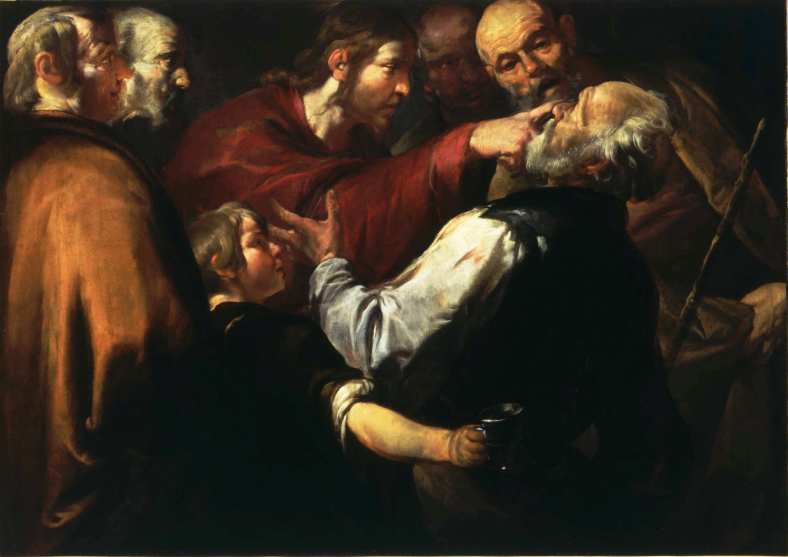
In chapter 9 of John’s gospel he records a story of Jesus healing a man who was born blind. In John’s story, Jesus made some mud out of saliva and dirt, then put the mud on the man’s eyes. Then Jesus tells the man to go wash off the mud in a pool. When the man does this, his blindness is gone!
Because this man was born blind and had begged in the temple area for years, the miracle was hard to deny as a claim that Jesus was the Messiah, but many of the people put their focus on the wrong question: the how of the miracle. Four times in the chapter someone asks how the man’s eyes were healed, as if the method of the healing was the important part. Some of “The neighbors and those who had seen him before” asked “how were your eyes opened?” [1] Then some Pharisees asked the man how he was healed. In both cases, the man formerly blind explained what Jesus had done.
Then, because Jesus had healed the man on the Sabbath and because practicing medicine on the Sabbath was against traditional Jewish regulations, the Pharisees asked, “How can a man who is a sinner do such signs?”[2] The Pharisees kept looking for an explanation. A scientific or natural explanation. Perhaps this wasn’t the same man who was born blind. So they found his parents, “and asked them, ‘Is this your son, who you say was born blind? How then does he now see?’”[3]
The better question is who healed the man born blind, but the Pharisees didn’t want to deal with that question. They had already made up their minds that Jesus wasn’t from God. So, they focused on the how, on the method. People still do this today, as Warren Wiersbe wrote: “We want to understand the mechanics of a miracle instead of simply trusting the Savior, who alone can perform the miracle.”[4]
Modern people want scientific explanations because they think nothing exists outside of scientific understanding and when something doesn’t fit that worldview it is denied or explained away. We want to fit miracles within our pre-existing understanding of the world. And when we can’t, we resist any way we can. In the case of the Pharisees and Jesus, “they cast him out.”[5] Anything to avoid the real question: who is this person who can do things that don’t fit into our narrow view of the universe? Comparing John’s gospel to modern events, we see this is nothing new.
However, if Jesus is who He said He was – God the Son – no miracle should be unbelievable because God has absolute control over His own creation. If Jesus is God, He exists outside of our universe and so obviously can’t be explained by using scientific laws that describe this universe. But we continue to resist. When people want to avoid dealing with their God, they still stick to the “how” question to avoid the more important question of “who.”
If you’re struggling to understand the miraculous stories of the Bible, make sure you’re asking the right (“who”) questions. If you’re talking to an unbeliever having the same struggles, make sure they’re asking the right questions, because: If Jesus is who God is, every how is possible, including the greatest miracle: the salvation of anyone who would believe in Him. And, Jesus can heal anyone who is blind to this reality.
[1] John 9:8-10 [2] John 9:16 [3] John 9:19 [4] Wiersbe, Warren. Be Alive (John 1-12) (1986). P. 143 [5] John 9:34
All the people benefit from leaders and rulers who fear God. In Deuteronomy, when God reluctantly says Israel may set a king over them in the future[1], He also required the king to have specific habits to cultivate a fear of God in them:
“And when he sits on the throne of his kingdom, he shall write for himself in a book a copy of this law, approved by the Levitical priests. And it shall be with him, and he shall read in it all the days of his life, that he may learn to fear the LORD his God by keeping all the words of this law and these statutes, and doing them, that his heart may not be lifted up above his brothers, and that he may not turn aside from the commandment, either to the right hand or to the left, so that he may continue long in his kingdom, he and his children, in Israel.” (Deuteronomy 17:18-20, emphasis mine)
These requirements have several parts. First, the king was to “write for himself in a book a copy of this law.” “This law” refers to what we now think of as the first five books of the Bible – all 187 chapters of it. Imagine the time that would take, but this tedious exercise was designed to help the king internalize the message. Quickly skimming over the Bible would not do.
Second, the king had to get this copy “approved by the Levitical priests,” to make sure nothing was added or left out, but also to remind the king that His authority is subject to God’s authority, as intermediated by the priests at that time. Regardless of what laws the king might pass, God’s laws would always reign supreme and eternal.
Third, the king was to “read in it all the days of his life,” because it takes time and effort to dig the treasures of wisdom out of the Bible. However, it is worth the effort because Psalm 19:10 tells us these truths are:
“More to be desired are they than gold, even much fine gold; sweeter also than honey and drippings of the honeycomb.”
Also, the king would be surrounded by reminders of his worldly greatness every day, so constant meditation on the law would show him his reliance on God. The king needs a constant reminder that he is under God, whose law applies to everyone.
These habits exist “that he may learn to fear the LORD,” which leads to “doing” the law. Even the king is expected to do what God commands, not just tell others to. With “doing” as the objective, the king will remain humble and learn the fear of God, because we may be able to know God’s word, but doing it is the real challenge and we can only succeed by His grace.
These habits also exist to make sure the king does not err “either to the right hand or to the left.” This encouragement is later echoed in Moses’ words in Joshua 1:7-8, but what does it mean? I think it means that without constant saturation in God’s word, we can fall into a trap of not following God’s positive will, but instead defining ourselves by what we’re against. In trying to avoid one sin, we drift too far in the opposite direction and into another, equally destructive, sin. Instead, positive obedience coming from the fear of God should be better than fine gold and “sweeter also than honey.” Truth is often subtle and not as black-and-white as we’d like it to be.
Most of us aren’t kings, but we can apply the passage from Deuteronomy in our prayers. 1 Timothy 2:1-2 “First of all, then, I urge that supplications, prayers, intercessions, and thanksgivings be made for all people, for kings and all who are in high positions, that we may lead a peaceful and quiet life, godly and dignified in every way.” But what shall we pray for them? As Deuteronomy suggests, we should pray that they know God, fear God, and obey God, that they may be humble, and we may prosper.
Also, are you a leader? Do you serve in a position of authority at your church, workplace, or other organization? These habits will benefit you and those you serve anywhere. (In societies where we can easily get a Bible, we don’t need to create our own copies of it, but we should seek to internalize as much of the Bible as possible, through memorization and other means.) As Solomon wrote in Psalm 127:1 –
“Unless the LORD builds the house, those who build it labor in vain. Unless the LORD watches over the city, the watchman stays awake in vain.”
If you’re not a leader, these habits are beneficial for you as well, as Psalm 128:1 says:
“Blessed is everyone who fears the LORD, who walks in his ways!”
Below are the chapters to read this week if you’re following along in my Bible in a year schedule, divided into morning and evening readings. Follow along any way you want: you can just do the evening reading, flip the morning and evening, or read it all. Whatever works for you and your schedule! It doesn’t have to be Bible in a Year for everyone.
This week we finish Ezekiel and the morning readings for the rest of the year will alternate between the minor prophets and the rest of the New Testament (from Colossians to the end). In the evening, Isaiah will take a while at one chapter a day, and then we’ll finish the year with Daniel.
Monday, October 21 Morning: Ezekiel 40-41 Evening: Isaiah 7
Tuesday, October 22 Morning: Ezekiel 42-43 Evening: Isaiah 8
Wednesday, October 23 Morning: Ezekiel 44-45 Evening: Isaiah 9
Thursday, October 24 Morning: Ezekiel 46-48 Evening: Isaiah 10
Friday, October 25 Morning: Colossians 1-2 Evening: Isaiah 11
Saturday, October 26 Morning: Colossians 3-4 Evening: Isaiah 12
Sunday, October 27 Morning: Hosea 1-3 Evening: Isaiah 13



 Driving Toward the Morning Sun