My knowledge of art and art history is just a bit above zero. I appreciate good art, but it’s just never been a significant interest of mine. However, that doesn’t mean I don’t have favorite works, and I’m pretty sure my number one is Supper at Emmaus by Caravaggio, painted in 1602 and posted below. The original can be found in the National Gallery in London, where I’ve seen it in person twice.
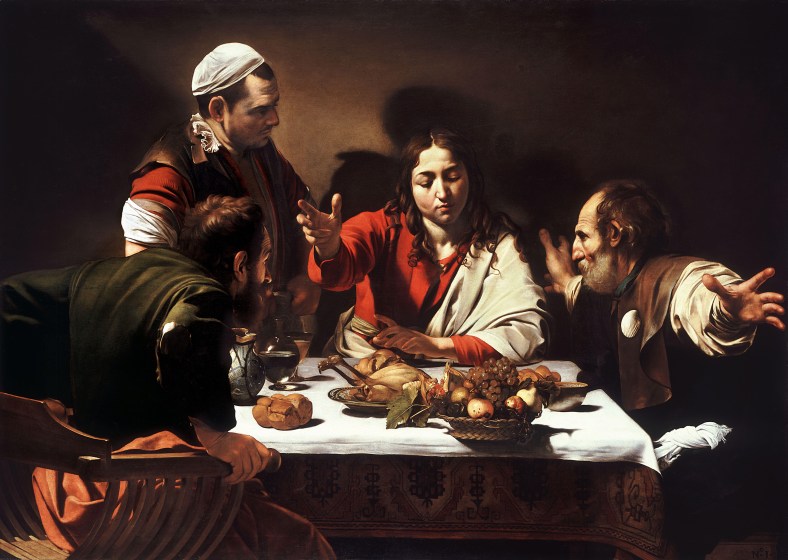
It’s truly a great work of art. Stylistically, I’m fascinated by the realism and the use of shadow and depth. But what really brings it to life for me is the shocked expressions on the two disciples at the right and left, who had doubts, but suddenly realized they were talking to the resurrected Christ.
The story behind the painting can be found in Luke chapter 24, verses 13-35, where the two disciples in the painting were walking from Jerusalem to Emmaus and were joined by Jesus after His resurrection, but they didn’t realize it was Him. They shared with Him that “some women of our company” had visited His tomb, where they did not find His body, but instead found angels who told them Jesus was alive. Then Luke tells us:
“And he said to them, “O foolish ones, and slow of heart to believe all that the prophets have spoken! Was it not necessary that the Christ should suffer these things and enter into his glory?” And beginning with Moses and all the Prophets, he interpreted to them in all the Scriptures the things concerning himself.”
The two disciples invited this “stranger” to stay with them, still not realizing who He was, and during dinner when Jesus blessed and broke the bread, “their eyes were opened and they recognized Him.” This is the moment captured in Caravaggio’s painting, where you can see both their shock and their excitement, preserved for all time in oil on canvas.
What strikes me when I consider this moment and this painting is whether my shock and excitement that Jesus is alive is as permanent as the disciples in the painting. I don’t consistently have the feelings these two men had at realizing Jesus Christ is alive. I almost never have the uncontrollable, physical response that they had, one jumping out of his seat and the other with arms spread wide in wonder. Granted, those two are permanently captured in paint, but isn’t their reaction as real as it should be?
Also, after Jesus “vanished from their sight” (we don’t know how), the two disciples said, “Did not our hearts burn within us while he talked to us on the road, while he opened to us the Scriptures?” Through His Spirit, He communicates to us through His Word whenever we are willing to pay attention about how “Moses and all the Prophets” testify to Him and His glory. Does my heart “burn within” me when I study the Bible? Most often not.
While the two disciples in the painting were real people, what was captured there was not all that those men were. Those men weren’t always that excited about Jesus. They surely had doubts at times and weren’t perfect. They were more like you and me than the moment represented by Caravaggio could show us. When they were weak, God’s grace was there for them, and it is there for us in our weakness. We’d love to always have the passion these two men had on, or shortly after, that first Easter when He rose from the dead, but the truth is we are inconsistent in our devotion and excitement.
Today let’s pray for God to give us more of what we see in Caravaggio’s painting. A more sustained sense of wonder at God’s work accomplished through the life, death and resurrection of Jesus. Let’s pray for the uncontrollable emotional and physical response of those two disciples. Let’s pray for God to carry us during the inevitable times when we don’t feel that way. And let’s pray that He would remove the things in our life that distract us.
Amen.
 Driving Toward the Morning Sun