Swearing Should Be Hurtful (Sometimes)

What does a Godly person act like?  In Psalm 15, David asks this same question:

O LORD, who shall sojourn in your tent?
            Who shall dwell on your holy hill?

Then David lists a set of qualities that God requires for one to be righteous, and it includes how we swear.  At the end of verse 4, David writes that a Godly person is someone “who swears to his own hurt and does not change.

Some of the qualities in the list are easy to understand, but what does it mean when someone “swears to his own hurt”?  David is not writing about swear or curse words.  He’s writing about vows or promises made, but not just any vows.

There are vows that are hurtful, but are not qualities of a Godly person, such as when Saul vowed in 1 Samuel 14:24 – “Cursed be the man who eats food until it is evening and I am avenged on my enemies.”  This vow resulted in a death sentence for Saul’s son Jonathan, which was overruled by the people.  Another example is Jephthah, who vowed in Judges 11:30-31 – “If you will give the Ammonites into my hand, then whatever comes out from the doors of my house to meet me when I return in peace from the Ammonites shall be the LORD’S, and I will offer it up for a burnt offering.”  This resulted in a death sentence for his own daughter, who was the first to come out of the house when he returned in peace.  Saul and Jephthah swore to their own hurt, but this type of swearing is not a quality of a Godly person.

There are also vows that help us get ahead in this world.  An honest reputation is good for a career or in getting along with people and feeling successful.  But it’s easier to keep your word when there is a tangible benefit in this world.  Honesty in these situations is not necessarily bad, but it just doesn’t rise to the level of righteousness.  These vows are not what David is writing about either.

What David means by someone “who swears to his own hurt and does not change” is a person who is honest because it’s what God is and what God wants from us, no matter what it costs them.  Even if honesty brings no benefit to the honest person, they remain honest anyway.

Maybe you’ve promised a spouse or friend that you will help with a project this weekend, but then you get a call from another friend who has tickets to a big game.  Maybe you’ve promised to play with your children or help with their homework, but then remember you have a work project that requires after-hours time to get done.  Maybe vowing to be honest at work means you have to reveal something that could hurt your businesses’ reputation?  A person who “who swears to his own hurt and does not change” is not affected by changes in circumstances, whether they might miss out on something, or whether there is a personal cost.

Is this difficult?  Yes.  It’s so difficult that James wrote: “my brothers, do not swear, either by heaven or by earth or by any other oath, but let your ‘yes’ be yes and your ‘no’ be no, so that you may not fall under condemnation.[1]  To James, keeping vows was so hard that it was something to be avoided.  So…

O LORD, who shall sojourn in your tent?
            Who shall dwell on your holy hill?

Who?  Jesus, the only one who ever kept all of their vows and promises, and offers His righteousness to us, both as a means for our salvation, but also as a model for us to follow.  He alone has fully done what is necessary for anyone to dwell in God’s presence.

Amen.


[1] James 5:12

Bible in a Year: Week of January 15-21

Fellow travelers:

Below are the chapters to read this week if you’re following along my Bible in a year schedule.  Reading 3 chapters a day on weekdays and 4 on weekends almost exactly covers the 1,189 chapters of the Bible.  I study the morning chapters and only read (or sometimes use an audio Bible for) the evening ones, but you can follow along any way you want.

2024 starts with Psalms and 1 Samuel in the morning, since so many Psalms are based on David’s life, which is covered in 1 and 2 Samuel.  The evenings will start with the Pentateuch.

Monday, January 15
Morning: Psalm 15, 1 Samuel 19
Evening: Genesis 15

Tuesday, January 16
Morning: Psalm 16, 1 Samuel 20
Evening: Genesis 16

Wednesday, January 17
Morning: Psalm 17, 1 Samuel 21
Evening: Genesis 17

Thursday, January 18
Morning: Psalm 18, 1 Samuel 22
Evening: Genesis 18

Friday, January 19
Morning: Psalm 19, 1 Samuel 23
Evening: Genesis 19

Saturday, January 20
Morning: Psalm 20, 1 Samuel 24-25
Evening: Genesis 20

Sunday, January 21
Morning: Psalm 21, 1 Samuel 26-27
Evening: Genesis 21

Glory Days Have Not Passed You By

One of my favorite books of the Bible is Ecclesiastes, and chapter 7 in particular is full of practical wisdom, such as:

“Be not quick in your spirit to become angry, for anger lodges in the heart of fools. Say not, ‘Why were the former days better than these?’ For it is not from wisdom that you ask this. – Ecclesiastes 7:9-10

People commonly refer to the “glory days” of their past.  When they were an athlete.  When they were younger.  Before they had responsibilities.  Before they experienced a loss of a loved one, job/career, home, or anything they held valuable.  Before the Covid-19 pandemic.  Somehow the past looks better.

In these verses, Solomon, who lived a life where he gained and lost far more than nearly anyone else ever will, categorically says this is foolish. He’s not doing this to criticize, but to keep others from repeating his own mistakes. To advise against anger for the wrong reasons about things that can’t be changed or fixed.

God’s mercies are new every morning, and with the path we’ve taken before today, He has prepared us for the day ahead in a way no other path could. Strive for what is ahead – your true “glory days” in Him! Start from here and listen for Him. Perfection lies ahead.

“Give us each day our daily bread” – Luke 11:3

Only God Has Tamed the Tongue

In many Psalms, the authors complain about the evils in the world and compare them with God and His perfect attributes.  Psalm 12 is one of these, and begins with David lamenting the ungodliness he sees in the world in the first verse:

Save, O LORD, for the godly one is gone;
            for the faithful have vanished from among the children of man.”

What is David so upset about?  James 3:7-8 tells us: “For every kind of beast and bird, of reptile and sea creature, can be tamed and has been tamed by mankind, but no human being can tame the tongue. It is a restless evil, full of deadly poison.”  David is upset by people’s inability to “tame the tongue,” which he describes in verses 2 through 4:

Everyone utters lies to his neighbor;
            with flattering lips and a double heart they speak.
May the LORD cut off all flattering lips,
            the tongue that makes great boasts,
those who say, ‘With our tongue we will prevail,
            our lips are with us; who is master over us?’”

David says the words of the unfaithful are lies, flattering, duplicitous, boasting, proud, and rebellious.  These adjectives also describe much of what we see and hear today, and if we’re honest, much of what we say.  How often do we say things just because they came to mind?  And if they are bad things, but we get away with it or get something we want from it, are we emboldened to continue?  After all, “no human being can tame the tongue.”

There is One, however, who has tamed the tongue.  David contrasts His words with ours in verses 6 and 7:

The words of the LORD are pure words,
            like silver refined in a furnace on the ground,
            purified seven times.
You, O LORD, will keep them;
            you will guard us from this generation forever.”

These words are pure, refined, purified, kept, and preserved.  The number seven in the Bible is often used to indicate perfection, so if His words are “purified seven times”, they are perfectly considered and constructed before they are delivered to us.  God keeps all His promises, and His word never expires.

Even when the world is full of people who speak ungodly words, the Lord’s words are pure and can be trusted. Because of this we know He will “guard us from this generation forever.”  Someday our words will be like His words.

Amen

The Body of Christ is Irreducibly Complex

Among the various camps in the debate between creation and evolution is a set of ideas called intelligent design (ID).  A key part of ID is “irreducible complexity,” a term that comes from the book Darwin’s Black Box, by Lehigh professor Michael Behe.[1]

In short, irreducible complexity argues that evolution by chance, without an intelligent designer driving it, is unreasonable because the multiple systems in a complex organism like a human body – circulatory, digestive, endocrine, muscular, respiratory, and so on – are all interdependent on each other.  The circulatory system alone, with the heart pumping blood through an elaborate system of arteries and veins, is difficult to imagine developing by chance occurrence, but a chance evolution of that system alongside all the other parts it is dependent on is even more far-fetched.  All systems evolving together in lockstep without failing is a much more difficult problem to explain scientifically without a Creator.  The circulatory system takes what the respiratory and digestive systems take in and deliver it to the other systems that use it.  Without the other parts, it has no function and cannot survive and further evolve.

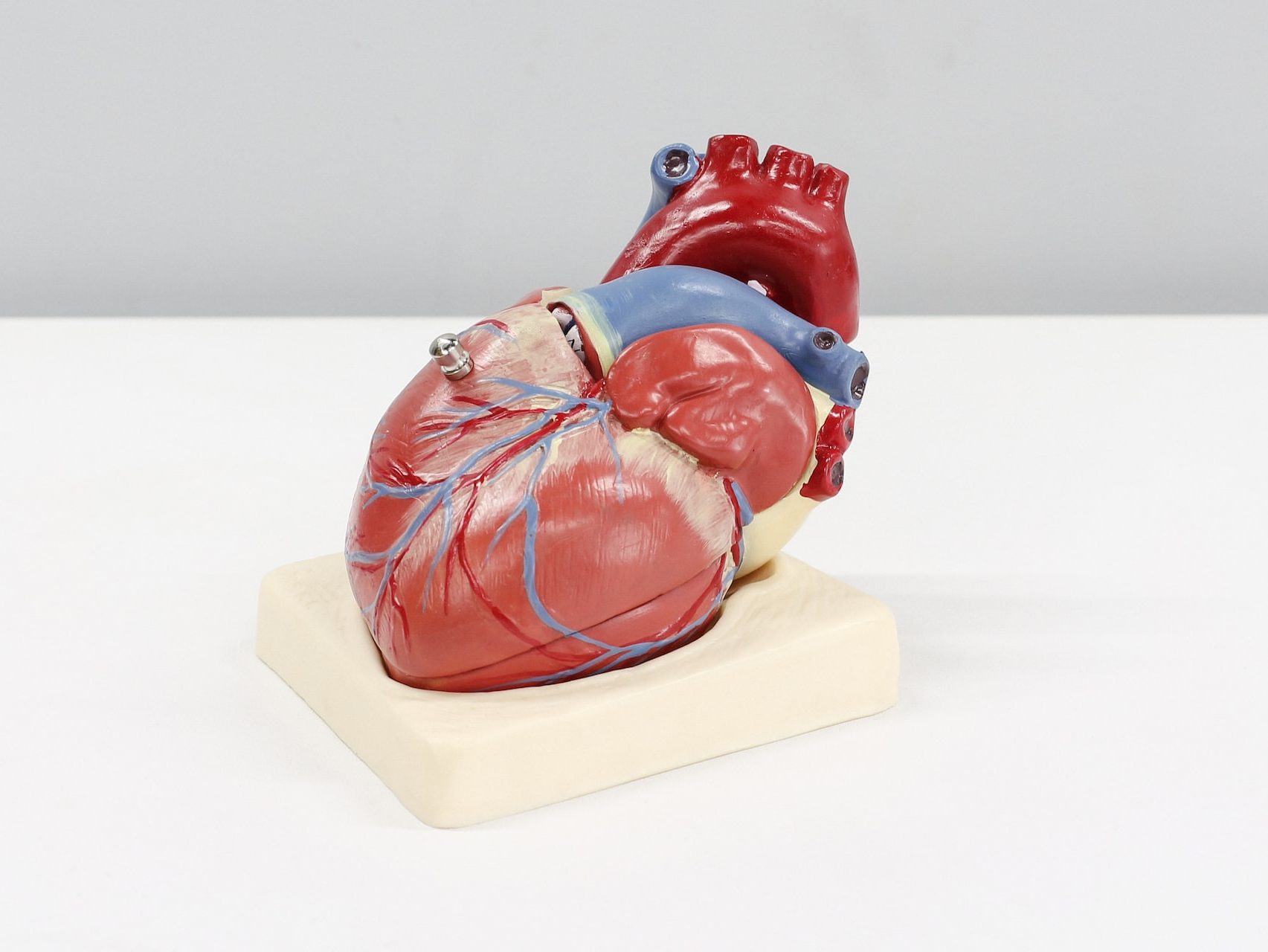
An isolated, inanimate, heart. Photo by Ali Hajiluyi on Unsplash

However, my intent here is not to prove intelligent design, but to consider the apostle Paul’s words about the church as the body of Christ.  In 1 Corinthians 12:12, he wrote: “For just as the body is one and has many members, and all the members of the body, though many, are one body, so it is with Christ.”  He continues that no part of the body can say it is not a part of the body because it has a different function than another part (1 Cor. 12:15-16), and also that no part of the body can say it doesn’t need all of the other parts (1 Cor. 12:21).  Those who are in Christ Jesus cannot be divided.

Paul follows his description of the body with 1 Corinthians 13, a powerful statement on the supremacy of love, and in context a gentle rebuke to the idea that a body can survive as individual, unrelated units.  In a human body, any part can only survive by serving the other parts.  Even an organ as incredibly complex and important as a heart cannot survive if it decided to pump blood only for itself.  Where would it get its nutrients?  How would it flee from danger?  As Paul wrote: “If the whole body were an eye, where would be the sense of hearing? If the whole body were an ear, where would be the sense of smell?” (1 Cor. 12:17).  Even an organ as important as the heart is useless in isolation.  It gets its very life and purpose by what it does for the body.

As Jesus said to His disciples in John 13:34-35 – “A new commandment I give to you, that you love one another: just as I have loved you, you also are to love one another.  By this all people will know that you are my disciples, if you have love for one another.

As the song says, they will know we are Christians by our love, and the church Jesus came to build is irreducibly complex.  There is no appendix[2] in the church, which is the body of Christ.


[1] Behe, Michael.  Darwin’s Black Box (1996).
[2] While we commonly think of this organ as useless, God as our Maker didn’t put it there by accident.