“Guard your steps when you go to the house of God. To draw near to listen is better than to offer the sacrifice of fools, for they do not know that they are doing evil.” – Ecclesiastes 5:1
When recently reading Ecclesiastes I was initially put off by the seeming harshness of this verse. What sort of sacrifice to God is foolish, or even evil? What is this verse of the Bible I believe in telling me to do, or not to do, and how does it point to Christ?
Then I was reminded of Micah 6:6-8: “With what shall I come before the LORD, and bow myself before God on high? Shall I come before him with burnt offerings, with calves a year old? Will the LORD be pleased with thousands of rams, with ten thousands of rivers of oil? Shall I give my firstborn for my transgression, the fruit of my body for the sin of my soul?” He has told you, O man, what is good; and what does the LORD require of you but to do justice, and to love kindness, and to walk humbly with your God?”
When Jesus said “it is finished” on the cross, He was saying His sacrifice is enough and it is all we need. We don’t go to church to negotiate with or bargain with God. We cannot impress God. We can offer nothing He does not already have and has not already provided. This is good news!
We only offer ourselves in worship. We “draw near to listen”, to know Him, and to follow Him. Take a listen to one of my favorite hymns today and just be available for whatever He has in store for you. He is enough for you, and for the world.
After a frantic period where Jesus learned of John the Baptist’s death, then was crowded by over 5,000 hungry people in the wilderness who wanted to make Him king after He miraculously fed them, He sought some time alone. Jesus told his disciples to get on a boat without Him and begin heading across the sea so He could spend time on the mountain that evening. Jesus always found time to be with His Father. This is the background for a small group study of the apostle Peter I recently led focused on Matthew 14:22-36, the story of Jesus, and then Peter, walking on water.
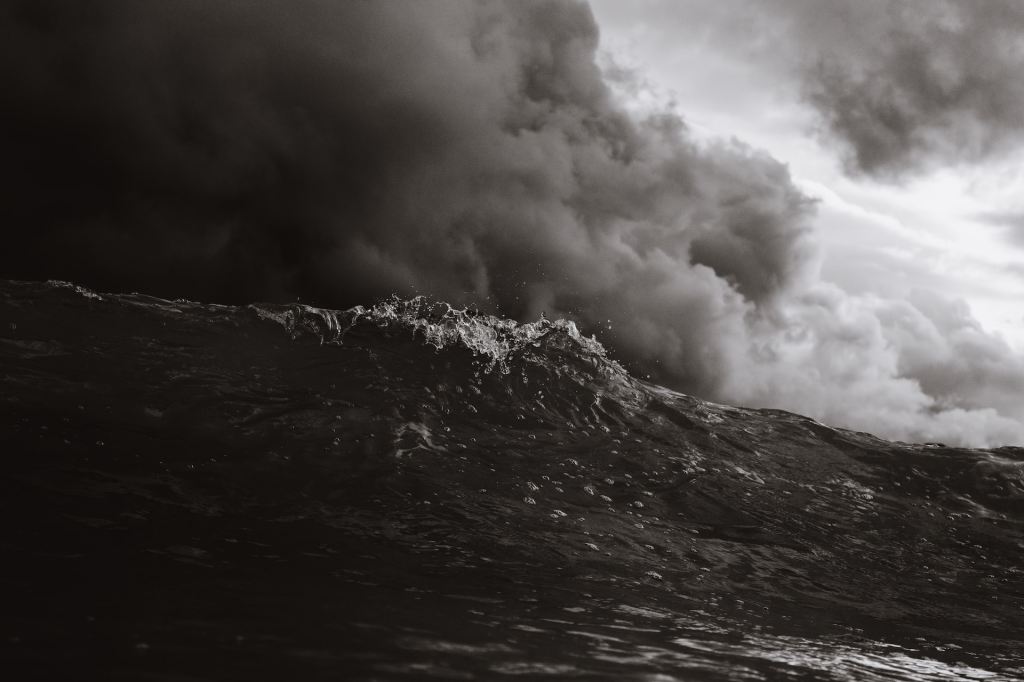
At night, probably shortly before dawn, the disciples were still rowing against the wind, being “beaten by the waves.” They should have been across by this time. In an earlier storm, recorded in Matthew 8:23-27, Jesus had been with the disciples on a boat in a storm, and He woke from a nap to quiet the storm that was terrifying them. This time, they were exactly where He had sent them: in the boat to cross ahead of Him. Even though Jesus was not with them, He knew they would be fighting a storm again, and He had taught them He is the Lord of the storms.
Amid the rain and wind and waves, the disciples saw something on the water and cried out in fear: “It is a ghost!” This was the only explanation they could come up with for something traveling over the water without sinking. But Jesus said “Take heart; it is I. Do not be afraid,” and they knew it was Him, walking on the water. He was still Lord of the storms.
In response, Peter (acting boldly as usual) exercised faith 3 times in this story. First, he believed Jesus was who He said He was. The initial shock and fear of what looked like a ghost passed when Peter heard His voice. Second, he knew Jesus was capable of walking on water, so why couldn’t He enable Peter to do it too? Third, when Peter “saw the wind, he was afraid, and beginning to sink,” he kept faith that Jesus could and would save him from drowning.
But why did Peter begin to sink? The text says he was distracted when he “saw the wind.” In that wind, he saw circumstances that he feared were more powerful than Jesus. Peter could believe Jesus could make him walk on water when he was in a boat, but when wind and waves started hitting him it was harder to trust. There’s a conflict here between faith and circumstances, doubt and trust. Faith can raise us above our circumstances, but only when we focus on Jesus to overcome our doubt. When we look away from Him, our circumstances can overwhelm us.
Peter learned that he could walk on water, but also that it was only possible by focusing his gaze on Jesus, not by relying on his own strength and ability. Only by relying on Him can we thrive. When walking by faith, hearing and obeying His Spirit, it can feel like walking on water, because “the fruit of the Spirit is love, joy, peace, patience, kindness, goodness, faithfulness, gentleness, self-control.” – Galatians 5:22-23a
Do you sometimes feel like you’re in a stormy sea, and getting across is taking longer than it should? Is there a stormy situation in your life that requires stepping out in faith? Are there circumstances you’re focusing on that make you feel you are sinking?
God sometimes knowingly sends us into storms to test our faith, just like Jesus sent the disciples into this storm to help them learn to trust Him. If you’re in a storm, seek Him and go to Him. Turn your eyes upon Jesus; He can make you walk above your circumstances.
In Mark’s Gospel, he tells a story of Jesus taking a nap, causing His disciples to panic. Does it ever seem like God is asleep, leaving you feeling adrift amid the world’s circumstances? When Jesus walked the earth, there were times when God literally was asleep.
The story comes from Mark 4:35-41.
On that day, when evening had come, [Jesus] said to them, “Let us go across to the other side.” And leaving the crowd, they took him with them in the boat, just as he was. And other boats were with him. And a great windstorm arose, and the waves were breaking into the boat, so that the boat was already filling. But he was in the stern, asleep on the cushion. And they woke him and said to him, “Teacher, do you not care that we are perishing?” And he awoke and rebuked the wind and said to the sea, “Peace! Be still!” And the wind ceased, and there was a great calm. He said to them, “Why are you so afraid? Have you still no faith?” And they were filled with great fear and said to one another, “Who then is this, that even the wind and the sea obey him?”
At the beginning of the story, Jesus told His disciples they were going to cross the Sea of Galilee, then knowing what was coming, “He who keeps Israel”[1] took a nap. Had the disciples understood Jesus, His napping should have reassured them that they were safe, since He was not concerned about the storm. Instead, they thought He didn’t care, which showed that fear of the storm had overcome whatever faith they had. Jesus said they were going across, but they doubted.
Which brings up a very important question.
When did the wind and the sea obey Jesus? At the beginning of the story, at the end, or both? Or at all times? Before Jesus calmed the storm, was the sea being disobedient to God’s laws and will?
I believe Jesus calmed this storm so that next time He wouldn’t have to. He was teaching them that He always cares, regardless of what the circumstances seem to say. He was teaching them that even when it seems like He’s asleep, He is still in control of our circumstances no matter how chaotic they look and feel to us. During the next storm, He wanted them not to panic, but to trust Him because He showed them no circumstance escapes His notice. The storm does not control us; He controls the storm.
When Jesus calmed the storm, He did not create a hedge (See Job 1:10) around His disciples, He just demonstrated that it existed all along. God was not going to let His Son drown before His mission was complete and neither will He let His other children drown before their work is done!
Sometimes when God seems distant and we feel we are sinking, in reality we are being given a divinely designed opportunity to learn to trust that:
The LORD will keep you from all evil; he will keep your life. The LORD will keep your going out and your coming in from this time forth and forevermore[2]
He knows sometimes we have to learn the hard way, and He knows best. Even when He is sleeping.
In a small group study of the apostle Peter, we studied Mark 1:29-39, where Jesus heals Simon’s mother-in-law, then “That evening at sundown they brought to him all who were sick or oppressed by demons. And the whole city was gathered together at the door. And he healed many who were sick with various diseases, and cast out many demons.” Jesus was certainly up most of the night ministering to the crowds that showed up. But “rising very early in the morning, while it was still dark, he departed and went out to a desolate place, and there he prayed.”
Simon Peter had to look for Him, since he wasn’t up early enough to see Jesus go to pray. Peter was exhausted. This is one of the subtle ways Jesus discipled Peter – by His example of being in constant contact with God the Father, even when it was hard or inconvenient. Even Jesus needed to report to the Father regularly. He put the Father first. Every day, even when He was up most of the night. Peter didn’t just witness many miracles, but he witnessed the relationship of Son to Father, and the dependence of the Son on the Father. Peter had to learn that we can’t minister to others solely on our own knowledge and strength.
The study then moved on to Luke 5:1-11, which is a story of Peter and other fishermen hauling in a miraculous catch of fish. Jesus finds these fishermen washing their nets, after a long, frustrating night of catching nothing. Jesus tells Simon “Put out into the deep and let down your nets for a catch.” Peter protests: “Master, we toiled all night and took nothing! But at your word I will let down the nets.” Imagine how Peter (a professional fisherman) would feel about a rabbi (not a professional fisherman) giving fishing advice! But soon their nets caught so many fish that “their nets were breaking.”
What made the difference? Sometimes what determines whether nothing happens, or something amazing happens is our willingness to listen and to obey. Our ability to keep in constant contact with the Father, through Jesus His Son. Jesus made time for the Father even after a long night of ministry, and Peter saw Him do it. Shortly after, Jesus showed Peter that even small changes in our routines and lives, done in obedience to Him, can make a big difference, but how can we know how to follow Jesus if we aren’t showing up to listen?
“Trust in the LORD with all your heart, and do not lean on your own understanding. In all your ways acknowledge him, and he will make straight your paths. Be not wise in your own eyes; fear the LORD, and turn away from evil. It will be healing to your flesh and refreshment to your bones.” – Proverbs 3:5-8
“The sluggard says, ‘There is a lion in the road! There is a lion in the streets!’” – Proverbs 26:13
Laziness has many motives, one being willful misunderstanding of circumstances. This Proverb reminds me to pause and pray for an accurate appraisal of any situation before reacting.
“What you hear in the forest but cannot see might be a tiger. It might even be a conspiracy of tigers, each hungrier and more vicious than the other, led by a crocodile. But it might not be, too. If you turn and look, perhaps you’ll see that it’s just a squirrel…If you refuse to look, however, then it’s a dragon” – Jordan Peterson






 Driving Toward the Morning Sun