Attention to God’s Details

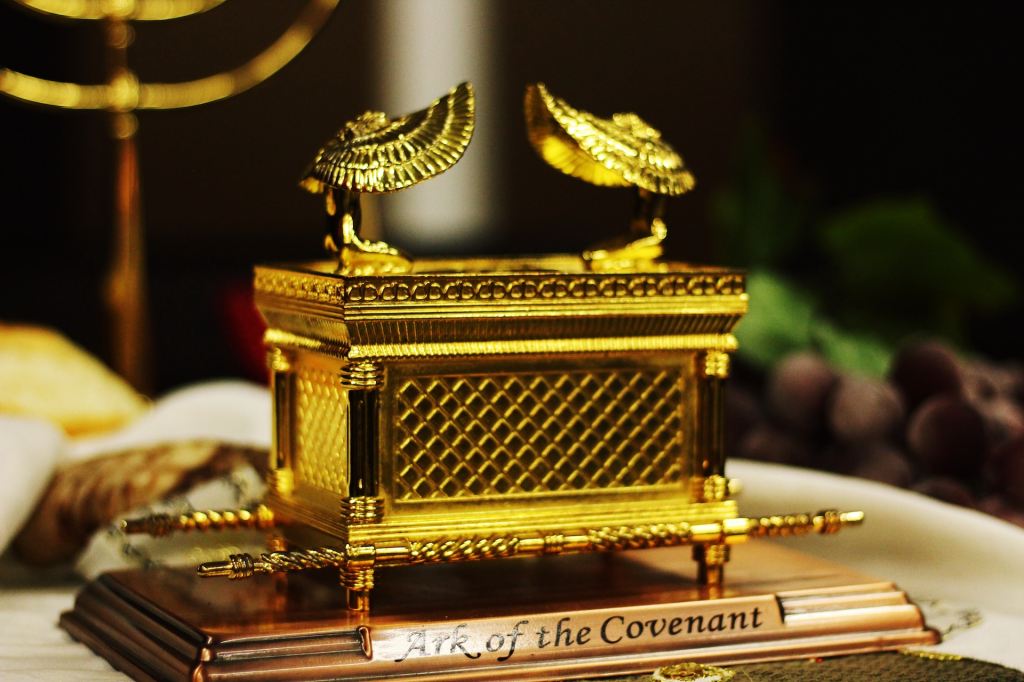
Bezalel made the ark of acacia wood. Two cubits and a half was its length, a cubit and a half its breadth, and a cubit and a half its height.” – Exodus 37:1

The ark in miniature. Photo by Igor Rodrigues on Unsplash

Most of Exodus chapters 36-40 cover the many, many details of the construction of the tabernacle and all of its utensils and other parts.  We may tire of reading chapters of details, but the point is that Bezalel and others put a massive amount of care (and obedience) into the implementation of God’s pattern for the tabernacle, as shown to Moses on the mountain.

What does it mean for us now?  That we should put as much care into learning what God wants of us and put it into action in our lives.

“For whatever was written in former days was written for our instruction, that through endurance and through the encouragement of the Scriptures we might have hope.  May the God of endurance and encouragement grant you to live in such harmony with one another, in accord with Christ Jesus, that together you may with one voice glorify the God and Father of our Lord Jesus Christ.”  – Romans 15:4-6

The Commission to Disciple

Many of you are familiar with the Great Commission, given to followers of Jesus at the end of the gospel of Matthew.  Its place at the end of the book suggests this Commission represents Jesus’ final instructions to His followers:

Go therefore and share the gospel with all nations, baptizing them in the name of the Father and of the Son and of the Holy Spirit

However, that’s not the Great Commission.  I changed some words.  “Share the gospel with” isn’t in the ESV translation of this verse.  Matthew 28:19 actually says:

“Go therefore and make disciples of all nations, baptizing them in the name of the Father and of the Son and of the Holy Spirit”

This illustrates a common idea that the Great Commission is mostly, or even all, about evangelism (sharing the good news of Jesus with people, in order to convert them to Christianity).  The verse appears so often in the context of evangelism that, even though it says “make disciples,” it is often thought of the first way I wrote it.

Making disciples is a much bigger subject than evangelism and takes place in a much broader context, suggested by adding verse 20 to the quote:

Go therefore and make disciples of all nations, baptizing them in the name of the Father and of the Son and of the Holy Spirit, teaching them to observe all that I have commanded you. And behold, I am with you always, to the end of the age.

Yes, evangelism is crucially important in the mission of the church (you can’t disciple if you don’t have Christians to disciple), but the Commission covers so much more that the church needs to do.  It’s not just about accumulating converts, but about making disciples who follow Jesus.  It covers anything involved with “teaching them to observe all that I have commanded you,” and God equips each member of His church to contribute.  As Paul wrote in 1 Corinthians 12:4-7:

“Now there are varieties of gifts, but the same Spirit; and there are varieties of service, but the same Lord; and there are varieties of activities, but it is the same God who empowers them all in everyone.  To each is given the manifestation of the Spirit for the common good.”

And in verses 8-10 he lists some of the gifts:

“For to one is given through the Spirit the utterance of wisdom, and to another the utterance of knowledge according to the same Spirit, to another faith by the same Spirit, to another gifts of healing by the one Spirit, to another the working of miracles, to another prophecy, to another the ability to distinguish between spirits, to another various kinds of tongues, to another the interpretation of tongues.

These gifts are for “the common good”, and Paul says in chapters 13 and 14 that these gifts are useless unless used in love to build up the church, to make it (both as a total body, and as individual members) more like Christ.  In other words, to disciple all nations since the church includes people from everywhere!

So with yourselves, since you are eager for manifestations of the Spirit, strive to excel in building up the church.” – 1 Corinthians 14:12

Paul also makes a point to warn about emphasizing or exalting some gifts above others:

“The eye cannot say to the hand, “I have no need of you,” nor again the head to the feet, “I have no need of you.”  On the contrary, the parts of the body that seem to be weaker are indispensable”[1]

Limiting the Great Commission to evangelistic efforts also risks raising evangelists above those with other gifts.  Maybe the teachers, helpers, and others will feel like the foot, which in Paul’s illustration, said:

Because I am not a hand, I do not belong to the body[2]

Every time Paul wrote about the spiritual gifts, in 1 Corinthians 12-14, in Romans 12, and in Ephesians 4, he stresses the unity of the church, founded on love among its members.  All gifts are part of the Great Commission when we know we are not making converts but making disciples.  Every Christian has a part to play, specific to their own gifts, passions, and opportunities, and no Christian should feel like a second-class citizen of the church.  Paul’s teaching on gifts is an encouragement to embrace diversity in the church – of gifts, of ministries, and of personalities – but not diversity of motive.  The only good motive is self-sacrificial agape love, and each gift is only effective to the degree that the one using it uses it in service to the growth of the church.

Perhaps the Great Commission should be renamed as the Commission to Disciple? What a difference a couple of words make.


[1] 1 Corinthians 12:21-22
[2] From 1 Corinthians 12:15
Enter His Gates: Participating in the Psalms

Photo by Steven Lasry on Unsplash

Psalm 100 is “A Psalm for giving thanks.”  Yesterday’s post focused on the first three verses, and today’s covers the last two, which continue the Psalmist’s encouragement to personally join them in thanksgiving.

Psalm 100:4 reads:

Enter his gates with thanksgiving,
            and his courts with praise!
            Give thanks to him; bless his name!”

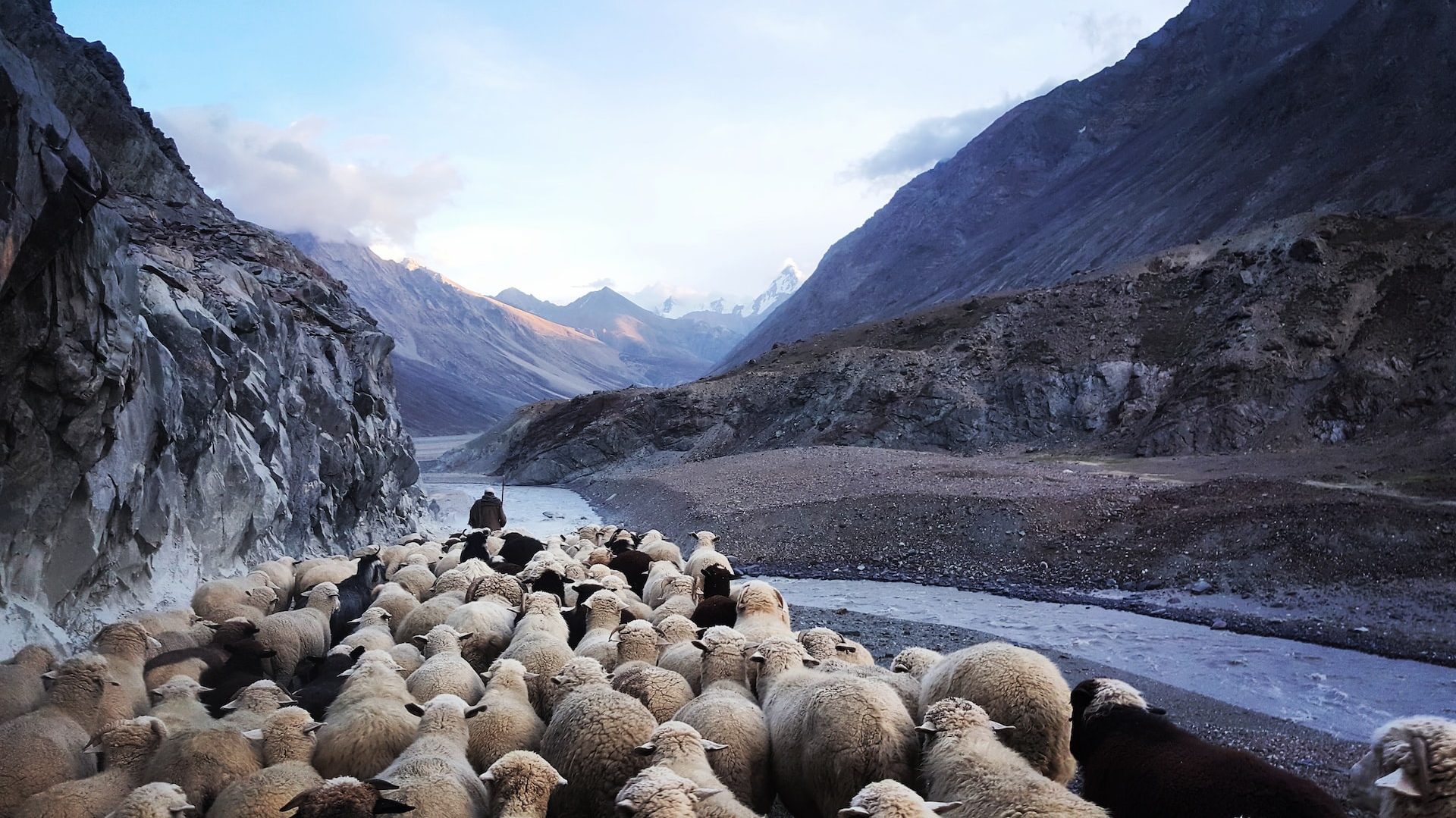
Verse 3 ended describing us as God’s sheep, and as our Shepherd, He guides us into His presence.  At the time the Psalm was written, this would probably be in His temple, but for us it is whenever we worship in public or in private.  Does our worship involve willing and joyful giving of thanks, praise, and blessing to God?  Or do we sometimes worship reluctantly?  Do we feel we don’t measure up to what God expects?  In case we need encouragement, the Psalmist continues with verse 5:

“For the LORD is good;
            his steadfast love endures forever,
and his faithfulness to all generations.

Like verse 3 covered yesterday, this verse is a list of things to be thankful for.  A list of reasons we can enter His gates and courts with thanksgiving and praise:

“For the LORD is good” – We can approach God and worship Him because He is good
“his steadfast love endures forever” – We can approach Him because His love is steadfast
“and his faithfulness to all generations.” – We can approach Him because of His faithfulness

It is His characteristics that make Him love us, and His character endures forever.  If we have lacked goodness, love, or faithfulness since we last met with God, His love for us in Christ overcomes it all.  His nature is 100% reliable, and worthy of our thanksgiving!

Take a moment and ask Him how you might participate in the Psalms, being thankful for His character regardless of how your day is going, or how you feel.  He wants to walk through it with you.  Be thankful!

Make a Joyful Noise: Participating in the Psalms

Photo by Adam Winger on Unsplash

A recent post about Psalm 96 said that “the writers aren’t just trying to teach about God, but they are trying to share their experience of Him.”  While that Psalm was about how to “sing to the LORD a new song” of praise, Psalm 100 is “A Psalm for giving thanks,” and like Psalm 96, spells out ideas for doing it.  Today will focus on the first three verses, and tomorrow on the last 2.

Psalm 100 begins with:

A Psalm for giving thanks.

Make a joyful noise to the LORD, all the earth!
Serve the LORD with gladness!
            Come into his presence with singing!

Know that the LORD, he is God!
            It is he who made us, and we are his;
            we are his people, and the sheep of his pasture.

First, the Psalmist wants the whole earth to make a joyful noise, but notes that singing and making a joyful noise are not the only part of giving thanks.  We are encouraged to thank God by serving Him, not reluctantly, but to serve with the same gladness we have when we sing in worship.

The third verse reads like a list of things to be thankful for.  When we feel like there’s nothing to be thankful for, or no motivation to serve, consider:

“Know that the LORD, he is God!” – Our Lord is not powerless, He is God!
It is he who made us, and we are his” – We are not accidents of a mindless nature, we are His!
We are his people, and the sheep of his pasture” – We do not have to wander aimlessly through life, not knowing where we are going, we belong to a flock and our Shepherd provides us pasture! 

Take a moment and ask Him how you might participate in the Psalms, carrying these instructions into your daily circumstances.

God Knows Where the Grass is Greenest

The Old Testament book of Numbers has a story about Balak, the king of Moab.  Scared of Israel after seeing their military success, he was desperate to find a way to avoid defeat himself.  Balak sought out Balaam, known as a prophet who spoke oracles, to curse Israel for him. After repeatedly paying Balaam and making many sacrifices, Balaam refused to curse Israel because God told him to bless Israel, not curse them.  Balak would not give up, and before a third try, “Balak said to Balaam, ‘Come now, I will take you to another place. Perhaps it will please God that you may curse them for me from there.’” (Numbers 23:27)

Where did Balak get the idea that changing location would get God on his side?  That changing location would change God’s mind or bring God’s blessing to Balak (in the form of a curse on Israel)?  Doesn’t it seem naïve?  God’s character doesn’t change with location, or any other circumstances.

However, how often do we think a change in circumstances will bring God’s blessing?  How often do we pray that God change our situation because we think the grass is greener somewhere else?  Maybe if I lived in a different place, God would bless me.  Maybe if I got a better job, would it be a blessing?  Maybe if I went to a different church?  Maybe if I was in a different relationship?   Maybe if God would put us where we want to be, that He will bless us then?  Are we saying “come with us God to another place, and perhaps it will please You to bless us there” in another way?

Warren Wiersbe wrote that “We are prone to think that a change in circumstances is always the answer to a problem. But the problem is usually within us and not around us. The heart of every problem is the problem in the heart.”[1]

God calls each of us for specific reasons, and the circumstances may be part of the reason.  Referencing whether it is better to be married or single, circumcised or uncircumcised, slave or free, the apostle Paul wrote in 1 Corinthians 7:24, “So, brothers, in whatever condition each was called, there let him remain with God.”  In other words, God wants to bless you in, or even through, your present circumstances.  He may change them, but He may not.

In God’s plan, the grass is usually greenest right where we already are. If we can faithfully be the blessing needed in our circumstances, God will be faithful in His time and place.  He will bless His people, only sometimes with better circumstances, but always with spiritual fruit.

God always says: “Come now, I will be with you where you are. It pleases me to bless you in all situations and circumstances.”

The grass is greenest where He is.


[1] Wiersbe, Warren.  Be Wise (1 Corinthians) (1982).