Forgetting What Lies Behind

Paul wrote his letter to the Philippians from a Roman jail, to encourage them to continue forward in the faith.  In it, he wrote: “Brothers, I do not consider that I have made [Christs righteousness] my own. But one thing I do: forgetting what lies behind and straining forward to what lies ahead, I press on toward the goal for the prize of the upward call of God in Christ Jesus.”[1]

In Paul’s life, “what lies behind” includes overseeing the stoning of Stephen recorded in Acts 7:57-58, and “ravaging the church, and entering house after house, [dragging] off men and women and committ[ing] them to prison.”[2]  We all have different shameful things in our past, but God forgets them.  His purpose is to always make us more like Christ, even when we struggle to move forward.  The prize is worth it, therefore we “press on toward the goal,” even if our current situation is discouraging and seems hopeless. After all, Paul knew that even prison was temporary and God could wash away all the sins of his past, present, and future to make him righteous like Christ.

[This Rewind Wednesday post is revised from Dec 2021]


[1] Philippians 3:13-14
[2] Acts 8:3

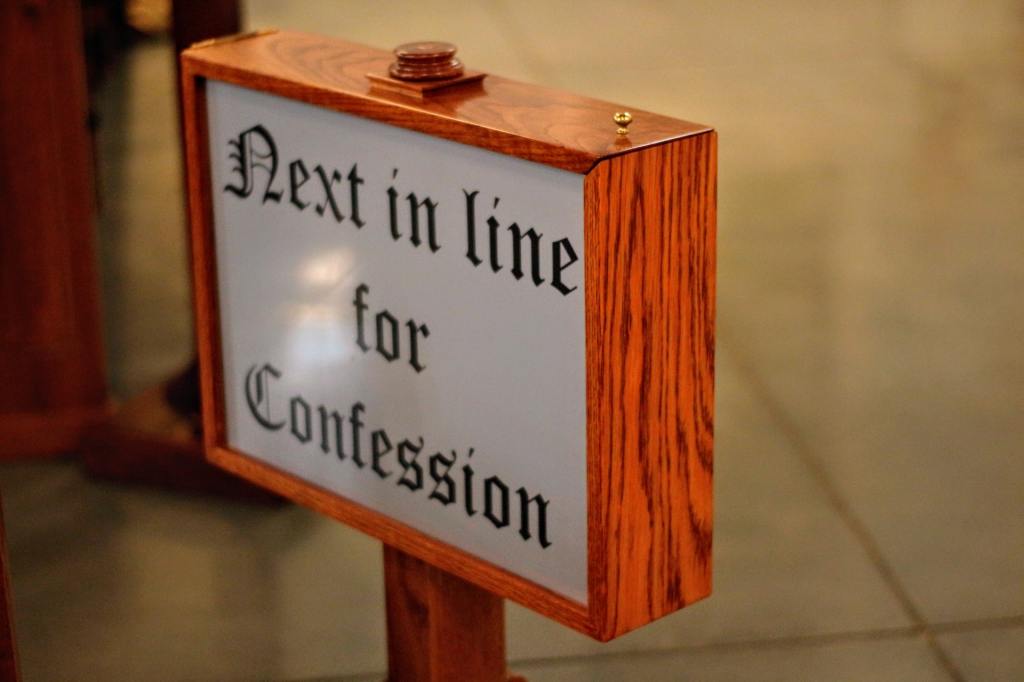
Confession: The Blessing Nobody Expects

What comes to mind when you think of confession?  Think about it for a moment.

For some, the thought might be a simple private prayer, or for some a confessional booth.  For others, no specific images might come to mind, but just a feeling of someone “out to get you.”  I expect some of you thought of the Spanish Inquisition, or at least the Monty Python skit making fun of it[1].  Where do these ideas come from?

The blame belongs in many places: secular culture, bad experiences with church, an emphasis on external over internal religion, and even Monty Python comedy skits.  My fantasy baseball league even has a team named “Spanish Inquisition” because the manager of that team thinks no one expects him to win – not even himself.

The mocking of secular culture aside, confession is an uncomfortable topic even for sincere Christians.  In Humphrey Carpenter’s biography of J.R.R. Tolkien, he shares the tension over confession between Tolkien and his then-fiancée Edith.  Tolkien was a practicing Catholic, while Edith was a member of the Church of England.  They had agreed as a couple to be Catholic, but Edith “began to dislike making her confession.  It was therefore all too easy when she was worried about her health (which was often) to postpone going to mass. She reported to Ronald [Tolkien] that getting up to go to church early in the morning and fasting until she had made her communion did not agree with her.”  She insisted “my health won’t stand it.”[2]  In my own Protestant church, we have a weekly prayer of confession, which the pastor regularly defends the importance of.  Few of us probably look forward to confession, whatever form we practice it in.

Photo by Shalone Cason on Unsplash

This discomfort with confession seems to be a shared part of mankind’s fallen nature, but if we look at well-known Bible verses on confession, we find that it is really about restoration, a rebirth of man’s relationship with God and a renewal of man to his ideal nature.  It is as different from God being “out to get you” as it could be.  1 John 1:9 encourages confession, because: “If we confess our sins, he is faithful and just to forgive us our sins and to cleanse us from all unrighteousness.”  God wants to give us forgiveness and cleansing, not condemnation and guilt.  Isaiah 1:18 explains this cleansing more poetically:

Come now, let us reason together, says the LORD:
though your sins are like scarlet,
            they shall be as white as snow;
though they are red like crimson,
            they shall become like wool.

Confession doesn’t need to be a dirty word.  The word “confess” means loosely to say the same thing about something, so confession means we agree with God (say the same thing he does) about sin – that it is bad.  But confession also applies to the rest of 1 John 1:9, that God “is faithful and just to forgive us our sins and to cleanse us from all unrighteousness.”  Full confession includes agreeing about the steadfast and dependable character of God, His faithfulness and justice, as well as His desire to forgive and cleanse.  If we doubt this desire, consider what He voluntarily suffered on the cross to provide for this forgiveness, and to demonstrate His enduring love.

By adding confession about the good things of God to our confession of our sin, our confession does not make us miserable about our own condition but shows us how different we are from what God wants for us, how deeply our sin needs to be corrected, and how wonderfully God has provided for the removal of sin.

But this does not come easily.  Referencing Hebrews 4:16, which says, “Let us then with confidence draw near to the throne of grace, that we may receive mercy and find grace to help in time of need,” Puritan preacher Thomas Watson wrote that “Christ went more willingly to the cross than we do to the throne of grace.”

Why is this?  Could it be that we have trouble whole-heartedly confessing that “he is faithful and just to forgive us our sins and to cleanse us from all unrighteousness”?  Monty Python joke that “nobody expects the Spanish Inquisition,” but do we fully expect God’s throne to be one of grace when we come to confess?


[1] If you’re not familiar with the skit, here’s a 4-minute example: https://youtu.be/Cj8n4MfhjUc
[2] Carpenter, Humphrey. Tolkien: A Biography.  (1977).  P. 68-69.

Today is Mo Gaba Day

Today my local public school system is celebrating Mo Gaba Day, in honor of Mosilla “Mo” Kingsley Gaba, born on January 26, 2006.  Who is Mo Gaba?  If you aren’t a Maryland local, you likely don’t know Mo’s amazing story, but it’s worth telling!

At 9 months old, Mo had his first cancer diagnosis and soon lost his sight completely and permanently.  Over his life he fought cancer in his brain, bones, legs and elsewhere, but even with these challenges, Mo became a local celebrity because of his unquenchable enthusiasm for the Baltimore Ravens and Orioles, and for life in general.  At 9 years old, he began calling local sports radio shows in secret while his mother was at work, sharing thoughts about his teams, and about life, that seemed way beyond his years.  To listeners, he was known as “Mo from Glen Burnie.”  Over time, people also learned of his health issues and his attitude became an inspiration to, and friend of, many, including then-Orioles player Trey Mancini, who had been diagnosed with colon cancer in early 2020.  Tragically, 14-year-old Mo Gaba died on July 28, 2020, after spending 75% of his life in hospitals, but he remains inspirational to many.

Mo Gaba and Trey Mancini

Two years later to the day, the Orioles held their first Mo Gaba Day, and something amazing happened: “Mancini hit an inside-the-park home run with a runner on base that started as what appeared to be a routine sacrifice fly. However, the ball deflected off the glove of Tampa Bay right fielder Josh Lowe after he lost it in the afternoon sun and hit him in the face, allowing Mancini to score…Trey commented about Mo playing around in the clouds so that he could score.”[1]  As Mancini rounded the bases, there was hardly a dry eye in attendance at the game, or watching on TV.  The Orioles won 3-0.

I don’t know much about Mo’s private life, the source of his hope and personality, or his religion, but share his story in the spirit of Philippians 4:8 – “Finally, brothers, whatever is true, whatever is honorable, whatever is just, whatever is pure, whatever is lovely, whatever is commendable, if there is any excellence, if there is anything worthy of praise, think about these things.”  Can followers of Christ provide hope as Mo did?

Lastly, below is what I posted to Facebook the day after hearing of his passing.

“RIP Mo Gaba, age 14.

Who is Mo Gaba?  A few years ago I started hearing him on the radio, calling in to the sports talk show I listened to in the car on my drive home.  He would have been about 10 when I first heard him.  Kids don’t call in much and the hosts usually aren’t patient with them so I wondered what was the deal with this very informed, very enthusiastic kid.  He loved his Orioles and Ravens!!!  Later I found out he was blind and had been fighting cancer his whole life. He was confined to a wheelchair. But he was so endearingly positive at all times.  The talk show host (Jeremy Conn) became a big advocate for him and his family, raising money to support him.  Other local sports figures and celebrities also began to support this kid who had an amazing personality in spite of his health problems that would crush many peoples spirits.  for example, “In 2019, Gaba became the first person to announce an NFL draft pick in Braille when he announced the Ravens’ fourth-round pick.”  Yesterday he was in the news (below) for getting into the Orioles Hall of Fame and today he’s gone.

We can all learn a lesson from his attitude in the face of adversity.  His joy was infectious. 

May we all experience joy as the world has become so negative and in turmoil!  A world that in some ways is teaching us to feel nothing but guilt and helplessness.  We are not victims in God’s eyes.

In the day of prosperity be joyful, and in the day of adversity consider: God has made the one as well as the other, so that man may not find out anything that will be after him” – Ecclesiastes 7:14”

https://www.baltimoresun.com/sports/orioles/bs-sp-orioles-mo-gaba-hall-of-fame-20200728-5kcctc4q6zeefbzkw6ahq2xg7q-story.html


[1] https://en.wikipedia.org/wiki/Trey_Mancini

The Crushing Obligation to Keep Doing More and More – Sunday Share from Kevin DeYoung

Some days we are able to follow Jesus’ advice in Matthew 6:34 – “Therefore do not be anxious about tomorrow, for tomorrow will be anxious for itself. Sufficient for the day is its own trouble.”  Other days we feel overwhelmed by our responsibilities, and on some days, we feel like we’re carrying all the problems of the world.  Whether it’s something in a sermon, on the news, a book we’ve read, the multitude of notifications on our phones and other devices, or something in our own conscience, we feel that the world needs more than we have to give.

In the linked article, author Kevin DeYoung writes that “most Christians hear these urgent calls to do more (or feel them internally already) and learn to live with a low-level guilt that comes from not doing enough. We know we can always pray more and give more and evangelize more, so we get used to living in a state of mild disappointment with ourselves.”  He shares some thoughts on how to relieve this anxiety and focus on what we need to focus on.  After all, even Jesus “did not try to do it all. And yet, he did everything God asked him to do.”

(Estimated reading time 7 minutes)

I discovered this through fellow blogger Barbara Harper, who posts a weekly list of good reads on Saturday.

https://kevindeyoung.org/the-crushing-obligation-to-keep-doing-more-and-more/

Don’t Fear Jezebel’s Algorithm

Yesterday I re-posted a story of King Jehoiakim’s attempts to destroy the prophet Jeremiah’s words with fire, as recorded in Jeremiah 36:20-25 (which survived).  I decided to share it again based on two events: 1) a comment I saw on Facebook yesterday lamenting that owning a Bible could be made illegal, and 2) Facebook’s reminder to me in “Memories” that two years ago to the day I had posted this:

“To any religious person who is dismayed at “their side” being shut down by social media: Name one of Gods accomplishments that required Twitter or Facebook.  The Holy Spirit is the original (and best) social network. Listen to Him. Post to Him. Wait for Him. The Answer lies there. He remains online for eternity and He has a plan.”

Resistance to spreading God’s word is as old as time.  Consider the Old Testament story of Elijah, who prophesied during the reign of Israel’s evil king Ahab and his wife Jezebel.  According to Who’s Who in the Bible, “Jezebel devoted herself to bringing the worship of Baal and his consort Asherah to Israel. She employed 450 prophets of Baal and 400 prophetesses of Asherah (1 Kings 18:19), and persecuted the prophets of the Lord, including Elijah (1 Kings 19:1-9).”[1]  Many prophets were killed.

Elijah despaired, as written in 1 Kings 19:10 – “I have been very jealous for the LORD, the God of hosts. For the people of Israel have forsaken your covenant, thrown down your altars, and killed your prophets with the sword, and I, even I only, am left, and they seek my life, to take it away.

Apostles also struggled to stay strong, including Paul.  When he was frustrated at resistance and lack of progress in Corinth, “the Lord said to Paul one night in a vision, ‘Do not be afraid, but go on speaking and do not be silent, for I am with you, and no one will attack you to harm you, for I have many in this city who are my people.”[2]

When Paul needed an example to encourage others to persist, he used Elijah’s story in Romans 11:2 – “God has not rejected his people whom he foreknew. Do you not know what the Scripture says of Elijah, how he appeals to God against Israel?  ‘Lord, they have killed your prophets, they have demolished your altars, and I alone am left, and they seek my life.’  But what is God’s reply to him? ‘I have kept for myself seven thousand men who have not bowed the knee to Baal.’”

Therefore, our hope is not in social networks where we can share God’s message, or in the benevolence of the programmers of algorithms that choose who sees what we post, or in the regulators and legislators who monitor the public square, or in the founding political documents that give us rights.  But:

For as the rain and the snow come down from heaven
            and do not return there but water the earth,
making it bring forth and sprout,
            giving seed to the sower and bread to the eater,
so shall my word be that goes out from my mouth;
            it shall not return to me empty,
but it shall accomplish that which I purpose,
            and shall succeed in the thing for which I sent it.” – Isaiah 55:10-11

Social networks, algorithms, regulators and government are not our enemy, but our enemy is the one who tries to convince us we need these things more than we need the God who made them and who made us all.  His word will accomplish its purpose, and we have Elijah’s and Paul’s words and actions as evidence.

God’s word withstands the fire.  Always.


[1] Gardner, Paul D., editor.  The Complete Who’s Who in the Bible.  (1995)
[2] Acts 18:9-10