In the previous post in this series on our Master’s voice, I wrote that: “We can’t see the reasons God wants us to trust Him because there is far more at work than we could ever imagine.” Sometimes truth is stranger than fiction, but sometimes great illustrations come from strange fictional places, like Jim Carrey movies and Douglas Adams books for example.
In The Restaurant at the End of the Universe,[1] the sequel to the sci-fi comedy classic The Hitchhiker’s Guide to the Galaxy, author Douglas Adams imagines a technology that harnesses full awareness of the universe as a profoundly cruel torture device. When Trin Tragula invented the “Total Perspective Vortex” to annoy his wife who kept accusing him of blowing things out of proportion, he found that when he tested it on her, “the shock completely annihilated her brain.” A victim is placed in the TPV and presented with a realistic model of the entire universe, with a tiny dot on top of a tiny dot that says, “you are here.” He concluded that “a sense of proportion” in such a massive universe would only make someone feel completely insignificant, hopeless, and insane beyond all hope of recovery. It’s a sci-fi comedy, but still, be careful what you wish for.
Another example from a different angle is the Jim Carrey movie, Bruce Almighty. This hilarious (but irreverent) comedy is based on Carrey’s character Bruce Nolan raging against God about his frustrating life. God, played by Morgan Freeman, appears and challenges Bruce to do any better, giving him “the job” for a temporary period to teach him a lesson. The 3-ish-minute video embedded here is my favorite part of the movie, where Bruce tries to figure out how to deal with his new awareness of all the prayers of the world.
If God thought it was possible, or a good idea, for us to know it all, we would. After all, even Nipper the dog from the “His Master’s Voice” painting would be distracted and unable to get anything done if he saw this picture, even though it contains only good news:
Our Master speaks to us as our creator, knowing both our limitations, but also what we are capable of as His marvelous creatures if we trust Him!
This post is fourth in a series that started with this post on His Master’s Voice. More to come…
[1] Adams, Douglas. The Restaurant at the End of the Universe. (1980). P. 79
Today we come back to the topic of our Master’s voice, which began with the painting “His Master’s Voice” and continues through the story of Gideon in the book of Judges, chapters 6 and 7. So far, Gideon has done his best to discern whether God was really talking to him, then set out with an army of 22,000 soldiers, which Gideon faithfully whittled down to only 300, at God’s instruction. Against an army “like locusts in abundance,” Gideon might have needed a little reassurance, because outside of a miracle[1] his army was going to fail miserably.
That very night, God spoke to Gideon, saying: “Arise, go down against the camp, for I have given it into your hand. But if you are afraid to go down, go down to the camp with Purah your servant. And you shall hear what they say, and afterward your hands shall be strengthened to go down against the camp.”[2] We know Gideon was still afraid because he took Purah and went down into the camp. We also know that God made provision for Gideon’s fear, instead of counting on Gideon to have perfect faith. Should Gideon have needed extra reassurance? No, but God provided what was needed to overcome Gideon’s fear, which was a bit more insight into God’s plan. Victory in battle is never a matter of how many soldiers are on God’s side, as if spiritual warfare was determined by democracy, but by whose side God is on.
When Gideon snuck into the camp: “behold, a man was telling a dream to his comrade. And he said, ‘Behold, I dreamed a dream, and behold, a cake of barley bread tumbled into the camp of Midian and came to the tent and struck it so that it fell and turned it upside down, so that the tent lay flat.’ And his comrade answered, ‘This is no other than the sword of Gideon the son of Joash, a man of Israel; God has given into his hand Midian and all the camp.’”[3]
Victory in battle is never
a matter of how many
soldiers are on God’s side
Some commentators suggest that the “barley” reference means that an inferior army would win, since barley was considered inferior to wheat and other grains, but what we know is that this dream put fear into the Midianite camp and emboldened Gideon to trust God, even though he didn’t understand Him. Overhearing these words in the camp let Gideon know that that God was at work in far more ways than he could imagine, that victory belongs to the LORD, and that he can trust that God has the knowledge he lacked. God is trustworthy, even if we don’t fully understand Him.
We only know part of our part in God’s plan. He knows all of our part, and also all of everyone else’s part. Each of us are but one of millions of Christians trying to figure out our relationship with God, and we have no idea what those other millions are up to. But God does, and if we insist God tells us everything before we act, we not only disobey God, but lose out on the opportunity to impact those other lives and see how awesome God’s plan really is!
Our ability to hear and obey our Master’s voice is not a question of complete knowledge, but of wisdom. Proverbs 17:24 says, “The discerning sets his face toward wisdom, but the eyes of a fool are on the ends of the earth.” Since “The fear of the LORD is the beginning of wisdom, and the knowledge of the Holy One is insight,”[4] from the story of Gideon, we learn that God was teaching Gideon to revere Him above any desire to see the “ends of the earth.” Wisdom keeps us on the path of life but doesn’t always mark it out for us far into the future. We can’t see the reasons God wants us to trust Him because there is far more at work than we could ever imagine.
“The secret things belong to the LORD our God, but the things that are revealed belong to us and to our children forever, that we may do all the words of this law.” – Deuteronomy 29:29
This post is third in a series that started with this post on His Master’s Voice. More to come…
[1] Or a certain action film directed by Zack Snyder… [2] Judges 7:9b-11a [3] Judges 7:13-14 [4] Proverbs 9:10
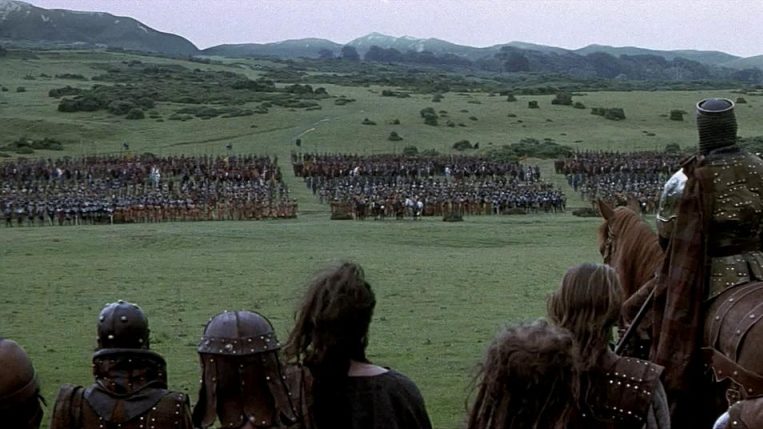
In Braveheart, one of my favorite movies, a Scottish soldier is afraid to fight because “the English are too many!” Imagine if God had responded that, actually, the Scottish army was too big. In the story of Gideon, something like that happened.
In a series of posts about hearing our Master’s voice, God speaks to and works through Gideon to rescue Israel from oppression by the Midianites, Amalekites, and others. After some serious doubts, covered in the last post, Gideon gained enough trust in God to gather an army, although he didn’t know the details of God’s plan. Judges 7 shows the plan being revealed and implemented and is the subject of coming posts.
Gideon gathered 22,000 soldiers south of the Midianite camp, and it was probably an inexperienced army since Judges 3:2 says many in Israel had yet to learn war. However, the army was too big: “The LORD said to Gideon, ‘The people with you are too many for me to give the Midianites into their hand, lest Israel boast over me, saying, ‘My own hand has saved me.’”[1] God says the fearful must return home, otherwise the army, and Gideon, would take credit that only God deserves. Only 10,000 remained, presumably those who trusted God for the victory.
But the Israelites were still too many, so the LORD has Gideon watch how the soldiers drank from the water. Those who knelt to drink were sent home, leaving only 300 men! Some suggest the soldiers who knelt showed that they were not ready for battle, probably putting down their weapons to drink, but whatever the reason, God was putting a plan into action, revealing it piece by piece, where Gideon could not possibly take credit and also risked massive failure. The enemy army was “like locusts in abundance, and their camels were without number, as the sand that is on the seashore in abundance.”[2]
Gideon must have been getting nervous, but God was about to show him that “If God is for us, who can be against us?” – Romans 8:31b. The Midianites were not too many for God to handle.
This post is second in a series that started with this post on His Master’s Voice and continues here.
When we want to hear our Master’s voice, we all have to overcome competing influences, like the lyrics of “Breathing” by Lifehouse say, “I’m trying to identify the voices in my head; God, which one’s you?” We all need a filter to pick the right voices, or influences, that we base our lives on, and filter out anything that competes for our Master’s attention. The Bible recommends it, as 1 John 4:1 says “Beloved, do not believe every spirit, but test the spirits to see whether they are from God, for many false prophets have gone out into the world.” Proverbs tells us to make our ear attentive toward wisdom and to incline our heart to understanding, and to treat wisdom and understanding as more valuable than silver and treasures.[1] But how do we do it?
Gideon from the book of Judges might also have related to Lifehouse’s lyrics. Gideon needed to filter out the voices, and probably the best-known part of his story is his use of a fleece to do that. During Gideon’s life, as recorded in the book of Judges, Israel was being oppressed by the Midianites, Amalekites, and others, who would wait until harvest then rob all the produce and livestock. The angel of the LORD appeared to Gideon, saying he would use Gideon to “save Israel from the hand of Midian”[2], but Gideon doubted that it was God speaking, and said “show me a sign that it is you who speak with me.”[3] Gideon may or may not have doubted that God was able to save Israel, but he certainly doubted whether this was really God talking. Therefore, Gideon needed to “test the spirits,” but how?
Gideon asked God for a sign, which God provided, giving Gideon confidence to break down an altar to Baal and destroy an Asherah.[4] But Gideon asked God for more proof that it was truly Him speaking, and that He was calling Gideon to save Israel. This extra step was the sign of the fleece, which is worth quoting in full, from Judges 6:36-40.
“Then Gideon said to God, ‘If you will save Israel by my hand, as you have said, behold, I am laying a fleece of wool on the threshing floor. If there is dew on the fleece alone, and it is dry on all the ground, then I shall know that you will save Israel by my hand, as you have said.’ And it was so. When he rose early next morning and squeezed the fleece, he wrung enough dew from the fleece to fill a bowl with water. Then Gideon said to God, ‘Let not your anger burn against me; let me speak just once more. Please let me test just once more with the fleece. Please let it be dry on the fleece only, and on all the ground let there be dew.’ And God did so that night; and it was dry on the fleece only, and on all the ground there was dew.”
A quick survey of study Bibles on this passage brings these comments on Gideon’s “test” of God:
“Even though the Spirit has come upon him, Gideon still struggles to trust the Lord.”
“The gathering of the tribes should have been sufficient evidence of God’s presence with Gideon, but he wanted a sign that God would do what He had promised.”
“Gideon’s desire for a second fleece sign evidenced his less than complete trust in God…He wanted to make certain that the first fleece sign was not merely a coincidence or the result of the natural absorption properties of a fleece.”
“Unlike Gideon, we have God’s complete, revealed Word. If you want to have more of God’s guidance, don’t ask for signs; study the Bible”
It’s easy, even encouraged, to criticize Gideon for testing God but if we put ourselves in his place can we do any better, even with the whole Bible? Sometimes the Bible is clear, as in “you shall not murder,” but what about questions like, “what should I write next?” Or “how can I encourage a friend?”
Consider that if Gideon had not put out the fleece maybe his story would’ve stopped right there, with him wallowing in doubt. After all, Israel was being persecuted by a powerful enemy – why take any risks? However, not knowing with 100% certainty what God’s will is does not mean that doing nothing is the right answer. If we have a decision to make where the Bible doesn’t seem to provide explicit direction, do we just follow Yogi Berra’s sarcastic advice: “When you come to a fork in the road, take it”?
I can relate to Gideon because I needed a filter, a reason to take the time to “test the spirits,” because I rarely know for sure what God wants. Much of the time, I “go with the flow,” and think if I avoid the wrong “flow” I’ll be ok. I write often not because I’m disciplined, but because I’m not. Writing is a tangible way to build the spirit-testing filter into my routine, even if it sometimes looks no wiser than Gideon’s fleece. So, why publish publicly to anyone with an internet browser? Because I take it more seriously, working on filtering out voices that aren’t useful to me, and wouldn’t be useful to anyone else. A published blog takes more effort than not writing at all, which is the point, and it helps me move forward.
The Benefit of the Doubt As I’ve written about Jeremiah and others, the Bible records openly the doubts of God’s people, because we all have a lot in common. Finding and trusting God’s voice is hard. If we criticize Gideon for demanding tests from God, are we really just criticizing ourselves and making it even harder? Our filters are also imperfect – does that mean we do nothing and get nowhere? Do we give up the call to “test the spirits,” leaving ourselves to “go with the flow” until we find a perfect method? Like Gideon, we are also prone to take the safe route, when offered what looks like a riskier alternative. To do something involves risk of not only doing the wrong thing, but also of being criticized for our methods. Doing nothing is sometimes the right answer, but it is also a choice, and we can’t always be clear why we choose it.
David sometimes encourages us to “wait for the Lord,” and he also wrote “Oh, taste and see that the LORD is good!”[5] when he was feigning madness before Abimelech, a questionable decision. We learn about God by experiencing Him, by taking action or by waiting, taking a chance either way, but over time learning that obedience is always the best decision, and also that He catches us when we fall. We can’t be perfect in this world, but He wants us to try and He will help us grow.
Centuries ago, Solomon wrote in Ecclesiastes 11:4: “He who observes the wind will not sow, and he who regards the clouds will not reap.” He may well have written to me: “He who observes the trolls will not blog, and he who fears the comment section will not write.” Or to Gideon: “He who observes the Midianites will not save Israel.” We all begin our trip to eternity wherever God finds us, where we are not only sinners, but also have a lot to learn about focusing on God’s voice. What might we all be observing that’s keeping us from sowing the seed of the gospel God has given us? Sometimes it’s doubt in our filters, in our ability to know for sure.
When we’re afraid of being compared to Gideon and his fleece, know that he is listed in Hebrews 11:32 as a faithful hero, and was received in heaven as a good and faithful servant by the grace earned on the cross by Jesus. So, let’s take it easier on Gideon and give him the benefit of the doubt. We are all in this together, including the heroes of the Bible. It’s God’s faithfulness that matters and He will overcome all of our doubts.
In the meantime, “No temptation has overtaken you that is not common to man.” – 1 Corinthians 10:13a
This post is second in a series that started with this post on His Master’s Voice, and continues here.
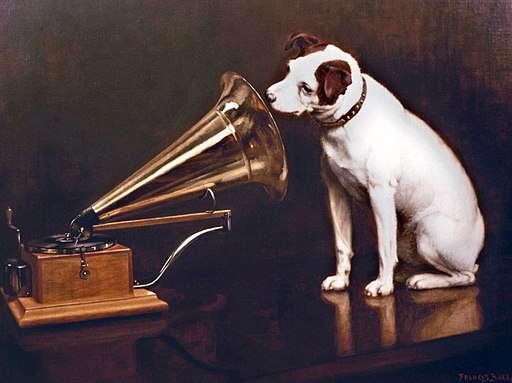
You may not know him by his name, but you’ve probably seen Nipper the dog. He’s quite famous, although he died in 1895. Nipper, of course, is the dog from the painting “His Master’s Voice” where he is listening intently to a gramophone. The picture became a popular logo for many companies, including RCA to sell record players, because the dog looks like it thinks his master is in there talking to him. The RCA recording technology is so clear!
“His Master’s Voice”, an 1898 painting by Francis Barraud. From Wikipedia Commons.
“His Master’s Voice” is also a good introduction to some posts I’m working on about hearing our Master’s voice. We might like to be like Nipper, and every now and then we might get a glimpse of what that’s like, but we’re unlike the painting a lot of the time.
For one thing, most dogs are naturally loyal and want to please their masters. That’s why Nipper loves the gramophone so much. A funny thing about dogs is that they don’t care what their masters believe. They won’t discuss philosophy with them. Not that their master’s philosophy doesn’t matter to the dog, because if their philosophy includes cruelty to animals, that’s very bad. Dogs just don’t think at that level. On the other hand, dogs are very, very excited and eager to hear you tell them to do something. Cats of course are very different – I have two of them – and they’re too often a better picture of how I really relate to my Master in heaven than Nipper is.
The other point is that dogs have great hearing. The painting has no sound, but you get the idea that, no matter how much noise was going on around him, Nipper would be right there, trying to find his master in the gramophone. In contrast, people are bombarded with loud voices from all directions and usually aren’t as good at filtering the good from the bad.
Centered on the story of Gideon from the book of Judges, I’ll be sharing a few posts soon about how difficult and messy listening for God’s voice really is. I’m trying to figure it out every day.
Ebenezer, looking concerned
Lastly, if you see Ebenezer (a squirrel and the blog’s mascot), tell him Nipper is only here for a short visit. Also remind him that in heaven, even the dogs and squirrels will lie down together in peace.
Coda One of my favorite song lyrics of all time is: “I’m looking past the shadows of my mind into the truth; And I’m trying to identify the voices in my head; God, which one’s you?”
It’s from a 2000 song called “Breathing” by Lifehouse. They probably didn’t have Nipper in mind when they wrote it, but it’s about us all wishing we could pay better attention to our Lord, to know His will, or sometimes just to be present with Him.
You can read the lyrics here, or if you have 4 ½ minutes, listen here. Apologies for any ads on these sites.







 Driving Toward the Morning Sun