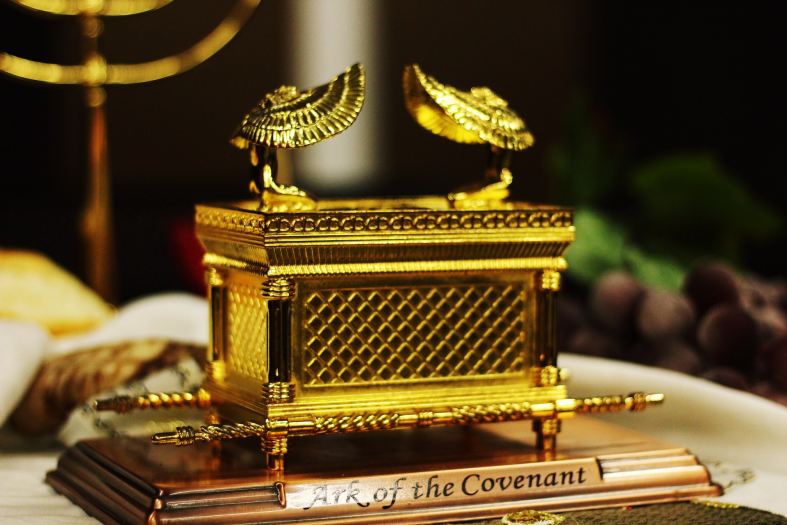
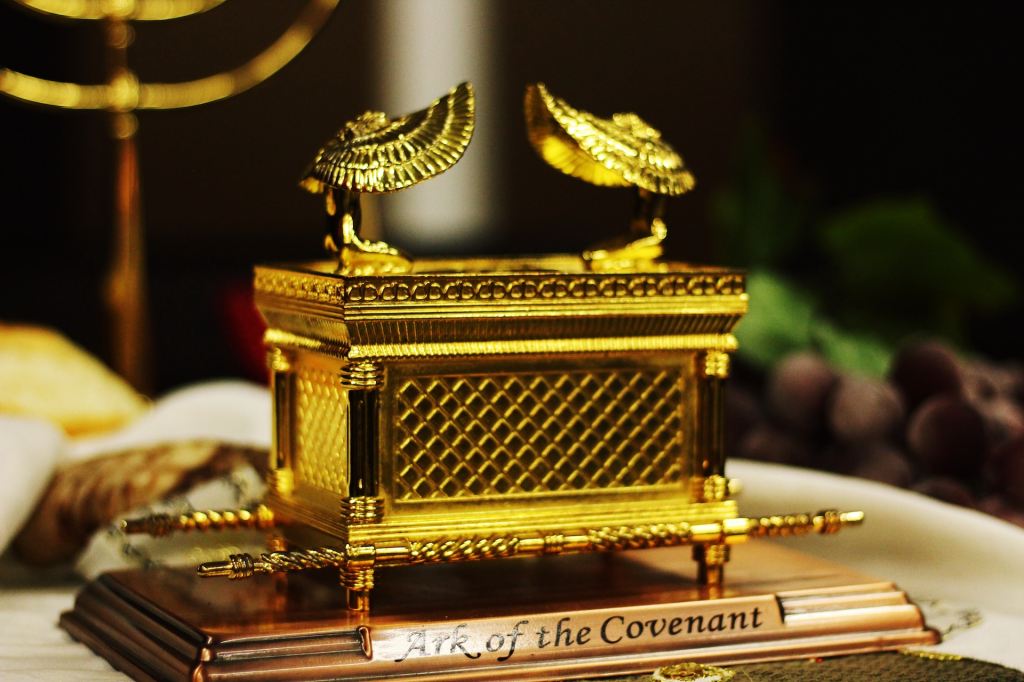
“Bezalel made the ark of acacia wood. Two cubits and a half was its length, a cubit and a half its breadth, and a cubit and a half its height.” – Exodus 37:1
Most of Exodus chapters 36-40 cover the many, many details of the construction of the tabernacle and all of its utensils and other parts. We may tire of reading chapters of details, but the point is that Bezalel and others put a massive amount of care (and obedience) into the implementation of God’s pattern for the tabernacle, as shown to Moses on the mountain.
What does it mean for us now? That we should put as much care into learning what God wants of us and put it into action in our lives.
“For whatever was written in former days was written for our instruction, that through endurance and through the encouragement of the Scriptures we might have hope. May the God of endurance and encouragement grant you to live in such harmony with one another, in accord with Christ Jesus, that together you may with one voice glorify the God and Father of our Lord Jesus Christ.” – Romans 15:4-6
Now that we’re into December 2025 is almost over and on come the “year in review” sort of posts. Curious about how to summarize what I wrote in 2025 I loaded my 2025 Word doc into ChatGPT and asked for a 5-bullet-point summary of themes. I promise I would never write a “normal” post using Generative AI, and I definitely would never use it without letting my readers know. However, I am curious about the technology and find it has some helpful uses, like summarization. So, here’s how ChatGPT summarized the blog for 2025:
“Deepening Faith Through Struggle and Growth Many posts emphasize how God matures believers through trials, weak moments, and long seasons of slow spiritual growth (like the mustard seed and “blade–ear–full grain” parables). Even tiny faith is destined to grow by God’s power, not ours.
Living as Servants of God in Everyday Life A central idea is that everyone serves something, and Christians are called to consciously serve Christ in ordinary tasks, not only in formal ministry. Daily life—work, family, routine chores—can fully please God.
Obedience, Trust, and the Danger of Self-Reliance Several posts warn against the “however” we raise against God’s commands, the pride of Babel, or Pharaoh-like hardness. The call is to trust God’s ways over our own reasoning and resist drifting off the path.
Radical Grace, Forgiveness, and Loving Others Well From Philip welcoming the former persecutor Paul, to teaching on forgiveness and serving the poor, the posts highlight God’s enormous grace and the call for believers to extend that same radical, healing forgiveness to others.
Eternal Perspective: Investing in What Lasts The posts frequently encourage readers to prioritize heaven over earthly success—storing treasure in heaven, remembering God’s justice, recognizing the temporary nature of human achievements, and preparing for the world to come.”
And now back to me (instead of ChatGPT).
Overall, I think this is a good summary. What themes resonated with you in 2025? What would you like to hear more of? Less of? What’s most helpful for your walk with God?
Thank you for letting Driving Toward Morning be part of your routine in 2025 and looking forward to God’s blessings in 2026!
This post was originally a response to a writing prompt: “Why do you blog?” This is a great question, because I shouldn’t be spending so much time on this blog without good reasons! But first, a broader question is: “Why write at all?” After that, choosing to blog is a second issue.
Why I write First, we are made to be creative. We are not random accidents with no creator and no purpose. Before man existed, the Bible describes God Himself as creative, taking a universe that was “without form and void”[1] and making it into something orderly. Then He put mankind in a garden, which was meant as a model for what we should turn the rest of the world into. Writing is a way to take formless ideas and turn them into something orderly. Creativity goes beyond what we typically consider art. It is using our God-given abilities to make this world more like Paradise.
Second, we are told to “test the spirits to see whether they are from God.”[2] Writing is a way to force myself to think through ideas I have or that I’ve come across. Everyone has in their conscience a variety of voices, or influences, that they follow. If we don’t take intentional time to consider why we believe what we believe and do what we do, we aren’t testing the spirits. We’re just doing whatever seems to come naturally, which isn’t the best approach.
Lastly, I write because I enjoy it and want to get better at it. Saint Augustine wrote: “I endeavor to be one of those who write because they have made some progress, and who, by means of writing, make further progress.”
Why I blog Many people write things and keep them private, and I also keep some of what I write private, but the only way writing can be useful to others is to write publicly, and blogs are about as public as it gets – I don’t filter who reads these. It also forces me to put things in a more “final” form than I otherwise might, thinking things through more thoroughly.
Christianity includes “speaking the truth in love.”[3] If I’ve found something truthful and beneficial to me, it could be beneficial to someone else, and I should share it. My writing motto is to be compelling and clear, but most of all charitable, meaning written for the benefit of the audience. Hopefully what I write here is worthwhile to others!
When writing, I keep in mind:
“Whatever you do, work heartily, as for the Lord and not for men, knowing that from the Lord you will receive the inheritance as your reward. You are serving the Lord Christ.” – Colossians 3:23-24
Here is the list of readings for this week: 2 chapters to read per day as the main reading plan, and extra chapters for anyone who wants to read the whole Bible in 2025. I hope this encourages others to read and study their Bible more, whatever parts they decide to read.
Follow along (or not) any way you choose! Also, let me know if you’re interested in me doing this again next year with a different order of books.
Somehow, this week we will be in 10 different books of the Bible!
2 chapter a day plan:
Monday, December 8: James 1-2 Tuesday, December 9: James 3-4 Wednesday, December 10: James 5, Jude Thursday, December 11: 1 John 1-2 Friday, December 12: 1 John 3-4 Saturday, December 13: 1 John 5, 2 John Sunday, December 14: 3 John, Nehemiah 1
Extra chapters for those reading the whole Bible this year: Habakkuk 3, Zephaniah 1-3, Haggai 1-2, Zechariah 1
Fans of the dystopian Hunger Games novels and movies know that the story takes place in a country called Panem. There, the extravagantly wealthy Capitol district holds an annual, televised battle royale, The Hunger Games, where children from each of the 12 desperately poor districts fight to the death until there is only one remaining. The purpose of these demented Games is to remind the people of the power of the Capitol, but also to provide entertainment. But why is the country called Panem?
Panem is likely a reference to the Latin phrase “panem et circenses,” or “bread and circuses,” which “means to generate public approval, not by excellence in public service or public policy, but by diversion, distraction, or by satisfying the most immediate or base requirements of a populace, by offering a palliative: for example food (bread) or entertainment (circuses).”[1] Under this way of thinking, for a government to remain in power it needs to provide the basic needs of its people. For an especially cynical government, it would mean they need only provide just enough bread and just enough circuses to keep the population from overthrowing them.
In the case of The Hunger Games, the Capitol reminded the other districts that they could have no bread (panem) without the Capitol’s “benevolence,” and that the only entertainment (circuses) they get is to watch their children kill each other. Talk about a government providing the very bare minimum!
The Hunger Games is obviously an extreme example, but fortunately, Christianity offers a better answer than just the bare minimum of “panem et circenses.” What benefits does it offer? Psalm 103 in the Bible begins in the first 2 verses with a call to:
“Bless the LORD, O my soul, and all that is within me, bless his holy name! Bless the LORD, O my soul, and forget not all his benefits”
And what are these benefits? Is it more than “bread and circuses”? It is, as verses 3-5 tell us that the Lord is the one:
“who forgives all your iniquity, who heals all your diseases, who redeems your life from the pit, who crowns you with steadfast love and mercy, who satisfies you with good so that your youth is renewed like the eagle’s.”
This Psalm says He can take care of both our spiritual and physical maladies. Jesus performed many miracles, so we “may know that the Son of Man has authority on earth to forgive sins,”[2] solving our spiritual alienation from God and each other. Likewise, the body’s diseases do not heal magically or by chance; they heal because God created us with that ability. He is the Great Physician.[3]
Also, He is the One who can save us “from the pit” – from ourselves and the punishment that our sin deserves, replacing our banishment from God’s presence with “love and mercy.” He is the One who has the perspective needed to define what is good, and as our Maker, knows what we need to thrive and be renewed. He offers many benefits we cannot find anywhere else.
Not just the fictional Panem, but all the nations of the real world, have nothing to offer but varying degrees of bread and circuses, various diversions and distractions and palliatives. No government in the world can provide the benefits God provides – those listed in Psalm 103 – and therefore only God offers what can truly satisfy. Therefore,
“Bless the LORD, O my soul, and forget not all his benefits”





 Driving Toward the Morning Sun