The Heavenly Holy of Holies

The temple King Solomon built in Jerusalem was not just as a place of worship and sacrifice, but also an image, or a model, of the cost of sin and of redemption.  The many courts, chambers, and walls were an object lesson in man’s separation from God because of his sin, and the required cost of restoring that relationship.  The most interior part of the temple, and hardest to get to, was the Holy of Holies, a room shaped like a perfect cube: 20 cubits by 20 cubits by 20 cubits.[1]  This cubed space was so sacred, and so holy, that only the high priest could enter it, and only once per year, and only after elaborate sacrifice.

However, by Christ’s sacrifice, we have hope: “We have this as a sure and steadfast anchor of the soul, a hope that enters into the inner place behind the curtain, where Jesus has gone as a forerunner on our behalf.” (Hebrews 6:19-20a).  In Mark’s gospel, we learn that when Christ died on the cross, “the curtain of the temple was torn in two, from top to bottom.”[2]  This curtain was the barrier covering the entrance to the Holy of Holies, and with Jesus’ death, entrance isn’t limited to just the high priest, but open to all who would believe in Him.  He entered “on our behalf” and anchors us to this most holy destination.

The Bible was not finished drawing this picture, though.  In Revelation 21, a new city – a new Jerusalem – is seen by the apostle John in a vision, coming down from heaven, and verse 16 says: “The city lies foursquare, its length the same as its width. And he measured the city with his rod, 12,000 stadia. Its length and width and height are equal.”  This vision was not meant to tell us that in Paradise we will all live inside a big cube.  As pastor Glenn Parkinson wrote: “Certainly all physical beings must exist somewhere, but this is not a vision of where God’s people will live, but how they will live when the former things have passed away.”[3]

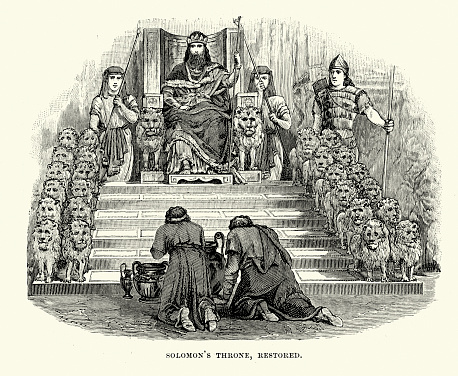
Don’t put Earth in a box. Photo by The New York Public Library on Unsplash

Earlier, Revelation 21:1 referred to a whole new heaven and earth, so the new Jerusalem probably represents something about life everywhere in this new creation, and in this image, God would have used things familiar to John, the author of Revelation, otherwise the visions wouldn’t make sense.  The only other architectural cube John would probably recall from Scripture would be the Holy of Holies, but what does that mean?

I believe it means that all of the new heaven and earth will be inhabitable by both God and His people.  All of Paradise will be holier than even the Holy of Holies, but because the church will be fully sanctified, God’s people can enter His presence without the many temple courts and chambers and walls symbolizing man’s separation from God.  Relationship between Creator and created will be fully restored.  Everywhere will be holy, and everyone will be holy.

No, the New Jerusalem isn’t literally a cube, but it symbolizes that in the new world, the temple is not even needed, because all is as it should be between God and man:

And I saw no temple in the city, for its temple is the Lord God the Almighty and the Lamb.” – Revelation 21:22

Praise God Almighty and the Lamb!


[1] 1 Kings 6:20 (a cubit was roughly 18 inches)
[2] Mark 15:38
[3] Parkinson, Glenn.  Tapestry: The Book of Revelation (2015).

Who We Shall Be

The apostle Peter wasn’t always a follower of Jesus.  He also wasn’t always Peter; he was originally named Simon.  He got his new name when his brother Andrew took him to meet Jesus.  Andrew “brought him to Jesus. Jesus looked at him and said, ‘You are Simon the son of John? You shall be called Cephas” (which means Peter).’” (John 1:42).

Photo by Lionel Gustave on Unsplash

Something that stands out in Jesus’ words are the phrases “You are,” and “You shall be.”  It’s as if Jesus saw 2 people: the one Simon was, and Peter that Simon would be.  The Simon of the present and the Peter of the future.  Jesus knew there was work to be done with this Simon who would become His disciple, but He also knew that the work would be completed.  It was inevitable that Simon would become Peter, the rock, which is what the name Peter means.  Cephas also means rock in Aramaic, but Peter is the Greek name we know him by.

But in the meantime, Peter was going to be a work in progress, like all of us.  Jesus sees everyone as they “are” and as they “shall be.”  He sees the raw material and He sees what it will take to finish each competed work of art.  Jesus takes us as we are, begins our transformation there, and will complete it in eternity.

Revelation 2:17 says of believers: “To the one who conquers I will give some of the hidden manna, and I will give him a white stone, with a new name written on the stone that no one knows except the one who receives it.”  This new name represents our future, eternal identity.  The person we will be when God is finished with His work of creation in us, the person Jesus sees in us, but that is beyond our wildest imagination. C.S. Lewis wrote that believers will “one day be a creature which, if you saw it now, you would be strongly tempted to worship.”  This is how completely we will be changed and conformed to the image and likeness of God that He intended for us from the beginning.[1]

So, if you ever feel disappointed in yourself, if you feel unworthy of God’s attention, if you wonder how God could love someone like you, remember: God sees who you “are” and who “you shall be.”  And who “you shall be” is beautiful beyond what we can imagine, but not beyond what He can see.

You are Simon the son of John? You shall be called Cephas” (which means Peter).


[1] Genesis 1:26-27

He is Always Abba, Father

Fellow travelers,

Just before being betrayed by Judas and arrested, Jesus sought some solitude in the garden of Gethsemane, where “he fell on the ground and prayed that, if it were possible, the hour might pass from him.  And he said, ‘Abba, Father, all things are possible for you. Remove this cup from me. Yet not what I will, but what you will.’” (Mark 14:35-36). Jesus knew He was soon to die.

Donald McKim notes that “In Aramaic, the language Jesus spoke, Abba is the word for ‘Father.’ It is a term that expresses the closest and deepest intimacy of the relationship of parent and child.”[1]  Jesus knew this intimacy even on the way to the cross.

McKim also quotes Philip Melanchthon, who said: “’Abba, Father’. By this he taught us that these two things are required in prayer, namely, the ardent affection of the mind and the faithful trust of children toward God: these two words testify that both of these aspects were present in Christ.”

The Father loves us always, even on our most difficult days.  Trust Him in prayer today.


[1] McKim, Donald K.  Everyday Prayer with the Reformers (2020).  P. 73.

A Psalm of God’s Strength and Power

The Bible software I use (Accordance) has the ability to highlight text, but so far I’ve only used it once, for Psalm 21.  In just 13 verses, David wrote “you” or “your” 25 times, referring to God as the source of his success and blessings, past, present, and future.  The short 13 verses of Psalm 21 provide a plethora of praises we can offer to confess that God is powerful, faithful and just.  Here is the entire Psalm, and I’ve bolded all the “you”s and “your”s, which I highlighted in Accordance:

“To the choirmaster. A Psalm of David.

O LORD, in your strength the king rejoices,
            and in your salvation how greatly he exults!
You have given him his heart’s desire
            and have not withheld the request of his lips. Selah
For you meet him with rich blessings;
            you set a crown of fine gold upon his head.
He asked life of you; you gave it to him,
            length of days forever and ever.
His glory is great through your salvation;
            splendor and majesty you bestow on him.
For you make him most blessed forever;
            you make him glad with the joy of your presence.
For the king trusts in the LORD,
            and through the steadfast love of the Most High he shall not be moved.

Your hand will find out all your enemies;
            your right hand will find out those who hate you.
You will make them as a blazing oven
            when you appear.
The LORD will swallow them up in his wrath,
            and fire will consume them.
You will destroy their descendants from the earth,
            and their offspring from among the children of man.
Though they plan evil against you,
            though they devise mischief, they will not succeed.
For you will put them to flight;
            you will aim at their faces with your bows.

Be exalted, O LORD, in your strength!
            We will sing and praise your power.”

What statements did you focus on while reading this?  Did you take the time to think about all 25 “you” statements (and the rest of the Psalm)?  Read it again.

The first section in this Psalm describes how our God is “faithful” in some ways, and the second describes “just.”  The first may come easier, with David giving God credit for all of his strength and success, but the middle section on justice may come across as harsh and harder to swallow.  However, it reminds us that only He knows for sure who His (and our) enemies are.  “Your hand will find out all your enemies.”  Only He determines the fates of others, including some who look like enemies now, but will come to faith in Him later.  With any enemy we can “wait upon the Lord”, as David often urges us, knowing God will either save them, or their plans will come to ruin by His design.

Yet, for those in Christ, “he is faithful and just to forgive us our sins and to cleanse us from all unrighteousness.”  Therefore, we echo David:

“Be exalted, O LORD, in your strength!
            We will sing and praise your power.”

Daily Readings for April 7 – 13

Fellow travelers:

Here is the list of readings for this week.  Each week I will post 2 chapters to read per day as the main reading plan, and for anyone who wants to read the whole Bible in 2025, I post the extra chapters needed for that goal.  Reading 3 chapters a day on weekdays and 4 on weekends almost exactly covers the 1,189 chapters of the Bible, so the “extra” readings are about 9 chapters per week.

Follow along (or not) any way you choose!

Monday, April 7: Psalm 97, Exodus 19
Tuesday, April 8: Psalm 98, Exodus 20
Wednesday, April 9: Psalm 99, Exodus 21
Thursday, April 10: Psalm 100, Exodus 22
Friday, April 11: Psalm 101, Exodus 23
Saturday, April 12: Psalm 102, Exodus 24
Sunday, April 13: Psalm 103, Exodus 25

Additional readings if you want to read the whole Bible this year:
1 Chronicles 23 – 2 Chronicles 2