Confession: The Blessing Nobody Expects

Dear fellow travelers,

What comes to mind when you think of confession?  Think about it for a moment.

For some, the thought might be a simple private prayer, or for some a confessional booth.  For others, no specific images might come to mind, but just a feeling of someone “out to get you.”  I expect some of you thought of the Spanish Inquisition, or at least the Monty Python skit making fun of it[1].  Where do these ideas come from?

The blame belongs in many places: secular culture, bad experiences with church, an emphasis on external over internal religion, and even Monty Python comedy skits.  My fantasy baseball league even has a team named “Spanish Inquisition” because the manager of that team thinks no one expects him to win – not even himself.

The mocking of secular culture aside, confession is an uncomfortable topic even for sincere Christians.  In Humphrey Carpenter’s biography of J.R.R. Tolkien, he shares the tension over confession between Tolkien and his then-fiancée Edith.  Tolkien was a practicing Catholic, while Edith was a member of the Church of England.  They had agreed as a couple to be Catholic, but Edith “began to dislike making her confession.  It was therefore all too easy when she was worried about her health (which was often) to postpone going to mass. She reported to Ronald [Tolkien] that getting up to go to church early in the morning and fasting until she had made her communion did not agree with her.”  She insisted “my health won’t stand it.”[2]  In my own Protestant church, we have a weekly prayer of confession, which the pastor regularly defends the importance of.  Few of us probably look forward to confession, whatever form we practice it in.

Photo by Shalone Cason on Unsplash

This discomfort with confession seems to be a shared part of mankind’s fallen nature, but if we look at well-known Bible verses on confession, we find that it is really about restoration, a rebirth of man’s relationship with God and a renewal of man to his ideal nature.  It is as different from God being “out to get you” as it could be.  1 John 1:9 encourages confession, because: “If we confess our sins, he is faithful and just to forgive us our sins and to cleanse us from all unrighteousness.”  God wants to give us forgiveness and cleansing, not condemnation and guilt.  Isaiah 1:18 explains this cleansing more poetically:

Come now, let us reason together, says the LORD:
though your sins are like scarlet,
            they shall be as white as snow;
though they are red like crimson,
            they shall become like wool.

Confession doesn’t need to be a dirty word.  The word “confess” means loosely to say the same thing about something, so confession means we agree with God (say the same thing he does) about sin – that it is bad.  But confession also applies to the rest of 1 John 1:9, that God “is faithful and just to forgive us our sins and to cleanse us from all unrighteousness.”  Full confession includes agreeing about the steadfast and dependable character of God, His faithfulness and justice, as well as His desire to forgive and cleanse.  If we doubt this desire, consider what He voluntarily suffered on the cross to provide for this forgiveness, and to demonstrate His enduring love.

By adding confession about the good things of God to our confession of our sin, our confession does not make us miserable about our own condition but shows us how different we are from what God wants for us, how deeply our sin needs to be corrected, and how wonderfully God has provided for the removal of sin.

But this does not come easily.  Referencing Hebrews 4:16, which says, “Let us then with confidence draw near to the throne of grace, that we may receive mercy and find grace to help in time of need,” Puritan preacher Thomas Watson wrote that “Christ went more willingly to the cross than we do to the throne of grace.”

Why is this?  Could it be that we have trouble whole-heartedly confessing that “he is faithful and just to forgive us our sins and to cleanse us from all unrighteousness”?  Monty Python joke that “nobody expects the Spanish Inquisition,” but do we fully expect God’s throne to be one of grace when we come to confess?


[1] If you’re not familiar with the skit, here’s a 4-minute example: https://youtu.be/Cj8n4MfhjUc
[2] Carpenter, Humphrey. Tolkien: A Biography.  (1977).  P. 68-69.
A Reminder of His Love

Dear fellow travelers,

How do we measure how much Jesus loves us?  We may say that His love is endless or infinite.  We may say that He loved us enough to take on human flesh and become a servant.  We may say that He loved us enough to suffer and die for us.  These are all true and there are good verses to tell us all of them, but I think His suffering communicates His love in a way nothing else can.  We get an example at the end of Isaiah 49:13-16, which says:

Sing for joy, O heavens, and exult, O earth;
            break forth, O mountains, into singing!
For the LORD has comforted his people
            and will have compassion on his afflicted.
14 But Zion said, “The LORD has forsaken me;
            my Lord has forgotten me.”
15 “Can a woman forget her nursing child,
            that she should have no compassion on the son of her womb?
Even these may forget,
            yet I will not forget you.
16 Behold, I have engraved you on the palms of my hands;
            your walls are continually before me.”

Verse 13 tells God’s people to rejoice, but in verse 14, they say they have been forsaken by God.  During the exile in Babylon, we can’t blame the people of Judah for thinking this way.  The symbols and institutions of their religion had been destroyed, and they had been forcefully removed from the land God had promised to them.  What can God say to reassure these people?  What can God say to the exiles of Isaiah’s time that could comfort the spiritual exiles of our time?

Isaiah begins with the image of a woman and her young child: “Can a woman forget her nursing child, that she should have no compassion on the son of her womb?”  God had bound Himself to His people as their Father, through His covenant which was based on His character of steadfast love and faithfulness (Exodus 34:6).  Unless God stops being loving (which He won’t) He won’t abandon His people.

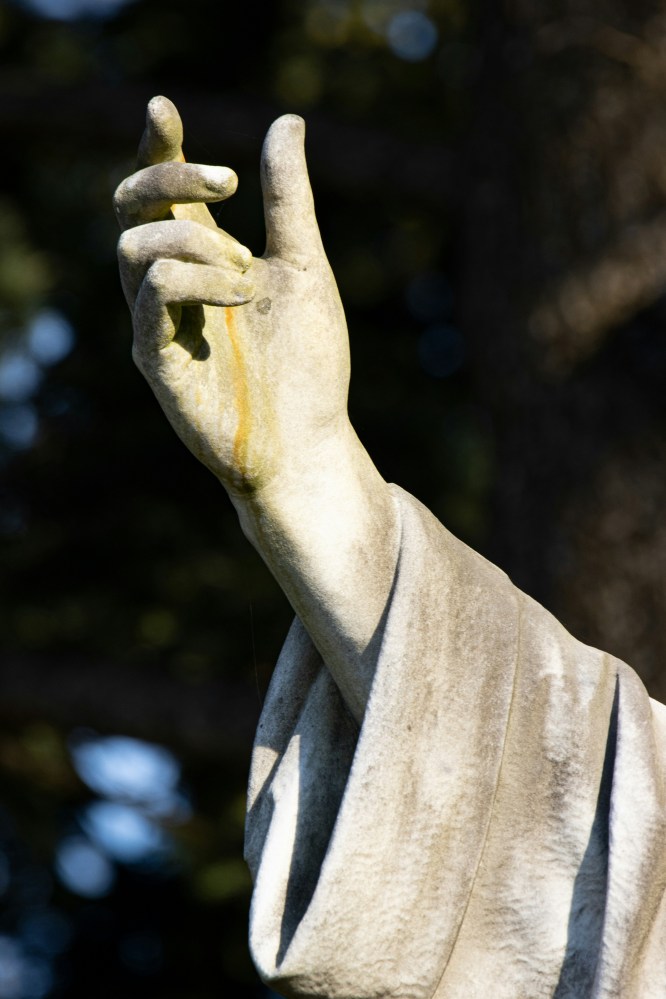
But the more powerful image for us today might be verse 16: “Behold, I have engraved you on the palms of my hands; your walls are continually before me.”  While this might have been enigmatic to Isaiah’s contemporary audience, who had no point of reference for anything “engraved” on God’s hands, today we know what marks God has on His hands: the scars of His crucifixion in the body of Jesus Christ.  The scars that He willingly received on our behalf.  Isaiah 49:16 suggests that these scars are a permanent reminder of God’s steadfast love that He has for His people.  “Your walls” would be the walls of Zion, the eternal city of God, and since God says these are “continually before me,” like the scars they are also a permanent reminder.

The Bible tells us Jesus kept the scars in His resurrected body before returning to heaven (Luke 24:39-40, John 20:27), as evidence to His followers that He really was the resurrected Messiah, but also as a reminder of His love for His people.  While it is debated whether Jesus will still have scars on His hands and feet in heaven, many believe He will, but even if He doesn’t, He will remember them.

So, if at times you feel like the people of Zion in verse 14: ““The LORD has forsaken me; my Lord has forgotten me,” then remember “Behold, I have engraved you on the palms of my hands.”  He hasn’t and won’t forget you.

He is Always Abba, Father

Fellow travelers,

Just before being betrayed by Judas and arrested, Jesus sought some solitude in the garden of Gethsemane, where “he fell on the ground and prayed that, if it were possible, the hour might pass from him.  And he said, ‘Abba, Father, all things are possible for you. Remove this cup from me. Yet not what I will, but what you will.’” (Mark 14:35-36). Jesus knew He was soon to die.

Donald McKim notes that “In Aramaic, the language Jesus spoke, Abba is the word for ‘Father.’ It is a term that expresses the closest and deepest intimacy of the relationship of parent and child.”[1]  Jesus knew this intimacy even on the way to the cross.

McKim also quotes Philip Melanchthon, who said: “’Abba, Father’. By this he taught us that these two things are required in prayer, namely, the ardent affection of the mind and the faithful trust of children toward God: these two words testify that both of these aspects were present in Christ.”

The Father loves us always, even on our most difficult days.  Trust Him in prayer today.


[1] McKim, Donald K.  Everyday Prayer with the Reformers (2020).  P. 73.

The God Who Puts Food on the Table

There are many reasons to praise God, many ways that He blesses us.  One of these is given in Psalm 111:5, and it’s something we shouldn’t take for granted:

He provides food for those who fear him;
            he remembers his covenant forever.

While this may be a reference specifically to God providing manna and quail to the Israelites when they wandered in the wilderness, it applies more broadly to any food provided to anyone at any time.  Therefore, we should praise Him whenever we have something to eat.

But He doesn’t just deliver food from the grocery store to us.  He provides everything required for food to exist in the first place.  He designed everything involved in the growth of what we eat.  Sunlight, rain, soil conditions and nutrients, all have a role in the growth of fruits and vegetables.  All of these roles act the way they need to be by design.  Food doesn’t exist by chance and is not an accident of a blind nature.

Then add what’s needed to produce the meat we may eat.  First, those plants need to contain what animals need to eat and grow.  The animals need to be able to not only digest those things, but then to turn them into something edible for us.  Again, all ordained by God, the intelligent creator of our universe, who “provides food for those who fear him.”

Also, He is not only a God who designs and provides, but a God of mercy, “For he makes his sun rise on the evil and on the good, and sends rain on the just and on the unjust.”[1]  He provides food even for those who do not praise Him and give thanks to Him, so they might come to know Him by His mercy towards them.

Those who fear God, praise and thank Him for the food He provides, the complexity of the world He designed, and His mercy toward all His people.  But also, to reflect His character, provide food for those in need, showing them the mercy and love of the God who puts food on our tables.

He provides food for those who fear him;
            he remembers his covenant forever


[1] Matthew 5:45b

Daily Readings for August 31 – September 6

Fellow travelers:

For those looking for a Bible reading plan, each week I post 2 chapters to read per day as a main reading plan, and for anyone who wants to read the whole Bible in 2026, I’ll post the extra chapters to read that week.  The main readings will include nearly all of the New Testament, plus Psalms, Proverbs, Ecclesiastes, the Prophets, and a few other Old Testament books.

Reading 3 chapters a day on weekdays and 4 on weekends almost exactly covers the 1,189 chapters of the Bible, so the “extra” readings will be about 9 chapters per week.  These readings will cover the Pentateuch, the OT histories, a few other OT books, plus Jude and Revelation from the NT.

Regardless, I hope this schedule encourages others to read and study their Bible more, whatever parts they decide to read.  Follow along (or not) any way you choose!

2 chapter a day plan:

Monday, August 31: Isaiah 63 – 64
Tuesday, September 1: Isaiah 65 – 66
Wednesday, September 2: 2 Corinthians 1 – 2
Thursday, September 3: 2 Corinthians 3 – 4
Friday, September 4: 2 Corinthians 5 – 6
Saturday, September 5: 2 Corinthians 7 – 8
Sunday, September 6: 2 Corinthians 9 – 10

Extra chapters for those reading the whole Bible in 2026:
2 Kings 2 – 10