
A Better Country

In Hebrews chapter 11 there is a list of Biblical figures who “by faith” were obedient to God, but it also says that, in this life, their faith was not fully rewarded.  Everyone mentioned in the chapter “died in faith, cnot having received the things promised[1]  But these faithful examples knew that God wouldn’t fail them.  In this world, they would be unfulfilled, “but as it is, they desire a better country, that is, a heavenly one.[2]

Their obedience was motivated not by current, earthly reward, but by future rewards in a new heaven and new earth.  Although Peter tells us “Beloved, do not be surprised at the fiery trial when it comes upon you to test you, as though something strange were happening to you,[3] Paul wrote “For I consider that the sufferings of this present time are not worth comparing with the glory that is to be revealed to us.”[4]  In this world, we will have trials and experience persecution, which means that much of what a Christian has to be thankful for is in the future.

However, our faithful actions can be motivated by a future hope, just as those listed in Hebrews 11 were.  Because of the unchanging character of God, and His faithfulness, we can be so sure of our heavenly future that we can be thankful for it now.  God promises “a better country” and He is trustworthy.

Do we desire this “better country”?  While we wander in this world, do we believe that “a better country” is possible?  Do we believe God when He says He has promised us our place in it?  Jesus said “In my Father’s house are many rooms. If it were not so, would I have told you that I go to prepare a place for you?[5]

If we trust God for our future in eternity, we have much more to live for and to be thankful for than we have right now!  When you count your blessings, don’t forget the ones in the future that you can count on.

Desire a better country.”


[1] Hebrews 11:13a
[2] Hebrews 11:16a
[3] 1 Peter 4:12
[4] Romans 8:18
[5] John 14:2
Words of Life and Death

Rummaging in the basement for a book recently, I found a book I wasn’t looking for: Encouragement: The Key to Caring by Dr. Larry Crabb and Dr. Dan Allender.  It was a good find.  The authors define encouragement as “the kind of expression that helps someone want to be a better Christian, even when life is rough.”[1]  This is the kind of expression recommended in Hebrews 10:23-25 – “Let us hold fast the confession of our hope without wavering, for he who promised is faithful.  And let us consider how to stir up one another to love and good works, not neglecting to meet together, as is the habit of some, but encouraging one another, and all the more as you see the Day drawing near.”  (emphasis mine)

However, if we don’t believe our words matter – that they have real power – we might think such encouragement is pointless.  Making a case for the power of our words, the authors cite these Proverbs:

Death and life are in the power of the tongue, and those who love it will eat its fruits.” – Prov. 18:21
Anxiety in a man’s heart weighs him down, but a good word makes him glad.” – Prov. 12:25
A gentle tongue is a tree of life, but perverseness in it breaks the spirit.” – Prov. 15:4
Gracious words are like a honeycomb, sweetness to the soul and health to the body.” – Prov. 16:24
A word fitly spoken is like apples of gold in a setting of silver.” – Prov. 25:11[2]

In these Proverbs, words have the power of life and death.  Power to lift or break a spirit.  They have real power to influence others for good, or for bad.  They can influence our health, bodily and spiritually.  Our words are one of the hardest things for us to control – especially online – and unless we realize their power, we’re too likely to take them lightly.  James wrote that taming our tongues may be our biggest challenge, and if we can tame it, we can tame our whole body.  (James 3:2-3)

Therefore, pray for more encouraging, more powerful words today, and that God would cleanse our hearts, the spring from which our words come[3], so we may praise Him and provide “sweetness to the soul and health to the body” of those around us.

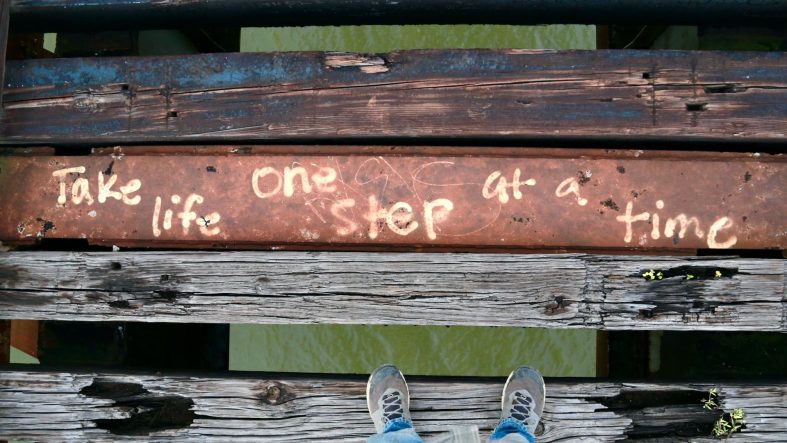
It won’t happen all at once, and all will stumble, but as the saying goes:

Yard by yard, life is hard!
Inch by inch, life’s a cinch!

Photo by Kevin Luke on Unsplash

[1] Crabb, Larry and Dan Allender.  Encouragement: The Key to Caring (1984).  P. 10.
[2] Ibid.  P. 19.  See also Proverbs 25:20 and James 3:5-6.
[3] James 3:11

Allow Me to Demonstrate

Life as a Christian in the 1st century must have been extraordinarily difficult.  Like Jesus these early disciples faced resistance both from religious leaders as well as the Roman government. Most of these early Christians had not met Jesus personally and also did not have the Bible we have today.  What did they base their faith on?  Largely on the witness of others and on the teachings and examples of the apostles. Paul, who brought many to Christ and founded many churches during his missionary journeys, knew that all of his actions would be scrutinized as to whether they reflected what he was teaching.

Paul told new Christians to keep a close watch on his life, because if Christ had not made a difference in Paul’s life, why should others believe it would make a difference in theirs?  If Paul didn’t personally have love, joy and peace[1] in his life, why should those hearing him preach expect Christ to provide them with love, joy and peace.  He knew actions speak louder than words.

To the church in Corinth Paul wrote: “my speech and my message were not in plausible words of wisdom, but in demonstration of the Spirit and of power, so that your faith might not rest in the wisdom of men butin the power of God.[2]  Paul saw his life as a “demonstration” of God’s power and knew that this demonstration would be more powerful than the competence of his “speech” and the complexity of his “message.”  It’s as if Paul had given a presentation describing God and His power, and then told his audience, “Allow me to demonstrate…”. Paul often gave thanks that the churches he wrote to were living examples of Christian faith lived out.

So, the question comes to us: what do our lives demonstrate?  Do we show love to others?  Do we have joy in all circumstances? Are we at peace with God and can we offer peace to others?  What do people notice about us?  The fruit of the Spirit, or the patterns of this world?

Pray for all of God’s people, including you and I, that we would walk with Christ, abiding in Him, so that we may bear the fruit of love, joy and peace that the world will notice.  When we proclaim Christ, with Paul we should be able to say “allow me to demonstrate…”


“People may not agree with our theology but they shouldn’t be able to argue with our lives.” – John McGowan

“Out of a hundred people, one will read the Bible, and the other ninety-nine will read the Christian.” – Dwight L. Moody


[1] Galatians 5:22
[2] 1 Corinthians 2:4-5

Bible in a Year: Week of November 25 – December 1

Fellow travelers:

Below are the chapters to read this week if you’re following along in my Bible in a year schedule, divided into morning and evening readings.  Follow along any way you want: you can just do the evening reading, flip the morning and evening, or read it all.  Whatever works for you and your schedule!  It doesn’t have to be Bible in a Year for everyone.

The morning readings for the rest of the year will alternate between the minor prophets and the last books of the New Testament.  In the evening, Isaiah will take a while at one chapter a day, and then we’ll finish the year with Daniel.

Monday, November 25
Morning: Hebrews 6-7
Evening: Isaiah 42

Tuesday, November 26
Morning: Hebrews 8-9
Evening: Isaiah 43

Wednesday, November 27
Morning: Hebrews 10-11
Evening: Isaiah 44

Thursday, November 28
Morning: Hebrews 12-13
Evening: Isaiah 45

Friday, November 29
Morning: Habakkuk 1-3
Evening: Isaiah 46

Saturday, November 30
Morning: James 1-2
Evening: Isaiah 47

Sunday, December 1
Morning: James 3-5
Evening: Isaiah 48

Let God Speak to Your Inner Wilderness

John the Baptist announced the coming of Jesus, baptized Him, and led the way for His ministry to begin.  This John was identified with “The voice of one crying in the wilderness: ‘Prepare the way of the Lord; make his paths straight’”[1] prophesied in Isaiah 40:3-5, which says:

A voice cries: ‘In the wilderness prepare the way of the LORD;
            make straight in the desert a highway for our God.
Every valley shall be lifted up,
            and every mountain and hill be made low;
the uneven ground shall become level,
            and the rough places a plain.
And the glory of the LORD shall be revealed,
            and all flesh shall see it together,
            for the mouth of the LORD has spoken.’”

Is Isaiah talking about a massive, miraculous geological event, creating an easier route for Jesus to take to His kingdom?  Perhaps in the future something like this will happen, but I think Isaiah is saying that God’s power over nature is a symbol of His power to reform and perfect us into the character of His Son Jesus.

Before Jesus comes into our lives, we are a spiritual wilderness full of uneven ground and rough places.  The path of our salvation begins in this wilderness, an unorganized chaos of thoughts and desires.  We are like “children, tossed to and fro by the waves and carried about by every wind of doctrine, by human cunning, by craftiness in deceitful schemes.”  However, the power of the LORD enters our low valleys – our guilty secrets, shame and depression – which will be raised up.  It progresses through our mountains and hills – areas of pride, self-sufficiency, and our desire for power – which will be made low.  God, with the same power that created the universe, removes all obstacles to the coming of His kingdom to us, and to the world.  He has given us His word, His Spirit, and fellow believers to strengthen us, “until we all attain to the unity of the faith and of the knowledge of the Son of God, to mature manhood, to the measure of the stature of the fullness of Christ, so that we may no longer be children, tossed to and fro by the waves and carried about by every wind of doctrine, by human cunning, by craftiness in deceitful schemes.”  (Ephesians 4:13-14)

John the Baptist called his followers to confession and repentance.  In announcing the coming of the kingdom of God, John anticipated a time when our internal and external wildernesses will become a paradise.  Until then, we each have different hills and valleys, different uneven and rough areas.  Until then, the world remains full of false doctrine, cunning, craftiness and deceit.

Today, pray that the powerful voice of our LORD will reach into your wilderness and remove obstacles on the path to His kingdom.  Pray that His word and His Spirit will reveal His glory.  Pray that all believers will answer the call of “the voice of one crying in the wilderness” to build up His church.

Amen.


[1] Isaiah 40:3, quoted in Matthew 4:3.