Here is another “Quint of Quotes” from my collection, on the theme of the Bible. I hope you find these five sayings interesting and thought-provoking. What quotes about the Bible do you like?
“This book will keep you from sin or sin will keep you from this book.” – D.L. Moody wrote this in the front of his Bible
“If people treated other books the way they treat the Bible, they would never learn anything.” – Warren Wiersbe
“Do I feed on the Word? That Word would be no food for me unless the Lord made it food for my soul, and helped me to feed upon it. Do I live on the manna which comes down from heaven?” – C.H. Spurgeon
“The New is in the Old concealed; the Old is by the New revealed.” – Saint Augustine
“All Scripture is breathed out by God and profitable for teaching, for reproof, for correction, and for training in righteousness, that the man of God may be complete, equipped for every good work.” – 2 Timothy 3:16-17
The TV show Whose Line is it Anyway? is probably the most-widely-known form of improvisational comedy, and one of my favorites. Four performers act out short scenes based on a set of rules for each scene or game, spontaneously adding their own creativity and (if successful) humor. For example, in the “Props” game, pictured, the performers were given two “P” shaped props to make jokes about. The show wouldn’t be any good if they just showed us the props and explained the rules over and over again. The show is pointless without spontaneous creativity. But why am I writing about improv on a Christian blog? But why am I writing about improv on a Christian blog? Because today I’m writing about a Bible study that leaves us to ask: Whose Plan is it Anyway?
Whose Pun is it Anyway?
In Judges 6-7, God delivers Israel from the Midianites using Gideon, who thought God couldn’t use him because “my clan is the weakest in Manasseh, and I am the least in my father’s house.” At times, Gideon doubts God is speaking to him and that He really means what He says, but God patiently answers Gideon’s questions and performs miracles, encouraging Gideon to move forward.
Eventually, Gideon and his 300-man army attacked the enemy army, which was “like locusts in abundance, and their camels were without number, as the sand that is on the seashore in abundance.”[1] After Gideon split his army into three groups, this was the plan of attack:
“So Gideon and the hundred men who were with him came to the outskirts of the camp at the beginning of the middle watch, when they had just set the watch. And they blew the trumpets and smashed the jars that were in their hands. Then the three companies blew the trumpets and broke the jars. They held in their left hands the torches, and in their right hands the trumpets to blow. And they cried out, ‘A sword for the LORD and for Gideon!’”[2]
Whose Plan is it Anyway? This is where improv comes in: the text does not tell us who came up with this wacky attack plan. Was it God’s idea or was it Gideons? Why leave it ambiguous? I think it is because, either way, it is not a decisive factor in the victory. The attack plan works because of God’s involvement, no matter whose idea it was. If it was Gideon’s idea, he was only using the abilities his Maker had given Him for the purpose of glorifying Him. If it was God’s, Gideon was also only using the abilities God gave him and dedicating them to God’s glory.
What’s amazing is that Gideon went from testing God with fleece to carrying out this attack. God had Gideon convinced it would work, and that it would work because God would make it work. Victory didn’t come from any advantage Gideon had or created, and all along God was determined to get the glory. The plan would have failed if God had not put fear into the camp, and had not let Gideon know about that fear by way of a dream a Midianite soldier had.
Like improv comedy, God’s rules only go so far before the performers need to take over. God gives us patterns, which are like the rules of an improv skit, not step-by-step instructions in every aspect of our lives. Adam and Eve were shown a pattern in the Garden of Eden, Moses was given a pattern for the tabernacle on the mountain, and Jesus lived a pattern of how to love the Father and our neighbor. Beyond the patterns and rules there is so much to do and explore. His will is for His people to make the world like Eden, to worship Him as He should be worshiped, and to love the world the way Jesus loved.
The Little Things To hear and obey His voice, we must spend time with Him in prayer and study, diligently learning the patterns He has laid out for us, but He does not expect us to stop there. At some point, we must take the guidance we have and move forward with the wisdom and creativity He has endowed us each with. When we do we will be like the servant who successfully invested his Master’s resources, and in return “His master said to him, ‘Well done, good and faithful servant. You have been faithful over a little; I will set you over much. Enter into the joy of your master.’”[3]
However, if we either do not diligently seek Him, or if we say He has not given us enough instructions, we may find ourselves cast out from the Master’s presence, hearing: “you ought to have invested my money with the bankers, and at my coming I should have received what was my own with interest.”[4]
In Gideon’s story, we see God’s compassionate understanding toward His people who struggle to hear and obey His voice but keep trying. We, like Gideon, are not always faithful over the little things such as prayer, study, and regular worship. But Only He fully knows the depth of our doubts and struggles, and He provides what we need to trust Him and move forward in faith, knowing our doubt is never fully overcome until eternity.
In the story, we also see that we must often act on trust, even when we think we have incomplete information. Like Gideon, we should be imperfectly persistent, wrestling with God who knows our faith is imperfect. He can bridge the gap to us in His unlimited grace.
So, where does God’s guiding voice stop, and our God-given creativity begin? Like a good improv comedy scene, the parts can come together perfectly, glorify God, and encourage His people to come along in faith, as the men of Naphtali, Asher, Manasseh, and Ephraim joined the battle against the Midianites once it was clear God had delivered the victory[5]. When we seek Him and find Him, and in faith move forward to spread His character and creativity in the world, glorifying Him.
God is glorified when His people attempt things that sometimes don’t make sense, then succeed because He provided the way. It’s always His plan anyway.
Soli Deo Gloria
[1] Judges 7:12 [2] Judges 7:19-20 [3] Matthew 25:21 [4] Matthew 25:27 [5] Judges 7:23-25
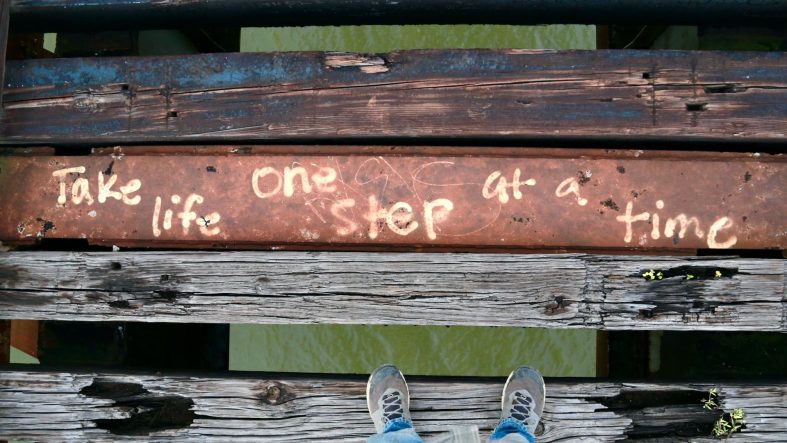
Are there small things you are doing that are harmful to you? Are there small changes you can make to improve your life? Can each of us build a better “liturgy” for our lives over time, step by step? Can we accumulate victories in small battles that help us fight bigger ones? Over time can we better love God, ourselves, and others?
Instead of making resolutions or celebrating Lent, I try to make a small, permanent change every 40 days after each New Year. I keep a list of the changes I’ve made or want to make. Sometimes I do nothing until later – I don’t criticize myself for missing a deadline or going back on something. This is all voluntary. If I fail at half (or more) of the changes, the successful ones still add up to a massive shift in habits over time. The changes don’t need to be “spiritual” or major, they just need to be something I think will make my life better, permanently. For example, in 2021, I decided to drink at least 32 oz of water a day, and I still do it (with an occasional miss).
If you want to participate, tomorrow, February 10th, is 40 days after the start of the New Year and time for the next change. If you do, keep a record of what you’re changing. As the months and years pass, hopefully the cumulative change is enormous.
My change for 2/10/26 is a daily step count goal. Since late 2024, I’ve been working from home after my company consolidated some of their real estate. Unfortunately, this means I’ve been getting more and more sedentary over time, especially in winter. My goal isn’t very aggressive (it’s about 1/3 less than my pre-WFH rate, but it’s about 50% more than what I’ve been doing) but it will be a good improvement for my health. To keep myself from getting discouraged about missing a day or two (which I will), the goal is an average over time. The goal is to feel better, not worse.
The next date on the schedule (40 days later) is 3/22/26, and I have a couple of things under consideration for then. I’ll be posting a reminder at about that time; if you want to participate, start making a list of things you might want to do more or less of, and let’s see what we can accomplish!
This habit has been helpful to me and might be to you, even if you have your own way of doing it. In the meantime, as I write this, I’m going to go walk the stairs in my house (and drink some water) because outside it feels like 8 degrees and there’s still ice everywhere!
For those looking for a Bible reading plan, each week in 2026 I will post 2 chapters to read per day as a main reading plan, and for anyone who wants to read the whole Bible in 2026, I’ll post the extra chapters to read that week. The main readings will include nearly all of the New Testament, plus Psalms, Proverbs, Ecclesiastes, the Prophets, and a few other Old Testament books.
Reading 3 chapters a day on weekdays and 4 on weekends almost exactly covers the 1,189 chapters of the Bible, so the “extra” readings will be about 9 chapters per week. These readings will cover the Pentateuch, the OT histories, a few other OT books, plus Jude and Revelation from the NT.
I hope this encourages others to read and study their Bible more, whatever parts they decide to read. Follow along (or not) any way you choose!
This week we finish another book (Ecclesiastes), moving on to Mark, and in the Bible-in-a-year plan, we move on to Exodus. I’m still way behind in Genesis as I wade through Warren Wiersbe’s 3-book commentary on it.
2 chapter a day plan:
Monday, February 9: Psalm 40, Ecclesiastes 12 Tuesday, February 10: Psalm 41, Mark 1 Wednesday, February 11: Psalm 42, Mark 2 Thursday, February 12: Psalm 43, Mark 3 Friday, February 13: Psalm 44, Mark 4 Saturday, February 14: Psalm 45, Mark 5 Sunday, February 15: Psalm 46, Mark 6
Extra chapters for those reading the whole Bible in 2026: Exodus 1- 10
Rummaging in the basement for a book recently, I found a book I wasn’t looking for: Encouragement: The Key to Caring by Dr. Larry Crabb and Dr. Dan Allender. It was a good find. The authors define encouragement as “the kind of expression that helps someone want to be a better Christian, even when life is rough.”[1] This is the kind of expression recommended in Hebrews 10:23-25 – “Let us hold fast the confession of our hope without wavering, for he who promised is faithful. And let us consider how to stir up one another to love and good works, not neglecting to meet together, as is the habit of some, but encouraging one another, and all the more as you see the Day drawing near.” (emphasis mine)
However, if we don’t believe our words matter – that they have real power – we might think such encouragement is pointless. Making a case for the power of our words, the authors cite these Proverbs:
“Death and life are in the power of the tongue, and those who love it will eat its fruits.” – Prov. 18:21 “Anxiety in a man’s heart weighs him down, but a good word makes him glad.” – Prov. 12:25 “A gentle tongue is a tree of life, but perverseness in it breaks the spirit.” – Prov. 15:4 “Gracious words are like a honeycomb, sweetness to the soul and health to the body.” – Prov. 16:24 “A word fitly spoken is like apples of gold in a setting of silver.” – Prov. 25:11[2]
In these Proverbs, words have the power of life and death. Power to lift or break a spirit. They have real power to influence others for good, or for bad. They can influence our health, bodily and spiritually. Our words are one of the hardest things for us to control – especially online – and unless we realize their power, we’re too likely to take them lightly. James wrote that taming our tongues may be our biggest challenge, and if we can tame it, we can tame our whole body. (James 3:2-3)
Therefore, pray for more encouraging, more powerful words today, and that God would cleanse our hearts, the spring from which our words come[3], so we may praise Him and provide “sweetness to the soul and health to the body” of those around us.
It won’t happen all at once, and all will stumble, but as the saying goes:
Yard by yard, life is hard! Inch by inch, life’s a cinch!
[1] Crabb, Larry and Dan Allender. Encouragement: The Key to Caring (1984). P. 10. [2] Ibid. P. 19. See also Proverbs 25:20 and James 3:5-6. [3] James 3:11






 Driving Toward the Morning Sun