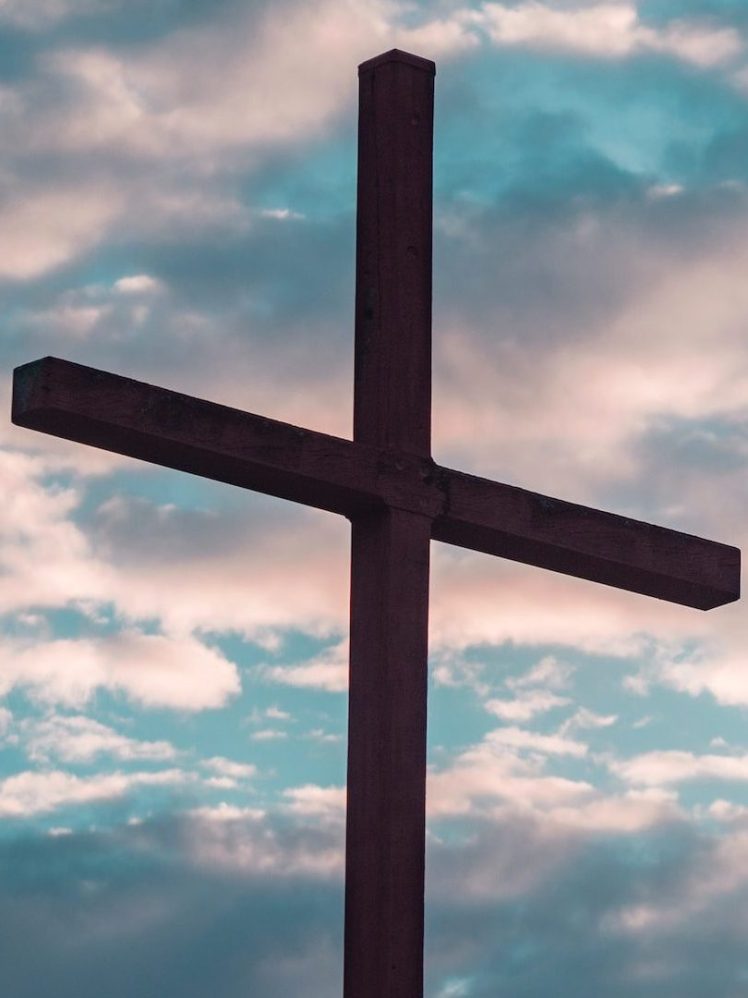
Only Christ Can Practice What We Preach

We all know the phrase “practice what you preach.”  It’s a way to call someone a hypocrite, and at the same time tear down what the other person claims to believe in.  These beliefs may be political or moral philosophies, but they may also be religious beliefs like denominations or theological systems.  For this post, I’ll call all of these “isms.”

The history of Christianity has been a constant conflict between and competition among different “isms.”  Catholicism, Lutheranism, Calvinism, Methodism, and others.  Even the ones that don’t use the actual letters “ism” at the end are still “isms.”  So much of being a Christian involves figuring out which “ism” we belong to, and also figuring out what’s wrong with the other “isms.”  I see this no more clearly than on social media, where the competing camps are so clearly identified, and people write others off for being in the wrong camp.

We put a lot of time and effort into being as good at our chosen “ism” as we can.  If we can go with the flow according to that “ism,” we can feel like we are pretty good Christians.  We may be able to do a decent job at following the “ism” that we preach, and in many cases following our “isms” isn’t a bad thing.  All denominations have their pros and cons, and they often attract people with similar strengths and weaknesses.

In God’s eyes there aren’t
different types of Christianity.

But as we seek to be the best at our “ism” that we can be, are we practicing Christianity?  Jesus confronts us with this in Matthew 19:17 – “And he said to him, ‘Why do you ask me about what is good? There is only one who is good. If you would enter life, keep the commandments.’

We may think of our “isms” as varieties or types of Christianity, and in a cultural way they are.  However, in God’s eyes there aren’t different types of Christianity.  There is only one Christianity – the life that Christ lived is the only practice of Christianity that will ever be good enough.  Even if I perfectly practice what I preach as a Presbyterian or Baptist, for instance, I’ll still fall far short of God’s standard for “good.”

“Isms” are unavoidable in this world, and they often point us in the right direction, but they don’t get us all of the way there.  We seek to please God as we best know how, but none of our “isms” are enough.  They aren’t enough to save us, and they’re also too much for us to perfectly practice what we preach.  We can’t meet our own, lowered, standards.

This is why the apostle Paul wrote “For I decided to know nothing among you except Jesus Christ and him crucified” in 1 Corinthians 2:2.

Preaching Christ crucified is the only thing we can preach that was ever practiced perfectly, because it wasn’t practiced by us.  It was practiced by the only One who was ever perfect, and it’s better than all of our “isms.”

For now we see in a mirror dimly, but then face to face. Now I know in part; then I shall know fully, even as I have been fully known.” – 1 Corinthians 13:12

We Will Not Live in Tents Forever

The apostle Paul was likely one of the finest Old Testament scholars of his day, and sometimes draws on existing imagery to make a point.  One example might be Proverbs 14:11-12, where the second verse is more widely known than the first, but not unrelated:

The house of the wicked will be destroyed,
            but the tent of the upright will flourish.
There is a way that seems right to a man,
            but its end is the way to death.

Physically, it seems obvious that a house is far more durable than a tent, but both of these Proverbs tell us not to judge by appearances.  Looks and reputation may suggest otherwise, but it is righteousness that determines eternal destiny, specifically acceptance of Jesus’ righteousness.

In 2 Corinthians 5:1-3, Paul gives an example of why we should focus not on what “seems right”, but instead focus on the unseen things that matter for eternity, drawing on the tent image:

For we know that if the tent that is our earthly home is destroyed, we have a building from God, a house not made with hands, eternal in the heavens.  For in this tent we groan, longing to put on our heavenly dwelling, if indeed by putting it on we may not be found naked.”

Photo by Hendrik Morkel on Unsplash

Paul, defending his apostleship to the Corinthians amidst his suffering while other false apostles lived in ease, knew that an upright tent was better than a wicked house in God’s eyes, and therefore being less comfortable was entirely worth it, since there was an eternal reward waiting in heaven.

Commenting on 2 Corinthians 5, Warren Wiersbe notes that “Heaven was not simply a destination for Paul: it was a motivation.  Like the heroes of faith in Hebrews 11, he looked for the heavenly city and governed his life by eternal values.”[1]

When frustrated by your earthly limitations, or frustrated by discomfort in this world, know that we will not live in these tents forever.  For His faithful, God is preparing an eternal dwelling for us.  While it “seems right to a man” to think a house is better than a tent, every tent and house in this world is temporary.  Hebrews 1:12 says of all creation, the earth and all the heavens, that:

like a robe you will roll them up,
            like a garment they will be changed.
But you are the same,
            and your years will have no end.

Do we long for our new, eternal heavenly dwelling?  Does this longing motivate us to live for God?  Let us keep Driving Toward Morning today!


[1] Wiersbe, Warren.  Be Encouraged (2 Corinthians) (1994).  P. 69.

When Rights Collide

For a time, Moses was the sole judge over Israel, deciding right and wrong in countless cases brought by the people.  This was a massive burden and brought him to exhaustion, until his father-in-law Jethro urged Moses to delegate some of the responsibility.  Jethro tells Moses to find some able, trustworthy men, and in Exodus 18:22, he says “And let them judge the people at all times. Every great matter they shall bring to you, but any small matter they shall decide themselves. So it will be easier for you, and they will bear the burden with you.”  Moses was to act essentially as a court of appeal for hard cases.  What kind of “great matter” might Moses get?

Deuteronomy 17:8 might be one example: “if any case arises requiring decision between one kind of homicide and another, one kind of legal right and another, or one kind of assault and another, any case within your towns that is too difficult for you, then you shall arise and go up to the place that the LORD your God will choose.”

What the Bible recognizes here is that the right solution isn’t always obvious.  The Bible recognizes that things can get messy.  Life isn’t always as black-and-white, right-versus-wrong as we might think.  There are complex situations where rights conflict with rights, rather than a simple right versus wrong.  Each side of the case – the plaintiff and the defendant – might be at fault.

For example, suppose one person assaulted another without provocation, but in return the other retaliated in an unjustified way.  Should both complaints cancel each other out, and no judgement declared either way?  Or should the judge enforce the penalty for both crimes independent of each other?  If one penalty is greater than the other, should a judge subtract one penalty from the other and enforce the difference on the person with the greater crime?  Would that be justice for either person?

Sometimes there aren’t easy answers, even based on God’s perfect, revealed law.  All of us are sinful and justice requires we be punished for the times we have violated some kind of legal right, committed come kind of assault, or harmed someone in another way.  What solution can untangle all of these competing claims for justice?

The only viable answer is forgiveness, but forgiveness doesn’t come free, or cheap.  For our violations against God, the cost of forgiveness was Jesus’ suffering and dying on the cross.  For our sins against each other, God demands that we forgive others as we have been forgiven by Him.  We are to bear the cross of not only our sins, but the sins of others.  Forgiveness is hard because it sometimes means not demanding that our rights be respected.  Sometimes it means our sense of justice might be violated.  Yet forgiveness is what our Lord demands.

As Jesus said in Matthew 6:14-15, “For if you forgive others their trespasses, your heavenly Father will also forgive you, but if you do not forgive others their trespasses, neither will your Father forgive your trespasses.

Moses may have been able to be the court of appeal for Israel, to bear the burden of every “great matter” of the time, but only Jesus could bear the burden of every matter for all time.  He asks us to follow His example, even when we think we have the right to do otherwise.

The Cross of Christ is History

Christians rightly focus on the historical fact of the life, death, and resurrection as the foundation of their faith.  Paul writes in 1 Corinthians 15:14 – “And if Christ has not been raised, then our preaching is in vain and your faith is in vain.”  For Christianity to matter, these things must have actually happened.  Therefore, a lot has been written providing evidence that these events happened, and that Christian faith is not based on speculation, but on solid history.

Today I’m going to take a different angle on the significance of the “historical” part of “historical fact.”  This post is about the more straight-forward meaning that these events happened in the past.

Why This Matters
Because Christ lived in the past, the life of righteousness He lived for us, and that we inherit through faith, is unchangeable.  There is no other life that could be lived, or will be lived, that could be better or achieve more than what God intended it to achieve.  Perfection is assured because it already happened.  He has not fallen short.

Because Christ died on the cross in the past, He did it in consideration of every past, present, and future sin of His people.  Nothing you, or I, or any of His people have done, are doing now, or will do in the future, can undo the cross, because it has already happened.  He will not change His mind, and He will stand by those who have faith in Him.

Because Christ was resurrected in the past, He has proven that death cannot hold Him and that He will raise His people to new life as well.  He is alive now, and aware of everything happening not only in the global 24/7 news cycle, but also in the hearts and minds of every man.  The same power that raised Him works in His people, telling them through His Spirit that there is no better plan than the cross to create a world where man perfectly loves God and loves his fellow man.

For if we have been united with him in a death like his, we shall certainly be united with him in a resurrection like his. We know that our old self was crucified with him in order that the body of sin might be brought to nothing, so that we would no longer be enslaved to sin. For one who has died has been set free from sin. Now if we have died with Christ, we believe that we will also live with him. We know that Christ, being raised from the dead, will never die again; death no longer has dominion over him. For the death he died he died to sin, once for all, but the life he lives he lives to God. So you also must consider yourselves dead to sin and alive to God in Christ Jesus.” – Romans 6:5-11

In a world full of pain and despair, “Preach the gospel at all times. And if necessary, use words.” – St. Francis of Assisi

Bible in a Year: Week of August 26 – September 1

Fellow travelers:

Below are the chapters to read this week if you’re following along in my Bible in a year schedule, divided into morning and evening readings.  Follow along any way you want: you can just do the evening reading, flip the morning and evening, or read it all.  Whatever works for you and your schedule!  It doesn’t have to be Bible in a Year for everyone.

This week we finish 2 Corinthians and Galatians.

Monday, August 26
Morning: 2 Corinthians 4-5
Evening: Esther 3

Tuesday, August 27
Morning: 2 Corinthians 6-7
Evening: Esther 4

Wednesday, August 28
Morning: 2 Corinthians 8-9
Evening: Esther 5

Thursday, August 29
Morning: 2 Corinthians 10-11
Evening: Esther 6

Friday, August 30
Morning: 2 Corinthians 12-13
Evening: Esther 7

Saturday, August 31
Morning: Galatians 1-3
Evening: Esther 8

Sunday, September 1
Morning: Galatians 4-6
Evening: Esther 9