Suffering of the Beloved

Many Psalms contemplate the reality of evil and suffering in the world, but in most cases, those Psalms end on a note of hope.  For example, Psalm 73 details the Asaph’s envy of the success and prosperity of the wicked in this world.  He considered following their path, and verse 2 says “But as for me, my feet had almost stumbled, my steps had nearly slipped.”  But by verse 28, the last verse of the Psalm, the writer is hopeful and returning to praise for God in faith:

But for me it is good to be near God;
            I have made the Lord GOD my refuge,
            that I may tell of all your works.

In contrast, Psalm 88 begins like this:
O LORD, God of my salvation,
            I cry out day and night before you.”

And ends like this (verse 18):
You have caused my beloved and my friend to shun me;
            my companions have become darkness.”

This is perhaps the low point of the Psalms, or even the whole Bible, ending with neither hope or praise, but only faith expressed in desperate prayer.  The Psalmist, Heman[1] the Ezrahite according to the introduction, describes himself like this: “For my soul is full of troubles, and my life draws near to Sheol” (verse 3).  And like this: “Afflicted and close to death from my youth up” (verse 15).  After writing that his companions have shunned him, he says that “my eye grows dim through sorrow,” which I take to mean that his sorrow is so great it is clouding his perception of everything.  Sorrow is all he can see.  Heman feels he is near death, perhaps because of sickness or depression, or maybe because society has rejected him, and he feels left for dead (verse 8).

Such despair isn’t as uncommon as we might think in the face of trouble.  The apostle Peter needed to encourage his first-century audience with these words in 1 Peter 4:12: “Beloved, do not be surprised at the fiery trial when it comes upon you to test you, as though something strange were happening to you.”  Note that to Peter, suffering is not “strange” for a Christian, nor should we “be surprised” by it.  Peter’s comment was immediately referring to persecution, but the same idea applies more broadly.  Suffering is part of life in this world – for anyone.

But also notice the first word in the verse: “Beloved.

Peter begins his statement about suffering with this so that those experiencing suffering do not think that God does not love them.  Our circumstances don’t, and can never, mean that we are not loved by God.  For us in modern times, we might be “surprised” by trials if we live in places friendly and welcoming to Christian culture.  Those who live in places hostile to Christianity may not be as surprised at trials that come, but need reassurance that they are loved.  In these places, that trials are not “strange,” but common, could bring people to a place without hope.
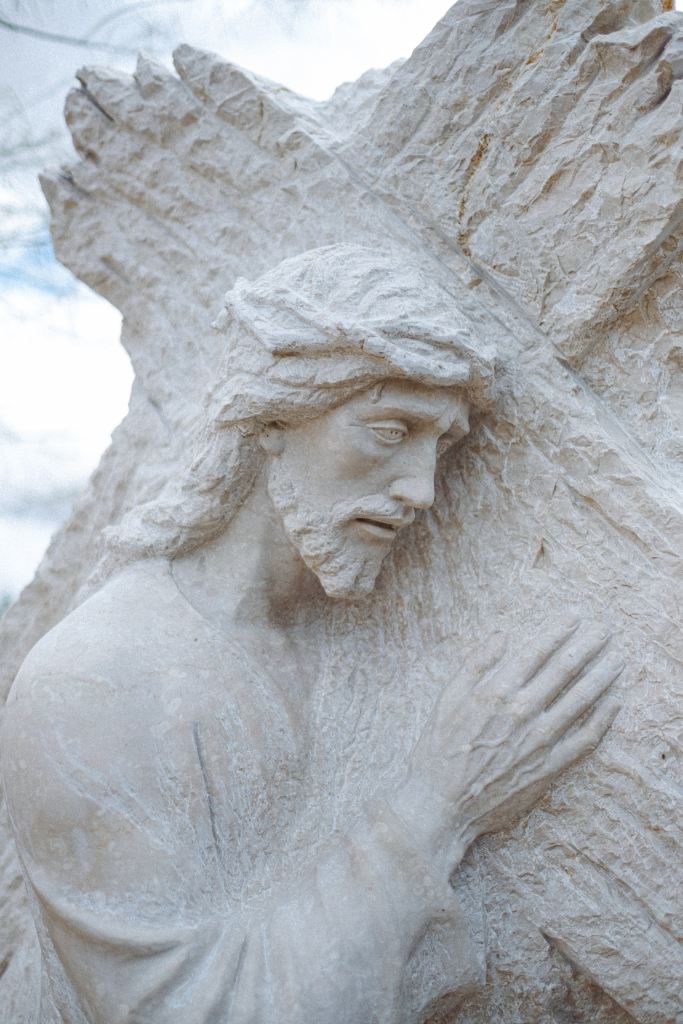
Photo by Wesley Tingey on Unsplash

However, when we are feeling like Heman, God still loves us, and like Heman we can pour out all our frustration to God.  He can take it.  Even when we are in “the valley of the shadow of death,[2] He remains with us and will sustain us.  When it seems we have nothing else, He will be there and listen.

Consider whether the Father did not love the Son when He suffered, or whether His suffering was proof that He loves us?   Therefore, Peter goes even farther in 1 Peter 4:13-14 – “But rejoice insofar as you share Christ’s sufferings, that you may also rejoice and be glad when his glory is revealed. If you are insulted for the name of Christ, you are blessed, because the Spirit of glory and of God rests upon you.

Good Friday was not the end of Jesus’ story, and although the day had three hours of darkness, the Son rose again and there was light!  Likewise, Psalm 88 was not the end of the Psalms; the last Psalm (150), begins like this:

Praise the LORD!
Praise God in his sanctuary;
            praise him in his mighty heavens!

And ends like this:
Let everything that has breath praise the LORD!
            Praise the LORD!

He is risen and you are Beloved.  Amen.


[1] Not He-Man, one of the fictional Masters of the Universe.
[2] Psalm 23:4

Missionaries Saved By Mysterious Army: History for March 28

Even people who believe in angels and demons may not see how they are relevant.  The Bible contains a lot of hints about a spiritual world we can’t see, but not a lot of detail about what it all means to us.  One of these hints is in the Old Testament book of 2 Kings during a war between Israel and Syria.  Trying to kill the prophet Elisha, the Syrian army surrounded the city of Dothan where he was staying.  Elisha’s servant saw the army, was worried and asked Elisha what they should do.  Elisha (and the LORD) responded:

“He said, ‘Do not be afraid, for those who are with us are more than those who are with them.’ Then Elisha prayed and said, ‘O LORD, please open his eyes that he may see.’ So the LORD opened the eyes of the young man, and he saw, and behold, the mountain was full of horses and chariots of fire all around Elisha.” – 2 Kings 6:16-17

On today’s date, March 28th, in 1953 something happened in Kijabe, Kenya which may be eerily similar to the events of 2 Kings.  I know several solid, Christian, professional people not known for sensationalism who were at the site of this event a handful of years later, and who spoke to people who witnessed it.  For this post, my primary source is the book “School in the Clouds: The Rift Valley Academy Story” by Phil Dow[1], but I could have written it entirely from second-hand accounts from people I know.  So, what happened?

In the decade of the 1950’s, Kenya was a British colony, but was embroiled in what is known as the Mau Mau, an extremely violent uprising against British rule.  Colonialism had added a new facet to tribal animosity in Kenya that existed long before the “Scramble for Africa”[2], where some Africans embraced and defended British efforts, while others strongly resented it and endorsed any means to repel the British and restore the “pure” African culture that existed before.

As part of a broader pattern of atrocities designed to scare the British into leaving, the Mau Mau planned an attack on Rift Valley Academy (RVA), a boarding school for children of missionaries.  Not only was the school symbolic of unwelcome outside influence in the eyes of the Mau Mau, but the school had also opened its doors as a refuge for Africans fleeing Mau Mau threats elsewhere.  On March 26th, Mau Mau fighters attacked a Christian group of Kikuyu (one of the Kenyan tribes) a few miles from RVA, killing 97 villagers and wounding 32 others, largely with machetes.  The Kikiyu tribe, historically a lower socioeconomic group, was divided between those who joined the Mau Mau for independence and those who backed British involvement because they saw Christianity and other Western influences as a positive.

RVA was on high alert, knowing the campus of schoolchildren and their caregivers were the Mau Mau’s next target.  Phil Dow wrote in his book:

“The sun rose Saturday morning accompanied by a host of rumors that confirmed an impending Mau Mau raid on RVA. Convinced that they would be attacked, several high school girls took time in the afternoon to write letters they hoped would be read by their parents if they were to be killed. That night the students went to bed under a star-filled sky fully clothed and expecting to be awakened by the sounds of gunfire and angry voices.”

They were awakened in the middle of the night to the sound of an alarm, some distant gunfire, but soon followed by an “all clear” bell.


Weeks later, some Mau Mau were caught hiding near the school and questioned about what happened on the night of March 28th.  They confirmed that an attack on RVA was attempted with the intention of burning the school to the ground and killing anyone they found there, but the attack was repelled by lines of British soldiers encircling the campus.  Later, other witnesses claimed the same.  However, “in March of 1953 there were no British soldiers at Kijabe.”  Multiple sources on RVA’s campus and among British authorities attest that the campus was vulnerable and mostly undefended, but something happened that spared the community and the lives of everyone in it so that the missionary work could continue.  The attempted attack raised the awareness of the British and provided time for them to install “protection of the very worldly kind” for RVA, including limited troops stationed there, along with defensive walls, barbed wire, and guard posts with mounted machine guns.

Dow concludes: “Whatever did happen that night, the Christian community at RVA was convinced that they had been kept safe by supernatural intervention. Indeed, the night’s events continue to be remembered as an example of God’s provision for the devoutly Christian community.”

What Elisha said in the Old Testament as:
Do not be afraid, for those who are with us are more than those who are with them”

Paul echoes in the New as:
What then shall we say to these things? If God is for us, who can be against us?  He who did not spare his own Son but gave him up for us all, how will he not also with him graciously give us all things?” – Romans 8:31-32

Amen.


Interested in more History? Select “History Bits” from the “Blog” drop down menu at the top of the page.


[1] Dow, Phil. School in the Clouds: The Rift Valley Academy Story.  (2003).  P. 130-132
[2] See summary at https://en.wikipedia.org/wiki/Scramble_for_Africa

Serving Other Gods

Foundational to God’s relationship with His people – His covenant – is the idea that He will be our God and we will be His people.  If we forsake all other “gods,” we will be blessed immeasurably by the true God, Yahweh.

However, in the time of the Old Testament prophet Jeremiah, right before the exile of Judah into Babylon, God’s people were not being faithful to Yahweh and were worse than prior generations in their rebellion.  So, Jeremiah says in chapter 16, verse 13 – “Therefore I will hurl you out of this land into a land that neither you nor your fathers have known, and there you shall serve other gods day and night, for I will show you no favor.”

This punishment has 2 parts: banishment from the Promised Land, and also “you shall serve other gods day and night.”  Have you ever thought that serving gods other than Yahweh is a punishment, or just that its bad or sinful?   It certainly isn’t the way the world sees it: many consider serving any god as punishment.  Others might have their own gods and would only consider serving other gods, including Yahweh, as punishment.  But here the Bible says that it is only punishment to follow false gods.

Why is this?  A good explanation comes from another prophet, Zechariah, in chapter 10, verse 2:

For the household gods utter nonsense,
            and the diviners see lies;
they tell false dreams
            and give empty consolation.
Therefore the people wander like sheep;
            they are afflicted for lack of a shepherd.”

Compared to a loving, omniscient, wise God, these other gods have no knowledge or wisdom and are not benevolent.  They cannot give us what we need to live and are not worthy of worship.  They cannot guide us like our Good Shepherd can.  Therefore, when we choose to follow anything other than Yahweh, are we punishing ourselves?

When Yahweh said “You shall have no other gods before me” in Exodus 20:3, He said it for our own benefit, and for His glory.

Amen.

Join Me on Twitter (X)

I created a Twitter/X account for myself, but also associated with this blog. If you’re a Twitter user, follow me @theSonwillrise1 and I’ll be sharing short thoughts and other interesting things I find.

Looking forward to seeing some of you there!

When All You Have is God

Photo by Greg Willson on Unsplash

Near the end of Book 3 in the Psalms (43-89), several Psalms read like cries for help by writers at the end of their rope.  In Psalm 86:14, for example, David writes: “O God, insolent men have risen up against me; a band of ruthless men seeks my life, and they do not set you before them.”  While the exact circumstance is unclear, David knows there is a wide conspiracy against him, and his only hope is to turn to God.  The Psalm opens with “Incline your ear, O LORD, and answer me, for I am poor and needy.”

Likewise, when we feel desperate and don’t know where to turn, these Psalms remind us that God will never turn us away.  On Psalm 86 John Calvin comments that “the more severely any one is oppressed, and the more destitute he is of the resources of human aid, the more inclined is God graciously to help him. That despair therefore may not overwhelm our minds under our greatest afflictions, let us support ourselves from the consideration that the Holy Spirit has dictated this prayer for the poor and the afflicted.”  In other words, because these Psalms are in the Bible, we can be sure that, no matter the mess our own choices or the actions of others have put us in, God in His steadfast love will listen.

Throughout the Psalm, David writes reminders of the character and works of God as a contrast to both his circumstances and his feelings of futility.  Like him we must always remember that our character is never so bad that God loving us is inconsistent with His character, and that our circumstances are never so bad that loving us is beyond His power to achieve.

When all you have is God, He is enough.

Even for the most desperate, there is always a way out, as Paul wrote in 1 Corinthians 10:13 – “No temptation has overtaken you that is not common to man. God is faithful, and he will not let you be tempted beyond your ability, but with the temptation he will also provide the way of escape, that you may be able to endure it.” In Psalm 86, David does not just pray for a miraculous deliverance, but in verse 11, David looks for the way of escape: “Teach me your way, O LORD, that I may walk in your truth; unite my heart to fear your name.”  A united heart is one that feels no anxiety because it knows it is seeking God’s will and willing to act on it based on reverence for Him.  God may urge us to merely wait for His deliverance, or prod us to actions we may not expect, but in all cases, He knows the way, because He is the Way. Only He can unite our hearts.

Bring your desperate anxiety to Him and let Him show you the way forward.  When all you have is God, He is enough.  When you feel your faith is weak because you can’t see or feel God in your life or the world around you, begin with “Incline your ear, O LORD, and answer me, for I am poor and needy,” and He will listen.