Presents of Presence: A Holiday Quint of Quotes

Dear fellow travelers,

With mere days remaining until Christmas, here is a Quint of Quotes, five sayings for the holidays!

“Attention is the rarest and purest form of generosity” – Simone Weil

“The highest form of knowledge is empathy, for it requires us to suspend our egos and live in another’s world” – Plato

“When given the choice between being right or being kind choose kind.” – from the book Wonder, by R.J. Palacio

Be kind to one another, tenderhearted, forgiving one another, as God in Christ forgave you.” – Paul, in Ephesians 4:32

“Strange, isn’t it? Each man’s life touches so many other lives. When he isn’t around he leaves an awful hole, doesn’t he?” – guardian angel Clarence Oddbody, in It’s a Wonderful Life

Merry Christmas to all my readers – first timers, occasional passersby, and a handful of regulars!

Jesus was Born to Overthrow King Herod, but How?

The story of Herod and the three wise men is familiar to most who celebrate Christmas.  After the birth of Jesus in Bethlehem, the wise men came looking for Him, having seen a star they believed signaled His coming.  Arriving in Jerusalem, they asked “Where is he who has been born king of the Jews? For we saw his star when it rose and have come to worship him.[1]  Word of this search made it to Herod, the then-current king of that region under Rome’s authority, and his first instinct was to eliminate what he saw as a threat to his own power.  In Herod’s eyes, only he was king of the Jews.

Herod came up with a simple plan: to use the wise men to help him find this threat.  “And he sent them to Bethlehem, saying, ‘Go and search diligently for the child, and when you have found him, bring me word, that I too may come and worship him.’”[2]  However, the wise men were warned in a dream not to return to Herod, so they went home after visiting Jesus.  “Then Herod, when he saw that he had been tricked by the wise men, became furious, and he sent and killed all the male children in Bethlehem and in all that region who were two years old or under, according to the time that he had ascertained from the wise men.”[3]

Herod believed so strongly in the necessity of the power of Rome and of his place in it that he was willing to commit mass murder.  If he couldn’t find the one child he wanted, he’d just kill them all.  He feared Jesus (or His followers) would overthrow him as king, and he was right but in the wrong sense.  Jesus would overthrow Rome.  He was born to overthrow every earthly kingdom – that is inevitable.

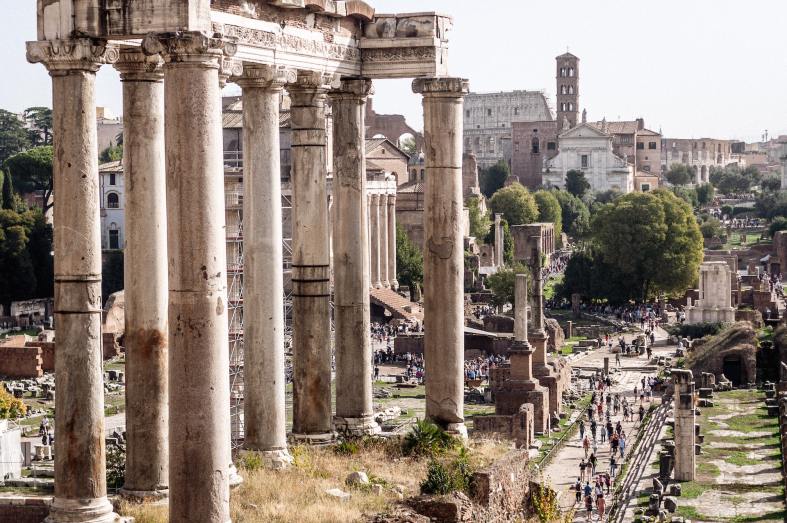
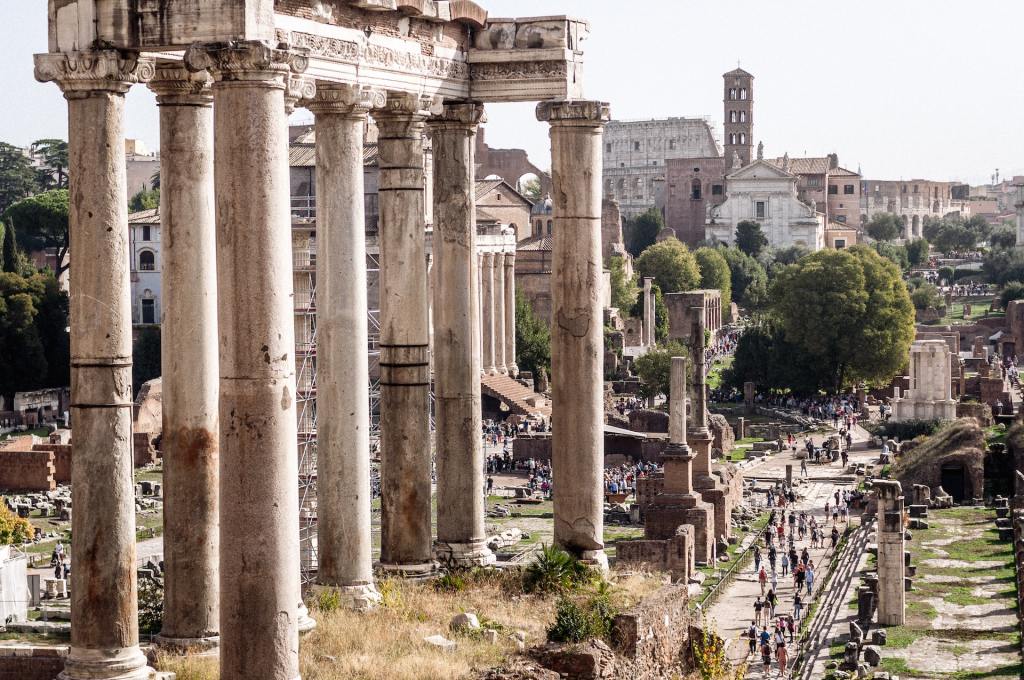
Much of Rome is already in ruins. Photo by Giu Vicente on Unsplash

Isaiah 40:17 proclaims that “All the nations are as nothing before him, they are accounted by him as less than nothing and emptiness.”  The word “emptiness” here is the Hebrew “bohu,” part of the phrase “tohu va’bohu” translated as “without form and void” in Genesis 1:2.  This phrase represents empty things with no eternal value or purpose.  So, while Isaiah doesn’t use the whole phrase from Genesis, he uses “less than” for emphasis instead.  When compared to God’s eternal purposes, all that every nation has ever devised and achieved is less than useless.  God has nothing to learn from our political and economic visions – He transcends them all.  No nation can or will accomplish what God has accomplished and will accomplish.

Therefore, Jesus’ other mission was to overthrow Herod’s dominion over Herod.  But Herod was determined to resist.  His heart was so hard that he preferred to hang on to a government willing to commit mass murder to preserve its own self-centered ways.  He thought he could preserve the façade of “Pax Romana,” the idea that worldly government can solve all of our problems, even while he, as an agent of Rome, was killing innocent children.  Herod saw it as in his own best interest, and in the interest of Rome, but this is one of many examples of “a way that seems right to a man, but its end is the way to death.”[4]

Jesus can overcome death only by overthrowing our views of our own “best interest” and what “seems right.”  He was not born and did not die and rise again just to overthrow Rome, but He came so we would have a way to overthrow ourselves and death itself.  Jesus will establish the only government that will matter in eternity: His Kingdom.  The soul of Herod, and of all of us, will outlive every society that ever existed, and ever will, on this earth.  The nations are all “accounted by him as less than nothing and emptiness.”  While Herod could find hope in Jesus if he wanted to, Rome itself never had any hope.

Therefore, the question Jesus asks all people is: Will we let Jesus overthrow us or will we, like Herod, go to great lengths to resist Jesus and try to preserve a world that is doomed to fail?

Isaiah 9:6 says “and the government shall be upon his shoulder.”  His Kingdom will be the only government we need, and He alone is uniquely qualified to establish and rule it.

For to us a child is born,
            to us a son is given;
and the government shall be upon his shoulder,
            and his name shall be called
Wonderful Counselor, Mighty God,
            Everlasting Father, Prince of Peace.”


[1] Matthew 2:2
[2] Matthew 2:8
[3] Matthew 2:16
[4] Proverbs 14:12, 16:25

The Destiny of the Wealth of Nations

Here in the United States, the year 1776 is celebrated as the political beginning of the nation, because the Declaration of Independence was approved on July 4 of that year.  Also in 1776, The Wealth of Nations by economist and philosopher Adam Smith was published and is foundational to our nation’s economy.  Its full title of An Inquiry into the Nature and Causes of the Wealth of Nations shows its purpose was to explore what makes some nations more well-off than others, with Smith concluding that capitalism, especially the elements of free trade and competition, was the best system.  I won’t argue here for capitalism or about where wealth comes from, but about where wealth is destined to end up.

Interestingly, the phrase “wealth of the nations” appears in the Bible 3 times, all in Isaiah 60 and 61, and the phrase “wealth of all the surrounding nations” appears once, in Zechariah 14.[1]  All of these references describe the future reign of the Messiah when all nations and peoples will acknowledge Him as Lord and dedicate their wealth in tribute to Him.

Isaiah 60:4-5 is the first mention of the phrase, and it says:

Lift up your eyes all around, and see;
            they all gather together, they come to you;
your sons shall come from afar,
            and your daughters shall be carried on the hip.
Then you shall see and be radiant;
            your heart shall thrill and exult,
because the abundance of the sea shall be turned to you,
            the wealth of the nations shall come to you.”

The next few verses read like an inventory of goods (camels, gold, flocks, ships, lumber) and places (Midian, Sheba, Kedar, Tarshish, Lebanon), showing that no thing and no place is excluded from the tribute to God.  Wealth from every source belongs to Him.

In the same chapter, verse 11 declares about the eternal city of God:

Your gates shall be open continually;
            day and night they shall not be shut,
that people may bring to you the wealth of the nations,
            with their kings led in procession.”

When we inquire into future of wealth, rather than its past and its sources, we find that the wealth of the nations is all His.  We own nothing.  We are only stewards and caretakers, regardless of what economic system we live in or believe in.

The earth is the LORD’S and the fullness thereof,
                        the world and those who dwell therein” – Psalm 24:1

Soli Deo Gloria


[1] It may be where Smith got his title idea, or it may just be coincidence.

Daily Readings for December 22 – 28

Fellow travelers:

Here is the list of readings for this week: 2 chapters to read per day as the main reading plan, and extra chapters for anyone who wants to read the whole Bible in 2025.  I hope this encourages others to read and study their Bible more, whatever parts they decide to read.  Follow along (or not) any way you choose!

Can’t believe the year is almost done!  The next week of readings will go into 2026, and we’ll begin the year with Psalms and Matthew in the 2-a-day plan, with extra readings from Genesis.

2 chapter a day plan:

Monday, December 22: Revelation 3-4
Tuesday, December 23: Revelation 5-6
Wednesday, December 24: Revelation 7-8
Thursday, December 25: Revelation 9-10
Friday, December 26: Revelation 11-12
Saturday, December 27: Revelation 13-14
Sunday, December 28: Revelation 15-16

Extra chapters for those reading the whole Bible this year:
Zechariah 9-14, Malachi 1

Limited Boasting

I took a strategy class years ago in business school, but about the only thing I remember the professor saying is (paraphrasing): “Strategy includes not only doing our best at what we do but also deciding what not to do.”  There were a couple of points to this.  One, it’s important to not get distracted in order to do the things that need to be done.  Second, and more importantly, it’s essential to be deliberate and intentional about what we should not be doing.  We should know what things ours are to deal with and which things aren’t.  Not that we can always avoid things, but strategy involves knowing what those things are.

The apostles Paul and Peter understood this principle.  In Romans 11:13, Paul referred to himself as “an apostle to the Gentiles.”  Of course, he often preached in the Jewish synagogues of the towns he visited, but he knew his emphasis should be on getting the Gospel to the Gentiles.[1]  On the other hand, the focus of Peter’s ministry was the Jews.  When he wrote 1 Peter, he addressed it to the “Dispersion,”[2] referring mainly to Jews living outside of Palestine, but he also knew Gentiles would benefit from it.

It is this division of labor that Paul refers to in 2 Corinthians 10:13 – “But we will not boast beyond limits, but will boast only with regard to the area of influence God assigned to us, to reach even to you.”

Paul did not boast in his own work but freely boasted of the work of God through him.  He wasn’t being arrogant, but giving God the glory for anything he succeeded in.  But even so, Paul knew his boasting had to be limited to work that was specifically his to do, in this case taking the gospel to Gentiles in Corinth.

If Peter and Paul had limits, each of us do as well.  God understands this better than anyone, since he is the one working through us and also defining those limits, or our “area of influence.”  Warren Wiersbe, commenting on the verse, wrote: “God is not going to measure us on the basis of the gifts and opportunities that He gave to Charles Spurgeon or Billy Sunday. He will measure my work by what He assigned to me.”[3]

It’s a shame in our culture that we have phrases like “silence is complicity,” as if every problem is every person’s problem to solve, and as if speaking out about problems is as good as actually doing something about them.  It’s also a shame that over-emphasis on other people’s problems can easily, and often, keep us from dealing with things right in front of us.  But how do we know what to deal with and not deal with?  Our social media feeds are not the answer.

Knowing our “area of influence”, in my experience, requires constant cultivation of our relationship with God.  Bible study, prayer, meditation, fellowship.  When I’ve made those investments, it’s been amazing how what God says to me has application to specific life situations.  Maybe when I read about patience, I find myself in a situation where it’s hard to be patient.  Maybe I read about holiness, and it makes me confront some sin or bad habit in my life.  Maybe I read about forgiveness and think of someone I may be ignoring or holding a grudge against.  Maybe I learn about a new way to express my spiritual gifts or find a new person to share them with.  Maybe I read about caring for widows and orphans and I learn about a single mother who needs help.

Not all tasks are ours to do, but it’s important to note that we are accountable for the tasks God has for us.  “For we are his workmanship, created in Christ Jesus for good works, which God prepared beforehand, that we should walk in them.” (Ephesians 2:10).  While he doesn’t call one person and ask them to do everything, He does call many and gives them their roles.

But the point of this post is that we can’t do everything.  Many situations require prayer that God will provide someone to help.  Someone to bring Christ into that situation.  Sometimes I’ve come across the solution later or found someone else who is in a position to help, but still, I’m not accountable to God for being perfect, for helping everyone I come across.

If we’re paying attention to the “area of influence” in front of us instead of every possible problem in the world, God can do great things through each of us.  But if we don’t intentionally decide to strategically leave some problems alone, we may find ourselves aimless and spinning our wheels.

May God give us all direction.

But we will not boast beyond limits, but will boast only with regard to the area of influence God assigned to us, to reach even to you.”


[1] See also 1 Timothy 2:7
[2] 1 Peter 1:1
[3] Wiersbe, Warren.  Be Encouraged (2 Corinthians) (1994).  P. 136.