Popular Orthodoxy: A Quint of Quotes

Fellow travelers,

Here is another “Quint of Quotes” from my collection.  These five somewhat related sayings suggest the particular time and place we live in may not be very different from every other time and place.  I hope you find them interesting and thought-provoking.

Now the serpent was more crafty than any other beast of the field that the LORD God had made.  He said to the woman, “Did God actually say, ‘You shall not eat of any tree in the garden’?…the serpent said to the woman, “You will not surely die.” – Genesis 3:1,4

“Every age has some ostentatious system to excuse the havoc it commits. Conquest, honour, chivalry, religion, balance of power, commerce, no matter what, mankind must bleed, and take a term for a reason” – Horace Walpole, British politician, in 1762

There is a way that seems right to a man, but its end is the way to death.” – Proverbs 14:12, 16:25

“At any given moment there is an orthodoxy, a body of ideas of which it is assumed that all right-thinking people will accept without question. It is not exactly forbidden to say this, that or the other, but it is ‘not done’ to say it… Anyone who challenges the prevailing orthodoxy finds himself silenced with surprising effectiveness. A genuinely unfashionable opinion is almost never given a fair hearing, either in the popular press or in the high-brow periodicals”. – George Orwell, in the 1945 introduction to ‘Animal Farm.’

For the time is coming when people will not endure sound teaching, but having itching ears they will accumulate for themselves teachers to suit their own passions, and will turn away from listening to the truth and wander off into myths.  As for you, always be sober-minded, endure suffering, do the work of an evangelist, fulfill your ministry.” – 2 Timothy 4:3-5

What is Our Conscience?

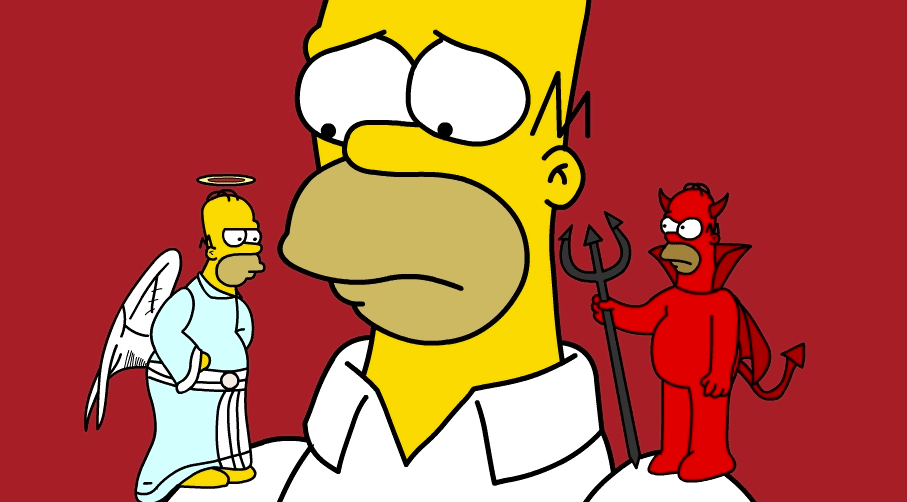
What do you think of when you think of a conscience?  For some it’s the image from old cartoons of a person with an angel on one shoulder and a devil on the other, each giving competing moral advice.  That image is funny partly because it might not be far from the truth.

For some, a conscience is a “moral compass” – that internal voice that helps us distinguish right from wrong.  While this is another good image for a conscience, we have new technology now.  We use GPS now, and when I think of a conscience, the voice of my GPS comes to mind.  Let me explain.

A compass is too simple a metaphor.  The voice of our conscience is not usually like a clear sign or bright, flashing lights pointing the way (although God can use whatever means He chooses).  In my experience, a conscience is more like a broken GPS system, that has many voices, not just one, like a real GPS.  Not that we’re all “hearing voices,” but since our conscience is giving us directions, a voice seems a good metaphor.  You could call it an influence or something else.  Anyway, some of the voices tell us to go places we shouldn’t and not to go places we should, and some of them lead us the right way.  We find ourselves weighing the pros and cons of these multiple voices.  For every decision we make, there’s a reason we make it, and often we don’t explicitly think about why.  It could be something we learned from our culture, our family, our education, or from anything we’ve experienced.  It might come from something we saw or listened to recently, or many years ago.  It could also be something we just invented ourselves.  But it’s there, trying to influence us.

Now not everyone has the same voices in their conscience.  For someone who isn’t a Christian, their GPS considers all the factors it has, and they make decisions as they see fit by prioritizing among the influences.  But for a Christian, salvation requires realizing our GPS is fundamentally broken, trusting someone who knows how to fix it, and then striving to follow the new instructions.  When this happens, a Christian gets an added feature in their internal GPS – a new voice.  This voice is the Holy Spirit, but it doesn’t become the only voice, it just adds one more competing voice to the cacophony. However, the Spirit is the only voice that can be trusted to guide us to the right destination 100% of the time.

As we make decisions in the world, each of us try to follow the advice of our conscience, but we must remember that our consciences are broken until we reach heaven.  Many voices work hard to influence us, and any voice that we follow into disobedience from God can be considered an idol for us.  Only the Holy Spirit speaks with the wisdom needed for us to fulfill our purpose as individuals made in God’s image.

However you think of what a conscience is, let Him rule it, and “in your hearts honor Christ the Lord as holy” – 1 Peter 3:15a

Then you can have a clean conscience, whatever you do.

Lessons from an Unlikely Idol

The history of the kings of Judah can read like a back-and-forth between construction of idols by bad kings and the destruction of idols by good kings.  Hezekiah was one of the few good kings, and one reason is recorded in 2 Kings 18:4, which says:

“[Hezekiah] removed the high places and broke the pillars and cut down the Asherah. And he broke in pieces the bronze serpent that Moses had made, for until those days the people of Israel had made offerings to it (it was called Nehushtan).”

Judah was meant to have only one God, the true God Yahweh, and to destroy anything that would lead them to idolatry.  Unfortunately, worshipping other gods in high places was not uncommon, and neither was worship of Asherah.  What’s interesting about this verse is the mention of this “Nehushtan.”  The origin of this bronze snake that Moses made comes from a story in the book of Numbers.

As often happened while they wandered the wilderness, the people of Israel complained to God and Moses that they would have been better off if still in Egypt.  They hated the food God was providing and accused Him of leading them into the wilderness to die.  As discipline for this grumbling, “the LORD sent fiery serpents among the people, and they bit the people, so that many people of Israel died.”[1]  The people repented and asked for the serpents to be removed, and Moses prayed for them.

The answer was that “Moses made a bronze serpent and set it on a pole. And if a serpent bit anyone, he would look at the bronze serpent and live.[2]  This serpent being lifted up was later identified in John 3:14 as a prelude to Jesus being lifted up on the cross, but in Hezekiah’s day it had become an idol, an object that took people away from worship of the true God and the then-future Christ.  Instead of being a symbol of salvation, the bronze serpent became a symbol of idolatry, which leads to damnation.

The story of the serpents ends there, and there is no mention that God told the people to keep this bronze serpent, or that God told them to give it a name.  This was probably the beginning of the problem, that Israel added to God’s intentions for it.

So, what are the lessons for us?

Nehushtan, the bronze serpent, was created at God’s command to be an aid to worship, a device for reminding His people of His provision for them, from above.  Instead, it became an idol.  What this tells us is that anything, even something once (or currently) used in worship, can become an idol.  Even things like private Bible study or public singing of hymns can be idols if we use them as ends in themselves and not as a way to worship our only God.  A thing can be an idol not because of what it is, but because of our attitude toward it.

Also, something that is an idol to one person might not be an idol to another.  The bronze serpent was not an idol to Moses, but it was to people in Hezekiah’s time.  So, if we know that something tempts us, that thing might not be a temptation for others, and vice versa.  Therefore, we should not be quick to judge others for doing things that bother us, but may not be a problem for them, and are not specifically prohibited in the Bible.

When Christ was raised up on the cross like the bronze serpent and was raised from the dead like those who survived the bites of serpents, He identified Himself as the only God and the only one worthy of our worship, but He also identified Himself as the merciful one who desires that we be merciful to each other.

Like ancient Israel, we all have Nehushtans in our lives that corrupt our worship, and like the good king Hezekiah, we must remove them from our lives to reform our worship.


[1] Numbers 21:6
[2] Numbers 21:9

Bible in a Year: Week of March 18 – 24

Fellow travelers:

Below are the chapters to read this week if you’re following along in my Bible in a year schedule, divided into morning and evening readings.  Follow along any way you want: just do the evening reading, flip the morning and evening, read it all.  Whatever works for you and your schedule!  It doesn’t have to be Bible in a Year for everyone.

This week we finish 2 Kings and begin 1 Chronicles.  After the 2 Chronicles books, we move to Ezra and Nehemiah, then on to the New Testament, starting with the gospel of Matthew.

Monday, March 18
Morning: Psalm 78, 2 Kings 23
Evening: Exodus 28

Tuesday, March 19
Morning: Psalm 79, 2 Kings 24
Evening: Exodus 29

Wednesday, March 20
Morning: Psalm 80, 2 Kings 25
Evening: Exodus 30

Thursday, March 21
Morning: Psalm 81, 1 Chronicles 1
Evening: Exodus 31

Friday, March 22
Morning: Psalm 82, 1 Chronicles 2
Evening: Exodus 32

Saturday, March 23
Morning: Psalm 83, 1 Chronicles 3-4
Evening: Exodus 33

Sunday, March 24
Morning: Psalm 84, 1 Chronicles 5-6
Evening: Exodus 34

The Cross and Power

And being found in human form, He humbled himself by becoming obedient to the point of death, even death on a cross.” – Philippians 2:8

Here Jesus endured the powerlessness that many feel. At any moment, Jesus could have chosen to free Himself from the cross, but He actively maintained His powerlessness for hours through the torture for our benefit. Any time we think power is the answer, we must consider this.

Photo by Wim van ‘t Einde on Unsplash