
An Audience With Our King

Do you ever feel like God wouldn’t listen to someone like you?  Who has done what you’ve done or thought what you’ve thought?  Or that He just doesn’t have time for you?  There’s an Old Testament story which shows that a good king, our King, is willing to listen to anybody.

This well-known story of King Solomon comes from 1 Kings 3, in two parts.  In the first part, Solomon asks God for wisdom to rule Israel instead of asking for “long life or riches or the life of your enemies,”[1]so God grants him wisdom, but also the riches and honor he didn’t ask for.  In the second part, an example is given of the wisdom God gave to Solomon.

This example comes in a story of two women who came to Solomon, both claiming that a newborn baby belongs to them.  One claims the other took their child after killing their own child by lying on him in her sleep.  The other claims the living child is their own.

Solomon’s judgement?  “Bring me a sword…Divide the living child in two, and give half to the one and half to the other.[2]  Surprisingly, only one of the women objected to killing the baby, saying the other woman could take him.  Solomon announces that this woman must be the mother instead of the woman who just said, “He shall be neither mine nor yours; divide him.”[3]  In his wisdom, Solomon preserves this child’s life, gives justice to the mother, and demonstrated the great gift God had given Solomon and his people.

But there’s another important detail in this story.  These women were “two prostitutes,[4] and therefore both babies were probably illegitimate.  There are many conclusions I could draw from this, but for now, just notice that King Solomon (surely a very, very busy king) found time to give audience to two prostitutes and provide justice between them.  He did not send them away because of who they are.

Our king Jesus is similar.  No matter who you are or what you’ve done, He will give you an audience.  You could be a prostitute, an unwanted child, or maybe you look like a model citizen, and God will listen to you, because the blood of Jesus shed on the cross covers all sins, not just some of them.

Anyone, really anyone, who sincerely comes to Him looking for wisdom and justice will find it in God’s kingdom.

Let us then with confidence draw near to the throne of grace, that we may receive mercy and find grace to help in time of need.” – Hebrews 4:16


[1] 1 Kings 3:11
[2] 1 Kings 3:24-25
[3] 1 Kings 3:26
[4] 1 Kings 3:16
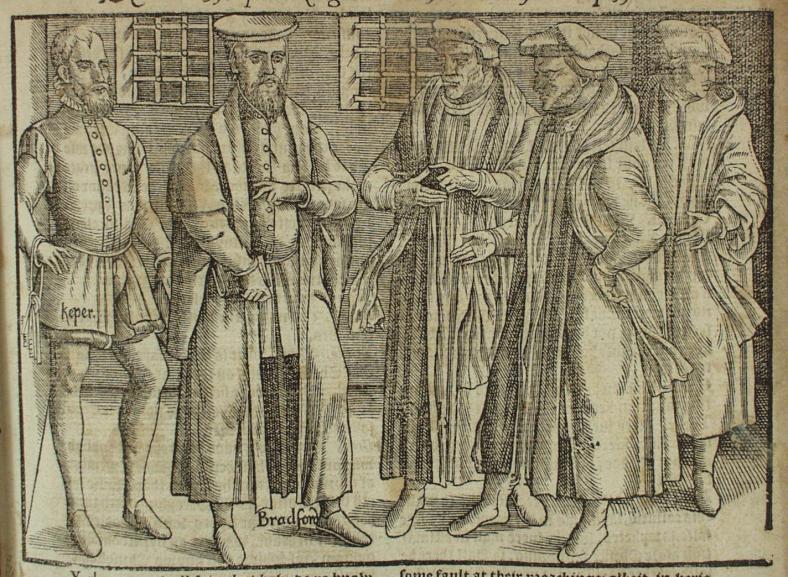
There Goes John Bradford (to Paradise): History for February 24

Born in 1510, John Bradford was a rising Protestant minister during the reign of King Edward VI in England and was well known for his pious dedication and unselfish nature.  After studying at Cambridge and preaching regularly around London, he was appointed as Chaplain to the King in 1551.  The common expression “There but for the grace of God go I” is often attributed to him and was a reminder to himself that grace alone has saved him.  An 1822 book on prayer says that:

“The pious Martyr Bradford, when he saw a poor criminal led to execution, exclaimed, ‘there, but for the grace of God, goes John Bradford’. He knew that the same evil principles were in his own heart which had brought the criminal to that shameful end.”[1]

Bradford and others in the Tower of London, from John Foxe’s Book of Martyrs (1563). Public Domain.

His worldly fortunes changed in 1553 when the Catholic Mary I became Queen, and one of her first priorities was persecution of prominent Protestants.  Bradford was arrested within a month, imprisoned in the Tower of London, and sentenced to death.  While in the Tower, he wrote a letter to his mother on this date, February 24, in 1554, that included a powerful statement about prayer: God “doth put off our prayers, that he might recompense it with abundance, that is, that he might more plentifully pour upon us the effect of our petitions.” [2]  On July 1, Bradford was burned alive at the stake.

In another book on prayer, Donald McKim wrote about Bradford’s letter:
“We can imagine that no one would seek an answer to his prayers more ardently than Bradford while awaiting death. Yet he believed that even with no apparent answers to prayers, God plentifully pours abundance on those who pray!
At the end of his letter Bradford mentions God’s promise-which believers receive and anticipate, even in the midst of their sufferings and afflictions. Paul recorded the promise: “What no eye has seen, nor ear heard, nor the human heart conceived, what God has prepared for those who love him” (1 Cor. 2:9) Plentiful abundance! Now and forever!”[3]

In John Bradford’s story, there is a terrible irony between two things he is known for – a common phrase and his martyrdom – but in the end, God is faithful, and I hope to meet Bradford someday in Paradise, where the grace of God has bought me a place.


[1] Bickersteth, Edward.  A Treatise on Prayer.  (1822).  Sourced from https://en.wikipedia.org/wiki/John_Bradford
[2] McKim, Donald K.  Everyday Prayer with the Reformers (2020).  P. 92.
[3] Ibid.

Compassion for the Harassed and Helpless

And Jesus went throughout all the cities and villages, teaching in their synagogues and proclaiming the gospel of the kingdom and healing every disease and every affliction. When he saw the crowds, he had compassion for them, because they were harassed and helpless, like sheep without a shepherd.” – Matthew 9:35-36

Jesus lived under the greatest empire the world had yet seen, and in a deeply religious Jewish culture developed over centuries.  The people had powerful leaders, both political and religious.  Why then were the people seemingly without a shepherd to lead them?

The Roman Empire touted widespread peace and prosperity due to the Caesars and their government.  But the people still had many unsolved problems and no hope.  “Throughout all the cities and villages” were diseased, afflicted and helpless people, and Jesus could help them all in ways the Romans could not or would not.

The Jewish Pharisees, jealous of Jesus’ ability to solve problems they could not, claimed “He casts out demons by the prince of demons.”  They rightly described His power as supernatural, but they called it evil.  Even as He was performing life-saving miracles, they could not tolerate Him as a rival, and so rejected the people’s only hope.

So, the people remained “harassed and helpless,” not knowing who to trust.

Is your culture also faithless?  Your workplace?  Your community or household?  Jesus encouraged His disciples to see rampant lack of faith as an opportunity to show the crowds the compassion of Jesus: “Then He said to his disciples, ‘The harvest is plentiful, but the laborers are few; therefore pray earnestly to the Lord of the harvest to send out laborers into his harvest.’” – Matthew 9:37-38

Today, pray for workers to bring in the harvest.  Also, know that God might make you and I those workers.  As in Jesus’ day, it is up to individual disciples to proclaim the gospel of the kingdom – through compassionate action and often in spite of what those in charge of other kingdoms might prefer.  Harassed and helpless sheep can be frustrated and difficult, but only humble disciples know the problems on the streets of their cities and villages best.

Pray for the compassion of our Great Shepherd who can work miracles. Is there a need He can meet through you today?

Photo by Erik-Jan Leusink on Unsplash

The God Who is Never Inadequate

Once upon a time, “Moses was keeping the flock of his father-in-law, Jethro, the priest of Midian, and he led his flock to the west side of the wilderness and came to Horeb, the mountain of God.”[1]  It seemed like a normal day for a shepherd until he saw a burning bush, but not any burning bush.  This one, though on fire, was not consumed by the fire.  As anyone would, Moses was curious and stopped to look.  Then, “When the LORD saw that he turned aside to see, God called to him out of the bush, ‘Moses, Moses!’ And he said, ‘Here I am.’”[2] [emphasis mine]

But just a few verses later, “Moses said to God, ‘Who am I that I should go to Pharaoh and bring the children of Israel out of Egypt?’”[3]  Moses’ “Here I am” quickly became a “Who am I,” and why?  Because God had spoken to Moses from the bush saying that He had come to deliver the Jews from their affliction as slaves under the Egyptians.  God wanted Moses to be His representative before Pharaoh, but Moses objected not just this one time, but three more times:

Then Moses said to God, ‘If I come to the people of Israel and say to them, ‘The God of your fathers has sent me to you,’ and they ask me, ‘What is his name?’ what shall I say to them?’” – Exodus 3:13
Then Moses answered, ‘But behold, they will not believe me or listen to my voice, for they will say, ‘The LORD did not appear to you.’’” – Exodus 4:1
But Moses said to the LORD, ‘Oh, my Lord, I am not eloquent, either in the past or since you have spoken to your servant, but I am slow of speech and of tongue.’” – Exodus 4:10

“What should I say?”  “Who are you?”  “What if they don’t listen?”  “I’m not a good speaker” …These were the objections Moses weighed against the fact staring him in the face that God was there, burning a bush without the fire consuming it.  Moses went from amazement to avoidance incredibly fast, once given a seemingly difficult task.

It’s easy to criticize Moses, but do we also change our view of God, and of ourselves, based on what God asks us to do?  Do we praise God on Sunday morning and in our private times, yet say we’re busy when asked to do something specific for God that might be uncomfortable?

If so, all of us, and Moses, are in plentiful company.  Gideon likewise pushed back on God’s call in Judges 6:15 – “And he said to him, ‘Please, Lord, how can I save Israel? Behold, my clan is the weakest in Manasseh, and I am the least in my father’s house.’”[4]

Jeremiah tried to argue with God in Jeremiah 1:6 – “Then I said, ‘Ah, Lord GOD! Behold, I do not know how to speak, for I am only a youth.’”[5]

Isaiah, like the others, claimed he was no good for what God asked him to do, and in Isaiah 6:5 “said: ‘Woe is me! For I am lost; for I am a man of unclean lips, and I dwell in the midst of a people of unclean lips; for my eyes have seen the King, the LORD of hosts!’”

Back to Moses’ case, he was either certain that a God who could make a bush burn without it being consumed could not empower him to speak, or just too scared to do what God had asked.  However, if we rely on God, who is always the I AM, we can do whatever He asks.  But if we focus on who we are, we cannot.  Our “Here I am” will became a “Who am I” when we feel inadequate.

Photo by Kelly Sikkema on Unsplash

We can read on and learn that later, God had strengthened the faith of this same Moses, so that when Israel was terrified and cornered against the Red Sea, with Pharaoh’s army approaching, he declared: “Fear not, stand firm, and see the salvation of the LORD, which he will work for you today. For the Egyptians whom you see today, you shall never see again.  The LORD will fight for you, and you have only to be silent.[6]  The Moses who was once full of excuses was used by God to deliver a nation.

If God is asking you to do something difficult or uncomfortable today, you know what to do.  We can’t read on to the rest of our story, but He has, and He knows what He is doing.


[1] Exodus 3:1
[2] Exodus 3:4
[3] Exodus 3:11
[4] I wrote about Gideon’s call in Giving Gideon the Benefit of the Doubt
[5] Likewise, in God Equips Those He Calls
[6] Exodus 13:13b-14

God Deserves a Standing Ovation

Do you ever clap for God?  Maybe we’ve clapped during a worship song or after a speech or sermon, but do we just clap for God because He’s God and we’re joyful about it?  Psalm 47:1 tells us to:

Clap your hands, all peoples!
            Shout to God with loud songs of joy!

Ok, but should we, really?  After verse 1 above, verse 2 begins with “For…”, a transition which usually means the writer is about to give us reasons for the thing previously mentioned, which is that we should praise God with clapping and shouts of joy.  So, seeing the “For…” we should ask “Why should we praise God?” and expect an answer in the next verses, which say:

For the LORD, the Most High, is to be feared,
            a great king over all the earth.

He subdued peoples under us,
            and nations under our feet.

He chose our heritage for us,
            the pride of Jacob whom he loves. Selah

Each of the 3 verses gives us reasons to clap our hands and shout in praise.  First, these verses remind us He is “king over all the earth.”  There are many authorities in the world, and many authorities we follow.  We have governments that rule us, cultures that influence us, and even spiritual forces that strive to pull us away from God.  But, however high and mighty these other authorities may be, only the Lord is “Most High”, as King of Kings and Lord of Lords.  While every other authority is flawed and can lead us astray, He is not and does not.  This is a cause for a clap of praise!

The next verse reminds us that He has overcome many opposing people and nations in the past:

He subdued peoples under us,
            and nations under our feet.

To its original audience, this probably referred to God’s victory over Egypt at the Red Sea, or the conquest of Canaan, however it can be read more broadly as God’s victory over any nation that seeks to rival Him.  Consider the Roman Empire, which to many at that time seemed like it ruled the entire world.  Roman emperors such as Nero and Diocletian tried to stamp out Christianity forcefully and violently, but in 410 AD, Germanic tribes would sack the city of Rome and eventually overthrow the empire.  No nation will outlast or overrule the reign of God.  This also is a cause for praise!

Lastly, verse 4 reminds us that however our circumstances might look to us, He loves us, provides for us, and will give us eternal refuge:

He chose our heritage for us,
            the pride of Jacob whom he loves. Selah

Being chosen by God is infinitely better than winning the lottery or anything else we might hope for in this world.  We might say we’ve won the spiritual lottery, only it was not won by chance, but by the favor of the Lord.  Our inheritance, our heritage, is guaranteed by Him.  Another reason to praise Him!  So…

Clap your hands, all peoples!
            Shout to God with loud songs of joy!

Photo by Guillermo Latorre on Unsplash