Blessed are the Poor in Spirit

This week I’m reposting a series on the first of the Beatitudes, the series of statements at the beginning of Jesus’ Sermon on the Mount that each begin with “Blessed are…”   The first Beatitude is Matthew 5:3 – “Blessed are the poor in spirit, for theirs is the kingdom of heaven.”    Today’s angle on it is how the statement addresses different people’s needs in such a simple way with only a few words.  This was the opening of a speech to great crowds that had followed him, crowds with all sorts of people.

The Greek word for “poor” in the Beatitude is a word suggesting one who has been reduced to begging.  They have nothing of their own and are entirely dependent on others.  Some in the crowd, who I’ll call “proud” would have felt rebuked, thinking their own works made them blessed, and might have been shocked to be compared with a beggar.  Others in the crowd I’ll call “ashamed” of their own works would have been comforted that they are blessed since they didn’t feel they measured up to the achievements of the proud.  They knew they were poor, but not blessed.  The proud think they’re ok because of what they’ve accomplished; the ashamed think they aren’t ok because their accomplishments seem smaller.  The “proud” and “ashamed” were both in need of good news.

Note that I did not contrast “proud” with “humble”, because I don’t think these are opposites.  Instead, humility is contentedness in our proper place before God and others.  The “proud” become humble when Christ rebukes them so that they can experience His blessing.  The “ashamed” become humble when Christ reassures them of His love and acceptance so that they can experience His blessing.
Photo by Aaron Burden on Unsplash

The first beatitude reminds everyone listening to Jesus that acknowledging our spiritual poverty is the first step in a process, but also that being poor is not incurable.  Knowing we are poor in spirit may actually be desirable, but only when paired with knowledge of His provision.  The more we realize our need and beg Him for the solution, the more He can, and will, bless us.  The crowds coming to hear Him needed to hear this Beatitude first of all because if anyone refuses to be humble before Christ, the rest of His speech won’t matter.  The kingdom is not for them (at least not yet).

In Christ, we are blessed because He is infinitely rich in spirit.  However, sometimes our pride or our shame prevent us from knowing that we are blessed!  Then when we lack hope in that blessing, we miss our King’s will for us in His kingdom.  We can’t be good enough, and don’t have to be good enough, and we don’t have be better or worse than anyone else.

Today the Great Physician waits to cure you if you will come and be humbled by Him.  Seek His blessing and His will.

Daily Readings for July 27 – August 2

Fellow travelers:

For those looking for a Bible reading plan, each week I post 2 chapters to read per day as a main reading plan, and for anyone who wants to read the whole Bible in 2026, I’ll post the extra chapters to read that week.  The main readings will include nearly all of the New Testament, plus Psalms, Proverbs, Ecclesiastes, the Prophets, and a few other Old Testament books.

Reading 3 chapters a day on weekdays and 4 on weekends almost exactly covers the 1,189 chapters of the Bible, so the “extra” readings will be about 9 chapters per week.  These readings will cover the Pentateuch, the OT histories, a few other OT books, plus Jude and Revelation from the NT.

Regardless, I hope this schedule encourages others to read and study their Bible more, whatever parts they decide to read.  Follow along (or not) any way you choose!

2 chapter a day plan:
Monday, July 27: 1 Corinthians 9 – 10
Tuesday, July 28: 1 Corinthians 11 – 12
Wednesday, July 29: 1 Corinthians 13 – 14
Thursday, July 30: 1 Corinthians 15 – 16
Friday, July 31: Isaiah 1 – 2
Saturday, August 1: Isaiah 3 – 4
Sunday, August 2: Isaiah 5 – 6

Extra chapters for those reading the whole Bible in 2026:
2 Samuel 5 – 13

The Last Enemy is Death

In life there are many difficult questions, and two of the hardest are also common objections to Christianity: 1) Why doesn’t God do anything about the evil in this world? and 2) Why do bad things happen to good people?

However, the Bible does not leave Christians without hope in the face of these questions.

First, part of what God is doing about the evil in this world is the fact that everyone dies.  The Bible teaches that every bad thing in this world is a result of sin – people deviating from God’s purposes – and that because of that sin the world is cursed[1].  Not only do people hurt each other, but the creation itself, including human nature, is not in its ideal state.

Death was not originally part of this world, but came in to the world as a result of sin and is a constant reminder of it.  In Genesis chapter 5, there is a genealogy from Adam to Noah.  The phrase “and he died” is repeated over and over again and is a reminder that this world is not perfect.  God created a consequence for the sin of mankind: death.  While the Bible doesn’t explain why there was a snake in the garden or why Adam and Eve sinned, it does describe what God is doing about it.  When we ask why bad things happen, we acknowledge that bad things exist, that they shouldn’t exist, and that they can happen to anyone.  God isn’t doing nothing about the evil in the world – we all die and that is part of the judgment.

So, the two objections to Christianity (Why doesn’t God do anything about the evil in this world? and why do bad things happen to good people?) end up being contradictory because part of what God does about the evil in this world is that bad things (death) happen to everyone.

However, the Bible teaches that there are two deaths: a physical death and a spiritual death.  In the first, our soul is separated from our body and our body dies.  In the second, our soul is separated from God eternally and our soul dies but exists forever away from God’s presence and blessings.  A second thing that God is doing about the evil in this world is that the first death is universal, but the second death is not.

Fortunately, judgement and death aren’t the only things God is doing about sin.  What does this mean?  Note the second half of God’s curse on the serpent from Genesis 3:15 –

I will put enmity between you and the woman,
            and between your offspring and her offspring;
he shall bruise your head,
            and you shall bruise his heel.

Who is being bruised here?  In the last phrase, Satan is injuring Christ through the crucifixion, but it’s described as a wound to the heel because it is not fatal.  Jesus was raised to life eternal.  On the other hand, Christ shall bruise the head of Satan – a fatal blow that he will never recover from.  This was determined from the beginning.

While judgement comes to all in physical death as a result of sin, through Christ there is a way out from spiritual, eternal death.  Jesus has paid the price for our sin and has conquered eternal, spiritual death as a result.

The last enemy to be destroyed is death.” – 1 Corinthians 15:26

Praise God!


[1] See Genesis 3:19 and 3:22

The Traps of the Wicked

The world is, unfortunately, full of people who seek to get other people in trouble, and this has been true for millennia.  Far back in Old Testament history, King David wrote in Psalm 140:4-5:

Guard me, O LORD, from the hands of the wicked;
            preserve me from violent men,
            who have planned to trip up my feet.
The arrogant have hidden a trap for me,
            and with cords they have spread a net;
            beside the way they have set snares for me. Selah

When David wrote this, he was probably describing immediate, physical threats against him, but when I read verse 5 it sounds like many obstacles Christians currently face.  Every day, we encounter traps put in front of us, and David’s Psalm has many applications.

What about irresponsible news coverage, which too often includes inappropriate opinions and suggestions about how we should think or act?  We could pray, “Guard me, O LORD, against putting my faith in falsehoods.”  Or “Guard me, O LORD, against temptation to hate my enemy.”  Or “Guard me, O LORD, from putting aside the work you have for me to do to fight battles that aren’t mine.”

Also, the internet is a dangerous place.  Many websites use sexual images to get our attention, and in some cases if we even stop for a second to stop scrolling and look, those websites take that as interest and show us more of the same.  We could pray “Guard me, O LORD, when websites ‘have hidden a trap for me, and with cords they have spread a net’”. Other websites use misleading and provocative headlines to pull us away from what we intended to look at.  “Guard me, O LORD, against click bait that leads me where I should not go, and that makes me spend my time unwisely.”

Back to the Psalm, note that in verse 5 David describes threats as being “beside the way,” meaning they are off the main path we should travel.  The traps may be hidden off the side of the road with bait trying to lure us aside to an ambush.  Therefore, the key is to stay on the road.  Proverbs 1:17 says “For in vain is a net spread in the sight of any bird.”  Even birds, if they see a trap, will know to avoid it.  Yet people don’t seem to be as wise, or else they wouldn’t fall for click bait and other temptations.

One of the best ways to stay away from those who “have planned to trip up my feet” is to stay busy doing good things.  Samuel Johnson wrote: “If you are idle, be not solitary; if you are solitary, be not idle.”  He knew temptation is most powerful when we are alone with nothing to do, which applies to much of our time online.  I try to use writing as a way to stay busy when solitary, but that doesn’t always work for me and might not work at all for others.

Staying on the right path, we avoid snares and traps, which are near, but not on, the true way.  Once we allow temptation to move us a little, we often find it has moved us a lot, and into a trap.

What can we all do to avoid the traps of the wicked?

Guard me, O LORD, from the hands of the wicked;
            preserve me from violent men,
            who have planned to trip up my feet.

“The LORD will Provide”

Many times, in the Old Testament, places were named or re-named to remind people of something significant that happened there.  One of these times happened in Genesis 22:14, which says: “So Abraham called the name of that place, “The LORD will provide”; as it is said to this day, “On the mount of the LORD it shall be provided.””  Those who know their Bible well and who have walked along with the Lord know that God provides in many places and at many times, but only one place was given this name.  What did God provide to Abraham and why was it so meaningful that a place needed to be named for it?

Back in Genesis 22:1, we are told that “God tested Abraham” by telling him to go and sacrifice his only son Isaac on Mount Moriah.  This is startling is so many ways, not least because human sacrifice is involved.  Although some cultures in Old Testament times practiced human sacrifice, in modern times it’s probably universally condemned.[1]  To Abraham however, it would also be startling because Isaac was his only son, and God had promised Abraham that “I will multiply your offspring as the stars of heaven.[2]  If Abraham killed his only son, who was born in Abraham’s old age from the previously barren womb of his wife Sarah by the promise of God, how would Abraham have so many descendants that he couldn’t count them?

While this didn’t make much sense, Abraham trusted God anyway and decided to follow His command.  Hebrews 11:19 tells us that Abraham believed God could raise Isaac from the dead if He so chose.  However we got there, God was going to keep His promise.  Abraham was able to keep this faith even though the trip to Moriah took more than 3 days.[3]  His faith in following through on this seemingly barbaric command was tested by time, but Abraham kept walking in faith.

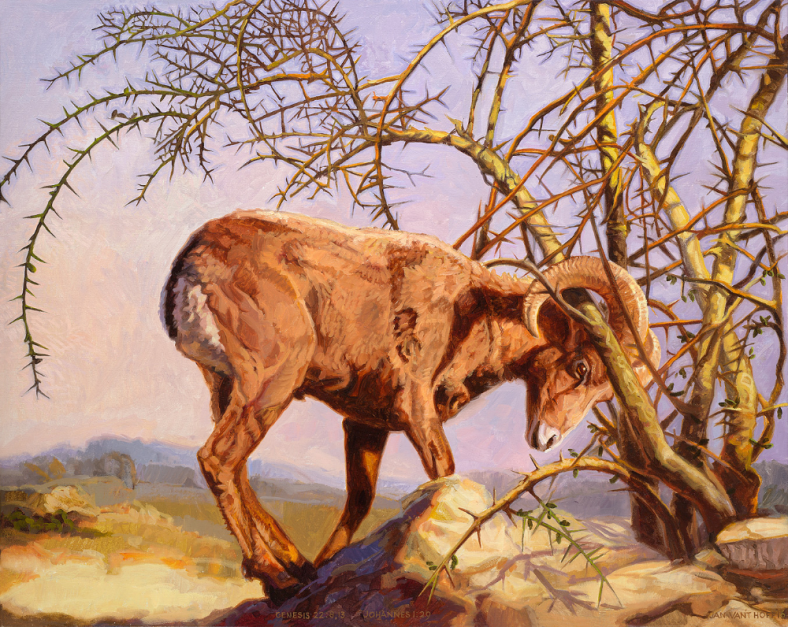
Which brings us back to the place name “The LORD will provide.”  After Abraham had bound his son Isaac, laid him on the wood and prepared to offer him as a burnt offering, God called out to him, saying “Do not lay your hand on the boy or do anything to him, for now I know that you fear God, seeing you have not withheld your son, your only son, from me.”[4]  Abraham then saw a ram caught in the bushes nearby, a perfect substitute for Isaac as a burnt offering!  Isaac was set free and the ram was sacrificed.  Dilemma resolved.  Then the place was named, but also, we read “as it is said to this day, “On the mount of the LORD it shall be provided.”

When the Bible says “as it is said to this day” it usually means until the day the passage was written down.  So, the saying “On the mount of the LORD it shall be provided” lasted until Moses wrote the book of Genesis.  But when and why did the phrase fall out of practice?  When reading this story, I thought this saying needs to be revived!  God still provides for us in amazing ways, but maybe not on Mount Moriah.

Does He provide for us whenever we want Him to?  Warren Wiersbe answers this question as: He provides for us “in the place of His assignment. Abraham was at the right place, so God could meet his needs. We have no right to expect the provision of God if we are not in the will of God.”

Abraham, in faith, knew that God would provide a solution to a seemingly offensive and impossible situation, and so He did.  But in our case, there are at least two ways we can fall short of obtaining God’s provision: one, we fail to follow His command because it doesn’t make sense to us, and two, we can expect Him to provide what we need for us even though we aren’t doing what He wants us to do.

What if God is asking us to do something that seems unwise financially, socially, or otherwise?  Maybe it doesn’t even make sense theologically, as it may not have to Abraham?  God wants to provide for us a way through that, a way to reward our faith and glorify Himself for our good.  But, if we aren’t willing to follow Him in that instance, we miss out on the blessing.

What if we feel like we’re missing out on some blessing and we don’t know why?  Maybe we don’t feel close to God, we don’t feel like He answers our prayers, we don’t feel like He loves us?[5]  It may be that He is asking us to do something and we aren’t following through.  We expect the blessings to flow at no cost to us.

If Abraham had not followed God’s command, he would have not been able to experience the amazing provision from God that led him to name the place “The LORD will provide.””  And sometimes if we aren’t walking with God in faith (or maybe not even spending enough time with God to know what He wants), we will never learn how He can provide.

What might God be asking you to do today?  Have you asked Him?  Follow Him and He will prove Himself faithful.  He will be glorified and it will be for your good.

Amen.


[1] I’m not aware of any place that still practices it, but I’m not an expert.
[2] Genesis 26:4
[3] Genesis 22:4
[4] Genesis 22:12
[5] I don’t mean to minimize the fact that some people just won’t feel good for medical reasons, such as clinical anxiety or depression.  Sometimes there are other factors at play that need to overcome in other ways.