An ACTS Prayer

Dear fellow travelers,

There are many ways to pray, and my personal prayers are generally highly improvised, but recently something different happened.  I very rarely write (or type) out prayers, but when I was organizing a file of verses I have, I realized a sequence of them made a good prayer outline, even following the ACTS outline I learned many years ago: Adoration, Confession, Thanksgiving, and Supplication.

The prayer is below.  The parts in quotes are adapted from the Scriptures in the footnotes, and the parts between are where we can “improvise”, but I found that the quoted parts help create a good frame of mind for the parts in between.

The Psalm 16 reference might need some explanation.  The Psalm, written by David, references the assignment of land in Canaan among the 12 tribes of Israel.  Numbers 26:56 says, “Their inheritance shall be divided according to lot between the larger and the smaller,” while the “lot” was probably something like a modern “roll of the dice.”  The verses quoted in this prayer recognize that although our circumstances, our “lot in life” are not random outcomes but chosen by our Creator.  Therefore, whatever our “lot” is, we can be thankful for it, and we can also know that our future “lot,” the things we ask for, are in His hands.

Feel free to use this yourselves and I hope it blesses you as it has me!

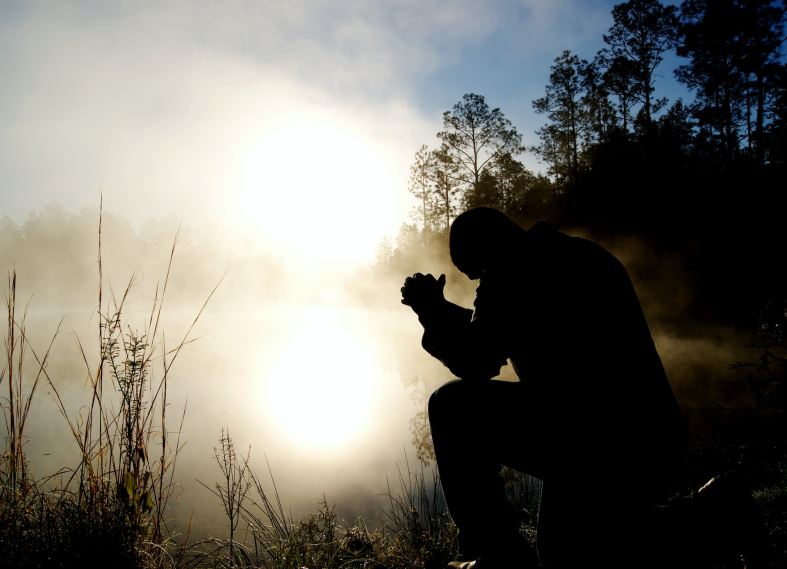
Photo by Gift Habeshaw on Unsplash

Adoration
“You are the LORD, you alone. You have made heaven, the heaven of heavens, with all their host, the earth and all that is on it, the seas and all that is in them; and you preserve all of them; and the host of heaven worships you.”[1]

Add your own prayers of praise!

Confession
“You are the LORD, a God merciful and gracious, slow to anger, and abounding in steadfast love and faithfulness[2]
Your steadfast love never ceases; your mercies never come to an end;
they are new every morning; great is your faithfulness.”[3]

Confess to the Lord, knowing that He is merciful and faithful!

Thanksgiving & Supplication
“You are my chosen portion and my cup; you hold my lot.
The lines have fallen for me in pleasant places; indeed, I have a beautiful inheritance.”[4]

Thank the Lord for what He has provided for you,
then put your petitions before Him!

Closing
“I bless the LORD who gives me counsel;
            in the night also my heart instructs me.
I have set the LORD always before me;
            because you are at my right hand, I shall not be shaken.

Amen”[5]


[1] Nehemiah 9:6
[2] Exodus 34:6
[3] Lamentations 3:22-23
[4] Psalms 16:5-6
[5] Psalms 16:7-8

Why We Pray

Why do Christians pray, and why should they pray?  We probably pay a lot more attention to what we are praying than why, and maybe sometimes we don’t pray because we don’t think its necessary.  This may happen when we don’t know the why.

There are many reasons (many “whys”) we could think of for why Christians should pray, and here are some:

Do we pray to tell God what we want or need?  No, because the Bible tells us[1] that God already knows what we need.  He already knows everything, including knowing what we need better than we do, as our Creator.

Do we pray to convince God we are worthy and deserve His audience?  No, because on our own we are unrighteous sinners and only deserve separation from God.  Jesus has already accomplished everything we need to be able to approach God.

Do we pray so that God will love us more?  No, God’s love is based on His own character, not our actions.  He can’t love us more, and won’t love us any less, than He does.  That He gave His Son to die on the cross for us proves this.

So, why?

Before teaching His disciples how to pray using what we now call the Lord’s Prayer, Jesus said to them: “Pray then like this.[2]  We often think of the Lord’s Prayer as instruction on how to pray, but maybe miss that Jesus told His disciples to pray.  It’s something He wants us to do, and regularly.

We pray because Jesus tells us to.  “Pray then like this” said Jesus because God desires a relationship with us and a big part of that relationship should be time spent in prayer.

Thomas Becon, an English cleric and Protestant reformer in the 1500’s, wrote this about prayer[3]: “For God neither for our worthiness nor for our unworthiness heareth us; but for his commandment and promise sake. He hath commanded us to pray; therefore ought we to pray. For if we should never pray till we were worthy of ourselves before God to pray, so should we never pray: but we therefore pray, because God hath commanded us so to do. Our worthiness is the humble confession of our unworthiness; and our obedience unto the commandment of God to pray maketh us most worthy.”

Therefore, pray, and often.

Pray without ceasing” – 1 Thessalonians 5:17


[1] Matthew 6:8, 6:32, Luke 12:30
[2] Matthew 6:9a
[3] McKim, Donald K.  Everyday Prayer with the Reformers (2020).  P. 65.

Prayer: A Quint of Quotes

Dear fellow travelers,

Here is another “Quint of Quotes” with some of my favorites on prayer, plus a bonus verse:

“Prayer is not getting man’s will done in heaven; it is getting God’s will done on earth” – Robert Law

“Pray as though everything depended on God, and work as though everything depended on you.” – Saint Augustine

“Do not pray for tasks equal to your powers.  Pray for powers equal to your tasks.” – Phillips Brooks

“We may be certain that whatever God has made prominent in His Word, He intended to be conspicuous in our lives.” – Spurgeon, on Colossians 4:2

“To be a Christian without prayer is no more possible than to be alive without breathing.” – Martin Luther

“Pray without ceasing” – 1 Thessalonians 5:17

There Goes John Bradford (to Paradise): History for February 24

Born in 1510, John Bradford was a rising Protestant minister during the reign of King Edward VI in England and was well known for his pious dedication and unselfish nature.  After studying at Cambridge and preaching regularly around London, he was appointed as Chaplain to the King in 1551.  The common expression “There but for the grace of God go I” is often attributed to him and was a reminder to himself that grace alone has saved him.  An 1822 book on prayer says that:

“The pious Martyr Bradford, when he saw a poor criminal led to execution, exclaimed, ‘there, but for the grace of God, goes John Bradford’. He knew that the same evil principles were in his own heart which had brought the criminal to that shameful end.”[1]

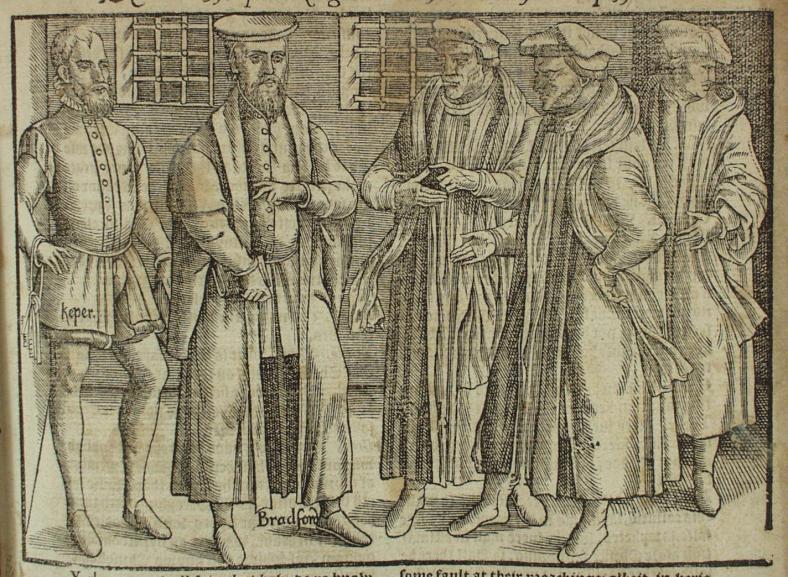
Bradford and others in the Tower of London, from John Foxe’s Book of Martyrs (1563). Public Domain.

His worldly fortunes changed in 1553 when the Catholic Mary I became Queen, and one of her first priorities was persecution of prominent Protestants.  Bradford was arrested within a month, imprisoned in the Tower of London, and sentenced to death.  While in the Tower, he wrote a letter to his mother on this date, February 24, in 1554, that included a powerful statement about prayer: God “doth put off our prayers, that he might recompense it with abundance, that is, that he might more plentifully pour upon us the effect of our petitions.” [2]  On July 1, Bradford was burned alive at the stake.

In another book on prayer, Donald McKim wrote about Bradford’s letter:
“We can imagine that no one would seek an answer to his prayers more ardently than Bradford while awaiting death. Yet he believed that even with no apparent answers to prayers, God plentifully pours abundance on those who pray!
At the end of his letter Bradford mentions God’s promise-which believers receive and anticipate, even in the midst of their sufferings and afflictions. Paul recorded the promise: “What no eye has seen, nor ear heard, nor the human heart conceived, what God has prepared for those who love him” (1 Cor. 2:9) Plentiful abundance! Now and forever!”[3]

In John Bradford’s story, there is a terrible irony between two things he is known for – a common phrase and his martyrdom – but in the end, God is faithful, and I hope to meet Bradford someday in Paradise, where the grace of God has bought me a place.


[1] Bickersteth, Edward.  A Treatise on Prayer.  (1822).  Sourced from https://en.wikipedia.org/wiki/John_Bradford
[2] McKim, Donald K.  Everyday Prayer with the Reformers (2020).  P. 92.
[3] Ibid.

Daily Readings for February 23 – March 1

Fellow travelers:

For those looking for a Bible reading plan, each week in 2026 I will post 2 chapters to read per day as a main reading plan, and for anyone who wants to read the whole Bible in 2026, I’ll post the extra chapters to read that week.  The main readings will include nearly all of the New Testament, plus Psalms, Proverbs, Ecclesiastes, the Prophets, and a few other Old Testament books.

Reading 3 chapters a day on weekdays and 4 on weekends almost exactly covers the 1,189 chapters of the Bible, so the “extra” readings will be about 9 chapters per week.  These readings will cover the Pentateuch, the OT histories, a few other OT books, plus Jude and Revelation from the NT.

I hope this encourages others to read and study their Bible more, whatever parts they decide to read.  Follow along (or not) any way you choose!

2 chapter a day plan:

Monday, February 23: Psalm 54, Mark 14
Tuesday, February 24: Psalm 55, Mark 15
Wednesday, February 25: Psalm 56, Mark 16
Thursday, February 26: Psalm 57, Song of Solomon 1
Friday, February 27: Psalm 58, Song of Solomon 2
Saturday, February 28: Psalm 59, Song of Solomon 3
Sunday, March 1: Psalm 60, Song of Solomon 4

Extra chapters for those reading the whole Bible in 2026:
Exodus 20-28