To Us a Child is Born

In response to a reader suggestion, I’ve figured out what Bible verses are quoted the most here and am writing a series about those verses.  Today’s post is #2 of the series, covering the verse quoted the 2nd least out of the 10 most quoted, Isaiah 9:6.

For to us a child is born,
            to us a son is given;
and the government shall be upon his shoulder,
            and his name shall be called
Wonderful Counselor, Mighty God,
            Everlasting Father, Prince of Peace.

This verse makes the most-quoted list because I of a Christmas series about it inspired by James Boice, who compared the 4 names Christ is called in this verse to Christmas gifts we can all have.  “Four gifts for Christmas. They are the greatest gifts that anybody can give or we can have, and they are all in Jesus. They are for us. They are for you, if you will have them.”

Boice speculated that if we took a poll (and people were honest), we could find out that people’s deepest needs are wisdom, the power to do what is right, satisfying relationships, and reconciliation with God and others through forgiveness.  Then we’d realize that the 4 aspects of Christ from Isaiah 9:6 would meet those deepest, most significant needs, like this:

            As Wonderful Counselor, He is our source of wisdom;
            As Mighty God, He will empower us to live as He did;
            As Everlasting Father, He invites us with unconditional love into His family;
            As Prince of Peace, He buys peace between us and Him, and between us and others.

Because Jesus came and lived and died for us, we can have all of these things because He offers them to us as a free gift to those who accept Him.  So, Christmas may have already passed, but Jesus still lives and is the fulfillment of Isaiah’s prophecy:

For to us a child is born,
            to us a son is given;
and the government shall be upon his shoulder,
            and his name shall be called
Wonderful Counselor, Mighty God,
            Everlasting Father, Prince of Peace.

Regardless of the season, we can be thankful for all that God has given us in Christ.

Amen.

My Favorite Christmas Song

People have strong opinions about Christmas music, like when is the right time to begin listening to it.  Personally, I like to have a long Christmas season but also don’t want to distract from other good holidays like Thanksgiving, so for me the right time is once Thanksgiving is done.  I have a Christmas playlist on my phone of my favorites and its playing regularly when I drive around or while I’m wrapping presents or putting up the tree.

People also care a lot about which songs to listen to, sometimes in strange ways.  A tradition we have every year (mainly because of my kids) is called “Whamaggedon.”  What’s that?  It’s a contest to see how long you can go without hearing “Last Christmas” by Wham.  Apparently, lots and lots of people play this and the winner(s) is the one who gets to Christmas without hearing it.  Not that it’s a bad song, but it’s just a fun thing to do in the holiday season.

There are a lot of things to like about Christmas music, even if it’s enjoying goofy songs like Frosty the Snowman or watching the Charlie Brown Christmas special on TV.  But when it comes to genuine Christmas carols, we all have our favorites.  Mine is a beautiful, simple song with a great theme of humility, a trait we can all appreciate during Christmas.

This carol imagines that, in addition to the 3 Magi, the baby Jesus also had other visitors who came to worship Him, including a “Little Drummer Boy.”  You can read the lyrics here, or watch the video below, a version performed by for KING and COUNTRY.  Generally, the simpler the version of the song, the better in my opinion.

Why do I like this carol so much?

Most of us aren’t like the Magi who travelled far and gave expensive gifts to the baby Christ.  We don’t have much gold, and we probably don’t keep frankincense and myrrh laying around.  If the Magi were recognized for bringing these lavish gifts in eternal Scripture, how can we measure up?  Is their example too hard for us to follow?  How can we adequately worship Jesus?  Little Drummer Boy answers these questions.

We can all identify with the boy because what he has to offer Jesus is something we can all offer: whatever we happen to have.  The Little Drummer Boy gives us assurance that if we offer what we have, whatever we have, to our King Jesus, He will accept it.  In the song, when Jesus smiles at the boy at the end of the song, we are all reminded that “There is therefore now no condemnation for those who are in Christ Jesus.” (Romans 8:1)

The Little Drummer Boy shows us that “God opposes the proud but gives grace to the humble” (James 4:6, 1 Peter 5:5).  Humility doesn’t mean thinking of oneself as worthless or inferior to others.  Humility means thinking of yourself in the proper place, a miserable sinner who is nonetheless loved by God and who God will use for His glory and will bring to perfection in eternity.  As the great Lion Aslan said in C.S. Lewis’ Prince Caspian, “You come of the Lord Adam and the Lady Eve. And that is both honor enough to erect the head of the poorest beggar, and shame enough to bow the shoulders of the greatest emperor on earth.”  Humility involves having the proper balance between shame and grace, with grace ultimately victorious.

This is why I wrote earlier that the simpler the version of this song, the better.  Just about anyone can tap out “rum pa pum pum” on a drum and identify with the little boy, but not everyone can perform the more elaborate cover versions of the song and to me that dilutes the beautifully simple lesson of the song: whatever you have, however little of it you have, offer it to Jesus and He will smile at you.  He will accept your worship, no matter how imperfect.  To Jesus, it’s not what you have that matters, but what you do with it.  You can be a beggar or an emperor, but with the right attitude toward Jesus our King, anyone can experience salvation and eternal life, gifts infinitely greater than anything on this earth and therefore infinitely greater than anything we have to offer Him.

So, whatever your particular “drum” is, pay Jesus a visit and play it for Him this Christmas and in the coming year!  Offer to Him whatever you have and see what happens!

Presents of Presence: A Holiday Quint of Quotes

Dear fellow travelers,

With mere days remaining until Christmas, here is a Quint of Quotes, five sayings for the holidays!

“Attention is the rarest and purest form of generosity” – Simone Weil

“The highest form of knowledge is empathy, for it requires us to suspend our egos and live in another’s world” – Plato

“When given the choice between being right or being kind choose kind.” – from the book Wonder, by R.J. Palacio

Be kind to one another, tenderhearted, forgiving one another, as God in Christ forgave you.” – Paul, in Ephesians 4:32

“Strange, isn’t it? Each man’s life touches so many other lives. When he isn’t around he leaves an awful hole, doesn’t he?” – guardian angel Clarence Oddbody, in It’s a Wonderful Life

Merry Christmas to all my readers – first timers, occasional passersby, and a handful of regulars!

Jesus was Born to Overthrow King Herod, but How?

The story of Herod and the three wise men is familiar to most who celebrate Christmas.  After the birth of Jesus in Bethlehem, the wise men came looking for Him, having seen a star they believed signaled His coming.  Arriving in Jerusalem, they asked “Where is he who has been born king of the Jews? For we saw his star when it rose and have come to worship him.[1]  Word of this search made it to Herod, the then-current king of that region under Rome’s authority, and his first instinct was to eliminate what he saw as a threat to his own power.  In Herod’s eyes, only he was king of the Jews.

Herod came up with a simple plan: to use the wise men to help him find this threat.  “And he sent them to Bethlehem, saying, ‘Go and search diligently for the child, and when you have found him, bring me word, that I too may come and worship him.’”[2]  However, the wise men were warned in a dream not to return to Herod, so they went home after visiting Jesus.  “Then Herod, when he saw that he had been tricked by the wise men, became furious, and he sent and killed all the male children in Bethlehem and in all that region who were two years old or under, according to the time that he had ascertained from the wise men.”[3]

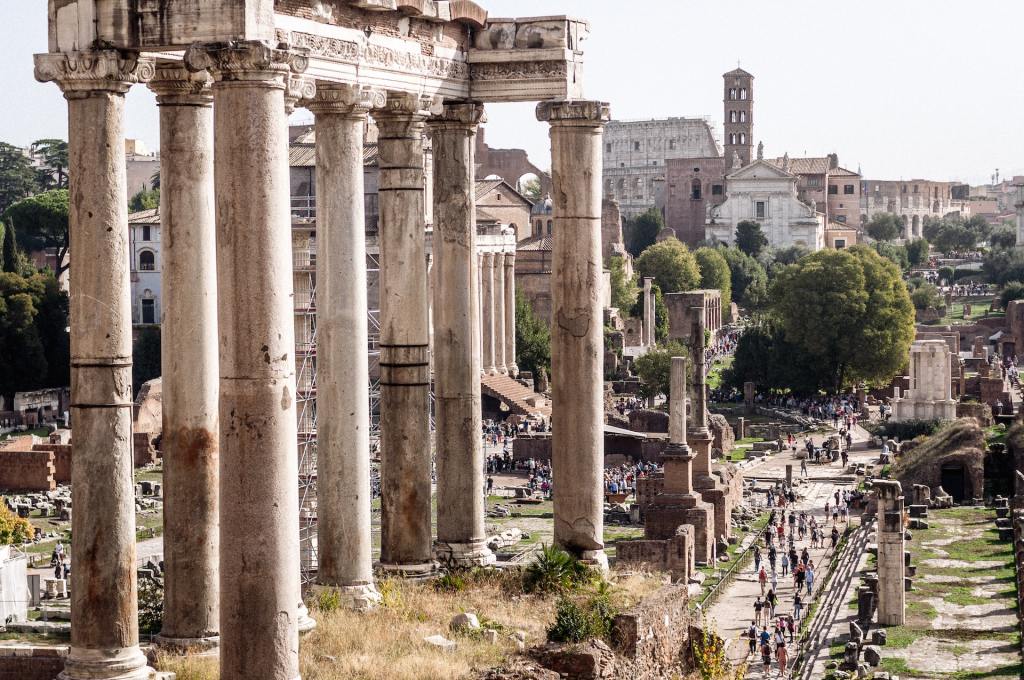
Herod believed so strongly in the necessity of the power of Rome and of his place in it that he was willing to commit mass murder.  If he couldn’t find the one child he wanted, he’d just kill them all.  He feared Jesus (or His followers) would overthrow him as king, and he was right but in the wrong sense.  Jesus would overthrow Rome.  He was born to overthrow every earthly kingdom – that is inevitable.

Much of Rome is already in ruins. Photo by Giu Vicente on Unsplash

Isaiah 40:17 proclaims that “All the nations are as nothing before him, they are accounted by him as less than nothing and emptiness.”  The word “emptiness” here is the Hebrew “bohu,” part of the phrase “tohu va’bohu” translated as “without form and void” in Genesis 1:2.  This phrase represents empty things with no eternal value or purpose.  So, while Isaiah doesn’t use the whole phrase from Genesis, he uses “less than” for emphasis instead.  When compared to God’s eternal purposes, all that every nation has ever devised and achieved is less than useless.  God has nothing to learn from our political and economic visions – He transcends them all.  No nation can or will accomplish what God has accomplished and will accomplish.

Therefore, Jesus’ other mission was to overthrow Herod’s dominion over Herod.  But Herod was determined to resist.  His heart was so hard that he preferred to hang on to a government willing to commit mass murder to preserve its own self-centered ways.  He thought he could preserve the façade of “Pax Romana,” the idea that worldly government can solve all of our problems, even while he, as an agent of Rome, was killing innocent children.  Herod saw it as in his own best interest, and in the interest of Rome, but this is one of many examples of “a way that seems right to a man, but its end is the way to death.”[4]

Jesus can overcome death only by overthrowing our views of our own “best interest” and what “seems right.”  He was not born and did not die and rise again just to overthrow Rome, but He came so we would have a way to overthrow ourselves and death itself.  Jesus will establish the only government that will matter in eternity: His Kingdom.  The soul of Herod, and of all of us, will outlive every society that ever existed, and ever will, on this earth.  The nations are all “accounted by him as less than nothing and emptiness.”  While Herod could find hope in Jesus if he wanted to, Rome itself never had any hope.

Therefore, the question Jesus asks all people is: Will we let Jesus overthrow us or will we, like Herod, go to great lengths to resist Jesus and try to preserve a world that is doomed to fail?

Isaiah 9:6 says “and the government shall be upon his shoulder.”  His Kingdom will be the only government we need, and He alone is uniquely qualified to establish and rule it.

For to us a child is born,
            to us a son is given;
and the government shall be upon his shoulder,
            and his name shall be called
Wonderful Counselor, Mighty God,
            Everlasting Father, Prince of Peace.”


[1] Matthew 2:2
[2] Matthew 2:8
[3] Matthew 2:16
[4] Proverbs 14:12, 16:25

The Savior Among Us

Behold, the virgin shall conceive and bear a son, and they shall call his name Immanuel” – Isaiah 7:14, Matthew 1:23

In the Gospel of Matthew, this verse from Isaiah is applied to our Lord Jesus.  The name Immanuel means “God with us” and the name Jesus means “the Lord saves.”  In these two names is a beautiful picture of salvation, which means a restoration to a life lived with God beginning imperfectly here on earth, but eventually perfectly in His paradise.  Salvation and togetherness go together.  What we are saved from is our inability to live with God because our sin and His justice were unreconciled until the cross.

Among Jesus’ last words on earth were His command to “make disciples of all nations” (Matthew 28:19).  Included in this is bringing the hope to the world that He brought to us by being present.  God did not leave us alone but bore the cost of our reconciliation on Himself.

Today, be among those who need the hope God provides through the salvation He bought.  His desire is to live among the world through us, calling His current and future people to live with Him.

Photo by Gareth Harper on Unsplash