Jesus’ Work Has Just Begun

The book of Acts, sometimes called the Acts of the Apostles, follows the four gospels in the New Testament and tells the story of the Christian church in its very early days.  Luke, who wrote one of the gospels to “Theophilus[1], is also the author of Acts, which he begins like this:

In the first book, O Theophilus, I have dealt with all that Jesus began to do and teach.

Note that word “began.”  Considering that the book of Luke ended with Jesus’ ascending into heaven[2], why does Luke write in Acts that Jesus “began to do and teach”?  Because what Jesus did before leaving earth was only the beginning.  Jesus’ activity in the gospels was only the start of His mission and story, and now He rules from the right hand of God the Father and continues to “do and teach” through His people by His Holy Spirit.  He will continue to do this for all eternity.

Therefore, Jesus is still personally active in the world.  Are you listening and learning through consistent prayer, Bible study and fellowship?  See what He will continue to “do and teach” through you and His church!


[1] Luke 1:3
[2] Luke 24:51

Weeds are Good for You

Are there people in the church, either in your own church, another local church, or somewhere in the global church, that seem a bit un-Christian?  Perhaps their doctrine is a bit different than yours, or perhaps they behave a bit differently.  Maybe they dress differently or have different standards in music.  They could have different political beliefs.  It could be anything.

Within a parable Jesus told in Matthew 13:24-30 is some wisdom about “those people.”  The parable is:

He put another parable before them, saying, “The kingdom of heaven may be compared to a man who sowed good seed in his field, but while his men were sleeping, his enemy came and sowed weeds among the wheat and went away. So when the plants came up and bore grain, then the weeds appeared also.  And the servants of the master of the house came and said to him, ‘Master, did you not sow good seed in your field? How then does it have weeds?’  He said to them, ‘An enemy has done this.’ So the servants said to him, ‘Then do you want us to go and gather them?’  But he said, ‘No, lest in gathering the weeds you root up the wheat along with them.  Let both grow together until the harvest, and at harvest time I will tell the reapers, “Gather the weeds first and bind them in bundles to be burned, but gather the wheat into my barn.”’”

For this post, the key phrase in the parable is “No, lest in gathering the weeds you root up the wheat along with them.”  The wheat in the parable represents God’s people, and the weeds represent unbelievers in the midst of them.  The servants ask the master whether they should pull up all the weeds immediately, which seems like a sensible thing to do.  Weeds are bad for crops, right?

The surprising response is that the servants should “Let both grow together until the harvest.”  Why?  Because in the master’s judgment it is better for the wheat if the weeds are allowed to grow.  In other words, removing the weeds before the harvest – when God will separate the wheat from the weeds – would be bad for the wheat harvest.  Until the harvest, the master warns that we could “root up the wheat along with them.”

In Matthew 25 where Jesus tells of the final judgment in verses 31-46, it’s strongly implied that some of the “wheat” will be surprised about being wheat and some “weeds” will be surprised about being weeds.  In verses 37-39 Christians say: “Lord, when did we see you hungry and feed you, or thirsty and give you drink?  And when did we see you a stranger and welcome you, or naked and clothe you?  And when did we see you sick or in prison and visit you?”  In verse 44, unbelievers say: “Lord, when did we see you hungry or thirsty or a stranger or naked or sick or in prison, and did not minister to you?

Therefore, if the wheat and the weeds themselves can be unsure which they are, how can anyone else definitively decide who doesn’t belong, especially to risk damaging those who do belong.  There will always be true and false believers in churches until Christ returns, so remember: According to the Master, the wheat is better off with the weeds than without.  Especially if sometimes what we think are weeds actually aren’t.
Bible in a Year: Week of March 18 – 24

Fellow travelers:

Below are the chapters to read this week if you’re following along in my Bible in a year schedule, divided into morning and evening readings.  Follow along any way you want: just do the evening reading, flip the morning and evening, read it all.  Whatever works for you and your schedule!  It doesn’t have to be Bible in a Year for everyone.

This week we finish 2 Kings and begin 1 Chronicles.  After the 2 Chronicles books, we move to Ezra and Nehemiah, then on to the New Testament, starting with the gospel of Matthew.

Monday, March 18
Morning: Psalm 78, 2 Kings 23
Evening: Exodus 28

Tuesday, March 19
Morning: Psalm 79, 2 Kings 24
Evening: Exodus 29

Wednesday, March 20
Morning: Psalm 80, 2 Kings 25
Evening: Exodus 30

Thursday, March 21
Morning: Psalm 81, 1 Chronicles 1
Evening: Exodus 31

Friday, March 22
Morning: Psalm 82, 1 Chronicles 2
Evening: Exodus 32

Saturday, March 23
Morning: Psalm 83, 1 Chronicles 3-4
Evening: Exodus 33

Sunday, March 24
Morning: Psalm 84, 1 Chronicles 5-6
Evening: Exodus 34

Time to Build the Church

What’s more important, your house or God’s?

Haggai was a prophet during the time shortly after the end of the Babylonian exile.  His main focus was encouraging the people to complete the rebuilding of the Temple, which had been destroyed at the beginning of the exile, in 586 B.C.  After returning to Israel, the people had become lazy and complacent about God’s house, the Temple, saying “the time has not yet come to rebuild the house of the LORD,[1] and made excuses not to rebuild it.  But Haggai challenged them, in true prophetic fashion, asking “Is it a time for you yourselves to dwell in your paneled houses, while this house lies in ruins?[2]  The problem was that the people took great care of their own houses with fancy paneling, yet weren’t concerned that the Temple was still a ruin.  “The time has not yet come,” they said.

Haggai told the people: “Go up to the hills and bring wood and build the house, that I may take pleasure in it and that I may be glorified, says the LORD.”[3]  This would involve a lot of hard work, God knows what it takes to build His Temple, and He also knows that it needs to be done and should be a priority.

Today, the equivalent of the Temple is the body of believers known as the church.  1 Peter 2:5 says, “you yourselves like living stones are being built up as a spiritual house, to be a holy priesthood, to offer spiritual sacrifices acceptable to God through Jesus Christ.”  God’s goal for the church is to perfect it in Jesus’ likeness, therefore no matter what condition the church is in here, it always needs to be built up.  We may be tempted to say “the time has not yet come” because we won’t be perfected until eternity, but He says ““Go up to the hills and bring wood and build the house, that I may take pleasure in it and that I may be glorified, says the LORD.”

Building the church (God’s house) may feel as difficult as climbing hills, gathering and transporting wood from forests to build a literal, physical Temple.  It’s not easy and we shouldn’t expect it to be.  But God will build His church and He wants our help.

When writing of our diverse spiritual gifts, Paul wrote in 1 Corinthians 14:12 – “So with yourselves, since you are eager for manifestations of the Spirit, strive to excel in building up the church.” Has the time come to build His church?  Yes, it has.

Strive to excel.”


[1] Haggai 1:2
[2] Haggai 1:4
[3] Haggai 1:8

The Body of Christ is Irreducibly Complex

Among the various camps in the debate between creation and evolution is a set of ideas called intelligent design (ID).  A key part of ID is “irreducible complexity,” a term that comes from the book Darwin’s Black Box, by Lehigh professor Michael Behe.[1]

In short, irreducible complexity argues that evolution by chance, without an intelligent designer driving it, is unreasonable because the multiple systems in a complex organism like a human body – circulatory, digestive, endocrine, muscular, respiratory, and so on – are all interdependent on each other.  The circulatory system alone, with the heart pumping blood through an elaborate system of arteries and veins, is difficult to imagine developing by chance occurrence, but a chance evolution of that system alongside all the other parts it is dependent on is even more far-fetched.  All systems evolving together in lockstep without failing is a much more difficult problem to explain scientifically without a Creator.  The circulatory system takes what the respiratory and digestive systems take in and deliver it to the other systems that use it.  Without the other parts, it has no function and cannot survive and further evolve.

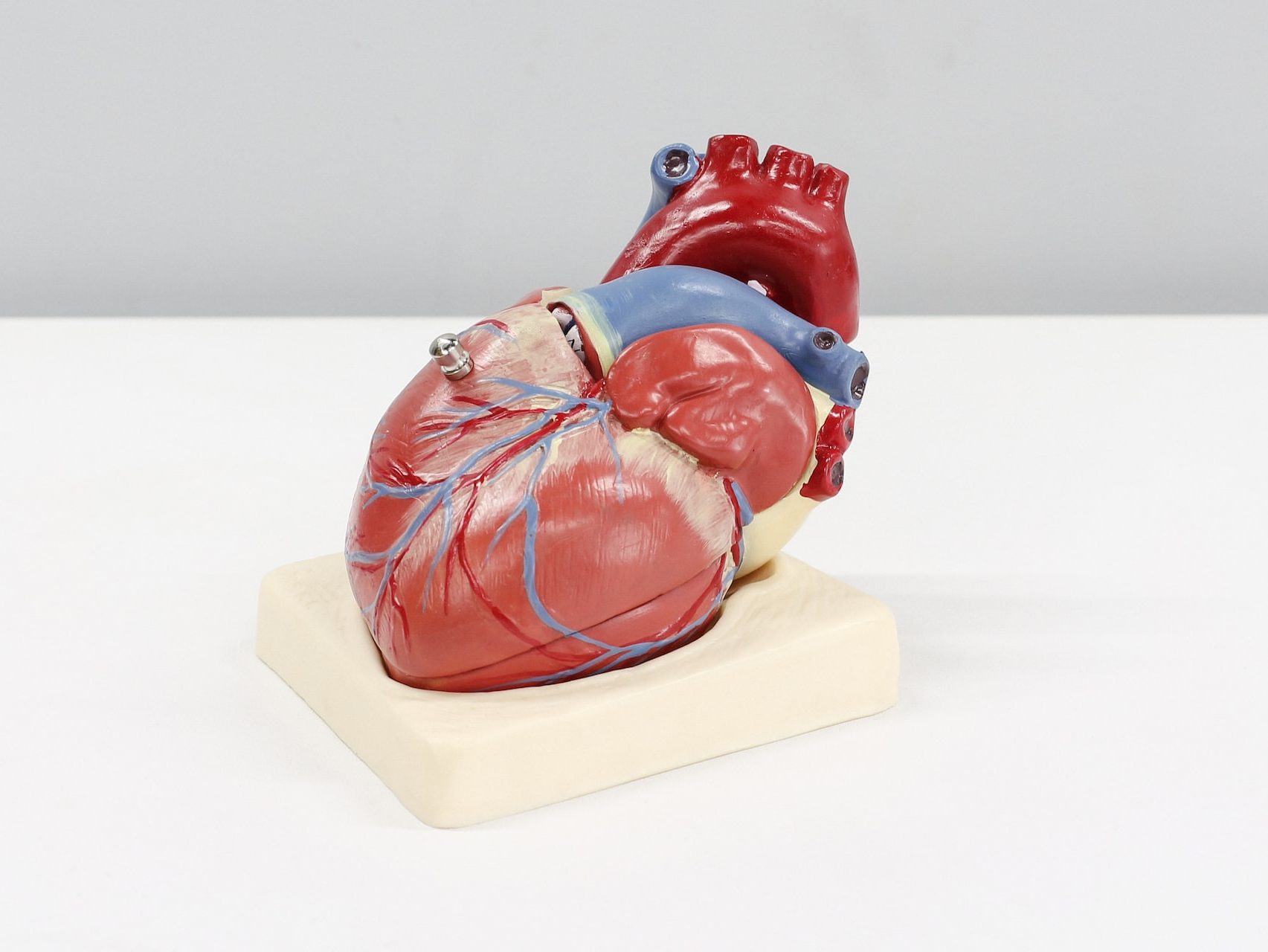
An isolated, inanimate, heart. Photo by Ali Hajiluyi on Unsplash

However, my intent here is not to prove intelligent design, but to consider the apostle Paul’s words about the church as the body of Christ.  In 1 Corinthians 12:12, he wrote: “For just as the body is one and has many members, and all the members of the body, though many, are one body, so it is with Christ.”  He continues that no part of the body can say it is not a part of the body because it has a different function than another part (1 Cor. 12:15-16), and also that no part of the body can say it doesn’t need all of the other parts (1 Cor. 12:21).  Those who are in Christ Jesus cannot be divided.

Paul follows his description of the body with 1 Corinthians 13, a powerful statement on the supremacy of love, and in context a gentle rebuke to the idea that a body can survive as individual, unrelated units.  In a human body, any part can only survive by serving the other parts.  Even an organ as incredibly complex and important as a heart cannot survive if it decided to pump blood only for itself.  Where would it get its nutrients?  How would it flee from danger?  As Paul wrote: “If the whole body were an eye, where would be the sense of hearing? If the whole body were an ear, where would be the sense of smell?” (1 Cor. 12:17).  Even an organ as important as the heart is useless in isolation.  It gets its very life and purpose by what it does for the body.

As Jesus said to His disciples in John 13:34-35 – “A new commandment I give to you, that you love one another: just as I have loved you, you also are to love one another.  By this all people will know that you are my disciples, if you have love for one another.

As the song says, they will know we are Christians by our love, and the church Jesus came to build is irreducibly complex.  There is no appendix[2] in the church, which is the body of Christ.


[1] Behe, Michael.  Darwin’s Black Box (1996).
[2] While we commonly think of this organ as useless, God as our Maker didn’t put it there by accident.