The Priorities of the Good Samaritan

The parable of the Good Samaritan is well-known, even by those who aren’t Christian.  Briefly, it goes like this: a man is robbed, beaten, and left for dead on the side of a road.  First a priest, and then a Levite, passed him by, offering no help at all.  But a Samaritan, a member of a group despised by many Jews, stopped and helped the man, even bringing him to further help and paying the necessary expenses.

There is a lesson in the story about priorities – what this Good Samaritan put first, and what he didn’t.  But before covering his #1 priority, here are some things he did not prioritize, even though these aren’t necessarily bad things:

His first priority was not to fight for stricter laws against robbers.  What the robbers did was probably already illegal, and definitely not morally right.  We don’t know the fate of the robbers in the story, but they might have gotten away with this near murder.  In modern times, if criminals are getting away with bad behavior, a movement sometimes grows to make something that is already illegal “more illegal.”  If robbing is against the law, some might lobby to make the punishment harsher, or to focus laws on particular victims or perpetrators, but if they’re getting away with it now, how will these changes help?  The Good Samaritan couldn’t do much about this immediately, so it wasn’t his first priority.

His first priority also was not to raise public awareness of violence along the highways.  He didn’t create posters and social media hashtags (I write as if those things existed then).  Such a campaign can have benefits.  It could help people be more careful when traveling, it might encourage the government to allocate more of its limited resources toward highway safety, but it will never completely solve the problem. The Good Samaritan couldn’t do much about this immediately, so it wasn’t his first priority either.

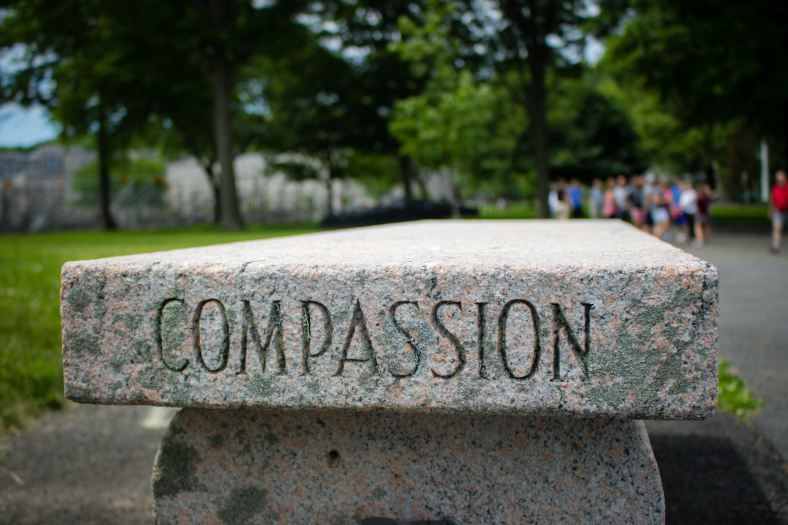
Photo by youssef naddam on Unsplash

So, what was the Good Samaritan’s priority?  He focused on what he could control, and any other concerns came later.  He focused on the problem right in front of him – a man beat up and near death on the side of the road.  Sometimes we can focus so much on advocating, that we lose sight of doing.  (I worry about that for myself as someone who spends so much time blogging.)  But the Good Samaritan “proved to be a neighbor[1] by taking care of the neighbor right in front of him.

We can also be deluded into thinking that our government and other institutions should be able to solve all of our problems if only we fight hard enough for it.  However, they never will be enough, because any and all institutions are made up of people who too often deny their own responsibility for the problems of the world. Especially on social media, we often get the illusion that we can offload our responsibility for the world to others, and that what’s happening somewhere else is more important than what’s right in front of us.

While advocacy can be a good and necessary thing, God wants us to prioritize doing, which is what everyone in heaven will do!  In heaven, everyone will be like the Good Samaritan (and like Jesus), and therefore we won’t need better laws, awareness campaigns powered by advertising and hashtags, or stricter enforcement of laws.  The bloody victim by the roadside won’t exist.  And that is something to look forward to!

In the meantime:
“I think each village was meant to feel pity for its own sick and poor whom it can help and I doubt if it is the duty of any private person to fix his mind on ills which he cannot help. This may even become an escape from the works of charity we really can do to those we know. God may call any one of us to respond to some far away problem or support those who have been so called. But we are finite and he will not call us everywhere or to support every worthy cause. And real needs are not far from us.” – C.S. Lewis


[1] Luke 10:36

A Mystery in the Good Samaritan Parable

The parable of the Good Samaritan is well-known, even by those who aren’t Christian.  Briefly, it goes like this: a man is robbed, beaten, and left for dead on the side of a road.  First a priest, and then a Levite, passed him by.  But a Samaritan, a member of a group despised by many Jews, stopped and helped the man, even bringing him to help and paying the necessary expenses.

There’s a great contrast made between these people, but another interesting question is what they have in common in the story: they are all identified by their cultural “tribe.”  This brings up another interesting contrast: the man, left bloodied on the side of the road, was not identified as anything other than a “man,” or broadly, a human being.  The only thing we know about this person is that “he fell among robbers, who stripped him and beat him and departed, leaving him half dead.[1]  What else was there to know?

By not defining this person, Jesus was not letting His audience limit their responsibility.  According to the Reformation Study Bible: “First-century Jews had various ideas about who was included in the category of ‘neighbor,’ whether marking its boundaries by community or clan affinities or by religious party affiliation (a Pharisee’s neighbors would be other Pharisees). Yet at its widest extent, the circle of ‘neighbors’ was confined to Israel.”  In short, the Jews were using tribalism to exclude people from the definition of neighbor, in a similar way people use concepts like intersectionality to include people over others today, but in the Good Samaritan parable, nobody is excluded.

To Jesus, the identity of the victim is not relevant – the neighborly thing to do isn’t to help because of who the person is (whether they belong to your own clan or tribe), but because they are a person – made in God’s image – who is hurt.  In other words, if there’s a bloody man on the road in front of you, don’t say God didn’t require you to deal with it because the man is not your neighbor, by some narrow definition.

Photo by Dave Lowe on Unsplash

Jesus was making the broadest interpretation possible.  When we consider the situation of each person on Earth – damaged by sin, robbed of their dignity, and left for spiritual death – isn’t everyone like this man by the side of the road?

While we can’t expect to help every hurting person we see, the message Jesus wanted us to hear by not identifying this victim is that we shouldn’t have any pre-defined rules about who is our neighbor when obeying the command: “You shall love your neighbor as yourself.[2]  Too often we create moral shortcuts about who to care for or not to care for, based on whatever our culture or group of friends agree on, allowing us to ignore obvious problems right in front of us.

If you find someone beat up and bloody on the side of the road, literally or metaphorically, help them if you can.  No matter who they are.  No shortcuts or pre-defined rules are allowed.


[1] Luke 10:30b
[2] From Matthew 22:39

Separating Good and Evil

Daily writing prompt
Do you have a quote you live your life by or think of often?

Today’s post is responding to a writing prompt: “Do you have a quote you live by or think of often?”  The most influential quote to me is this one from Aleksandr Solzhenitsyn:

“The line separating good and evil passes, not through states, not between political parties either, but right through all human hearts.”

Much of the conflict in history, and in modern times, comes from a human tendency to group people into separate groups, where one is “evil”, and the other is “good.”  There are probably thousands of examples throughout history, but some that come to mind are religious categories like Catholic versus Protestant, political categories like Republican versus Democrat, or Marxist categories like “oppressed” versus “oppressor.”  Humanity follows a pattern over and over again, where we lump people into categories, then attack our enemies accordingly.  If someone belongs to the “other” group, they are evil, and if someone belongs to our own group, they are good.

In opposition to this, the Solzhenitsyn quote calls to attention Romans 3:23, which declares: “for all have sinned and fall short of the glory of God.”  This verse, and the quote, tear down the idea that people can be easily separated into “good” and “evil.”  That nations can be divided into good and evil.  That political parties can be categorized as good and evil.  Because every single person included in every single one of these categories is themselves a mix of good and evil, each of the groups themselves is a mix of good and evil.

Therefore, the quote calls us to treat people as individuals, dealing with them according to their specific situation and needs.  Without accepting that each person is imperfect (at best), societies may pretend to treat people as individuals, but they’re really stereotyping people according to their groups and pitting them in battle against each other.

For the Christian church, the quote doesn’t demand that we withdraw from politics altogether, but it does demand that we act with more compassion toward those we disagree with.  All too often, and especially on social media, we see category-based name calling and condemnation coming from Christians who categorize people and work hard to defeat those enemies that belong to other groups.

However, Jesus said in Matthew 5:43:
You have heard that it was said, ‘You shall love your neighbor and hate your enemy.’  But I say to you, love your enemies and pray for those who persecute you.

Imagine if we followed Jesus’ words.  Imagine if everyone could be humble based on the evil that lives within them, and therefore treat the people who we view as evil as equals before God, and just as in need of grace as we are.  The church, and the world, would be much better off if Christians were as good at loving their enemies as they are at identifying them.

Therefore, a quote that drives a lot of what I think, write, and do is this one:

“The line separating good and evil passes, not through states, not between political parties either, but right through all human hearts.”

The God Who Puts Food on the Table

There are many reasons to praise God, many ways that He blesses us.  One of these is given in Psalm 111:5, and it’s something we shouldn’t take for granted:

He provides food for those who fear him;
            he remembers his covenant forever.

While this may be a reference specifically to God providing manna and quail to the Israelites when they wandered in the wilderness, it applies more broadly to any food provided to anyone at any time.  Therefore, we should praise Him whenever we have something to eat.

But He doesn’t just deliver food from the grocery store to us.  He provides everything required for food to exist in the first place.  He designed everything involved in the growth of what we eat.  Sunlight, rain, soil conditions and nutrients, all have a role in the growth of fruits and vegetables.  All of these roles act the way they need to be by design.  Food doesn’t exist by change and is not an accident of a blind nature.

Then add what’s needed to produce the meat we may eat.  First, those plants need to contain what animals need to eat and grow.  The animals need to be able to not only digest those things, but then to turn them into something edible for us.  Again, all ordained by God, the intelligent creator of our universe, who “provides food for those who fear him.”

Also, He is not only a God who designs and provides, but a God of mercy, “For he makes his sun rise on the evil and on the good, and sends rain on the just and on the unjust.”[1]  He provides food even for those who do not praise Him and give thanks to Him, so they might come to know Him by His mercy towards them.

Those who fear God, praise and thank Him for the food He provides, the complexity of the world He designed, and His mercy toward all His people.  But also, to reflect His character, provide food for those in need, showing them the mercy and love of the God who puts food on our tables.

He provides food for those who fear him;
            he remembers his covenant forever


[1] Matthew 5:45b

Compassion is More Than Skin Deep

Many miraculous healings are highlighted in the four gospel records of Jesus’ ministry, and many point to a greater miracle: that God, in His mercy and compassion, heals us of the sin that divides us from Him and each other.  Today’s post will focus on a miracle recorded in Mark 1:40-42, where Jesus heals a leper:

And a leper came to [Jesus], imploring him, and kneeling said to him, ‘If you will, you can make me clean.’  Moved with pity, he stretched out his hand and touched him and said to him, ‘I will; be clean.’  And immediately the leprosy left him, and he was made clean.

There is more to this story that Mark didn’t write.  What’s missing?  Jesus pointing out that this leper is breaking Old Testament law. 

In Leviticus 13:45-46, Moses wrote that: “The leprous person who has the disease shall wear torn clothes and let the hair of his head hang loose, and he shall cover his upper lip and cry out, ‘Unclean, unclean.’  He shall remain unclean as long as he has the disease. He is unclean. He shall live alone. His dwelling shall be outside the camp.

Because the kind of leprosy referred to in Leviticus and Mark was highly contagious and possibly deadly, this weird ritual was required to prevent accidental transmission of disease, but this particular leper couldn’t stay away from Jesus, and because Jesus was surrounded by crowds, the leper was potentially putting others in danger.  Mark doesn’t write that Jesus was concerned about this.

But the leper wasn’t entirely at ease, doubting whether Jesus would condemn him as an outcast and lawbreaker, or heal him.  What he did not doubt was that Jesus was capable of healing him, as he said to Jesus: “If you will, you can make me clean.”  To this leper, it was a question of whether this religious leader would be willing to help him.  He probably spent a lot of time being told to go away because of his disease; to follow the Levitical law.  Perhaps even now, in modern times, some might be curious about God’s power, but see religious people as uncaring and unwilling to help someone who is so obviously diseased and sinful.  Perhaps they are uncaring because other people are so obviously diseased and sinful.

In Leviticus chapter 13 there are also rules about how to identify a leper, and it’s usually when the symptoms are “deeper than the skin.” (See Leviticus 13:3, 20, 25, and 30). From this phrase, Warren Wiersbe notes in his commentary on Mark chapter 1 how leprosy is an apt metaphor for sin: “Like sin, leprosy is deeper than the skin (Lev. 13:3); it spreads (Lev. 13:5–8); it defiles and isolates (Lev. 13:44–46) …Anyone who has never trusted the Savior is spiritually in worse shape than this man was physically.”[1]

Not only can diseases be more than skin deep, but inner sin can be more dangerous and contagious.  As Jesus taught in the Sermon on the Mount, murder is an outward manifestation of inner anger[2], and adultery is an outward manifestation of inner lust[3].  Sins “deeper than the skin” may be the most important sins because they are the root of the visible external sins.

Fortunately, like inner sin and like leprosy, God’s compassion is also more than skin deep.  In Mark 1:41, the phrase “moved with pity” is a translation of a Greek word that suggests not just a passing feeling or sentiment, but something you literally feel in your guts.  The Greek word appears only 12 times in the New Testament, and always referring to Jesus or God the Father.  You might say that Jesus’ compassion for the leper was so powerful that He felt the leper’s pain in his own gut and was compelled to help him.

Unconcerned about whether His actions would condone the leper’s disregard for the law, the compassion of Jesus compelled Him to heal not just the leper’s bodily disease but also his spiritual disease of sin.  As written in Luke 15:10 – “Just so, I tell you, there is joy before the angels of God over one sinner who repents.” Jesus had His priorities right.

May we be likewise “moved with pity” for the sick and lost!


[1] Wiersbe, Warren.  Be Diligent (Mark) (1987).  P. 28.
[2] Matthew 5:21-22
[3] Matthew 5:27-30